

TL;DR
We show Azure data teams how to share one governed lakehouse without granting everyone the same compute, permissions, or production duties. Our operating blueprint assigns five roles, governs bronze, silver, and gold assets, maps a dataset journey, and sets controls that reduce duplicate transformations while preserving SQL, ML, and pipeline freedom.
How Data Teams Share One Governed Lakehouse
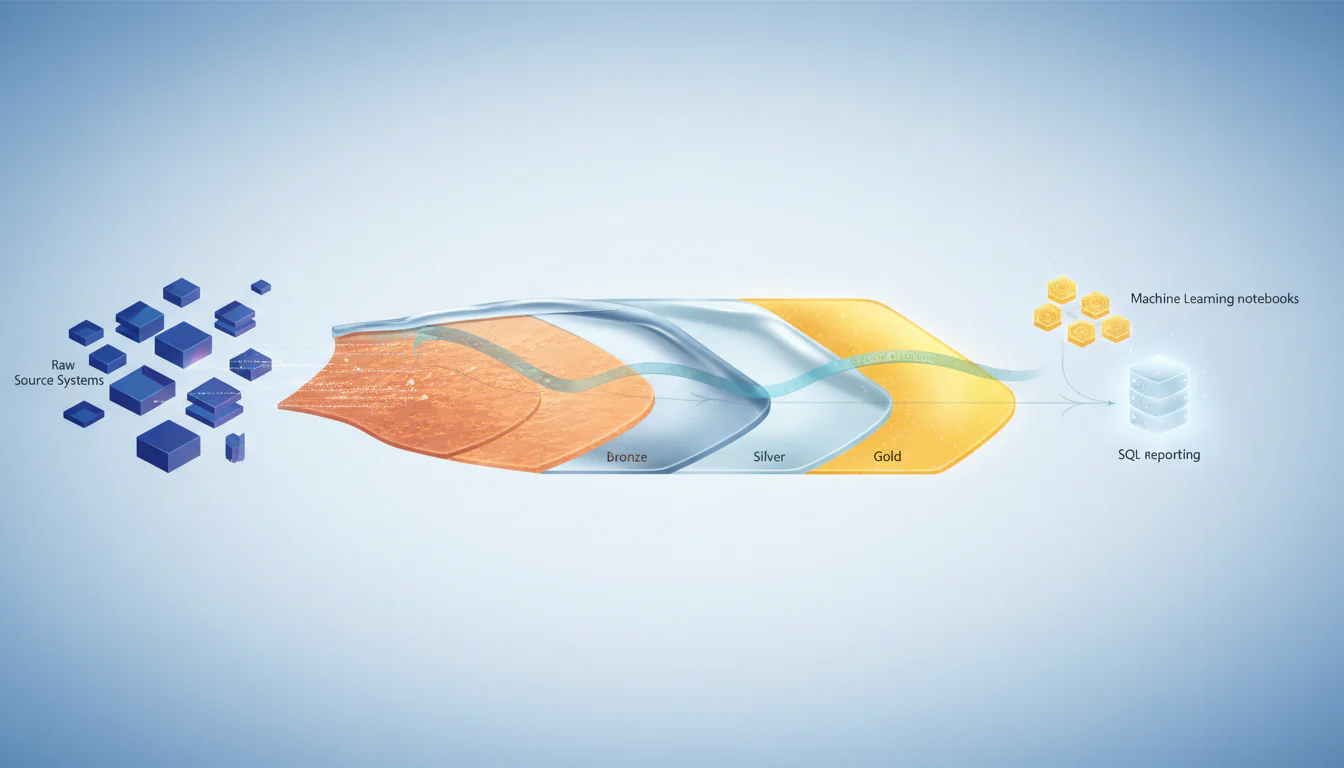
A governed lakehouse becomes easier to operate when every team agrees on where data gains trust. The familiar 3 layers give teams a shared quality path from raw records to curated business data.
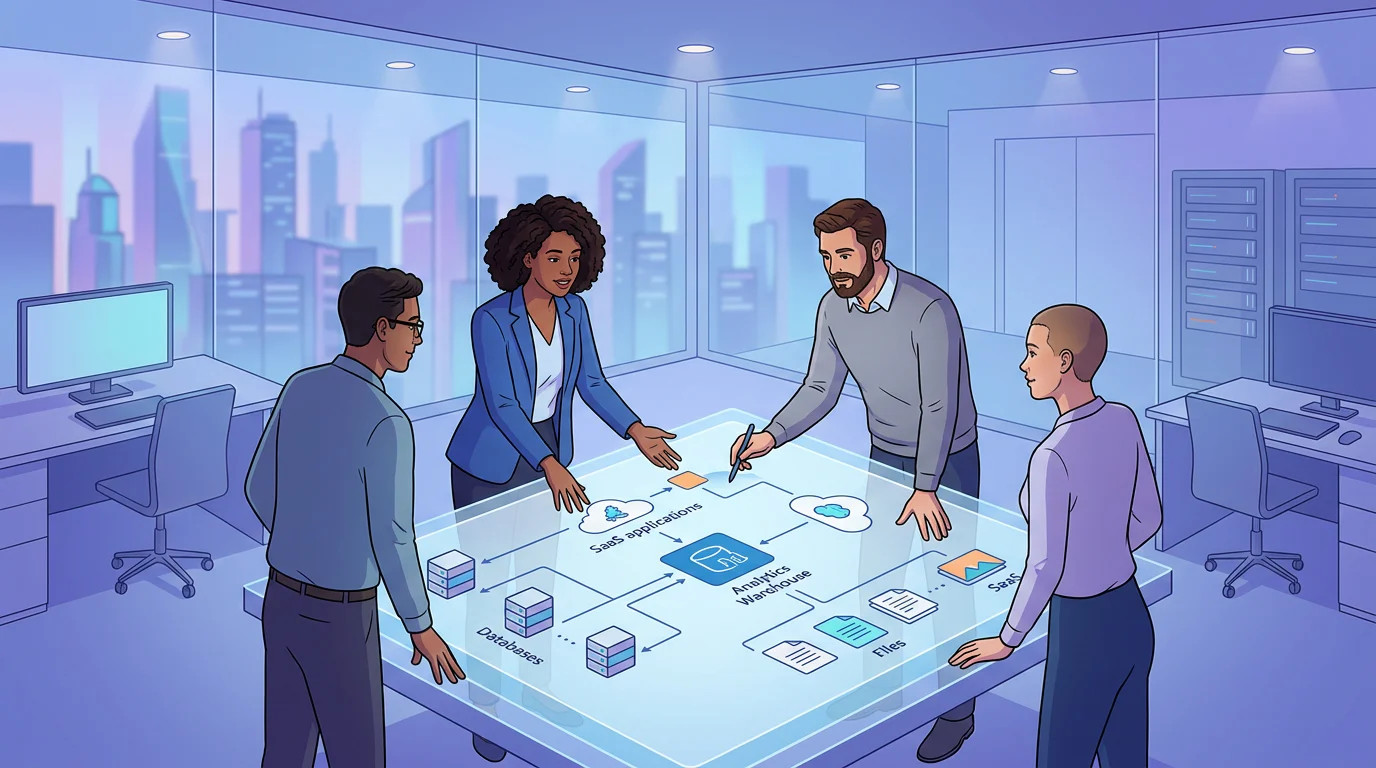
A one governed lakehouse model lets data engineers, SQL analysts, and data scientists share governed tables and metadata while keeping compute, interfaces, permissions, and production duties separate. Engineers run ingestion and reliability, analysts use certified business models, and scientists use approved detailed data and feature sets. A central catalog records ownership, access, lineage, and definitions.
We map the architecture, role boundaries, data contracts, lifecycle controls, and duplicate-prevention habits that make that arrangement work in a real Azure data team.
Shared Data Plane
Storage and Delta Tables → Catalog, Lineage, Ownership, Policies

Separate Work Planes
Pipeline Jobs → Bronze → Silver → Gold
SQL Endpoints → Certified Semantic Models → BI
ML Notebooks → Approved Silver Data and Features → Models
How Do Five Roles Share One Governed Lakehouse?
We start with a simple rule: shared data does not mean shared responsibility. Our operating model gives each role a clear write boundary, a defined approval path, and access only to the assets needed for its work. That protects production data without forcing analysts or scientists to wait on engineering for every query.
This division reflects a practical role ownership pattern: engineering owns pipelines and notebooks, BI owns semantic models, and business owners manage KPI definitions. We use the same split because it makes change decisions visible before they become broken reports or unreliable models.
| Role | Owns | Reads | Writes |
|---|---|---|---|
| Data Engineer | Ingestion, reliability, transformations | Source and operational data | Bronze and silver assets |
| SQL Analyst | Queries, report logic, semantic-model proposals | Certified gold and approved silver data | Personal and reviewed BI assets |
| Data Scientist | Features, experiments, model outputs | Approved silver data and feature sets | Sandboxed outputs |
| Data Owner | Definitions, certification, approval | Domain quality and usage evidence | Metadata and approval decisions |
| Platform Administrator | Identity, guardrails, monitoring | Audit and platform metadata | Security and workspace controls |
Data Engineers Own Reliable Movement
We ask engineers to preserve raw inputs in bronze, validate and conform reusable entities in silver, then publish production transformations through scheduled jobs. They are accountable for delivery reliability, schema handling, quality tests, and recovery paths, not for deciding what a revenue metric means.
That separation makes a unified platform more useful than a shared storage location alone. Engineering can improve the pipeline without rewriting an analyst’s report logic or changing a scientist’s experimental workflow.
Analysts and Scientists Share Data, Not Interfaces
Analysts need stable SQL access to certified measures and business-friendly models. Scientists often need more detailed, approved silver data, plus feature sets that preserve the grain required for training and evaluation.
We keep these interfaces separate because reporting and experimentation have different risks. A report should not change because a notebook is testing a new feature, and a scientist should not need permission to alter a certified business table to explore a hypothesis.
Data Owners and Administrators Guard Different Decisions
Data owners approve meaning, permitted uses, classification, and certification. Platform administrators configure identity groups, workspace boundaries, audit controls, and capacity guardrails. We do not let either role silently absorb the other’s responsibility.
That distinction gives teams an accountable answer when someone asks who can approve a field, certify a metric, or authorize a production release.
What Does a Governed Lakehouse Operating Model Share and Isolate?
A lakehouse works when the data plane is shared and the work planes are deliberately separate. We centralize storage, managed table formats, metadata, lineage, and policy enforcement. We isolate the compute and interface each role uses to create value from those assets.
In practice, an Azure team can use a Spark-oriented engineering workspace alongside a SaaS analytics workspace with native SQL and semantic modeling. The exact tooling can differ, but the operating principle stays the same: teams should query the same dataset, not rebuild it in disconnected copies.
Share the Data Plane
We treat raw source records, conformed silver entities, curated gold tables, catalog entries, and ownership metadata as shared organizational assets. Every reusable table receives a meaningful name, a named owner, a quality status, and a documented grain.
This is how we centralize analytics data without centralizing every decision. The shared layer supplies a common source of truth, while each domain still controls its own approved data products.
Isolate the Compute Plane
Engineers run pipelines and scheduled production jobs. Analysts use SQL endpoints and certified semantic models. Scientists use notebook and ML compute with approved libraries, data scopes, and experiment locations.
We isolate these environments because compute carries different failure modes, costs, and access needs. A notebook running an experiment should not inherit the permissions of a production pipeline, and an analyst’s SQL endpoint should not become a path to raw sensitive data.
Keep Serving Assets Governed
Gold tables are useful, but business users usually consume a semantic model, report, dashboard, or approved API rather than a physical table. We make serving assets part of the governed estate, with named owners and certification rules.
This approach helps teams decide when a separate real-time stack is necessary and when an existing shared product already meets the freshness, detail, and access requirement. For a structured selection lens, use our platform comparison before standardizing a work pattern.
Who Owns Bronze, Silver, and Gold Data?
Bronze, silver, and gold are quality layers, not job titles. We assign ownership based on the kind of decision each asset represents: technical delivery in bronze, reusable conformed detail in silver, and business-ready consumption in gold.
The medallion guidance is straightforward: bronze preserves raw inputs, silver corrects and enriches them, and gold supports reports and dashboards. We add an operating contract so teams know who produces, validates, approves, and consumes each layer.
| Layer | Purpose | Producer And Validator | Accountable Owner | Main Consumers |
|---|---|---|---|---|
| Bronze | Raw, replayable source record | Engineer validates delivery and completeness | Engineering data-product owner | Engineers, operations, audit teams |
| Silver | Cleaned, conformed, detailed data | Engineer validates tests and contract | Domain data owner | Analysts, scientists, engineers |
| Gold | Curated business metrics and models | BI validates logic, owner certifies | Business or domain data owner | Reports, executives, approved ML uses |
Every reusable table gets a data contract. We document the producer, owner, schema version, freshness expectation, quality checks, sensitivity classification, retention rule, and approved consumers. A change to grain, metric logic, sensitive fields, or retention triggers review before deployment.
We also keep silver valuable in its own right. It is the detailed shared layer that often supports both SQL analysis and model training, while gold remains the curated layer for trusted business consumption. Our Azure lakehouse fundamentals reinforce this distinction so teams do not force every use case through a single reporting table.
How Does a Dataset Reach BI and Model Training?
Consider an order dataset arriving from a transactional system and a customer system. We first land each input in bronze with source identifiers, ingestion timestamps, and enough raw detail to replay the load when a source defect appears.
A production job then checks schema, volume, freshness, and duplicate records before publishing conformed customer and order entities to silver. The data owner reviews the contract, BI creates approved revenue measures from gold, and science uses authorized silver history or approved features for a churn experiment.
We rely on Fabric lineage to connect the pipeline, table, semantic model, report, experiment, and model where that visibility is supported. Before a breaking change, we inspect downstream dependencies, publish a versioned replacement, give consumers a migration window, and retire the earlier contract only after approval.
If a quality check fails, we stop promotion to the next layer and keep the previous certified output available. That gives analysts and model users a known-good asset while engineers investigate the source or transformation issue. Our Azure data roadmap treats this failure path as a core engineering skill, not an edge case.
How Do We Prevent Duplicate Transformations?
Duplicate transformations usually begin with a reasonable request: an analyst needs a metric quickly, a scientist needs a feature now, or an engineer cannot find a trustworthy existing table. We reduce that pressure by making reusable silver entities, certified gold models, and approved definitions easy to discover.
The prevention mechanism is social as much as technical. We require an owner, contract, and change review for shared assets, then make lineage and quality status visible. A new transformation is justified when it serves a new grain, latency requirement, or contract, not merely because a different team prefers its own copy.
- Reuse Conformed Entities: We direct teams to approved silver tables before they create personal joins or cleanup logic.
- Publish Metric Definitions: We expose common KPIs through reviewed gold tables and semantic models.
- Version Breaking Changes: We replace incompatible schemas deliberately rather than silently changing a shared table.
- Review Consumer Impact: We inspect reports, pipelines, and models before approving a material change.
- Keep Experiments Separate: We allow exploratory outputs without presenting them as certified production data.
Access control matters here too. Fine-grained access controls can expose the right rows, columns, folders, and tables without creating a less-governed duplicate for every audience.
We pair that access model with reusable code and disciplined deployment. Our ETL modernization work emphasizes SQL and transformation modules that can be reviewed, tested, and used across jobs, instead of burying durable business logic inside one notebook.
Build This Operating Model with Vision Board
At Vision Board, we teach the operating decisions that turn a lakehouse diagram into reliable team practice. We work from realistic Azure data-engineering situations: landing change data, shaping durable Delta tables, exposing governed SQL, and keeping machine-learning work tied to approved datasets. Our learning approach asks engineers to build, test, document, and review the handoffs that matter when several roles touch the same domain.
If your team needs stronger shared standards, start with our guided Azure course materials, then use our exercises to practise contracts, role boundaries, deployment discipline, and lineage-based change reviews. We focus on the judgment behind the tools, including when to protect raw data, when to certify a model, and when to stop a duplicate transformation. Build the skills to run one governed lakehouse without blurring production ownership, compute boundaries, or data access, safely every day, with Vision Board.
FAQs on One Governed Lakehouse
Can Analysts and Data Scientists Use the Same Lakehouse Table?
Yes. We let both roles read one approved silver table when its contract, classification, and query permissions fit, while keeping separate compute and write boundaries.
Should Scientists Write to Gold Tables?
Usually, no. We reserve gold assets for reviewed business consumption, let scientists publish controlled experimental outputs elsewhere, and promote only reusable, validated results through ownership review.
What Happens When a Silver Schema Changes?
We pause promotion for breaking changes, inspect downstream lineage, publish a versioned replacement, give consumers a migration window, then retire the earlier contract deliberately after approval.