
Lakehouse Training vs. Project-Based Implementation: Which Route Fits Your Data Team?
Lakehouse training vs. project-based implementation helps Azure teams consolidate BI, data engineering, and ML with shared storage.

Lakehouse Training vs. Project-Based Implementation: Which Route Fits Your Data Team?
The storage layer behind a lakehouse can manage petabyte-scale tables with billions of files, according to Delta documentation. That scale does not solve tool sprawl by itself, because teams still need agreement on ownership, tables, and workload boundaries.
Lakehouse Training vs. Project-Based Implementation is a choice between readiness and proof. Choose training when owners still disagree about shared storage, table formats, governance, or workload boundaries. Choose implementation when those decisions are settled but duplicate data movement continues. Most fragmented teams should train key owners, consolidate one costly workflow, measure it, then expand.
We compare both routes, provide an audit and implementation sequence, and show how batch processing, ML, and BI can share governed data without forcing every workload onto one compute engine.
How Do We Choose Lakehouse Training vs. Project-Based Implementation?
The right choice starts with the team’s constraint, not a platform purchase or a course calendar. If engineers, BI developers, ML practitioners, and data owners describe the target architecture differently, implementation will merely create a new version of the same fragmentation.
| Decision Signal | Best Route |
|---|---|
| Owners disagree about authoritative data, access rules, or workload boundaries | Start with training and produce one agreed reference architecture. |
| The source, consumers, owner, and duplicated movement are already known | Start with one bounded implementation project. |
| Production risk is unclear or rollback is difficult | Use training to establish constraints, then select a more reversible workflow. |
| Stakeholders need evidence before wider change | Implement one workflow and measure copy reduction, maintenance effort, and reliability. |
| The estate is fragmented but key owners are available | Use a hybrid path: train the owners first, then deliver one verified consolidation result. |
When Does Training Come First?
Training comes first when the team lacks a shared model for storage, table formats, governance, semantic definitions, and workload boundaries. The deliverable is not attendance. It is an agreed design, a clear ownership map, a baseline audit, and a shortlist of workflows that are safe to test.
We use this route when the discussion still circles around whether every workload must move at once. A sound lakehouse design gives teams a way to share governed data while preserving specialized compute where it is useful. Our flexible training can help a team build that common language before it commits to a delivery sequence.
When Is a Project Ready?
A project is ready when one workflow has a known source of truth, identifiable downstream consumers, a business owner, and a way to run old and new paths in parallel. It should solve a visible problem, such as repeated extracts for reporting and model training, rather than attempt to redesign every data domain.
The first implementation should prove a narrow claim: the same governed tables can serve the intended consumers with less unnecessary movement and less operational effort. If that claim cannot be tested, the workflow is still a training candidate.
Why Use a Hybrid Path?
Most teams need both routes in order. We recommend a short architecture alignment phase for the accountable owners, followed by one real project that tests the design against refresh behavior, permissions, metric definitions, and operational support.
A layered raw, refined, and curated design gives the team a practical vocabulary for that conversation. The layering guidance describes how data quality can progress from raw ingestion to business-ready tables for engineering, ML, and analytics consumers.
What Is Creating Tool Sprawl?
Tool sprawl is rarely caused by one bad technical choice. It usually grows as each team solves a local problem with another copy, schedule, interface, or business definition. Over time, BI extracts drift from engineering outputs, ML data preparation forks from reporting logic, and no one can state which table is authoritative.
Start by auditing movement instead of inventorying products. The useful question is not how many tools exist. It is how many times the same data is copied, transformed, renamed, refreshed, and re-owned before someone can use it.

| Audit Area | What To Record |
|---|---|
| Data Stores | Source name, format, authoritative status, retention, location, and owner. |
| Data Movement | Every pipeline, interface, export, copy, transformation, and downstream destination. |
| Refresh Behavior | Schedule, latency expectation, failure handling, and consumers affected by delay. |
| BI And ML Dependencies | Semantic models, model-training datasets, feature tables, extracts, and duplicated files. |
| Operating Effort | Runtime cost, storage cost, maintenance time, incidents, manual repair, and support owner. |
| Governance | Classification, access model, lineage visibility, quality checks, and metric-definition owner. |
The audit should expose avoidable movement without implying that every existing system is wrong. A legacy pipeline may still be the safest integration point, while an unnecessary export used only to feed a report is a better consolidation target. For teams modernizing established ingestion work, our migration guide can help separate useful orchestration from duplicate downstream copies.
The practical output is a map of handoffs. Once the team can see each copy and its reason for existing, it can decide whether to reference data in place, ingest it once into shared storage, transform it into a trusted table, or leave the current path untouched.
How Can Batch Processing, ML, and BI Share Storage?
Batch processing, model training, and BI do not need identical tools to share a lakehouse. They need durable storage, transactional table metadata, clear access controls, and a catalog that makes the same governed data discoverable to each workload.
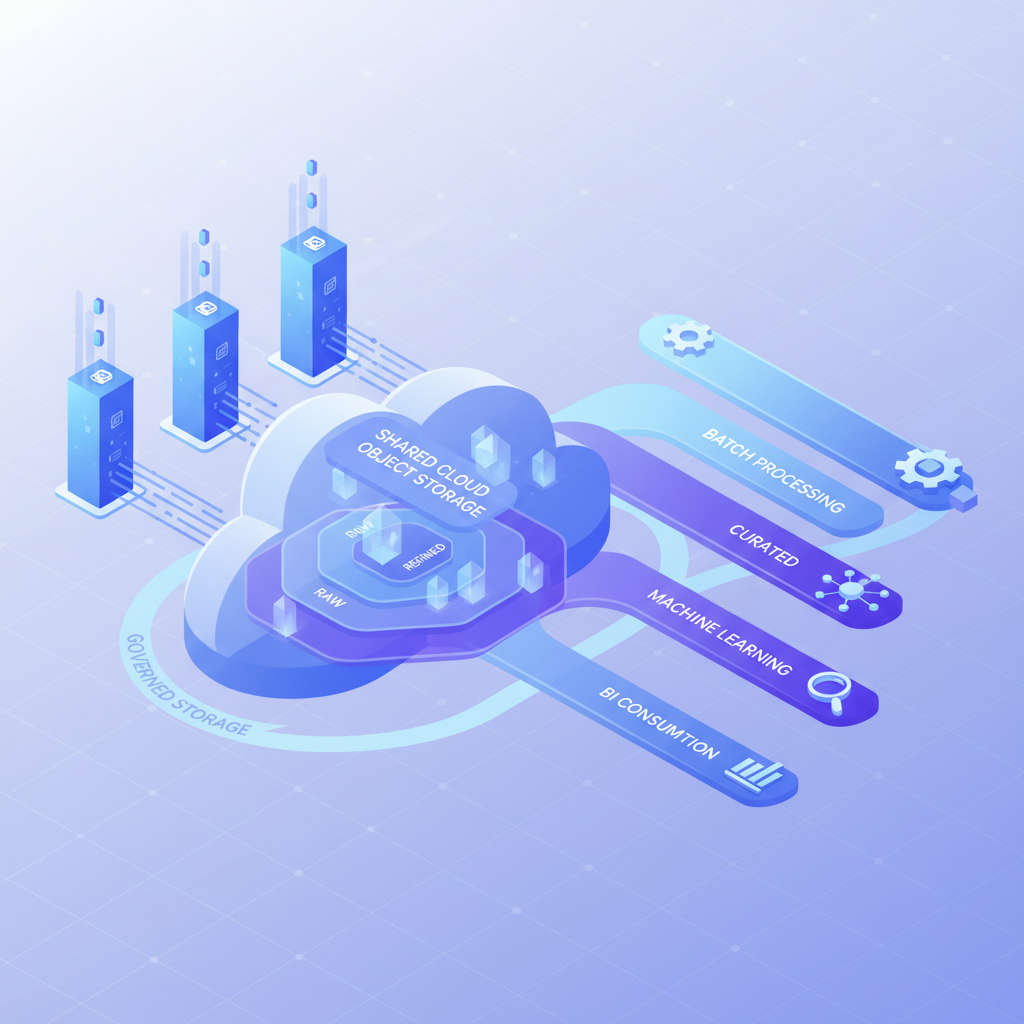
Keep Storage Shared and Compute Specialized
The design principle is simple: consolidate the data contract before consolidating every execution engine. Batch jobs can transform raw data into validated tables. ML practitioners can train from governed refined data. BI teams can consume curated tables through a semantic layer. Each group works against a consistent data foundation without requiring the same notebook, query interface, or runtime.
This approach reduces duplicate storage and refresh chains while allowing each workload to retain an appropriate compute pattern. Our architecture path helps teams connect these roles to a shared Azure lakehouse design.
Make Tables Transactional
Delta Lake adds transaction logs, schema enforcement, version history, and ACID behavior to data stored in cloud object storage. That matters when batch jobs, interactive analysis, and pipelines need readers to see consistent table states instead of partially written files. The transaction guide also explains how the format unifies batch and streaming patterns.
Apache Iceberg addresses the same architectural need through table metadata and catalogs. A shared catalog can make one data layer available to multiple compute engines, which is why the catalog guidance is useful when portability is a design goal. Either format still requires explicit compatibility testing before multiple engines write to the same production tables.
Preserve Trusted Metrics Without Blocking Raw Access
Shared storage is not a reason to give every user unrestricted access to every layer. Engineers and ML practitioners need controlled access to raw and refined data for investigation and experimentation. Business users need stable metric definitions, approved dimensions, and semantic models that prevent every dashboard from recalculating revenue, inventory, or customer counts differently.
We recommend treating semantic models as governed data products. The raw-to-curated layers support technical exploration, while the semantic layer protects the definitions used for business decisions.
How Do We Consolidate One Workflow Without a Platform Replacement?
A low-risk consolidation does not begin by retiring systems. It begins by proving that one workflow can produce the same or better outcome with fewer copies, clearer ownership, and a reliable rollback option.
Use the following sequence to move from a tool-sprawl audit to one verified result. Each step should leave the team with an artifact that makes the next decision easier.
Map and Rank the Work
- Map: Trace the source, copies, transformations, refreshes, interfaces, consumers, owners, and business outcome for one workflow.
- Rank: Compare candidate workflows by duplicate movement, fragility, business importance, operating effort, and reversibility.
This work converts a vague modernization program into a decision backlog. It also reveals whether a workflow is actually an integration challenge, a governance challenge, or a semantic-definition challenge.
Select and Implement the Right Boundary
- Select: Choose a workflow with a clear owner, a bounded consumer group, and a way to validate results in parallel.
- Implement: Reference accessible open-format data in place where appropriate, ingest only what requires managed movement, then build raw, validated, and curated tables with documented access rules.
Not every data source should be copied into a new environment. Official unification guidance distinguishes in-place references from replication and notes that complex transformations, external destinations, and real-time ingestion can still require dedicated movement tools.

Validate, Then Expand
- Expand: Compare the shared-data path with the prior path, document the measured outcome, retire only the redundant copy, and reuse the pattern for the next workflow.
A conversion path is successful when consumers trust it, owners can support it, and the team can explain what improved. For structured files, transformation guidance documents an approach that can convert supported data into managed Delta tables while retaining synchronization with the source.
If your team needs deeper technical practice before implementing the first workflow, our course options provide a practical next step.
What Makes a First Project Safe, and Who Owns It?
The best first project is not necessarily the largest source of spend or the most visible dashboard. It is a workflow that demonstrates value while keeping the blast radius small. It should have repeated movement worth eliminating, a business consequence worth protecting, and a fallback path that is easy to test.
Score the First Workflow
| Criterion | Low Suitability | Strong Suitability |
|---|---|---|
| Duplicate Movement | One controlled copy with a clear purpose | Repeated copies serving similar BI, engineering, or ML needs |
| Fragility | Stable, documented, and rarely repaired | Frequent manual intervention, failures, or undocumented handoffs |
| Business Value | Limited audience or unclear sponsor | Decision-critical use with an accountable sponsor |
| Reversibility | Wide impact and difficult rollback | Bounded consumers and parallel validation possible |
| Data Readiness | Unclear source, definitions, or owner | Clear source of truth, owner, and acceptance checks |
Choose a candidate only when it scores well on value and reversibility. A high-cost workflow with unclear ownership is not an early win. It is a risk signal.
Divide Governance and Semantic Responsibilities
A shared lakehouse works when ownership is visible at each layer. Data owners should define access, classification, and retention. Engineering owners should maintain pipelines, table contracts, and quality checks. BI owners should maintain shared metric definitions. ML owners should validate feature and training-data fitness.
| Responsibility | Accountable Owner | Delivery Focus |
|---|---|---|
| Raw Data Access And Retention | Data owner | Classification, permissions, and retention policy |
| Table Quality And Lineage | Data product owner | Schema, tests, freshness, and dependency visibility |
| ML Data Fitness | ML owner | Training data, feature definitions, and reproducibility |
| Trusted Metrics | BI owner | Semantic model, certification, and change management |
| Business Acceptance | Business sponsor | Outcome, priority, and consumer validation |
Clear role boundaries support trusted reuse. The governance guidance distinguishes data owners, stewards, consumers, and central governance responsibilities, which is a useful starting point for assigning accountability.
Define the Exit Criteria
Training is complete when named owners agree on storage boundaries, table contracts, governance rules, a measured baseline, and a first workflow selection. Implementation is complete when the team has verified a reduction in unnecessary copying, documented operating effort, validated consumer outputs, tested rollback, and assigned support ownership.
We encourage teams to capture the before-and-after evidence in a short decision record. It makes the next project faster, prevents the first result from becoming an undocumented exception, and gives stakeholders a defensible reason to expand. Our learner stories show why practical delivery evidence matters more than generic completion claims.
How Does Vision Board Turn Learning into Delivery Proof?
At Vision Board, we help Azure data teams turn architecture knowledge into a scoped delivery result, without treating a platform migration as the only path forward. We begin with the owners who must agree on storage boundaries, table contracts, governance, and consumer expectations. Then we work from a real workflow, its copies, its refreshes, its handoffs, and its business consequence. Our learning path gives engineers, BI developers, and ML practitioners a common vocabulary. Our project support turns that vocabulary into a tested shared-data pattern, clear ownership, and evidence stakeholders can inspect. If your team needs flexible study before a live implementation, we can shape the sequence around your workload, schedule, and existing estate. Start by choosing the route that makes a useful claim measurable in practice, then build the proof, retain the decision model, and choose the next workflow with Vision Board.
FAQs on Lakehouse Training vs. Project-Based Implementation
Should We Start with Training or Implementation?
Choose training when owners cannot yet agree on authoritative tables, access rules, workload boundaries, or success measures. Choose implementation when one bounded workflow is ready to test.
Can Batch Processing and ML Share Lakehouse Storage?
Yes. Shared object storage and transactional table metadata let batch jobs, model training, and BI read governed tables while each workload retains appropriate compute for its tasks.
What Is the Best First Consolidation Project?
Start with a workflow that repeats copies, fails visibly, matters to a business sponsor, and can run in parallel until validations show the shared path is reliable.
Do We Need to Replace Every Existing Tool?
No. Keep systems that still meet an operational need. Retire only unnecessary movement after parallel validation, then use our playlist to align owners on the architecture.