
Which Unified Analytics Platform Fits Your Workload? A Unified Analytics Platform Comparison
Compare unified analytics platforms for Spark, streaming, ML, and BI with a workload-sizing rubric, table format trade-offs, and migration map.

Which Unified Analytics Platform Fits Your Workload? A Unified Analytics Platform Comparison
Modern data teams rarely struggle because they cannot find enough features. They struggle because the wrong platform shape creates unnecessary operations, duplicated data, or slow BI. Spark Structured Streaming can achieve end-to-end latency as low as 100 milliseconds, but low latency alone does not justify a more complex architecture.
For a unified analytics platform comparison, we choose the smallest managed architecture that can keep one governed copy of data usable for batch processing, streaming, machine learning, and dashboards. A Spark-first managed platform fits engineering-led teams, a capacity-based suite fits BI-led teams, and a composable stack fits teams willing to run more infrastructure.
We cover the requirements that matter, compare four platform shapes, assess Delta Lake and Apache Iceberg, map a Hadoop-era migration, and show how to avoid building more platform than your workload needs.
How Should We Run a Unified Analytics Platform Comparison?
We start with workload shape, not a feature checklist. A team processing 2 TB each day has an average inbound rate of about 23.15 MB per second before bursts, compression, backfills, replication, and transformation. That average is useful for planning, but peak rate and recovery expectations should drive the streaming design.
For a data estate beginning at 500 GB and growing 30% monthly, we plan for compounding rather than current size. At that rate, the footprint becomes about 23.3 times larger in 12 months. We use that scenario to test storage layout, BI concurrency, job recovery, and operational capacity before selecting a platform.
- Daily Ingest: Record the raw, compressed, and curated volume separately.
- Growth Rate: Model retention and monthly compounding, not just the current footprint.
- Peak Event Rate: Measure the busiest sustained period, not the daily average.
- Concurrency: Count simultaneous engineering jobs, ML runs, dashboard users, and refreshes.
- Latency: Define the business freshness target in seconds or minutes.
- Availability: Set recovery, replay, and reporting expectations before choosing streaming components.
- Compliance: Document residency, access-control, lineage, and audit requirements.
We use this worksheet to keep the platform conversation connected to architecture fundamentals in our lakehouse guide. When a team cannot state its peak rate, retention horizon, and serving target, we treat a major platform commitment as premature.
Which Platform Shape Fits Batch, Streaming, ML, and BI?
We score platform shapes by their fit for documented requirements, not by marketing claims. A score of five means the capability is native with little assembly work, three means it is practical with meaningful trade-offs, and one means it creates substantial operating burden for that workload.
The most important distinction is whether we need a shared data foundation with independently scalable compute. That separation lets engineering jobs, ML training, and dashboard queries use the same governed data without competing for the same runtime.
| Platform Shape | Batch | Streaming | ML | BI | Governance | Openness | Operations | Cost Model |
|---|---|---|---|---|---|---|---|---|
| Managed Spark-First Lakehouse | 5 | 4 | 5 | 4 | 5 | 4 | 4 | 3 |
| Capacity-Based Unified Suite | 4 | 4 | 4 | 5 | 4 | 4 | 5 | 4 |
| Managed Spark Plus Kafka-Compatible Event Service | 4 | 5 | 4 | 3 | 3 | 5 | 3 | 3 |
| Composable Open-Source Stack | 4 | 5 | 4 | 3 | 3 | 5 | 1 | 2 |
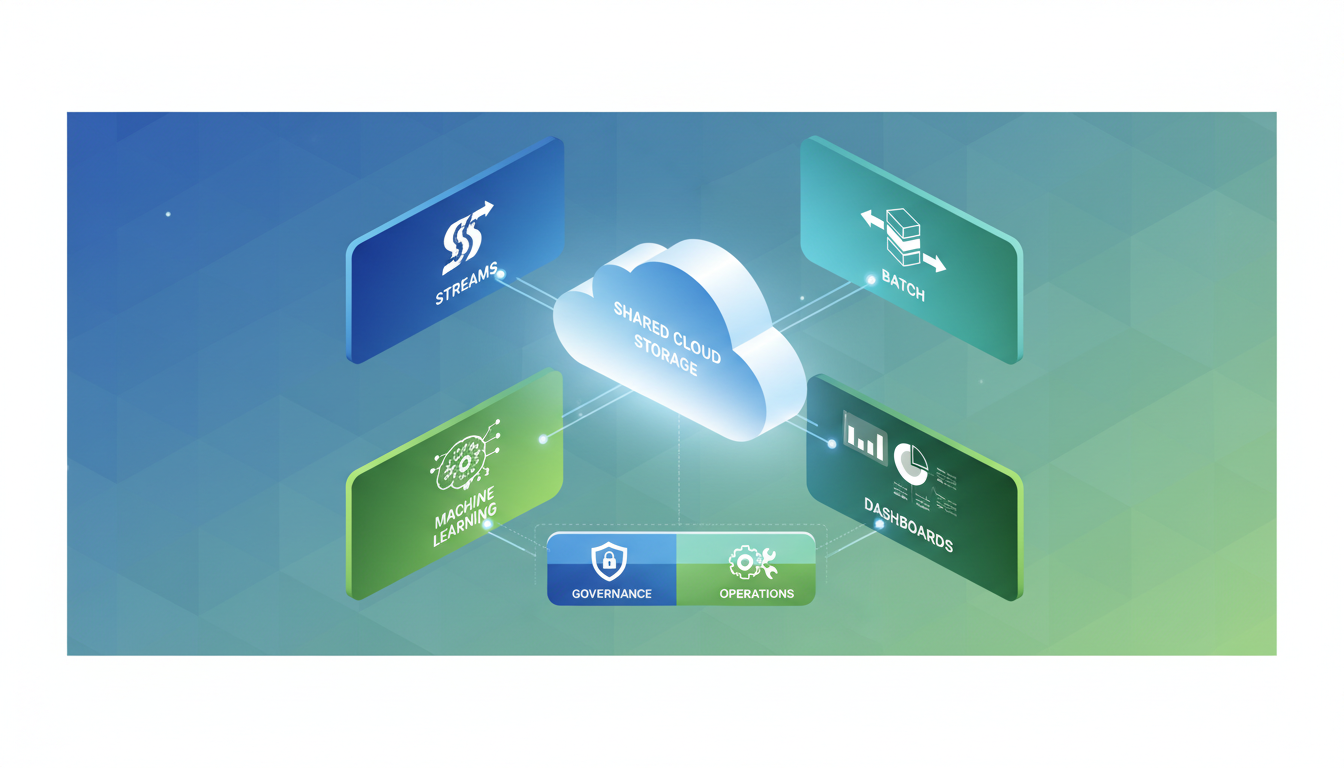
Managed Spark-First Lakehouse
We recommend this shape when Spark engineering, structured streaming, XGBoost training, experiment tracking, and governed SQL are all central to the team’s work. It keeps the data engineering and ML lifecycle close to the same tables, while separate SQL compute can protect dashboard workloads from long-running jobs.
We still test BI connector behavior and query isolation. A good platform fit does not mean every workload should run on one cluster, and our team training formats help teams separate product knowledge from durable architecture skills.
Capacity-Based Integrated Suite
We consider this shape when Power BI-style semantic modeling, managed operations, and broad self-service analytics matter more than deep platform customization. It can be a strong choice for teams that want Spark, real-time ingestion, notebooks, and dashboards under one capacity model.
We treat capacity sharing as both its benefit and its risk. Engineering activity, data movement, and BI demand may draw from the same budget, so we validate the real concurrency pattern rather than assuming one shared pool will stay responsive.
Managed Spark Plus Event Service
We use this combination when streaming is a primary product requirement and the team needs a durable, replayable event backbone without operating brokers. Spark handles incremental transformations, while the event service manages ingestion, retention, and consumer separation.
This is usually the practical middle ground for a retail migration that has batch history, transaction streams, and reporting needs. We test that operating model against measured recovery and query-isolation expectations before we recommend it.
Composable Open-Source Stack
We reserve this shape for teams with strong platform engineering capacity and genuine multi-engine requirements. It can offer the highest portability, but it also creates responsibility for upgrades, catalog integration, security, observability, incident response, and data maintenance.
We do not call it more future-proof simply because it has more independently selectable parts. It is future-proof only when the team can reliably operate those parts.
When Should We Choose Delta Lake or Apache Iceberg?
We choose a table format based on the engines that must read and write the same data, the schema changes we expect, and the transaction semantics our pipelines need. Both formats can support a lakehouse design, so the decision should not become a proxy for choosing the most elaborate platform.
Delta Lake provides ACID transactions, schema enforcement, time travel, and a unified approach to batch and streaming tables in its format documentation. We lean toward it when Spark is the primary engine and streaming ingestion, merges, and governed curated tables are central.
| Decision Area | Delta Lake | Apache Iceberg | Our Selection Rule |
|---|---|---|---|
| Interoperability | Broad connector ecosystem with Spark-first strengths | Designed for multi-engine access across Spark, Flink, Trino, Hive, and more | Choose Iceberg when independent engines are a firm requirement |
| Schema Evolution | Schema enforcement and controlled evolution | Full schema and partition evolution | Test exact reader and writer versions |
| Transactions | ACID transactions with strong Spark integration | Serializable isolation and optimistic concurrency | Validate concurrent-write behavior in a pilot |
| Batch And Streaming | One table can serve batch and streaming paths | Strong open table abstraction across engines | Match the format to the primary compute path |
| Operational Fit | Simpler for Spark-led teams | Often better for multi-engine estates | Avoid dual formats without a documented need |
Apache Iceberg is especially useful when multiple engines must safely share the same tables, and its open table docs describe schema evolution, hidden partitioning, partition evolution, and serializable isolation. We do not run both formats by default. We add another format only when a clear interoperability requirement outweighs the cost of two maintenance paths.
Before committing, we run a small but realistic test: one historical backfill, one incremental stream, one schema change, one concurrent query pattern, and one recovery exercise. We also recommend reviewing a curriculum audit before treating a tool-focused course as preparation for those architectural decisions.
What Is Minimum Viable, Growth-Ready, or Excessive?
We define minimum viable architecture as the smallest design that meets the current workload without blocking an expected, measurable next stage. It is not the cheapest-looking setup, and it is not a stripped-down version of an enterprise reference architecture.
For many growing teams, minimum viable means shared object storage, one open table format, managed event ingestion, Spark transformation, governed SQL access, experiment tracking, and a compatible BI connection. It does not require self-managed brokers, multiple catalogs, or a dedicated real-time serving layer before the workload proves those needs.
Minimum Viable for a Growing Fintech Workload
For a data estate growing 30% monthly, we keep a single governed copy of data, isolate the most important BI queries, and make recovery testable. We add dedicated components only when concurrency, latency, regulatory isolation, or operational risk demands them.
We also keep model development close to the curated data. XGBoost or comparable models need reproducible feature pipelines, experiment history, and a clear deployment path, not necessarily a separate data platform.
Growth-Ready for a 2 TB Daily Retail Workload
For a retail workload with 2 TB daily ingest, we plan separately for normal flow, peak events, replay, and promotion-period backfills. Shared storage remains the foundation, but engineering compute, stream processing, and dashboard serving should scale independently when contention appears.
Spark Structured Streaming works well when the same engineering team owns batch and incremental data logic. We introduce Flink when continuously stateful event-time processing is the dominant need, because its checkpoint model supports consistent recovery in stateful processing.
We use team learning options to help teams decide whether their current operating model can support that separation before they introduce another production service.
Operationally Excessive by Design
We identify overbuilding when a team runs a self-managed broker without a broker-level requirement, maintains two table formats without multi-engine demand, or creates separate copies for ML and BI before shared governed tables have failed.
We also avoid real-time model serving when scheduled batch scoring meets the actual business SLA. Our preferred design is the one that can be explained, measured, and supported by the available team, not the one with the most boxes on an architecture diagram.
How Should We Replace a Hadoop-Era Stack Safely?
We use phased coexistence because legacy data systems usually contain hidden dependencies in scheduling, access policies, metadata, and replay assumptions. The goal is not to recreate every old component in a new location. Our migration guide helps teams preserve business outcomes while reducing operational drag.
Hadoop separates distributed storage, resource management, and parallel processing into distinct modules, as the Hadoop modules outline. That separation helps us map each capability deliberately instead of treating the legacy stack as one indivisible product.
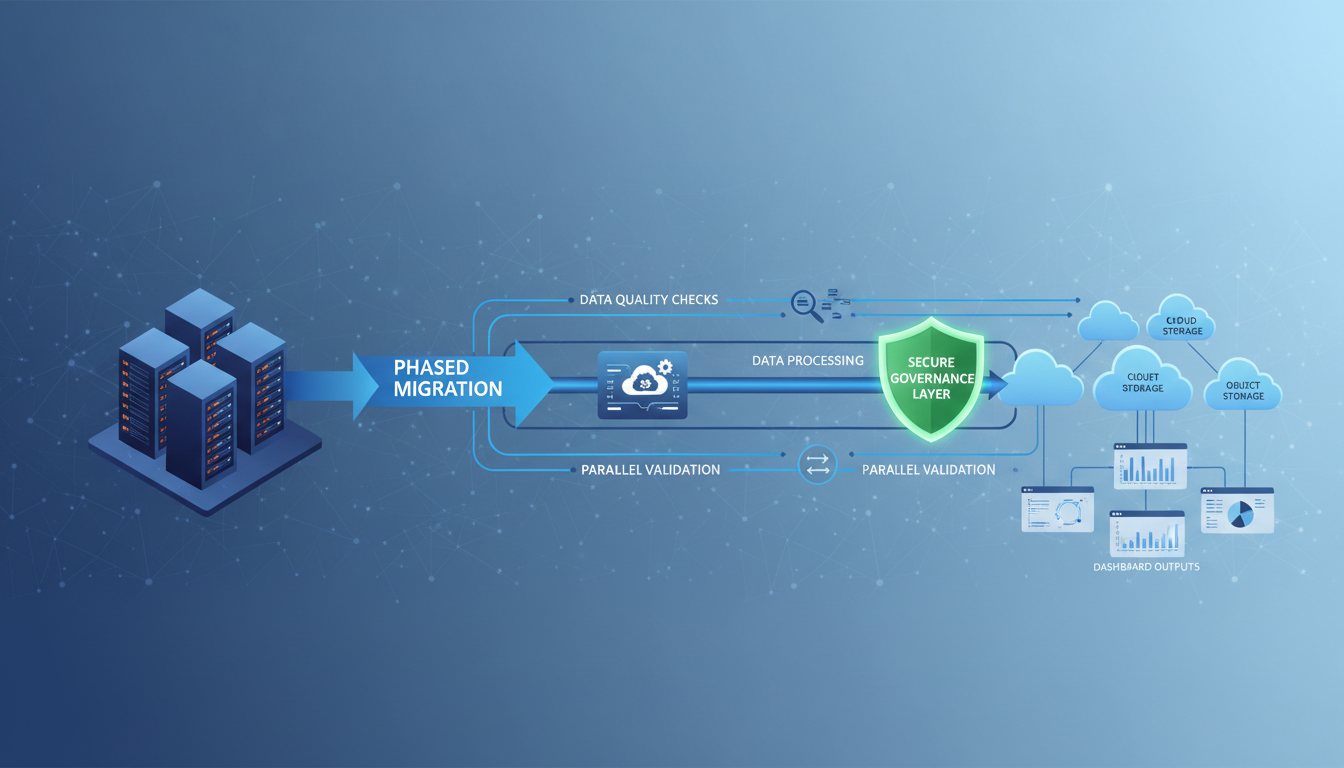
| Existing Capability | Target Capability To Evaluate | Phased Coexistence Step |
|---|---|---|
| Ingestion | Managed event service or Kafka-compatible endpoint | Mirror selected streams and validate offsets and replay |
| HDFS Storage | Cloud object storage with governed table layers | Copy immutable history first and reconcile counts |
| YARN And MapReduce | Managed Spark jobs with isolated compute | Port one representative batch pipeline |
| Kafka | Managed event ingestion or managed Kafka | Dual-write or mirror before cutover |
| Security | Central catalog, identity controls, row and column policies | Translate policies and test least privilege |
| Scheduling | Managed jobs, pipelines, or workflow orchestration | Run old and new schedules in parallel |
| Metadata | Governed catalog, lineage, and dataset ownership | Migrate high-value datasets first |
| Coexistence | Read legacy history while new writes move forward | Define cutover gates and a rollback window |
We treat workflow migration as its own workstream because a retired Hadoop scheduler can still contain production logic in its graphs, retries, and timing assumptions. The final migration gate is evidence, not confidence.
We compare record counts, business totals, late-data handling, access outcomes, recovery behavior, and dashboard freshness before cutover. Teams can use learner outcomes to see why practical validation matters more than a slide-deck architecture.
How Can Vision Board Help Your Team Choose?
At Vision Board, we help cloud data engineering teams turn platform selection into a learning and delivery plan. We begin with the workload worksheet, map existing pipelines and tables, then use hands-on exercises to test Spark jobs, streaming recovery, table formats, governance, SQL serving, and ML workflows. Our courses and team sessions focus on decisions that change architecture quality: where compute should separate, which skills belong inside the team, and which managed services reduce operational burden. We also help teams translate migration assumptions into measurable acceptance criteria before a costly cutover. We make progress practical through structured practice, credible evidence, and decisions stakeholders can audit before they commit scarce budget and engineering time. Whether your next step is an individual learning path or a group program, we can help you build confidence without treating a vendor scorecard as a solution. Explore our learning options, projects, and team-ready guidance at Vision Board
FAQs on Unified Analytics Platform Comparison
Which Platform Shape Fits a Retail Team Processing 2 TB Daily?
For this workload, we start with managed Spark, durable event ingestion, and separate BI compute. We add a dedicated stream engine only when measured latency requires it.
What Is Sensible for 500 GB Growing 30% Monthly?
We choose shared storage, test query isolation and recovery, and avoid dedicated infrastructure until retention, concurrency, or sub-second processing requirements prove that managed services cannot meet them.
Can One Data Lake Serve Spark, XGBoost, and Looker?
Yes, we keep governed tables central, isolate engineering and BI compute, track experiments, and validate connector behavior before committing to a semantic layer or replacement BI tool.
When Should We Choose Iceberg Instead of Delta?
We choose Iceberg when multiple engines must write and read the same tables. We prefer Delta when a primary Spark workflow needs native streaming integration and reliable merges.