Does This Data Engineering Program Teach Lakehouse Engineering? An Azure Lakehouse Curriculum Audit

TL;DR
The publicly available material establishes broad data engineering instruction, not verified lakehouse depth. We found references to SQL, Python, ETL, cloud services, Spark, and Azure, but no public proof of current Delta Lake internals, Fabric labs, Azure Data Factory coverage, table maintenance, governance, or a capstone. Prospective learners should request a dated syllabus and lab evidence, and we give you project, instructor, and enrollment checks to reuse.
Does This Data Engineering Program Teach Lakehouse Engineering? An Azure Lakehouse Curriculum Audit
For Azure data engineers, a lakehouse requires more than a cloud module: Microsoft says Fabric pipelines include more than 200 connectors for bringing data into the platform.
The publicly available material establishes broad data engineering instruction, not verified lakehouse depth. We found references to SQL, Python, ETL, cloud services, Spark, and Azure, but no public proof of current Delta Lake internals, Fabric labs, Azure Data Factory coverage, table maintenance, governance, or a capstone. Prospective learners should request a dated syllabus and lab evidence before enrolling.
We will separate what the program actually states from what an Azure lakehouse curriculum audit needs to see, then give you project, instructor, and enrollment checks you can reuse.
What Does the Public Curriculum Actually Prove?
Our review of the public program pages, checked on 8 August 2026, found a broad career-switch curriculum. The current landing page describes an eight-month program with live classes, 1:1 mentorship, industry projects, and six named modules. That is useful context, but module names alone are not evidence of lakehouse implementation depth.
What the Current Pages List
The current page lists Programming, Data Engineering Fundamentals, Data Engineering Tools, Cloud Technologies, Focused DSA for Data Engineers, and Machine Learning in Data Engineering. A separate public explainer expands that broad outline to SQL, Python, database management, warehousing, modeling, ETL, big-data fundamentals, real-time processing, system design, cloud providers, DSA, and GenAI concepts.
What the Pages Say Learners Can Do
The explainer associates Python with processing, automation, ETL pipelines, validation, and orchestration. It also describes scalable pipelines, distributed systems, reliability considerations, and broad cloud architecture. Those are relevant foundations for Azure data engineering, but they do not show whether learners configure a governed lakehouse or operate tables after deployment.
What Is Not Publicly Verified
We could not publicly verify lesson hours, detailed learning outcomes, lab instructions, grading criteria, cloud accounts, assessment rubrics, project repositories, current project briefs, or named mentor cards. We also could not verify a dated Azure-specific syllabus. Our lakehouse path explains why those details matter when the target role involves production data systems.
| Published Area | Public Evidence Found | Lakehouse-Depth Conclusion |
|---|---|---|
| Azure and cloud | Azure is referenced alongside other cloud providers | Azure-specific tooling and labs are not publicly verified |
| Spark | Spark is named in public explanatory material | Hands-on Spark scope is not publicly verified |
| ETL and real-time processing | Both are described at a high level | Orchestration, recovery, and operational evidence are not publicly verified |
| Azure Data Factory | No explicit public mention found | Not publicly verified |
| Fabric and lakehouse | No explicit public mention found | Not publicly verified |
| Delta, Iceberg, and Hudi | No explicit public mention found | Not publicly verified |
Which Azure and Lakehouse Skills Are Explicitly Documented?
The public material explicitly mentions Azure in a general cloud context. It also refers broadly to Spark, ETL, real-time processing, system design, and a Spark-based platform. That is enough to establish a data-engineering orientation. It is not enough to establish an Azure lakehouse specialization.
The distinction matters because current Fabric guidance includes lakehouse and Delta-table concepts, medallion implementation, and table optimization as data-engineering work. Review the official Fabric curriculum and compare its concrete capabilities with the program’s dated lab list, not its headline module names.
For the specific concerns prospective learners raise, the fairest answer is also the most restrained: we cannot call Azure Data Factory content current or outdated because the reviewed public pages do not document ADF content at all. The same applies to Fabric, Delta Lake, and lakehouse technology. Ask for a live syllabus that names the service, the lab, the learning objective, and the version date.
If you are moving from traditional integration work, our SSIS migration guide can help you frame better questions about orchestration, testing, deployment, and monitoring.
What Does an Azure Lakehouse Curriculum Audit Check?
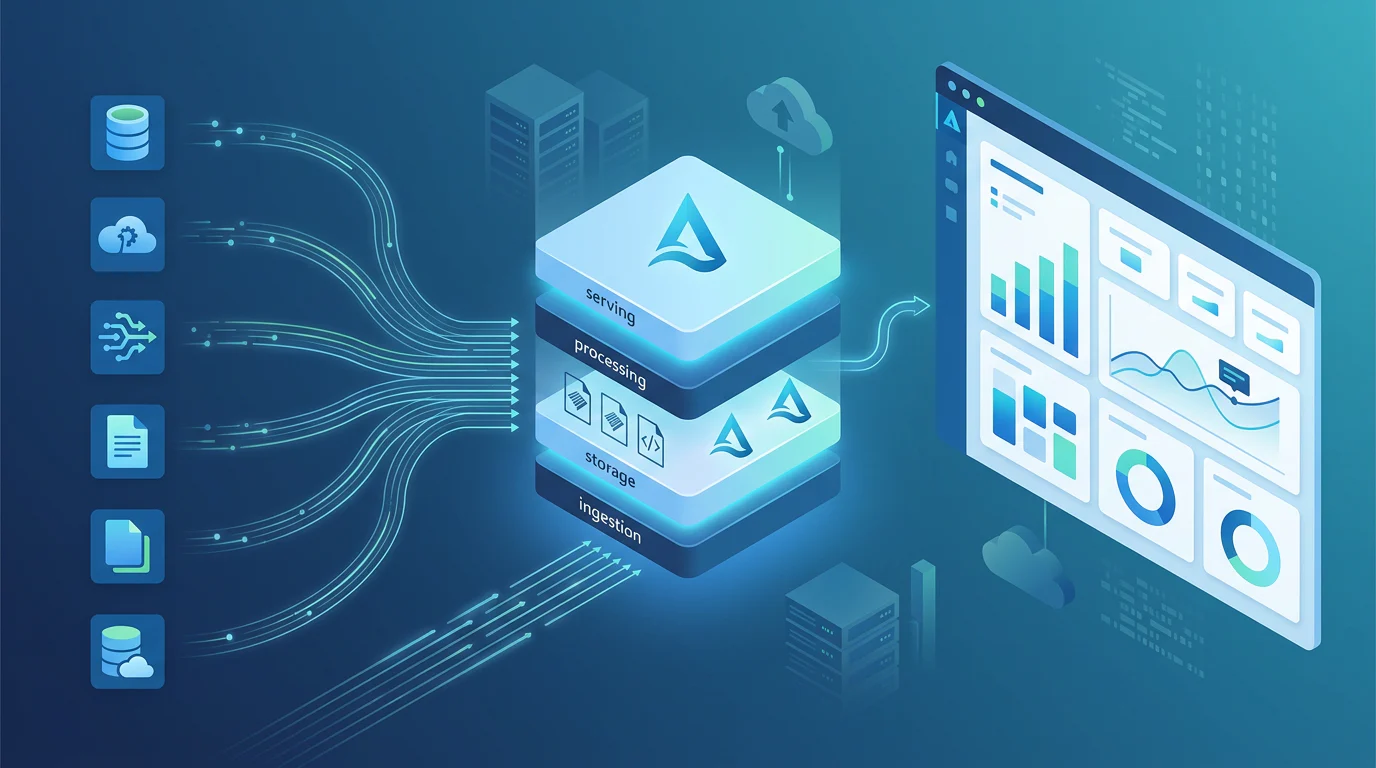
A useful Azure lakehouse curriculum audit does not reward a syllabus merely for mentioning cloud, Spark, or a warehouse. We look for evidence that a learner can build and run a durable data product, including how table formats behave, how data moves through layers, and what happens when jobs fail.

Transactions and Table Formats
Delta Lake documentation identifies ACID transactions, scalable metadata, unified batch and streaming, schema enforcement, time travel, and upserts as core capabilities. A serious curriculum should let learners use those concepts, not just define them. Use the Delta basics as a benchmark for the technical proof to request.
Layers, Streaming, and Governance
A credible lakehouse lab should ingest raw data into Bronze, validate and refine it in Silver, then publish curated Gold outputs. It should also handle late or bad records, use incremental or streaming ingestion, and document access, ownership, lineage, and quality controls.
Optimization and Operations
Production depth includes file layout, compaction, maintenance, monitoring, alerting, retry behavior, backfills, and recovery. It also includes deployment through separate environments. A course can be valuable without every one of these topics, but it should not be marketed as deep lakehouse engineering without evidence of them.
| Criterion | Evidence To Request | Public Status |
|---|---|---|
| Transactions and table semantics | ACID, MERGE, schema enforcement, time travel | Not publicly verified |
| Table formats | Delta exercises, plus Iceberg or Hudi context where relevant | Not publicly verified |
| Medallion layers | Bronze, Silver, and Gold tables with quality gates | Not publicly verified |
| Streaming and CDC | Checkpoints, late data, replay, and incremental loads | Not publicly verified |
| Governance | Access roles, cataloging, lineage, and ownership | Not publicly verified |
| Optimization | File maintenance, compaction, and layout decisions | Not publicly verified |
| Operations | Monitoring, retries, backfills, and incident recovery | Not publicly verified |
| Capstone | Deployed, tested, reviewed end-to-end implementation | Not publicly verified |
For a practical next step, compare any syllabus against our Fabric formats before deciding whether it fits your schedule and technical goals.
Do the Public Projects Demonstrate Production Readiness?
Public materials describe industry-style projects, including a telemetry-style pipeline, a transformation exercise, and an analytics solution. Those examples can be useful portfolio starters. The public project area, however, did not display technical project cards or requirements in the page version we reviewed, so we cannot verify their architecture or operational standard.
A project becomes evidence of lakehouse readiness when it requires more than reading data and producing a dashboard. We would expect it to include ingestion, layered transformation, tests, orchestration, deployment, monitoring, and recovery after a controlled failure. Fabric supports source control and deployment pipelines for lakehouse lifecycle management, as its deployment guidance explains.
Use this rubric during a syllabus-review call:
- Ingestion: Ask which realistic source enters the platform and how incremental changes arrive.
- Transformation: Ask to see Bronze, Silver, and Gold tables, including validation and quarantine rules.
- Testing: Ask whether data-quality checks fail a run and how those failures are reviewed.
- Operations: Ask for monitoring, alerting, retry, replay, backfill, and incident-recovery evidence.
- Deployment: Ask how code moves through development, test, and production environments.
- Review: Ask whether a mentor evaluates a repository, architecture decision, and documentation.
A course that can show a redacted repository, run history, failed-run recovery, and feedback rubric has stronger evidence than one that only promises real-world projects. Our learning playlist can help you recognize the building blocks while you evaluate a project brief.
How Can You Verify Instructors and Enrollment Terms?
A provider’s claim that mentors are experienced is a starting point, not a verification method. We recommend checking named people and recent technical work, because lakehouse tools, governance practices, and deployment workflows evolve quickly.
Ask for each instructor’s name, current role, recent Azure lakehouse work, teaching responsibility, 1:1 mentoring cadence, and one verifiable technical artifact. This might be a conference session, technical article, code contribution, architecture presentation, or a public professional profile that establishes relevant delivery experience. Anonymous testimonials and untraceable titles cannot answer that question. Our video walkthroughs can also help you recognize the technical explanations a credible mentor should be able to give.
Governance is especially worth checking. Lineage supports troubleshooting, root-cause analysis, quality work, compliance, and impact analysis, according to Purview guidance. A mentor who can explain these operational concerns is offering more relevant support than one who can only review interview answers.
On current terms, the public page verifies an eight-month duration, live classes, and 1:1 mentorship. It does not publicly show a numeric total fee, exact class schedule, specific mentorship cadence, or track-specific refund details in the reviewed capture. Obtain each item in writing, along with tax treatment, financing terms, recording access, and the dated syllabus. You can compare the detail expected in an evidence-led review with our learner stories.
Why Did We Build Vision Board for Azure Lakehouse Engineers?
Vision Board exists for Azure data engineers who need proof before they invest time in a course. We teach the practical, Azure-first work that the audit asks a syllabus to demonstrate: building lakehouse pipelines, reasoning about data quality, and explaining operational choices in interviews. Our learning materials connect concepts to practice, so you can use a checklist, inspect a project, and decide what you still need to master for real projects.
Start with a practical learning route, then choose the support format that suits your schedule without losing momentum at work. Compare the projects you want to build with the evidence you expect from any program, and use our community resources to keep your questions technical. We want you to leave every counseling call with facts, not vague promises, and a clear next step. When you are ready to deepen your Azure lakehouse skills on your terms, continue with Vision Board.
FAQs on Azure Lakehouse Curriculum Audit
Does the Publicly Available Material Prove Delta Lake Training?
Not yet. Reviewed pages do not explicitly document Delta Lake lessons, table operations, lab exercises, or assessments, so learners should request a dated syllabus before payment.
Does It Publicly Document Azure Data Factory or Fabric Coverage?
Neither tool is explicitly documented in reviewed public material. Broad Azure references do not establish current product coverage, hands-on hours, assignments, or instructor expertise for learners.
What Is in a Credible Lakehouse Capstone?
A credible capstone ingests realistic data, builds layered tables, tests quality, orchestrates runs, deploys safely, monitors failures, backfills data, and documents ownership, lineage, and decisions clearly.
How Should I Check Instructor Credentials?
Ask for each instructor’s name, current role, recent Azure lakehouse work, delivery responsibilities, mentoring cadence, and one verifiable technical artifact demonstrating hands-on production experience with data systems.
What Terms Should I Obtain in Writing?
Get the total price, tax treatment, finance terms, refund policy, batch schedule, recording access, mentorship cadence, project scope, and the current dated syllabus in writing.