


TL;DR
We explain why AI data governance regulations now require teams to build provenance, access, content-labelling and audit evidence into delivery workflows. The EU began enforcing key AI Act transparency rules on 2 August 2026, while high-risk requirements follow later, giving data teams time to establish reusable controls before releases and audits expose gaps.
EU AI Data Governance Regulations Move Controls Upstream
The EU’s AI transparency rules began applying on 2 August 2026, and the Commission’s initial transparency code list included 180 organisations. That turns data governance from a late review task into a delivery concern for teams building, deploying or operating AI.
On 2 August 2026, the EU began enforcing AI Act transparency rules for certain AI systems, while enforcement powers also took effect. For teams navigating AI data governance regulations, the practical consequence is clear: provenance, access, content-labelling and evidence controls belong in pipelines and releases, not in post-deployment reconstruction.
We examine what is live now, what comes later, and how we would turn the change into a workable data and AI delivery practice.
What Changed on 2 August
The immediate shift concerns transparency. Certain AI systems must disclose when people are interacting with AI, and specified generated or altered content needs labelling or machine-readable marking. These requirements make an ordinary engineering question more important: can the team identify the data, model, workflow and release responsible for an output?
That is why upstream governance matters. A team cannot reliably add provenance after an AI workflow has already crossed multiple data sources, permissions, prompts and downstream channels. Instead, the release process needs to preserve who approved each source, what purpose the data serves, who may access it and how an output should be identified. The EU enforcement update confirms that enforcement powers are now active for applicable provisions.
For Azure data teams, this is a reason to treat metadata, lineage and access policy as delivery assets. A governed lakehouse is useful here because it makes shared data easier to locate, control and explain before AI applications consume it.
What AI Data Governance Regulations Require Now
The most useful distinction is between rules that are enforceable today and high-risk system requirements that arrive on later dates. Conflating the two invites either panic or delay.
Transparency Rules Are Live
Providers and deployers within scope need controls that support disclosure, content identification and evidence of how those controls operate. The financial exposure is concrete: Article 50 breaches can carry fines of up to €15 million or 3% of worldwide annual turnover, as explained in the Commission’s Article 50 guidance.
High-Risk Rules Follow Later
The current timetable lists 2 December 2027 for Annex III high-risk systems and 2 August 2028 for high-risk AI embedded in regulated products. That runway should be used to establish repeatable dataset documentation, quality checks and lineage, not to postpone governance until the deadline becomes urgent. The current timetable also makes clear that AI Act obligations apply progressively.
Privacy Duties Do Not Pause
Where AI uses personal data, existing data-protection duties remain relevant throughout the lifecycle. Teams should therefore avoid treating AI regulation as a separate compliance stream. Purpose limitation, data minimisation, security and accountable processing should inform source selection, access design and release approval from the start.
How to Shift Controls Upstream
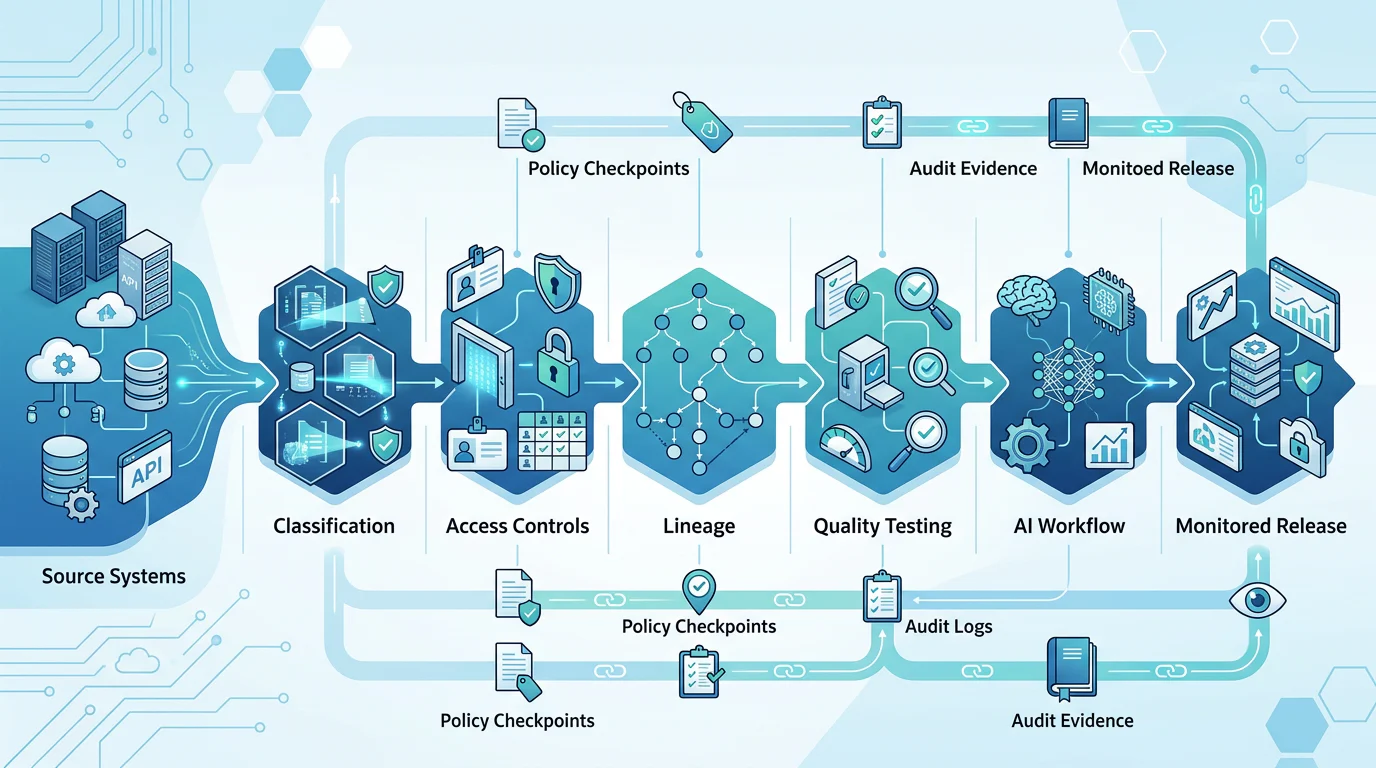
Shift-left governance is not a new committee between an engineer and a deployment. We see it as a set of checks that travel with the data and AI workflow, allowing teams to resolve routine controls automatically and bring meaningful exceptions to the right people. The NIST AI RMF offers a useful structure through its Govern, Map, Measure and Manage functions.
Start with Scope and Ownership
Assign a named owner for each AI use case. Record its intended purpose, users, jurisdictions, connected tools, model provider and data sources. This gives teams a practical boundary for deciding what can enter the workflow and who owns a change when the system evolves.
Treat Data as a Governed Product
Attach classification, permitted purpose, retention, access policy, lineage and quality thresholds to important datasets. The result is not more documentation for its own sake. It is a dependable decision point before data reaches a model, agent or application. Teams building this capability can apply it directly to pipeline delivery.
Test Evidence at Release
Make evidence retrieval part of the release definition. A reviewer should be able to trace the approved source, access path, test result, disclosure decision and accountable owner without assembling a retrospective spreadsheet. This also helps teams distinguish a genuine control failure from a simple process gap.
What Teams Should Do Next
We would use the next 90 days to prove this approach on one meaningful AI workflow, then reuse the controls rather than launch a broad compliance program without operating evidence.
-
Inventory: Identify AI systems, data sources, connected tools, output channels and owners, then flag systems that may fall within current transparency duties.
-
Build: Define purpose limits, classifications, access boundaries, lineage expectations and output-labelling responsibilities for the selected workflow.
-
Test: Add release checks, simulate an evidence request and document the exceptions that still require human review.
This work should sit alongside privacy engineering, not after it. The UK regulator’s ICO guidance similarly frames data protection by design as a lifecycle responsibility. A unified analytics platform can help teams centralise the data, metadata and delivery practices that make that responsibility manageable.
Build Upstream Governance Skills with Vision Board
Vision Board helps Azure data teams turn governance requirements into delivery habits. In our learning experiences, we work from the workflow itself: trace a source, classify it, set purposeful access, test a pipeline, and retain evidence a reviewer can follow. That is the capability this moment calls for, especially when AI applications share lakehouse data, automated workflows, and generative content. We focus on the practical collaboration between engineers, analysts, platform owners, and risk stakeholders, so controls are understood before a release becomes urgent. Explore our courses and apply the approach to your team’s active data and AI work through our course store.
FAQs on AI Data Governance Regulations
Which Rules Became Enforceable on 2 August 2026?
Article 50 requires certain providers and deployers to tell people when they interact with AI and to label or mark specified generated or manipulated content.
Are High-Risk AI Data Governance Rules Already Live?
Not generally. The Commission lists 2 December 2027 for Annex III high-risk systems and 2 August 2028 for high-risk AI systems embedded within regulated products.
What Does Shift-Left AI Governance Mean in Practice?
Start with a named owner, approved data sources, purpose limits, access controls, lineage, tests, output disclosure rules and retained evidence that a reviewer can retrieve.