Should Hadoop-to-Cloud Migration Training Use Classes or Live Projects?


TL;DR
We recommend a blended Hadoop-to-cloud migration training model: live classes establish shared Azure foundations, while assessed projects reveal delivery, governance, and ownership gaps. We show India-US scheduling, a legacy-to-cloud skills map, a live-platform scorecard, and a capstone that tests whether teams can transfer learning into production work.
Should Hadoop-to-Cloud Migration Training Use Classes or Live Projects?
Moving an on-premises Hadoop estate is a team change as much as a platform change. Microsoft gives candidates 100 minutes for its current Fabric Data Engineer exam, a useful reminder that a credential samples knowledge rather than a full migration.
For Hadoop-to-cloud migration training, we recommend a blended model: live classes give distributed teams a shared Azure vocabulary and safe practice, while guided migration projects test their ability to make ownership, governance, deployment, incident, and handoff decisions together. Neither format alone reliably prepares a global team for production transfer.
Below, we compare both formats, map legacy responsibilities to cloud work, and show how India-US teams can learn live without creating an unfair timetable.
What Do Instructor-Led Classes Teach Before a Cloud Migration?
Live classes are the fastest way to align people who currently use different language for the same work. A Hadoop administrator, data engineer, governance lead, and platform owner need a common understanding of ingestion, lakehouse design, identity, deployment, monitoring, and cost ownership before a project squad can make useful decisions.
Classes also make it easier for us to spot uneven foundations early through labs, instructor questions, and baseline assessments. A 225-study synthesis found active-learning classes had lower average failure rates than traditional lectures, but we treat that as support for hands-on learning design, not proof of migration outcomes.
| Decision Factor | Instructor-Led Classes | Live Migration Projects |
|---|---|---|
| Learning Goal | Shared foundations and vocabulary | Applied delivery and operating habits |
| Risk | Safe sandbox practice | Controlled exposure to migration trade-offs |
| Feedback | Immediate instructor correction | Technical, governance, and collaboration feedback |
| Assessment | Quizzes and discrete labs | Working artifacts and review evidence |
| Scalability | Strong for a distributed cohort | Best in smaller coached squads |
| Production Transfer | Indirect | Stronger when work resembles production |
A classroom-heavy start fits teams still building their Azure baseline. We use it to establish the minimum knowledge every contributor needs, then connect those lessons to an Azure learning path that matches the team’s role and current platform.
What Do Live Migration Projects Reveal That Classes Cannot?
A good migration project does not simply ask learners to rebuild a sample pipeline. It gives a cross-functional squad a realistic backlog, incomplete information, competing priorities, and a defined evidence trail. That is where unclear ownership, weak data contracts, deployment gaps, and missing handoff habits become visible.
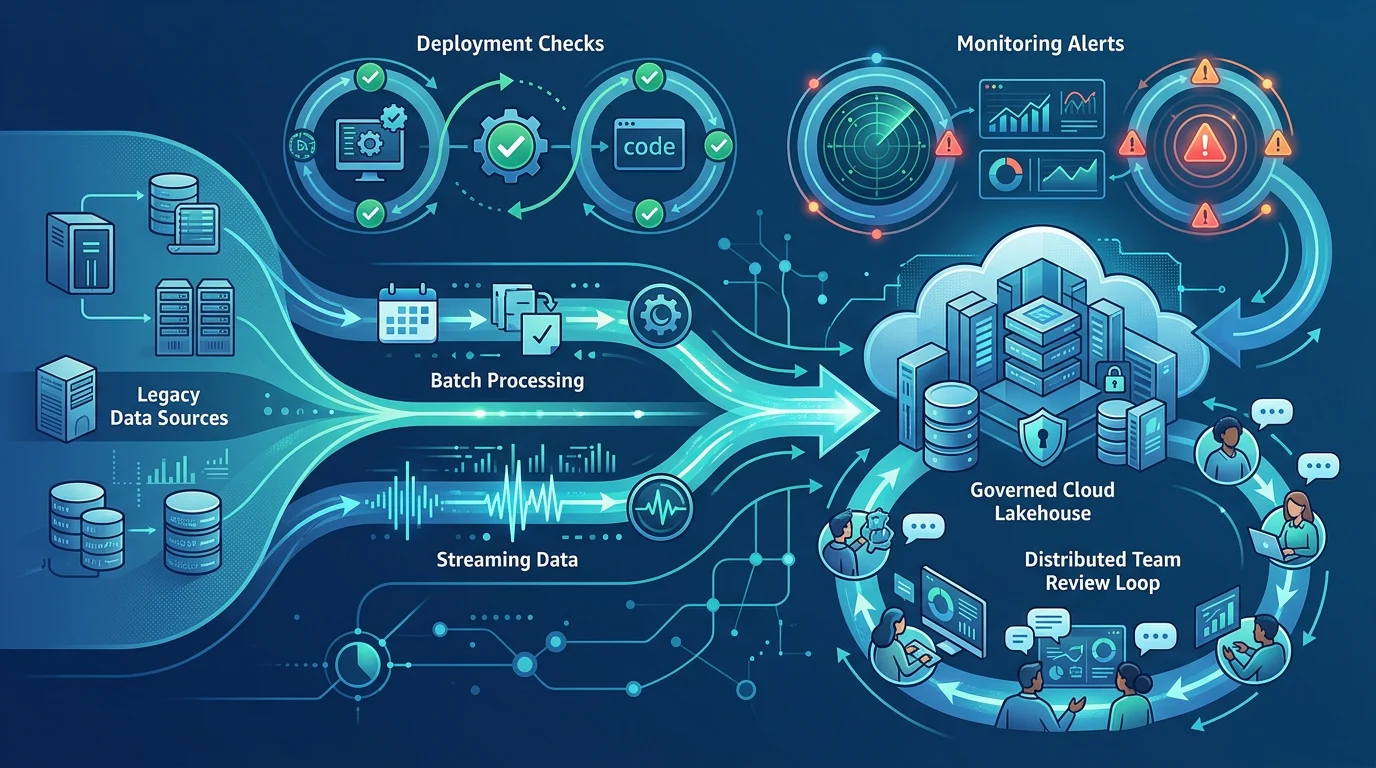
Projects should remain controlled. They can use masked data, sandbox workspaces, and fictional incidents while still requiring the same decisions a production team will face. Azure pipeline monitoring surfaces run status, duration, errors, inputs, outputs, and statistics, which makes it useful for both technical practice and operational review.
Build from a Realistic Migration Backlog
Start with a prioritised source inventory, named owners, acceptance criteria, and known risks. Each squad should select one batch pipeline and one streaming use case rather than attempting a broad but shallow rebuild.
Test the Pipeline and the Team
The capstone should require data reconciliation, a data-quality threshold, a governance decision, peer review, deployment to a test environment, and a monitored run. The team should also explain who responds when the pipeline fails and who can approve a change.
Preserve Evidence of Readiness
Retain the architecture decision record, pull-request evidence, validation result, deployment record, incident timeline, and retrospective. That creates a far more useful assessment than attendance alone, and it helps leaders choose a project-based route with clear expectations.
Which Skills Must Change After Hadoop in Hadoop-to-Cloud Migration Training?
The migration is not a one-for-one tooling swap. Legacy administrators often own cluster health and storage operations, while cloud teams share responsibility across platform services, workload delivery, governance, security, and cost. The curriculum must make that responsibility change explicit.
| Legacy Capability | Cloud-Native Responsibility | Applied Evidence |
|---|---|---|
| Hadoop, HDFS, YARN, MapReduce | Lakehouse and Spark workload design, capacity choices, managed platform services | Build and optimize a governed workload |
| Hive SQL and metastore practices | Managed tables, semantic access, lineage, and quality controls | Reconcile and publish a migrated dataset |
| HBase access patterns | Choose a managed serving pattern for access and latency needs | Document the design and recovery decision |
| NiFi flows | Orchestration, connectors, retries, and change capture | Ship a parameterised batch pipeline |
| Kafka or streaming feeds | Event ingestion, consumer responsibility, lag, and schema monitoring | Deliver a streaming pipeline and alert runbook |
| On-premises operations | Identity, CI/CD, observability, security guardrails, and FinOps | Deploy through a controlled environment path |
Azure Event Hubs can ingest millions of events per second and supports Kafka compatibility, so streaming training needs to cover throughput, partitions, consumers, retention, and failure response rather than just connector setup.
Reassign Ownership, Not Just Tasks
Cloud adoption often moves teams from a finite project mindset to durable product ownership. Workload teams need authority to deliver and operate their data products, while platform teams provide reusable services and guardrails. Microsoft’s operating-model guidance makes the same distinction between project completion and ongoing, cross-functional ownership.
Teach Self-Service Boundaries
Learners should practise requesting access, publishing a data product, defining ownership, and escalating a policy exception. This is how self-service remains useful without becoming uncontrolled. Our unified platform guide helps teams connect those responsibilities to a shared analytics architecture.
Put Certifications in Their Proper Place
Relevant credentials can help verify baseline knowledge. DAMA’s CDMP requirements include a 100-question, 90-minute fundamentals exam, while Microsoft credentials assess role-specific platform skills. Neither replaces a capstone that proves a team can deploy, monitor, govern, and recover a migrated workload together.
How Should India-US Teams Receive Live Migration Training?
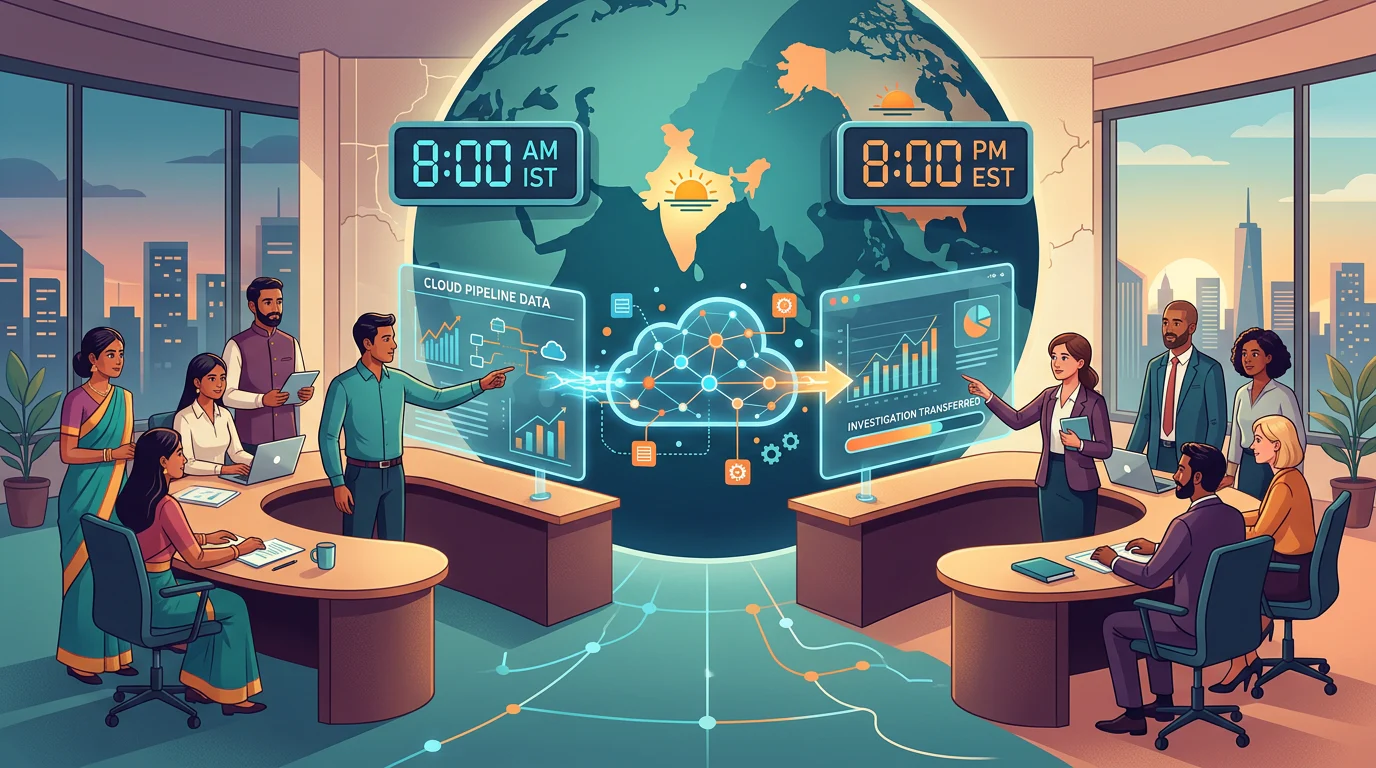
A single global class time usually creates a predictable loser. India does not observe daylight saving time, while US schedules change through the year, so teams need repeated cohorts and local-time scheduling rather than a fixed conversion copied into every invitation. India’s clock remains consistent, but US offsets do not.
We recommend delivering the same core live lab twice, once convenient for India and once convenient for US participants. A rotating integration clinic can bring both regions together periodically, while regional office hours and recordings provide follow-up support without asking one group to absorb every late-night session.
| Delivery Component | India-Focused Cohort | US-Focused Cohort | Shared Evidence |
|---|---|---|---|
| Live Lab | India business hours | US business hours | Same brief and rubric |
| Project Review | Regional review window | Regional review window | Recorded demo and decision log |
| Office Hours | India support window | US support window | Escalation queue and owner |
| Integration Clinic | Rotating burden | Rotating burden | Published actions and owners |
| Handoff Exercise | End-of-day update | Start-of-day acknowledgement | Open risk and next action |
Recordings are reinforcement, not a replacement for live interaction. Meeting platforms can retain attendance evidence for a defined period, for example Microsoft documents one-year retention for its attendance-report scenarios. We pair that evidence with assessed lab and project work, then adapt the model through our global-team training approach.
How Should Teams Evaluate a Live Training Platform?
A platform should support the learning design, not dictate it. During procurement, test each capability with the organization’s real identity, recording, accessibility, and retention requirements. A polished meeting interface is not enough if instructors cannot see who completed a lab or if the organization cannot retain evidence for compliance.
Score each capability from zero to two, then require a minimum threshold before choosing a platform. Microsoft’s meeting controls illustrate the kinds of features teams should verify, including recording, transcription, consent, download restrictions, and expiration controls.
| Requirement | What To Verify |
|---|---|
| Attendance Tracking | Named attendance, join and leave data, export, and retention |
| Assessments | Individual scores, retakes, rubrics, and completion evidence |
| Breakout Labs | Instructor access, team support, and recovery options |
| Instructor Interaction | Live questions, screen support, and regional office hours |
| Async Reinforcement | Searchable recordings, transcripts, captions, and controlled access |
| Compliance Evidence | Consent, audit export, retention, and policy fit |
| Learner Analytics | Attendance, lab completion, assessment trends, and intervention signals |
The scorecard should be reviewed with both learning and security stakeholders. For a closer format decision, compare live training options before treating self-paced access as equivalent to guided team learning.
Which Blend of Classes and Projects Fits the Team?
For most active migrations, blended delivery is the practical answer. It front-loads shared learning, then spends coaching time where the organization has real delivery risk. That sequence makes it possible to measure both individual understanding and the team’s ability to operate together.
| Team Condition | Best Fit | Why |
|---|---|---|
| New cloud skills and no migration backlog | Classroom-Heavy | Establish shared architecture, security, and governance language |
| Experienced engineers with a clear backlog | Project-Heavy | Focus coaching on delivery friction and ownership |
| Mixed experience with active migration risk | Blended | Combines baseline consistency with applied evidence |
| No named owners or weak management support | Leadership Alignment First | A capstone cannot fix unassigned accountability |
Microsoft’s Cloud Adoption Framework treats operating model, skills, migration planning, and cost estimation as connected planning concerns. We do too. Start with a baseline assessment, build core skills live, form cross-region squads, and graduate only after the capstone demonstrates technical delivery and operational accountability. Our migration cohort plan shows how that progression can work in practice.
Build Migration Readiness with Vision Board
Vision Board helps data teams turn cloud ambitions into practiced operating habits. We start by learning where your engineers, analysts, platform owners, and governance leads actually need a shared foundation. Then we shape live instruction around the Azure tools, legacy workload patterns, and delivery risks your migration faces. Our project work is not a generic final lab: we use a realistic backlog, cross-region handoffs, assessment rubrics, and reviewable evidence so leaders can see both individual progress and team readiness. We can support repeated India-US cohorts, regional office hours, recordings for reinforcement, and a capstone that requires design, build, validation, deployment, monitoring, and incident response. If your team needs to move from Hadoop knowledge to accountable cloud delivery, we will help you choose the right class-to-project balance and make the learning transfer measurable for sponsors across every cohort, before work reaches production. Visit Vision Board.
FAQs on Hadoop-to-cloud Migration Training
Should Hadoop-to-Cloud Migration Training Start with Classes or Projects?
Use classes first to establish common architecture, security, and governance language. Move quickly into assessed project squads once the migration backlog, owners, and environment controls are defined.
How Can India-US Teams Attend Live Training Fairly?
Run repeated regional cohorts, rotate occasional shared sessions, provide regional office hours, record reinforcement material, and require asynchronous handoffs that both regions review and acknowledge.
What Should a Migration Capstone Include?
Include a realistic backlog, batch and streaming pipelines, validation, governance decisions, deployment evidence, monitoring, an incident simulation, and a retrospective with named ownership and next actions.
Which Skills Replace Hadoop Administration in Cloud Teams?
Teams need lakehouse design, orchestration, streaming operations, identity, governance, CI/CD, monitoring, cost accountability, and product ownership, alongside their existing data engineering knowledge.
Are Certifications Enough to Prove Migration Readiness?
No. Certifications validate individual knowledge, but a capstone shows whether distributed teams can build, govern, deploy, monitor, and recover cloud data workloads together under pressure.