Which Enterprise Data Management Training for Global Teams Fits?
Compare live instruction and Azure project practice for enterprise data management training for global teams.

Which Enterprise Data Management Training for Global Teams Fits?
Teams retiring legacy Hadoop workloads face an operating challenge as well as a technical one. For example, Microsoft ended support for HDInsight 4.0 and 5.0 on March 31, 2025, according to its HDInsight support guidance.
Enterprise data management training for global teams works best as a blended model: live instruction creates shared decisions about governance, ownership, quality, and change, while project-based Azure practice proves teams can build, secure, deploy, monitor, and recover real workloads across regions. Neither model alone gives a Hadoop migration team both operating discipline and engineering evidence.
We compare the two models, show a practical India-US delivery rhythm, define the curriculum and project evidence that matter, and explain how we measure a rollout.
Which Enterprise Data Management Training for Global Teams Fits?
The right choice depends on the gap the team must close. If leaders and engineers disagree about data ownership, quality expectations, access decisions, or escalation paths, live instruction should come first. If those decisions are already settled but delivery is slow or fragile, a project cohort should lead.
| Decision Factor | Live Framework Instruction | Project-Based Azure Practice | Blended Model |
|---|---|---|---|
| Primary outcome | Shared operating language | Demonstrated engineering ability | Governance decisions applied in delivery |
| Best for | Teams aligning roles and controls | Teams building or modernizing workloads | Hadoop-to-cloud migration teams |
| Evidence produced | Attendance, decisions, exercises | Repositories, deployments, runbooks | Decisions plus reviewed production artifacts |
| Main weakness alone | Does not prove build capability | Can reinforce inconsistent governance | Requires deliberate sequencing |
| Instructor role | Facilitator and domain expert | Technical reviewer and coach | Both |
What Live Instruction Actually Solves
Live sessions are useful when a team needs to agree on the work before it starts. We use them to establish shared definitions for ownership, stewardship, metadata, data quality, access approval, incident escalation, and migration acceptance criteria.
This is where framework-led learning earns its place. It gives business owners, governance leads, architects, and engineers a common language for decisions that otherwise become late-stage project disputes. For technical learners who need a broader route afterward, our Azure learning paths comparison helps place that foundation in a practical skills sequence.
What Project Practice Actually Proves
A realistic project tests whether engineers can turn those decisions into an operating workload. The work should include ingestion, transformations, security controls, observability, deployment, failure handling, and a clear handoff to the people who will support it.
Microsoft’s active Fabric Data Engineer credential emphasizes data loading patterns, architectures, orchestration, security, monitoring, and optimization, as its Fabric certification page explains. That makes it a useful technical benchmark, but a credential still does not replace a reviewed team project.
When Each Model Is Insufficient Alone
Framework learning alone can leave a team able to discuss governance but unable to operate a streaming pipeline or recover a failed release. Project-only learning can create technically capable individuals who still disagree on who owns quality, access, and business definitions.
We recommend the blended path when a migration changes both the platform and the way teams work. Start with live foundations, move into scoped Azure delivery, then review the evidence together. Our live versus self-study guide helps teams decide which parts truly need instructor time.
How Should India-US Teams Schedule Live Instruction?
A global schedule should protect participation rather than force one region to depend entirely on recordings. India uses IST at UTC+5:30 throughout the year, while U.S. daylight saving time changes the offset each spring and fall. In 2026, U.S. daylight saving time runs from March 8 through November 1, according to NIST’s DST dates.
We use repeated live sessions rather than expecting every learner to attend every time slot. Each person joins one instructor-led session, completes the same applied work, and has access to a recording only as reinforcement.
| Delivery Element | U.S. East Session | U.S. West Repeat | India Support |
|---|---|---|---|
| Live class | 8:00 to 9:30 a.m. ET | 7:00 to 8:30 a.m. PT | Join the workable local session |
| India timing during U.S. daylight time | 5:30 to 7:00 p.m. IST | 7:30 to 9:00 p.m. IST | One required live attendance |
| India timing during U.S. standard time | 6:30 to 8:00 p.m. IST | 8:30 to 10:00 p.m. IST | Rotate late-session burden where needed |
| Office hours | Alternating East and West windows | Alternating East and West windows | Questions collected asynchronously |
| Handoffs | Written decision log | Written decision log | Named owner and due date |
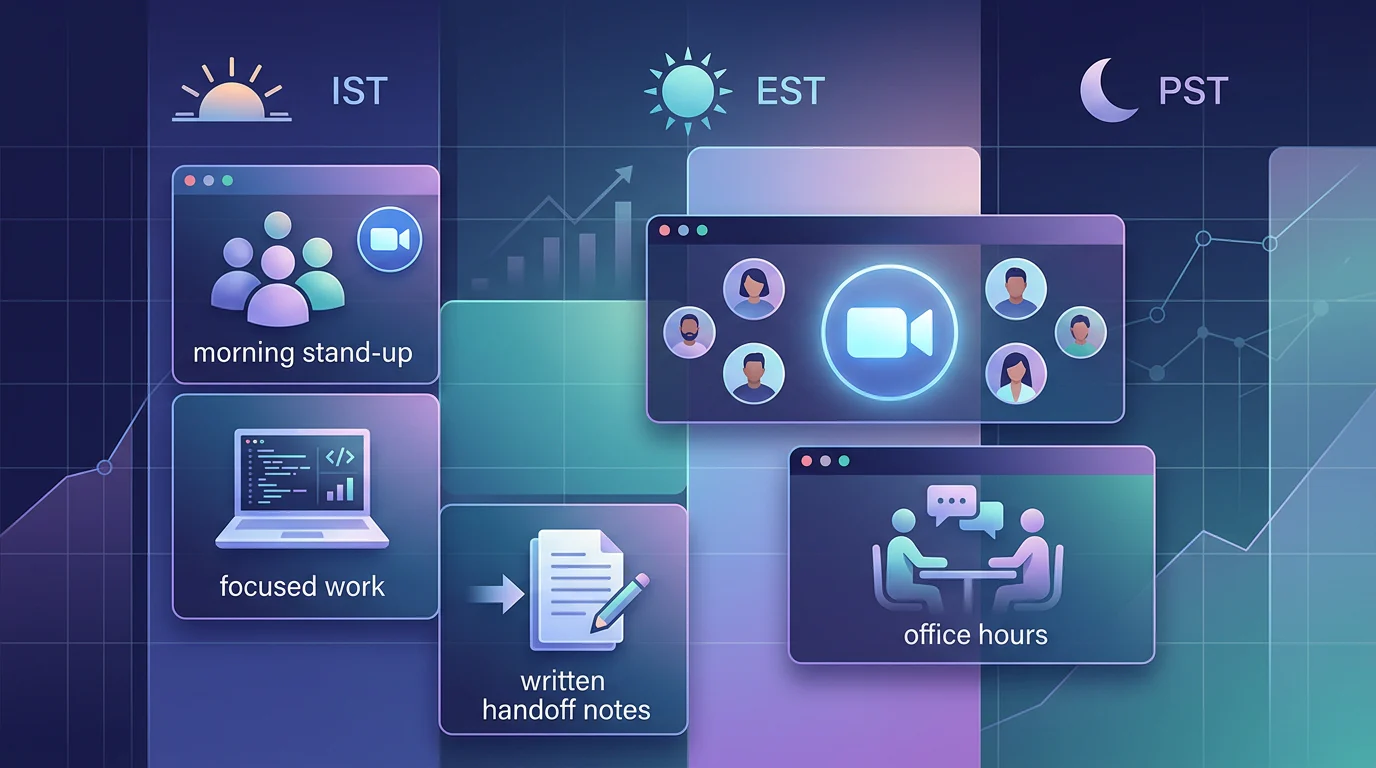
Recordings matter, but they are not a substitute for live questioning, shared decisions, and project feedback. We track attendance by region, lab completion, office-hour questions, review-gate participation, and unresolved blockers. That gives managers evidence of engagement without mistaking a video view for applied learning.
For teams deciding how much live delivery they need, our flexible training formats show the tradeoff between scheduling convenience and instructor access.
What Should a Hadoop-to-Cloud Curriculum Cover?
A migration curriculum should start with the work that already exists. Before teaching a target platform, we map sources, batch jobs, streaming jobs, schedules, dependencies, SLAs, identities, classifications, consumers, and recovery requirements. This reveals which work is a technical conversion and which work requires a new operating decision.
Target Architecture and Workload Choices
Learners should be able to explain how batch orchestration, streaming ingestion, replication, and data virtualization serve different workloads. Fabric supports these different ingestion paths, including batch pipelines, real-time Eventstreams, mirroring, and OneLake shortcuts, as outlined in its ingestion overview.
We do not teach those capabilities as a feature list. We tie each one to latency needs, ownership, failure modes, and production support. Our unified platform overview gives learners useful context before they make those architectural choices.
Governance and Operating Roles
Cloud adoption changes how access, quality, and accountability are managed. The curriculum should cover named data owners, steward responsibilities, glossary and metadata practices, quality thresholds, approval paths, audit evidence, and incident escalation.
For Azure data teams, the role model must connect business accountability to engineering implementation. A useful learning exercise is to assign a data owner, a steward, a platform engineer, and an incident owner to every capstone domain. That turns governance into operating behavior rather than a slide deck.
Culture Change and Migration Decisions
The difficult part of a Hadoop-to-cloud move is often deciding what to stop doing. Teams need a definition of done for retirement, a way to prioritize workloads, a cross-region decision log, and a clear escalation route when source data, access, or quality blocks delivery.
We pair those decisions with a platform map. For teams evaluating replacement patterns, our Hadoop replacement framework helps connect legacy workloads to a modern target state without treating every job as identical.
What Proves Azure Engineering Practice Is Production Ready?
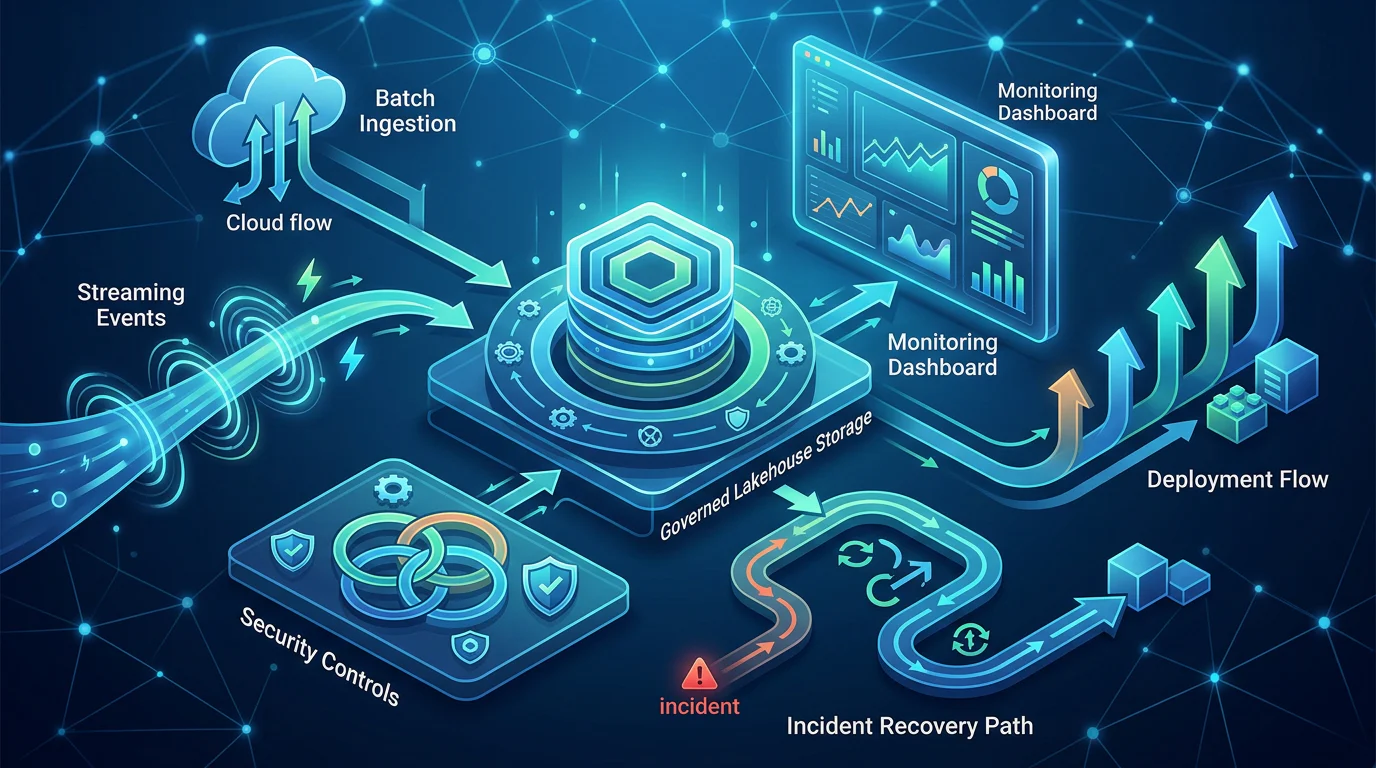
We look for evidence that a team can run a workload, not simply finish a lab. A meaningful capstone starts with a representative source system and ends with a reviewed solution that other engineers can understand, deploy, monitor, and recover.
Ingestion, Batch, and Streaming
The project should require one scheduled batch path and one streaming path, plus transformations, schema handling, data-quality checks, error routing, and documented lineage. The team should explain why each path exists and what happens when the source or pipeline fails.
That approach prevents the common problem of a polished demo with no operational edge cases. Our production-realistic labs guide expands on the difference between a tutorial exercise and work that resembles an actual delivery environment.
Security, Observability, and Recovery
The capstone should include least-privilege access, test identities, reviewable permissions, pipeline status, logs, alerts, a triage runbook, and a recovery exercise. Teams should demonstrate both normal execution and an intentional failure scenario.
Fabric’s reliability guidance notes that disaster recovery requires preparation and manual restoration steps from customers, which is why we treat recovery as a practiced skill rather than an assumed platform feature. We also expect teams to show their deployment approach through version control, test gates, and promotion across environments.
CI/CD and Review Evidence
Every project should have a repository, documented environment configuration, a reviewed change, and a release path. Fabric supports Git integration and deployment pipelines for moving work through development, test, and production, as described in its CI/CD documentation.
We review functional correctness, quality evidence, security design, monitoring, documentation, incident handling, and handoff quality. Our Azure pipeline modernization resource can help teams frame that work as a gradual improvement program rather than a single risky cutover.
How Should Compliance and Credentials Shape the Rollout?
Training operations have their own governance requirements. We work with each organization’s legal, privacy, security, and procurement teams to define recording notices, learner-data access, retention, vendor processing, and cross-border delivery controls before the cohort begins.
For India-based learners, the Digital Personal Data Protection Act, 2023 sets expectations around clear consent, purpose-limited processing, and rights such as erasure in applicable situations. The exact implementation should be reviewed with counsel against the organization’s facts and current obligations, using the official DPDP Act text.
Credentials should reinforce role fit, not become the only success measure. CDMP Associate requires a Data Management Fundamentals pass score of at least 60 percent, while Practitioner and Master require additional specialty exams and higher scores. Master also requires relevant experience and a CV review, according to the published CDMP levels.
We position governance credentials for people who own policy, quality, metadata, stewardship, and operating controls. We position technical paths for engineers responsible for data loading, transformation, security, monitoring, and optimization. Our modern engineering curriculum shows how those roles can learn together without turning every learner into the same specialist.
Build Your Blended Program with Vision Board
At Vision Board, we turn this comparison into an operating plan for your actual team. We start with a baseline of roles, Hadoop dependencies, target workloads, and India-US participation constraints. Then we shape live foundations around your governance decisions, give engineers realistic Azure work, and review what they ship rather than merely recording course completion. Our instructors can run repeated live sessions, office hours, project checkpoints, and leadership readouts that make cross-region progress visible. We also align review gates with security, observability, deployment, and recovery, so learning changes daily delivery habits. You leave with evidence your leaders can use: participation records, reviewed artifacts, role ownership, unresolved risks, and a practical next-step roadmap. If you are deciding whether your group needs shared management language, build-ready engineering practice, or both, we will help you choose the blend that matches the migration. Explore our Vision Board training.
FAQs on Enterprise Data Management Training for Global Teams
Can Recordings Replace Live Instruction for Global Teams?
No. Recordings help participants review material, but they cannot replace instructor questioning, shared decisions, lab feedback, or accountable handoffs that convert learning into operational behavior.
Why Are Projects Necessary in a Hadoop Migration Program?
Projects show whether engineers can deploy and operate data workloads, while live foundations establish ownership, quality rules, escalation paths, and the shared language project teams need.
Which Credential Fits Governance Roles Versus Engineering Roles?
Governance roles benefit from data-management credentials, while engineers benefit from role-based technical paths. Use both as supporting evidence alongside reviewed project delivery, role accountability, and operational readiness.
What Should Be Reviewed Before Recording Training Sessions?
Review recording notice, learner-data purpose, retention, access controls, vendor processing, cross-border transfer, and local legal obligations with privacy, security, procurement, legal, and regional leadership stakeholders.