What Should Modern Azure Data Engineering Training Cover?
Modern Azure data engineering curriculum: SQL, Spark, Delta Lake, Fabric, Databricks, Power BI, and production delivery skills.
What Should Modern Azure Data Engineering Training Cover?
Relational-data professionals do not need a second career to work with lakehouses. They need an ordered learning path, especially when Fabric Data Factory now connects to more than 170 data sources across cloud, multicloud, and hybrid environments.
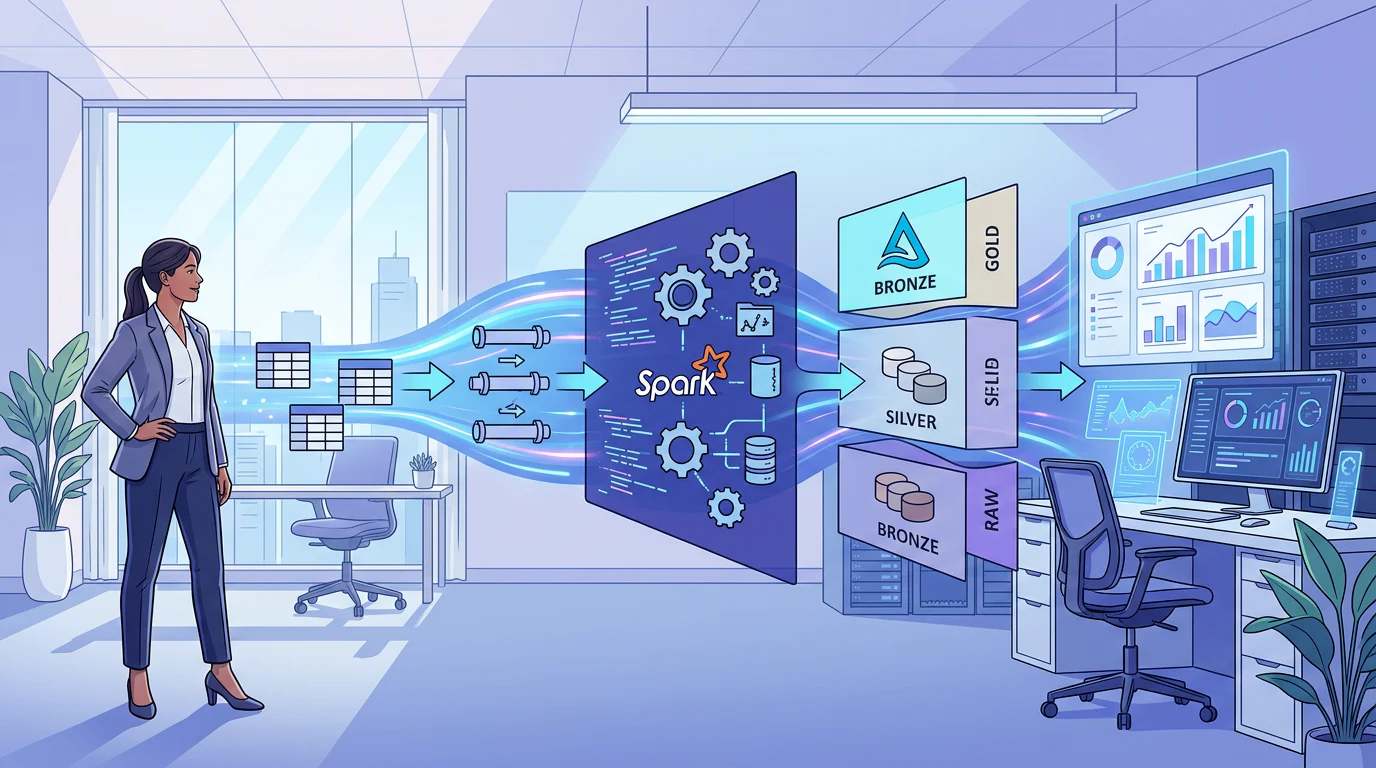
Modern Azure data engineering training should take relational-data professionals from SQL and dimensional modeling through ingestion, Spark, Delta Lake, medallion design, Fabric, Databricks, Power BI, governance, and production operations. It should assess one connected project, including batch, streaming, testing, deployment, and monitoring, rather than treating each platform as an isolated module.
We will map the prerequisite bridge, define the practical skills that belong in a current program, and show how to evaluate whether a learning path can prepare you for real delivery work. Our Azure learning paths provide further context for choosing that sequence.
How Do SQL Skills Become Lakehouse Skills?
We start with the skills many data professionals already have: SQL joins, facts, dimensions, grain, source systems, and scheduled loads. Those concepts remain valuable, but the execution model changes when data is distributed across files, partitions, compute clusters, and versioned tables.
The bridge should be explicit. A learner who understands a star schema can understand a semantic model, because semantic-model guidance describes facts as the domain records and dimensions as the structures used to filter and analyze them. We use that familiar foundation before introducing Spark execution and lakehouse storage.
| Relational Concept | Lakehouse Counterpart | Practical Evidence |
|---|---|---|
| Staging table | Bronze landing zone | Raw source capture with load metadata |
| Cleansed warehouse layer | Silver Delta table | Validated, deduplicated, standardized data |
| Fact and dimension model | Gold table and semantic model | Documented grain and business-ready metrics |
Incremental MERGE | Delta upsert workflow | Idempotent incremental load |
| Query-plan tuning | Spark UI and physical plan review | Partition and shuffle diagnosis |
| Database permissions | Catalog and workspace governance | Access and ownership matrix |
We treat the first successful conversion of a relational table as the start of the journey, then require learners to trace data through validation, serving, and operations. We also encourage learners to use our lakehouse learning guide as a companion, because the aim is not to abandon SQL. It is to understand where SQL remains the right tool and where distributed processing changes the engineering decision.
What Must a Modern Azure Data Engineering Curriculum Teach?
A modern Azure data engineering curriculum must connect ingestion, transformation, storage, orchestration, reporting, and operations. Tool familiarity alone is not enough, because production failures usually occur at the boundaries between those capabilities.
We expect learners to build pipelines with Azure Data Factory and Fabric Data Factory, then decide whether an activity, low-code dataflow, SQL transformation, or Spark notebook is the right place for a particular step. Our unified analytics guide helps frame that decision around the complete workflow rather than a single product screen.
| Capability | What Good Training Teaches | Required Artifact |
|---|---|---|
| Ingestion | Parameters, triggers, retries, CDC, watermarks | Incremental source-to-raw pipeline |
| Orchestration | Dependencies, control flow, reruns, alerts | Recoverable scheduled workflow |
| Transformation | SQL, DataFrames, notebooks, data quality | Tested silver-layer transformation |
| Serving | Dimensional models and semantic models | Gold dataset and report |
| Governance | Ownership, access, lineage, auditability | Role and lineage design |
| Delivery | Git, reviews, deployment, monitoring | Dev-test-production release |
The curriculum should make learners prove that their ingestion is repeatable. We look for source identifiers, row counts, timestamps, watermarks, error handling, and a recovery procedure, not a one-time successful copy operation.
How Do Spark Fundamentals Prepare Learners for Optimization?
Spark deserves more than a brief introduction to DataFrames. We teach it as the mental model that explains why a pipeline can run quickly one day and become expensive, slow, or unstable after a source or join changes.
Understand Partitions and Shuffles
Partitions determine how distributed data is split into work, while shuffles move data to satisfy operations such as joins and aggregations. The Spark tuning docs explain that shuffle operations can build large hash tables within individual tasks, which is why learners need to reason about data size and parallelism.
We require a learner to explain narrow and wide transformations, inspect a stage, and identify when a join or aggregation has caused an avoidable data movement. Our Spark-free ETL comparison provides useful context for workloads where Spark is not the best fit.
Read Plans and Choose Join Strategies
A current program should teach physical-plan reading, join order, broadcast patterns, skew, statistics, and the tradeoffs of caching. Learners should not memorize a list of optimization settings without understanding what the workload is doing.
The evidence we want is practical: a baseline job, a plan inspection, an identified bottleneck, a targeted change, and a measured outcome. That turns performance work into an engineering explanation instead of a collection of untested tips.
Connect Optimization to Reliable Design
Performance is also a data-design concern. File layout, incremental processing, table maintenance, and clean dimensional models all affect what Spark must read and move.
We therefore expect an assessment that includes a deliberately skewed join or over-partitioned workload. The learner should diagnose it, make an appropriate change, and explain why that change is safe for the downstream pipeline.
How Should Delta Lake and Medallion Architecture Be Taught?
Delta Lake should be taught as the reliability layer for a lakehouse, not as a file format learners mention once and forget. Its core capabilities include ACID transactions, schema enforcement, time travel, upserts, and support for both batch and streaming workloads, as documented in the Delta Lake docs.
Build Bronze, Silver, and Gold with Gates
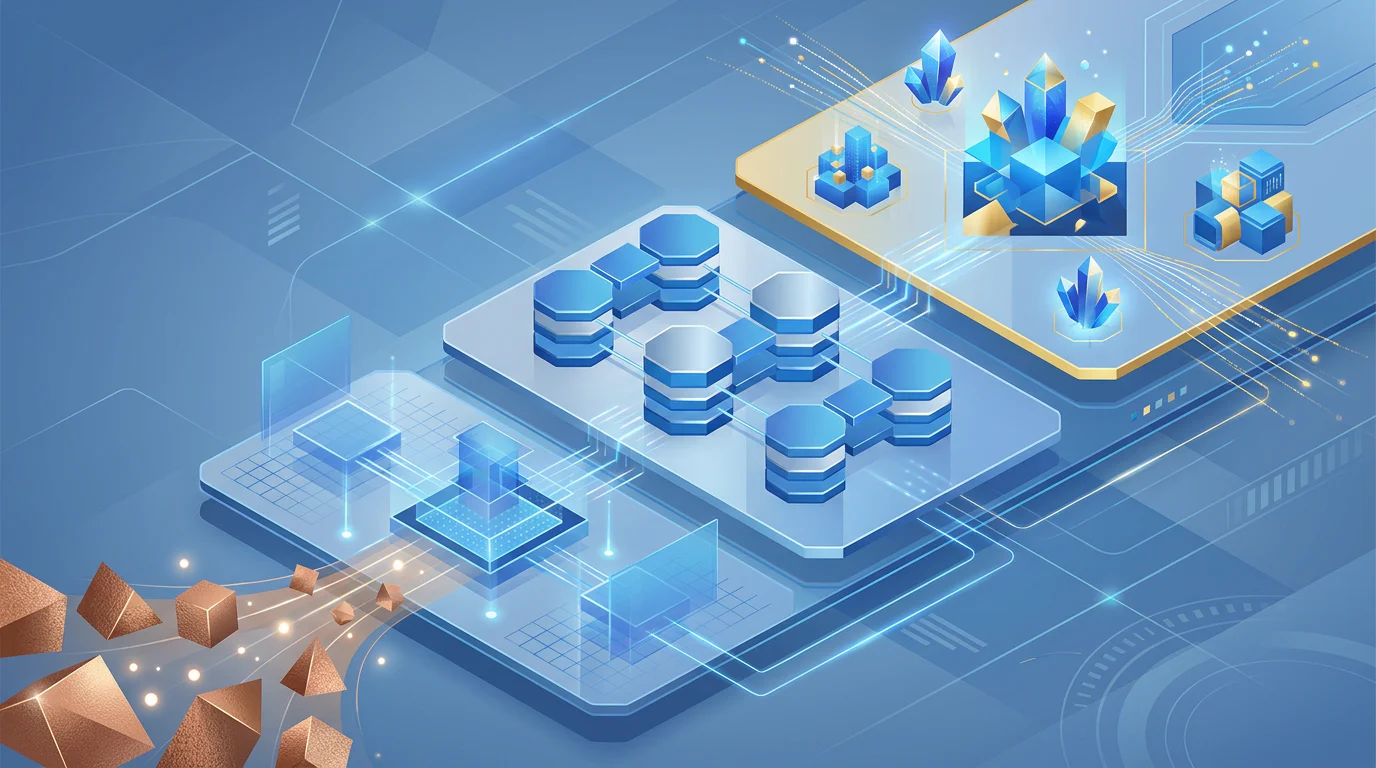
Bronze preserves source data and load metadata. Silver validates, standardizes, deduplicates, and quarantines records that fail defined checks. Gold publishes data shaped for reports, semantic models, and trusted business consumption.
A quality gate must be visible between each layer. We expect raw source fidelity at bronze, technical and business validation at silver, then documented grain and consumer-ready metrics at gold. Our governed lakehouse guide shows why those handoffs matter.
Practice Incremental and Corrective Workflows
A useful exercise includes an incremental MERGE, a late-arriving record, a malformed schema change, and a time-travel recovery. This reveals whether a learner understands durability and replay, rather than only how to write an initial table.
We also expect learners to document the handling of duplicates, null business keys, rejected records, and source drift. Those decisions are where data quality becomes visible to the teams relying on the final report.
Keep Consumer Needs in View
Bronze should not become a reporting shortcut. Gold is the layer where data is shaped for trusted use, while Power BI models and dashboards should consume outputs with a clear owner, refresh expectation, and definition of quality.
That approach protects downstream users from raw operational variability and gives engineers a clear standard for deciding when a table is ready to serve.
How Does Full-Stack Practice Turn Training into Production Readiness?
The strongest learning project is a connected lakehouse, not a set of unrelated labs. We build the capstone around operational database data, file-based reference data, and event-style records so learners see how ingestion, Spark, Delta, reporting, and governance influence one another.
- Ingest Sources: Build parameterized pipelines that land relational, file, and event data in ADLS or OneLake with audit fields.
- Transform Data: Use Spark and Delta tables to create bronze, silver, and gold layers with documented quality checks.
- Serve Analytics: Model gold data for Power BI, define business measures, and validate that the report reflects the intended grain.
- Operate Safely: Use Git, peer review, deployment stages, testing, monitoring, and a recovery runbook.
Fabric is designed to cover end-to-end workflows, including ingestion, transformation, real-time processing, analytics, and reporting, according to the Fabric architecture. We teach the handoffs between these responsibilities so learners can explain why a pipeline belongs in one location and not another.
Governance must be part of the project from the beginning. Unity Catalog provides access control, lineage, and audit capabilities, so our platform architecture comparison treats governance as a design requirement rather than a final checklist item.
Production readiness also means observing the result. Learners should inspect failed runs, compare durations, configure notifications, and explain their rerun strategy. The Fabric Monitoring Hub can display up to 100 activities per item from the previous 30 days, making monitoring a skill that should be practiced in the same project as development.
Why Learn with Vision Board?
At Vision Board, we teach Azure data engineering as a connected production discipline, not a tour of disconnected menus. We help relational-data professionals move from dependable SQL habits into Spark execution, Delta reliability, medallion design, orchestration, governance, and business-facing models. Our work asks learners to build, test, explain, and improve a pipeline, so capability is demonstrated in artifacts rather than inferred from attendance. We also keep the learning path anchored to the dependencies that real delivery teams face: source changes affect ingestion, transformations affect quality, quality affects reports, and releases affect operations. If you want to evaluate your next step against a practical, modern stack, explore Vision Board’s learning resources and choose the path that matches the work you want to do. Join us when you want feedback that connects architecture choices to real operational consequences, and build confidence through work you can defend. Start with Vision Board.
FAQs on Modern Azure Data Engineering Curriculum
Can I Start with Only SQL Experience?
Yes. We begin with grain, joins, and dimensional models, then make distributed processing tangible through partitions, shuffles, and Delta tables before asking learners to optimize production jobs.
Must I Learn Both Databricks and Fabric?
Yes, if your target role spans the Azure analytics stack. We teach their distinct jobs, shared Delta patterns, orchestration handoffs, governance responsibilities, and reporting outcomes.
What Delta Lake Work Should I Be Able to Show?
Show a schema-enforced table, an incremental merge, a time-travel recovery, and quality-gated bronze, silver, and gold data. We expect you to explain each decision during a technical review.
How Do I Know Whether a Course Is Current?
Check whether Spark tuning, Delta reliability, Fabric integration, governance, testing, monitoring, and deployment are assessed through one project with clear evidence, rather than merely mentioned in a syllabus.