How Should You Learn Azure Lakehouse Engineering?
Learn Azure lakehouse engineering from SQL foundations through Spark, Delta Lake, Fabric, orchestration, governance, and Power BI.

How Should You Learn Azure Lakehouse Engineering?
For relational-data professionals, the move into lakehouse work is a change in how data is stored, processed, and operated. Microsoft labels its current four-module learning path for Azure Databricks data engineering as intermediate, which is a useful reminder to build foundations before chasing platform features.
Azure lakehouse engineering is best learned in dependency order: begin with object storage and distributed processing, add PySpark, Delta Lake, and bronze-silver-gold design, then learn orchestration, governance, streaming, performance tuning, and Power BI serving. SQL experience transfers well, but it does not replace practice with partitions, file-backed tables, incremental loads, and failure recovery.
We built this guide to help you choose a starting point, sequence the modern Azure stack, test a course’s technical depth, and produce a portfolio project that resembles real engineering work.
What Should You Know Before Beginning Azure Lakehouse Engineering?
You do not need to become a distributed-systems specialist before starting. You do need to know where your current experience ends. SQL developers usually bring strong joins, schemas, and dimensional modeling. ETL developers understand sources, transformations, schedules, and operational handoffs. Analysts often bring business context and semantic-model awareness. Existing data engineers may already know reliability patterns but need to connect them to Azure services.
The first goal is not certification vocabulary. It is knowing whether you can explain where data lives, how it arrives, what transforms it, how its quality changes, and how a business user consumes it. Our lakehouse architecture guide can help frame those questions before you commit to a course.
| Starting Role | Transferable Strengths | First Gap To Close | Best Starting Point |
|---|---|---|---|
| SQL Developer | Joins, schemas, dimensional models | Files, partitions, distributed execution | Object storage and Spark SQL |
| ETL Developer | Source mappings, schedules, retries | Delta tables and incremental file processing | ADLS or OneLake, then Delta |
| Data Analyst | Business metrics, SQL, reporting | Ingestion, tests, engineering operations | Lakehouse concepts and DataFrames |
| Existing Data Engineer | Pipelines, monitoring, cloud basics | Azure and Fabric integration choices | Platform architecture and capstone |
A useful dependency map is simple: SQL and modeling lead to object storage, object storage leads to Spark, Spark leads to Delta tables, Delta leads to medallion layers, and those layers support orchestration, governance, streaming, and BI. Skipping the early links makes later labs feel like tool clicks instead of engineering decisions.
How Do Relational Warehouse Skills Translate to the Lakehouse?
A relational warehouse keeps much of the storage and table-management complexity behind a database engine. A lakehouse makes more of that physical reality visible. You work with object storage, files, partitions, distributed compute, and table formats that add transaction and metadata behavior above those files. That is why a strong SQL background is valuable but incomplete.
The conceptual bridge is the medallion pattern: bronze holds raw data, silver validates and refines it, and gold serves business-ready tables. Think of bronze as durable source evidence, silver as governed engineering output, and gold as the contract consumed by BI.
| Familiar Warehouse Concept | Lakehouse Equivalent | New Engineering Question |
|---|---|---|
| Table | Delta table backed by files | How are files written, partitioned, and maintained? |
| Staging area | Bronze layer | Can raw data be replayed and audited? |
| Transformation model | Silver layer | Is processing incremental, testable, and idempotent? |
| Data mart | Gold layer | Does the semantic model receive stable business definitions? |
| Scheduled ETL job | Orchestrated pipeline | What happens when a run fails or arrives late? |
Start with the concepts that make SQL portable: schema, grain, keys, quality rules, and query intent. Then learn what changes in distributed execution: data movement, skew, partitions, file sizes, and job observability. If you are moving from package-based ETL, our SSIS migration guide is a practical companion for translating familiar pipeline thinking.
What Is the Right Learning Sequence from Storage to BI?
The best learning sequence makes every new tool answer a problem created by the previous stage. We recommend learning storage and distributed processing before sophisticated orchestration, because a pipeline cannot rescue a transformation you do not understand. Likewise, learn Delta and incremental design before streaming, because streaming magnifies weak assumptions about schemas, late data, and recovery.
This sequence is not a checklist for collecting product badges. It is a progression from moving data, to trusting data, to operating data. Retain your own notes and run evidence for every stage.
Stage One: Build Storage and Spark Foundations
Learn ADLS Gen2 or OneLake, Parquet, partitions, Spark DataFrames, Spark SQL, and basic PySpark. Build a batch load from files, inspect the physical layout, and compare a selective query with a broad scan. Your proof of mastery is being able to explain why layout and data movement affect a workload.
Stage Two: Add Delta and Medallion Design
Learn Delta writes, schema enforcement, MERGE, quality checks, and bronze-silver-gold transformations. Microsoft’s Delta architecture guidance recommends retaining bronze data as the raw source of truth and applying quality controls through the layers.
Stage Three: Orchestrate, Govern, and Monitor
Learn parameters, triggers, retries, job dependencies, lineage, access controls, and run monitoring. Create a pipeline that can fail deliberately, recover predictably, and leave enough evidence for another engineer to diagnose what happened. Use a learning playlist alongside the labs to reinforce the concepts without replacing practical work.
Stage Four: Stream, Tune, and Serve
Learn checkpoints, late-arriving data, schema changes, query plans, file maintenance, semantic models, and BI freshness. The important outcome is not merely a dashboard. It is a trustworthy path from event or source change to a governed business metric.
| Stage | Prerequisite | Skill | Lab | Proof Of Mastery |
|---|---|---|---|---|
| Storage And Spark | SQL basics | ADLS or OneLake, Parquet, DataFrames | Partitioned batch load | Explain partitions and scan behavior |
| Delta And Medallion | Storage and Spark | Delta tables, MERGE, quality layers | Bronze to silver to gold | Build an idempotent incremental load |
| Operations | Delta and Medallion | Orchestration, governance, monitoring | Parameterized pipeline with retries | Diagnose and recover a failed run |
| Streaming And Tuning | Operations | Checkpoints, schema evolution, optimization | Stream with controlled schema change | Recover safely and validate output |
| BI Serving | All prior stages | Semantic model and report consumption | Gold tables to Power BI | Document lineage and freshness |
When Should You Learn Databricks, Fabric, Data Factory, and Power BI?
Learn these services together when you need to understand the handoffs between ingestion, processing, governance, and consumption. Learn them separately only long enough to understand each service’s core job. Azure Data Factory is useful for movement and orchestration. Azure Databricks is where deeper Spark, Delta, streaming, and tuning work becomes important. Fabric provides a unified analytics environment centered on OneLake. Power BI is where curated data becomes a semantic model and report experience.
Fabric’s six lifecycle stages describe a useful end-to-end mental model: bring data in, store it, prepare it, analyze it, manage it, and share it. That is the full stack your learning path should connect, even if a future role concentrates on one stage.
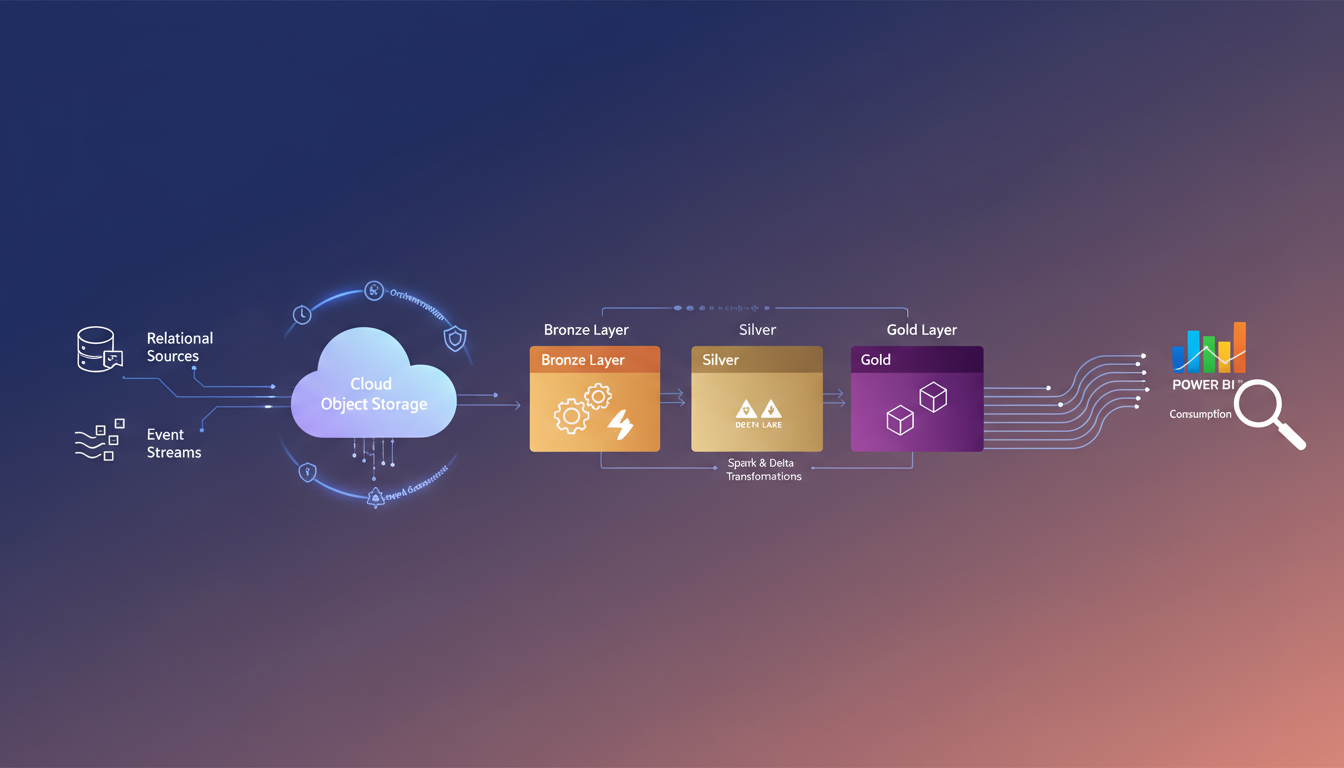
For Fabric-focused work, OneLake shortcuts are worth learning because they can reference data stored in ADLS Gen2 without copying it. Direct Lake then lets Power BI semantic models work with Delta tables in OneLake, as explained in the Direct Lake overview. Our Fabric training options can help you decide how to fit that platform work around your schedule.
The integration question is therefore not “Which platform wins?” Ask instead: where will source data land, where will Spark transformations run, how will jobs be orchestrated, where will governance be enforced, and how will BI consume approved gold data? A modern program should make you answer each question with a working lab.
Which Labs Demonstrate Production-Ready Lakehouse Skills?
A credible learning path has labs that expose failure modes, not just happy-path demos. We look for work that requires you to ingest data more than once, handle a changed source schema, prove that duplicate records do not corrupt outputs, and inspect what happened when a workload performed badly. Those exercises demonstrate judgment, which is the difference between a tutorial and engineering practice.
Batch and Incremental Ingestion
Build a batch ingestion flow from a relational extract or file source. Add a watermark or control table, load raw data to bronze, and use a stable key to MERGE changes into silver. Document why a rerun does not double-count data. If you are deciding between coached learning and implementation-led development, our implementation route can help you choose.
Streaming Ingestion and Schema Evolution
Ingest events with a checkpoint, add a new field to the source, and record the recovery steps. The official schema evolution guidance notes that a streaming query can fail when its planned schema changes, making restart behavior and target-table configuration essential lab material.
Performance Tuning and Observability
Compare an untuned transformation with an improved version. Inspect partitioning, execution behavior, file layout, and runtime metrics. Write a short incident note that identifies the symptom, likely cause, change made, and a prevention measure.
Build One Connected Capstone
Use a realistic retail, operations, or product-events scenario. Ingest a relational extract and event data, preserve raw bronze data, validate silver entities, publish gold KPIs, apply access and lineage controls, monitor pipeline runs, and expose a documented Power BI semantic model.
- Architecture evidence: Show the source systems, data layers, orchestration boundaries, governance controls, and BI endpoint.
- Code evidence: Include readable ingestion and transformation code, with comments explaining incremental behavior.
- Operational evidence: Save run history, test results, a failed-run recovery note, and a performance observation.
- Business evidence: Define the gold metrics, expected refresh behavior, and the report’s intended audience.
Use our curriculum audit to evaluate whether a program reaches that standard.
How Can Vision Board Help You Build Real Azure Lakehouse Engineering Skills?
At Vision Board, we built this path for people who already understand data but need evidence that they can engineer a current Azure lakehouse. We help you turn a SQL-first starting point into a practical sequence of storage, Spark, Delta, orchestration, governance, and BI work, with each stage producing something you can inspect and explain. Rather than treating completion as the outcome, we encourage you to retain notebooks, pipeline run histories, data-quality checks, architecture notes, and a dashboard that reveals whether the gold layer is trustworthy. Our learning resources also help you judge whether a coached route or a project-led route fits your time, feedback needs, and current role. We keep the focus on connected, current platform work, so your next course decision reflects the job you want. Now choose the next practical step in the Vision Board course store
FAQs on Azure Lakehouse Engineering
These questions address the most common starting decisions for relational-data professionals who want a practical, current route into modern Azure lakehouse work.
Can a SQL Developer Learn Azure Lakehouse Engineering Without Spark Experience?
Yes. Begin with storage concepts, DataFrames, and Spark SQL, then add PySpark through small transformation labs. SQL fluency makes joins, schemas, and dimensional modeling familiar.
Should I Learn Fabric or Databricks First?
Start with the environment your intended team uses, but learn shared concepts first. Fabric suits unified analytics workflows; Databricks adds deep Spark engineering, streaming, and tuning.
When Should I Build a Lakehouse Capstone?
Build a capstone after understanding source data, incremental logic, and table design. It should connect orchestration, governance, monitoring, and BI into one observable engineering workflow.
What Proves That My Learning Is Technically Deep?
Show readable code, architecture decisions, tests, pipeline-run evidence, dashboard screenshots, and a recovery note. Reviewers need proof that the pipeline behaves predictably when source data changes.