

TL;DR
We find that Microsoft Fabric production hands-on labs are valuable for learning individual platform tasks, but guided exercises alone do not prove production readiness. This audit shows what official labs cover, where they stop, and how we extend a medallion lab with governance, deployment, observability, recovery, and portfolio evidence.
Are Microsoft Fabric Labs Production-Realistic?
The official exercise catalog lists 10 data-engineering exercises alone, alongside warehouse, real-time, data science, semantic-model, security, and lifecycle work. That breadth makes the labs a strong practical starting point for learners building Fabric fluency.
Microsoft Fabric production hands-on labs are realistic at the individual-task level, but they do not independently simulate a production deployment. They teach lakehouses, Delta tables, medallion transformations, pipelines, warehouses, real-time ingestion, security, monitoring, and semantic models in guided environments. Production readiness also requires representative data, environment promotion, source control, recovery testing, capacity testing, governance boundaries, and operational ownership.
We audit what the exercises genuinely teach, identify the production work they leave to the learner, and provide a seven-step way to turn a guided lab into defensible project evidence.
Are Microsoft Fabric Production Hands-On Labs Realistic?
We use “realistic” narrowly: does an exercise make someone perform a task they would encounter in a real Fabric environment? On that test, many do. We do not treat a successful guided run as evidence that someone can make the same workload secure, repeatable, observable, and recoverable under changing requirements.
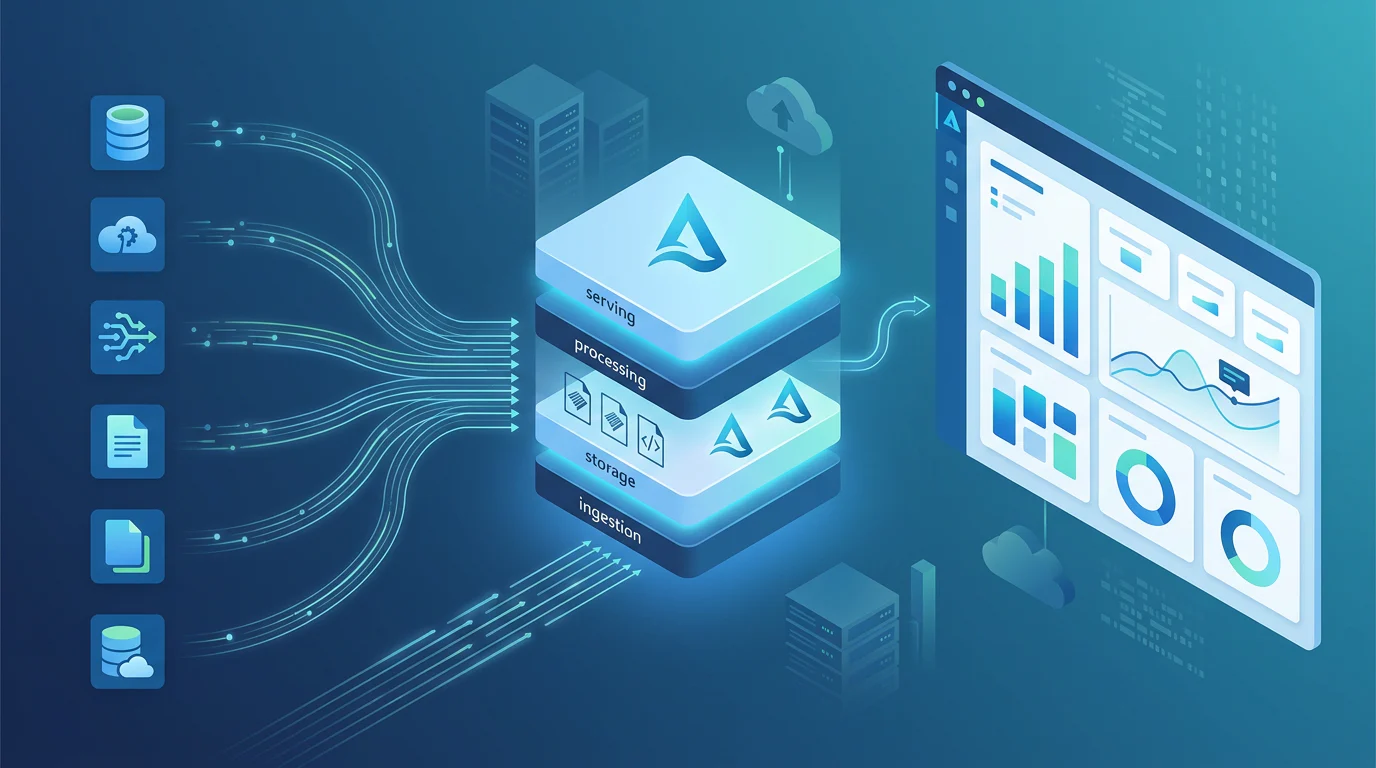
The catalog covers the main Fabric experiences rather than one narrow data-engineering path. That is useful because production lakehouses connect ingestion, transformation, modeling, security, and operations. It is also why learners should use labs as building blocks, then connect them into one owned system through a learning path.
| Official Exercise Area | Current Exercise Count | Examples That Resemble Real Work |
|---|---|---|
| Data engineering | 10 | Spark, Delta tables, medallion layers, pipelines, Dataflows Gen2 |
| Data warehouse | 7 | Dimensional models, T-SQL loads, monitoring, SQL security |
| Real-Time Intelligence | 5 | Eventstreams, KQL, dashboards, alerts |
| Data science | 5 | Notebooks, Data Wrangler, MLflow, batch predictions |
| Semantic models | 6 | Direct Lake, DAX, performance analysis, row-level security |
| Security and governance | 4 | Workspace access, item permissions, OneLake roles, lineage |
| Operations and lifecycle | 5 | Ingestion, monitoring hub, deployment pipelines |
The important distinction is scope. A lab can be hands-on and still be intentionally constrained: a supplied dataset, a known destination, a prescribed sequence, and one correct completion path make learning faster. Production work starts when those constraints disappear.
Which Official Exercises Most Closely Resemble Production Tasks?
The strongest labs are not “toy examples” in the sense of being fictional capabilities. Creating Delta tables, shaping data in Spark, configuring security, observing warehouse queries, and promoting content are authentic Fabric tasks. The missing realism usually lies in scale, uncertainty, cross-team ownership, and operating the system after the happy path.
Where the Labs Are Closest to Daily Delivery
The medallion exercise asks learners to transform raw data through bronze, silver, and gold layers, then create a star schema. Pipeline exercises connect external ingestion to notebooks and table loading. Warehouse exercises cover dimensions, facts, stored procedures, query patterns, monitoring, and security. Real-time exercises add event ingestion, KQL, dashboards, and conditional alerts.
Those are meaningful technical building blocks. A learner who has completed them should be able to navigate the relevant Fabric experiences and explain the basic job each item performs. Our lakehouse curriculum audit is a useful companion when deciding whether a broader learning sequence actually connects those tasks.
Where Guidance Stops Before Production Begins
Most official exercises are designed for completion in roughly 20 to 45 minutes. That is appropriate for instruction, but it means the instructions can assume a known source, stable schema, valid credentials, cooperative capacity, and an expected output.
A production team must decide what to do when records arrive late, source columns change, data quality drops, capacity is constrained, a deployment fails, or a different team needs access. Those decisions are not shortcomings of the labs. They are the next layer of work the labs are meant to prepare learners to attempt.
A Transparent Eight-Criterion Lab Rubric
We score only what a published exercise explicitly demonstrates. “Observed” means the learner performs the activity. “Partial” means the capability appears without full production constraints. “Absent” means the activity is not demonstrated in the exercise.
| Criterion | Medallion Lakehouse Lab | Pipeline Ingestion Lab | Secure Data Access Lab | Deployment Pipeline Lab |
|---|---|---|---|---|
| Data scale | Absent | Absent | Absent | Absent |
| Ambiguous requirements | Absent | Partial | Partial | Partial |
| Integration depth | Partial | Observed | Partial | Partial |
| Security | Absent | Absent | Observed | Absent |
| Deployment | Absent | Absent | Absent | Observed |
| Observability | Absent | Partial | Absent | Partial |
| Failure handling | Absent | Absent | Absent | Absent |
| Cost awareness | Absent | Absent | Absent | Absent |
This rubric avoids a false choice between “real” and “worthless.” The exercises offer real individual tasks, while production readiness requires proving that those tasks work together under constraints. That is also the difference we ask teams to examine in our team training comparison.
What Production Gaps Must a Fabric Lab Still Close?
The gap is less about adding more buttons to click and more about adding consequences. A production lakehouse needs known owners, representative data, controlled access, repeatable releases, operational signals, and a way back when something goes wrong. Microsoft’s operational guidance specifically recommends source control, environment promotion, validation checks, approval gates, logs, and alerts for Fabric workloads in its operational guidance.
| Production Requirement | What A Guided Lab Demonstrates | What The Extension Must Prove |
|---|---|---|
| Data volume and variability | A repeatable sample scenario | Late records, duplicates, malformed values, changing schemas, and backfills |
| Data-quality ownership | Transformations and basic validation | Rules, quarantine output, reconciliation, owner, and resolution process |
| Governance boundaries | Security features in isolation | Workspace design, least privilege, lineage, labels, and access reviews |
| Release engineering | Basic environment promotion | Git workflow, automated checks, approval, parameterization, and rollback |
| Operations | Monitoring features | Alert thresholds, retries, replay, runbook, and recovery objectives |
| Capacity awareness | Functional execution | Baseline usage, performance testing, throttling response, and scaling decision |
Capacity is a practical example of why successful labs are not the final test. Fabric’s Capacity Metrics app exposes 14 days of capacity data, while default Fabric activity-log retention is 30 days, so a long-running project needs an explicit telemetry and retention plan. We recommend recording what signals matter before the project has an incident, not after it. Monitoring defaults make that operational boundary clear. For the broader development path, pair this work with how to learn lakehouse engineering.
How Can You Turn a Guided Lab into a Real-World Lakehouse Project?
We turn a lab into a project by preserving its core technical pattern and adding decisions, evidence, and failure cases around it. Start with the medallion exercise because it naturally connects ingestion, Delta tables, transformations, modeling, and downstream consumption.

Steps One Through Three: Make Data Behave Like a Source System
-
Define the operating contract: Name the data owner, intended consumers, refresh target, acceptable data delay, and recovery target before building the pipeline.
-
Use representative inputs: Ingest at least two source formats and introduce duplicate records, late records, missing values, and a backfill scenario instead of only clean sample data.
-
Build quality into each layer: Preserve raw records and ingestion metadata in bronze, validate and quarantine exceptions in silver, then publish only documented, reconciled gold tables.
Schema change belongs in this phase. Fabric’s Delta guidance explains that schema enforcement rejects mismatched writes by default, while additive changes can use mergeSchema; renamed, dropped, and type-changed columns can affect downstream queries and semantic models. A schema guide gives the technical basis for a test case that proves the team can manage drift.
Steps Four and Five: Add Governance and Controlled Releases
-
Separate environments and access: Create Development, Test, and Production workspaces. Document who can build, approve, consume, and administer each one. Apply least privilege, test restricted access, capture lineage, and record how sensitive data is handled.
-
Make releases repeatable: Connect the development workspace to Git, require peer review, parameterize environment-specific values, promote through a deployment pipeline, run automated checks, and rehearse a rollback to a known stable release.
Workspace roles and fine-grained OneLake access are useful only when their interaction is understood. For example, elevated workspace roles can bypass OneLake security enforcement, so a real access test must use the intended restricted identity rather than an administrator account. The official security model is essential reading before declaring a least-privilege design complete.
Steps Six and Seven: Operate, Fail, and Recover
-
Measure the workload: Baseline Spark duration, warehouse query performance, refresh time, and capacity consumption. Set alerts for failed jobs, excessive duration, retries, storage growth, and throttling.
-
Run deliberate failure drills: Test an invalid schema, unavailable source, duplicate batch, failed deployment, and replay from bronze. Capture the recovery steps, actual recovery time, and unresolved risks in a runbook.
This is where a portfolio moves beyond attractive screenshots. It shows judgment under imperfect conditions and gives reviewers artifacts they can inspect. A project-based implementation adds the delivery context that isolated lab completion cannot supply.
What Evidence Proves a Fabric Project Is More Than a Toy Example?
A capstone should make it possible for another engineer to understand what was built, verify how it behaves, and recover it without relying on the original author’s memory. We look for linked technical evidence rather than a claim that the project is “enterprise-ready.”

Use this acceptance checklist before presenting the work as practical Microsoft Fabric training:
- Architecture diagram showing sources, bronze, silver, gold, consumers, owners, and environment boundaries.
- Source-to-target mapping and data contract with freshness, quality, and consumer expectations.
- Incremental-load design, watermark or change logic, backfill process, and duplicate-handling evidence.
- Data-quality rules, quarantine records, reconciliation results, and a named resolution owner.
- Schema-evolution test with downstream impact assessment for the SQL endpoint and semantic model.
- Workspace, item-sharing, and OneLake-role matrix tested with restricted identities.
- Lineage evidence and a documented sensitive-data treatment decision.
- Git history, peer review, automated validation, promotion record, and rollback evidence.
- Capacity and performance baseline, alert configuration, and observed response to a controlled failure.
- Runbook that records recovery steps, recovery objective, result, and residual risk.
This checklist does not require a large enterprise dataset to be credible. It requires deliberate evidence that the system can be changed, secured, monitored, and recovered. Learners comparing self-study with organized practice can use our Fabric team options to decide where guided support adds the most value.
How Can Vision Board Help You Build Production-Ready Fabric Skills?
At Vision Board, we help learners move from completing a Fabric exercise to explaining the engineering decisions behind it. We focus on the work that makes a project credible: defining a data contract, choosing a lakehouse pattern, creating repeatable pipelines, testing security with the right identities, promoting changes safely, and documenting recovery. Our goal is not to replace official labs. We use them as useful foundations, then add the conditions that reveal whether a design can survive real delivery.
We also help teams turn a learning project into evidence they can review together. That means architecture diagrams, reusable notebooks, quality checks, release records, capacity observations, and clear operational ownership. Whether you are learning independently or building a shared team standard, explore the next step with Vision Board.
FAQs on Microsoft Fabric Production Hands-on Labs
Are Microsoft Fabric Labs Realistic?
Microsoft Fabric labs realistically teach ingestion, transformation, security, and modeling tasks, but learners must independently add scale, governance, deployment controls, operational monitoring, and recovery testing.
Which Fabric Labs Matter Most for Lakehouse Work?
Start with lakehouse, Delta, Spark, medallion, pipeline, security, monitoring, and deployment exercises. Connect them into one project using representative data and documented operating responsibilities.
Do Official Labs Cover Fabric Governance and Security?
Yes, official exercises cover workspace access, item permissions, OneLake roles, lineage, row-level security, and column-level security. Production use still needs boundary testing, reviews, and audit evidence.
How Do I Build a Fabric Portfolio Project?
Extend a guided medallion lab with incremental ingestion, quality rules, environment separation, source control, monitoring, failure drills, and an evidence checklist another engineer can inspect.
What Proves a Fabric Project Is Practical?
Practical Fabric projects include architecture, contracts, tests, security matrices, Git history, deployment records, performance baselines, alerts, recovery results, and clear operating ownership for critical responsibilities.