
Indonesia Signals AI Data Governance Regulations for Agentic Finance


TL;DR
At Vision Board, we explain why Indonesia’s 27 August 2026 warning on agentic AI in finance matters now. Existing banking and data rules already create a governance baseline, but teams should map authority, constrain data access, preserve audit evidence, and monitor the national AI roadmap.
Indonesia Signals AI Data Governance Regulations for Agentic Finance
On 27 August 2026, Indonesia’s deputy communications and digital minister warned that agentic AI can make decisions and execute transactions in financial services. That raises the stakes beyond using AI to summarize information or support an employee.
Indonesia’s latest policy signal is not a new law. But because agentic AI can make decisions and execute financial transactions, AI data governance regulations now need to cover authority limits, customer-data access, human escalation, and auditable evidence before autonomous actions reach customers.
We explain what changed, which rules already matter, and what financial data teams should do while national AI policy develops.
The August 27 Signal Is About Action, Not Chat
The important shift is autonomy. An assistive tool can draft a response or surface a recommendation. An agent can receive an objective, retrieve data, call a tool, and take a consequential action. In finance, that may affect a payment, a customer record, a fraud response, or a product decision.
The policy message is therefore broader than a warning about model accuracy. It is about accountability when systems interact with systems and decisions move faster than a person can review them. The government has said it is preparing a National AI Roadmap and AI ethics guidance for presidential-level regulation, but it has not announced a compliance date. Teams should treat this as a prompt to strengthen controls now, not as permission to wait for a final rulebook.
The Rules Already on the Books Matter Now
Indonesia is not starting from zero. OJK launched its banking AI guidance on 29 April 2025 as a minimum benchmark for responsible AI development and deployment. It frames governance across the AI life cycle and the banking business life cycle, with risk management and prudence at the center.
AI Governance Is a Lifecycle Responsibility
For a data team, lifecycle governance means more than approving a model before launch. It includes deciding what data enters the system, validating quality and fairness, controlling access, monitoring outputs, and retaining evidence when something goes wrong. A governed lakehouse can make ownership, lineage, and shared controls more practical across these stages.
Banking IT Controls Also Apply
OJK’s 2026 IT regulation, effective 1 March 2026, applies to all commercial banks. It covers IT governance, third-party providers, offshore transaction processing, personal-data management, internal audit, and reporting. An agentic system does not sit outside those responsibilities because it uses a new interface or model provider.
Why Agentic AI Changes Finance Risk
The international concern is clear. The Financial Stability Board identifies four related vulnerabilities from financial AI adoption: third-party dependency, market correlation, cyber risk, and model, data-quality, and governance risk in its 2024 assessment. Agentic systems can intensify each one because they link reasoning to action.
Authority Limits Prevent Scope Creep
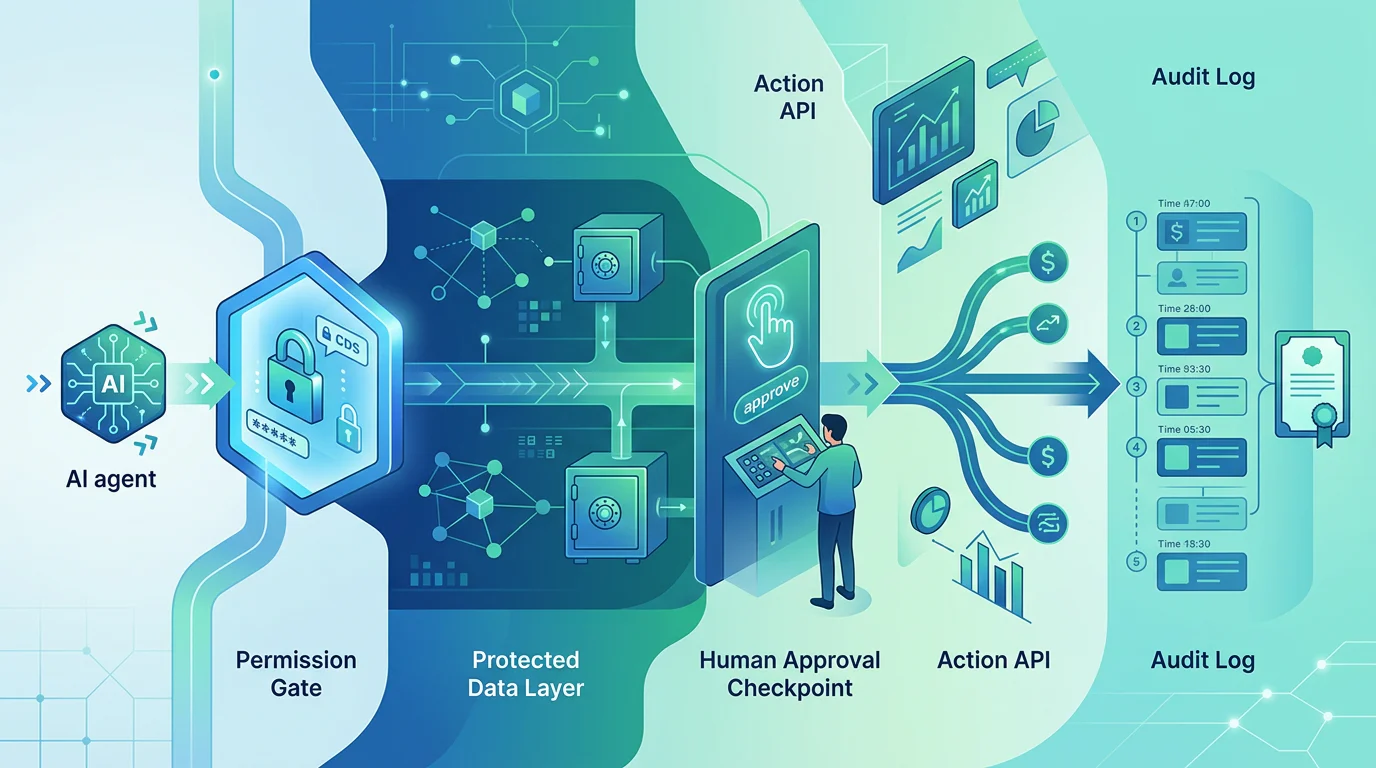
An agent should have an explicit action boundary. Teams need to distinguish between read-only retrieval, recommendations, actions requiring approval, and autonomous execution. A customer-facing system should never gain broader authority merely because it performed well in a narrow test.
Customer Data Needs Purpose and Permission Controls
Financial data is valuable, sensitive, and attractive to attackers. Teams should document approved data sources, retention periods, provider access, and the purpose for each agent workflow. Protecting a dataset is not enough if an agent can combine it with external tools or send it into an unapproved process.
Audit Evidence Must Follow the Action
We recommend logging the request, authority scope, retrieved data, tool call, human intervention, outcome, and any override. That evidence lets a team investigate a customer complaint or incident without relying on a vague description of what the model “intended.”
Shared Providers Can Create Shared Exposure
Cloud and model-provider dependencies can become a sector-wide concern when many firms rely on similar infrastructure. Bank Indonesia highlighted those dependencies, alongside data quality, metadata, governance, and data sovereignty, in its July 2026 release. A unified analytics platform helps teams see where data, controls, and dependencies are shared.
What Financial Data Teams Should Do Now
The most useful response is not a sweeping AI ban or an unstructured pilot. It is a short inventory of every system that can act on financial data, customers, or transactions. We would start with the use cases that can cause the greatest customer or operational impact.
Classify Systems by Decision Authority
Label each workflow as assistive, advisory, approval-gated, or autonomous. Then identify prohibited actions, monetary or operational limits, the responsible business owner, and the person who can stop execution. This makes authority visible before it becomes embedded in an API connection.
Make Controls Testable Before Production
Test prompt injection, wrong-data retrieval, provider outages, duplicated actions, and failed approvals. A production-ready workflow should have a safe failure mode and a clear incident path. Our modern data curriculum is built around the practical foundations teams need to make those controls operational.
Monitor Policy Without Pausing Improvement
Track the National AI Roadmap, ethics guidance, OJK supervisory updates, and cross-sector sandbox activity. At the same time, improve data quality, lineage, security, and accountability. Those are useful investments whether the next policy step arrives as guidance, a technical rule, or a new supervisory expectation.
Build Practical Controls with Vision Board
At Vision Board, we help data professionals turn governance requirements into work teams can use: clear data ownership, secure pipelines, quality checks, and operating controls. This policy signal is a prompt to connect AI capability with practical data discipline before new agents gain production authority. Our learning resources help teams build the shared technical language needed to map data flows, explain controls, and improve evidence for real-world systems. Whether your next step is strengthening a governed platform, improving data-engineering fundamentals, or preparing a team for more responsible AI work, we focus on skills that connect architecture to accountable delivery. Start with Vision Board.
FAQs on AI Data Governance Regulations
Is a New Agentic AI Law Already in Force?
No new law took effect on August 27. Existing banking, data protection, and AI ethics frameworks still apply while national roadmap and guidance are being prepared.
What Is the First Control for an AI Agent That Can Act?
Set clear authority limits, prohibit high-impact actions without approval, log every tool call, test failure paths, and keep a human able to stop execution immediately.
What Should Financial Teams Monitor Next?
Monitor the presidential roadmap, ethics guidance, OJK supervisory updates, cross-sector sandbox activity, and new expectations for reporting, testing, consumer protection, and accountability requirements.