


TL;DR
We explain how a unified analytics platform lets Azure data engineers, SQL analysts, and data scientists share governed lakehouse data while retaining different tools, compute, and permissions. We map the shared control plane, role handoffs, bronze-silver-gold ownership, workload safeguards, and the failure modes teams must prevent.
How Does a Unified Analytics Platform Serve Every Data Role?
A shared data estate still needs workload boundaries. On a documented F64 capacity, Spark can reach 384 Spark vCores with its 3x burst factor, which is why teams must govern compute as carefully as they govern tables.
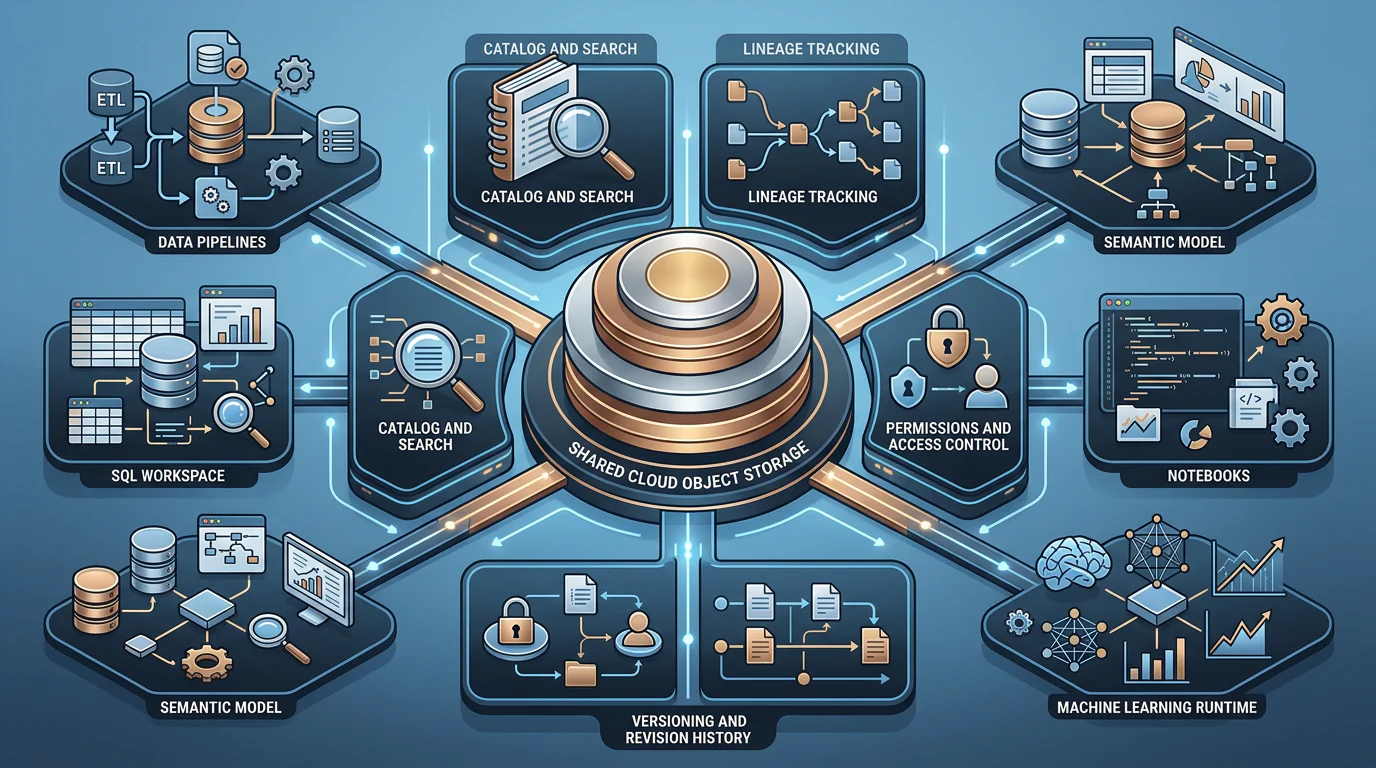
A unified analytics platform lets Azure data engineers, SQL analysts, and data scientists work from the same governed data without forcing identical tools, permissions, or compute. Shared storage, open table formats, catalog metadata, lineage, and access policy form the control plane; pipelines, SQL endpoints, semantic models, notebooks, and ML runtimes remain role-specific working surfaces.
We will show the architecture, role boundaries, layer ownership, handoffs, and practical safeguards that let one lakehouse support several data disciplines without creating interference.
How Does a Unified Analytics Platform Work Across Data Teams?
The operating model starts with one important distinction: sharing data is not the same as sharing every workspace, runtime, or editor. We recommend a common governed foundation, then allow each team to use the interface that best suits its job. For a broader architectural view, start with our unified architecture primer.
What Belongs in the Shared Control Plane?
Shared storage is the physical foundation. In an Azure-oriented lakehouse, that means data is stored once, published as governed tables, and made discoverable through catalog metadata, lineage, permissions, and agreed business definitions. OneLake is designed for multiple analytical engines to use the same stored data, including Delta Parquet and Iceberg tables, as described in the OneLake documentation.
The shared plane should contain durable contracts, not personal work. A published table needs an owner, description, refresh expectation, schema-change process, sensitivity classification, and documented consumers. Those controls give an analyst and a scientist confidence that they are using an approved asset instead of two untracked copies.
What Stays Role-Specific?
Data engineers need orchestration, Spark jobs, testable transformations, and monitored ingestion. Analysts need SQL endpoints and semantic models. Data scientists need notebooks, experiment tracking, model registration, and a controlled route for predictions to return to the data estate. A shared platform succeeds when those surfaces meet at the same governed assets rather than when everyone is pushed into one tool.
Open table formats make that arrangement practical. Delta tables support transactional writes, schema enforcement, streaming and batch patterns, plus historical version access, capabilities summarized in the Delta Lake documentation. The result is a common data contract with several legitimate ways to work.
How Should Teams Publish Changes?
Treat production data products like software releases. Engineers validate input structure, transformations, and quality checks before publishing. Analysts validate metric logic before broadening report access. Scientists connect experiments to documented datasets and approved feature definitions before a model becomes operational.
We encourage teams to use development, test, and production boundaries, source control for definitions, and named approvers for meaningful changes. That structure keeps collaboration visible without requiring one team to wait inside another team’s workspace.
What Does a Unified Analytics Platform Share Across Roles?
The answer is not simply “the lake.” The platform shares evidence about the lake: where data came from, who can use it, which tables are approved, what changed, and which downstream reports or models may be affected. Our guide to centralizing analytics data provides useful context for that foundation.
Lineage turns a shared asset into an accountable asset. A data team should be able to trace a gold metric back through its semantic model, refined tables, transformations, and source systems. Fabric’s lineage view maps workspace relationships and upstream connections, which makes impact analysis more concrete than relying on tribal knowledge alone. See the documented Fabric lineage behavior for the platform-level view.
A shared definition is equally important. “Revenue,” “active customer,” or “churned account” cannot mean one thing in a notebook and another in a dashboard. The governed semantic layer should publish business measures, while the lakehouse should publish reusable physical tables. Scientists can read data from the refined layer, but they should not silently recreate business metrics that analysts already maintain.
Permissions are the final part of the contract. Grant access according to the work someone must perform, not their job title alone. An analyst may read approved gold tables without changing pipelines. A scientist may read selected silver data and write feature outputs without gaining unrestricted bronze access. An engineer may publish transformations without automatically receiving broad access to sensitive consumer reports.
How Do Engineers, Analysts, and Scientists Collaborate on a Lakehouse?
A productive lakehouse has explicit handoffs. Engineers publish stable, tested data products. Analysts consume curated tables and semantic models to answer business questions. Scientists use documented raw or refined data to develop features and models, then return predictions to a governed workflow. We cover the core technical skills behind this pattern in our Azure engineering roadmap.
What Do Data Engineers Own?
Data engineers own reliable movement and transformation of data. Their work includes ingestion, schema validation, quality checks, orchestration, test execution, dependency monitoring, and the publication of trusted tables. They should version pipeline and environment definitions so changes can be reviewed and promoted rather than recreated manually, a workflow supported by Fabric CI/CD.
What Do SQL Analysts Own?
SQL analysts own analysis-ready access and business-consumable definitions. They discover approved assets, query curated tables through SQL endpoints, build or use semantic models, and escalate gaps in shared metrics instead of creating unmanaged extracts. A SQL analytics endpoint provides read-only querying over lakehouse Delta tables while supporting views and SQL security, as explained in the SQL endpoint guide.
What Do Data Scientists Own?
Data scientists own reproducible experimentation and model outcomes. They should record training inputs, feature logic, parameters, metrics, code versions, and model artifacts, then register an approved model version before deployment. MLflow experiments can track those details and compare runs, according to the MLflow experiment documentation.
| Role | Inputs | Tools | Outputs | Compute | Permissions | Ownership |
|---|---|---|---|---|---|---|
| Data Engineer | Source contracts, raw files, streams, APIs | Pipelines, notebooks, Spark jobs, tests | Bronze, silver, and published gold tables | Managed pipeline and Spark compute | Write to assigned layers, read required upstream assets | Data contracts, reliability, quality gates |
| SQL Analyst | Certified gold tables, semantic models | SQL endpoint, reporting tools, semantic model editor | Governed queries, measures, reports | SQL query compute | Read approved data, build on authorized models | Metric logic and business interpretation |
| Data Scientist | Approved bronze and silver data, feature definitions | Notebooks, ML runtime, experiment tracking | Feature assets, experiments, models, predictions | Isolated Spark or ML compute | Read approved datasets, write scoped outputs | Reproducibility, evaluation, model records |
The matrix does not mean every role receives the same access. It means every role can understand the source, status, and downstream use of the assets it touches.
Who Owns Bronze, Silver, and Gold Data Layers?
No platform assigns accountable owners automatically. We recommend that teams make ownership visible at the layer level, then refine it by domain and data product. The three layers represent increasing quality and readiness: bronze preserves raw data, silver standardizes and enriches it, and gold serves curated analytics and decision-making needs. That structure follows current medallion guidance.
Bronze should preserve source fidelity and restrict access where raw data is sensitive. Silver should become the reusable conformed layer, where teams resolve duplicates, align keys, test quality, and document entities. Gold should expose approved metrics, facts, dimensions, and semantic models for broad use. For a deeper ownership model, see our governed lakehouse guide.
| Layer | Responsible Producer | Accountable Approver | Primary Consumers | Quality Gate | Permitted Access |
|---|---|---|---|---|---|
| Bronze | Source producer and data engineer | Engineering owner | Engineers, approved scientists | Landing completeness, schema capture, quarantine handling | Restricted raw read and controlled write |
| Silver | Data engineer and domain data-product team | Domain data steward | Engineers, analysts, scientists | Conformance, deduplication, business-key and freshness tests | Approved domain read, controlled transformation write |
| Gold | Analytics engineer or BI team | Analytics owner and business steward | Analysts, report consumers, approved ML users | Certified measures, reconciled definitions, consumer validation | Broad governed read, limited publish rights |
The word “accountable” matters most. When a metric changes, a schema evolves, or a sensitive field appears, the team should know who approves the change and who must review downstream effects before release.
Does Unified Analytics Require Everyone to Use the Same Tools?
No. A unified analytics platform should connect specialized tools through shared data contracts, not erase the distinct ways teams work. An analyst can stay in SQL while a scientist stays in Python, provided both work from governed versions of the same approved data and respect the same ownership rules.
The handoff path should be visible: pipeline to bronze table, transformation to silver, publication to gold, analyst query through a SQL endpoint or semantic model, scientist notebook to feature asset, experiment to registered model, then batch predictions or endpoint results back into governed tables. We recommend documenting that path beside each important data product, alongside our pipeline modernization plan.
How Can Analysts and Scientists Use the Same Data?
Analysts should use curated tables and shared semantic definitions for business reporting. Scientists can read approved refined tables, and only the raw data necessary for their approved use case, to create feature assets and train models. They meet at the contract, not by duplicating each other’s workflow.
When a model creates predictions, those results need an owner, version, scoring timestamp, and destination table. That lets analysts understand whether a prediction is current, while engineers can monitor the scoring workflow and scientists can connect outcomes to the correct model version.
Where Should Compute Be Isolated?
Shared storage does not require a shared queue. Separate ad hoc SQL, scheduled transformation, Spark, and model-serving workloads where practical, then monitor capacity consumption and set workload expectations. In Fabric warehouse workloads, SELECT and non-SELECT operations use separate resource pools by default, as outlined in the workload management guidance.
Which Failure Modes Need a Regular Review?
- Duplicated Gold Tables: Consolidate competing outputs before they become separate sources of truth.
- Uncontrolled Notebooks: Require an owner, source control, parameters, review, and a documented production path.
- Competing Metrics: Publish one approved definition and identify the semantic-model owner.
- Unmanaged Extracts: Replace locally copied data with governed query access or approved shared datasets.
- Expensive Shared Compute: Separate scheduled production work from exploratory workloads and review consumption.
- Unclear Layer Ownership: Name a responsible producer and accountable approver for every important data product.
- Untracked Model Outputs: Return predictions to governed tables or workflows with model and scoring metadata.
Teams that want to convert these controls into build-ready skills can use our Azure lakehouse learning path to sequence the work from architecture through implementation.
How Can Vision Board Help Your Data Team?
At Vision Board, we help Azure data teams turn a shared-platform diagram into repeatable habits. Our instructor-led work focuses on the decisions that cause the most friction in real estates: where data products live, how bronze, silver, and gold ownership works, which SQL and notebook paths are approved, and how teams promote changes safely. We use practical architecture reviews and build exercises so engineers, analysts, and data scientists can rehearse handoffs before production pressure exposes gaps. Teams can choose a delivery format that matches a live cohort or self-paced license model, then connect the learning plan to their lakehouse, pipeline, governance, and semantic-model priorities. The result is not a generic tool tour. It is a role-aware operating model your team can apply, review, and improve together. We also help leaders turn ownership, quality gates, and access rules into shared practice. Start with Vision Board.
FAQs on Unified Analytics Platform
How Does Unified Analytics Work Across Data Teams?
Engineers publish tested data products, analysts query approved tables and semantic models, and scientists train on documented versions, so every handoff stays visible, governed, and reusable.
Can Analysts and Data Scientists Use the Same Data?
Yes, when storage, permissions, lineage, and definitions are shared. Analysts use SQL and semantic models, while scientists use notebooks, experiments, feature tables, and model runtimes.
Who Owns Bronze, Silver, and Gold Data Layers?
Assign accountable owners by layer: engineering protects bronze ingestion, domain stewards approve reusable silver data, and analytics owners certify gold metrics, models, and consumer-ready products.
Does Unified Analytics Require Everyone to Use the Same Tools?
No. Shared governance connects specialized tools rather than erasing them. Isolation, least-privilege access, lineage, versioned releases, and ownership boundaries prevent one workload from disrupting another in production.