
Microsoft Fabric Team Training or Self-Study? Cost, Skills, and Scheduling Compared
Compare Microsoft Fabric team training and self-study on full cost, working schedules, labs, certification, completion evidence, and skills.
Microsoft Fabric Team Training or Self-Study? Cost, Skills, and Scheduling Compared
Microsoft Fabric gives teams a unified data and analytics platform, and its 60-day trial can make initial experimentation accessible. The harder decision is whether learning should remain individual and asynchronous or become a managed team investment.
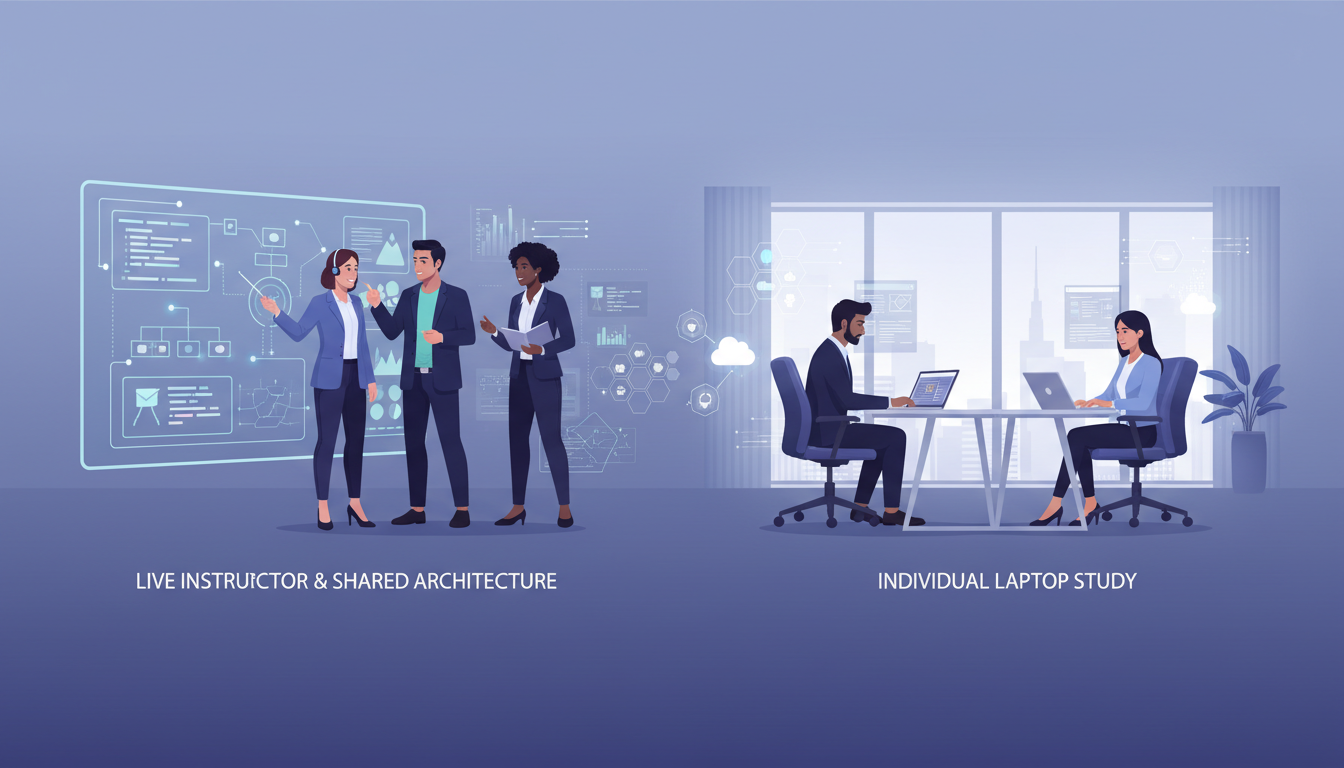
Structured Microsoft Fabric team training is usually better when a working analytics group needs a shared architecture, a deadline, instructor feedback, and proof that people can apply the work. Self-study suits teams with protected time, internal mentors, and low-risk projects. Compare both routes on total cost, scheduling, lab depth, completion evidence, and remediation.
We break down the economics, delivery choices, certification fit, applied-skill proof, and a practical way to test the decision before training the full team.
| Decision Factor | Structured Team Training | Self-Study Subscription |
|---|---|---|
| Cost View | Tuition or program fee plus employee time, labs, administration, and repeat attempts | License costs plus employee time, labs, administration, and remediation |
| Schedule | Fixed sessions create protected learning time | Flexible access depends on each learner protecting time |
| Feedback | Live questions, troubleshooting, and architecture review can be built in | Feedback depends on internal mentors or separate support |
| Completion Evidence | Attendance, assessments, and capstones can be defined upfront | Progress data may show consumption, not applied ability |
| Best Fit | Shared implementation, deadline, uneven starting skills | Strong internal mentoring, lower risk, self-directed learners |
What Does Microsoft Fabric Team Training Actually Cost?
The honest answer is that no single price answers the team question. A public class fee or annual license is only one line in the budget, while employee time and unresolved implementation gaps can easily change the decision.
We recommend comparing two total-cost scenarios for the same role group and target outcome. Keep tuition or the private-program fee separate from internal instructor time, then add lab access, protected learner hours, administrative effort, exam attempts, and the time needed to remediate people who do not complete the first route.
Build the Team Cost Model
Use the same inputs for each option:
- Team size: The number of employees expected to complete the learning path.
- Hourly labor cost: Fully loaded employee cost for protected learning, administration, and remediation.
- License price: Per-person subscription price for the chosen term.
- Instruction price: Per-seat tuition or the quoted price for a private cohort.
- Completion rate: A measured pilot or historic internal completion rate, not an assumed industry benchmark.
- Remediation hours: Expected follow-up time for incomplete, blocked, or underprepared learners.
For self-study, multiply the license price by team size, then add protected time and expected remediation. For a structured cohort, start with the instruction price and add learner time, labs, administration, and repeat attempts. This comparison matters because a lower purchase price can still become the more expensive route when it creates more manager follow-up or project rework.

A Fabric lab also needs a cost assumption. Microsoft’s trial includes F4 or F64 capacity configurations and up to 1 TB of OneLake storage, but trial access is not a permanent production-like environment. Paid F capacities have no time commitment and are billed per second with a one-minute minimum, according to Microsoft’s purchase guidance. To separate current offers from hidden team cost, inspect our course store alongside the full model.
Which Delivery and Scheduling Model Fits a Working Team?
A working team should select a delivery model based on the help it needs while learning, not just on calendar convenience. Private instruction can be tailored to an existing architecture and deadline. Public cohorts can provide a fixed cadence. Self-paced options reduce calendar friction, while blended delivery preserves flexibility without removing live checkpoints.
The schedule should be explicit before procurement: session length, time-zone coverage, recording policy, office hours, make-up access, lab expiry, and total program duration. We advise readers to compare these terms against our flexible formats guide, then put the agreed conditions into the purchase scope.
| Delivery Model | Scheduling Strength | Evidence To Require | Main Risk To Test |
|---|---|---|---|
| Private Instruction | Sessions can align to team availability | Attendance, lab rubric, architecture review | Scope or make-up access is vague |
| Public Cohort | Published dates create a visible deadline | Completion record and assessment | Calendar does not fit all employees |
| Self-Paced Subscription | Learners choose their own study time | Progress export and manager checkpoints | Completion relies on internal discipline |
| Microsoft Learn | Free, asynchronous role-based content | Module and learning-path progress | Completion alone does not prove applied work |
| Blended Delivery | Live core sessions plus asynchronous practice | Both capstone and progress evidence | Weak handoff between live and self-study work |
Microsoft Learn can report units, modules, completed learning paths, and credentials for organizational accounts. That reporting is useful for oversight, but it does not automatically establish that a learner can troubleshoot a pipeline or defend an architecture choice. Microsoft explains the available fields in its reporting service.
Which Certification Path Should Guide Microsoft Fabric Team Training?
Certification alignment should follow the work your team must perform. We do not treat an exam as a substitute for project evidence, but current exam objectives provide a useful shared definition of the skills a program should cover.
DP-600 aligns to analytics engineering work: preparing data, managing analytical assets, and implementing semantic models. DP-700 aligns to data engineering work: ingestion, transformation, orchestration, security, monitoring, and optimization. Microsoft lists DP-600’s preparation objectives as 45 to 50 percent of the exam, with maintenance and semantic-model work each weighted at 25 to 30 percent in the current DP-600 guide.
| Selection Question | DP-600 | DP-700 |
|---|---|---|
| Primary Role | Fabric analytics engineer | Fabric data engineer |
| Best Team Need | Analytics assets, semantic models, governance, lifecycle | Data loading, orchestration, security, monitoring, optimization |
| Official Course Duration | Four days | Four days |
| Core Practical Proof | Reusable analytics and semantic-model decisions | Working ingestion and orchestration design |
| Exam Use | Knowledge signal for analytics engineering | Knowledge signal for data engineering |
Both exams are scheduled for 100 minutes, and Microsoft requires a score of 700 or higher. Use the current DP-700 objectives when the team owns data-engineering delivery rather than analytics-model ownership. Before choosing either track, we suggest reviewing our curriculum audit for the difference between course coverage and actual lakehouse readiness.
What Proves Employees Can Apply Fabric Skills?
A completion certificate can document attendance. A badge can document completed content. Neither automatically proves that a team can build, secure, monitor, or improve an analytics solution together.
We look for practical evidence that maps to the job. For analytics engineering, that means a team can justify data preparation choices, model and secure reusable assets, and manage deployment impact. For data engineering, it means learners can choose ingestion patterns, configure orchestration, identify failures, and optimize the work they deploy.
Define the Lab Standard
A worthwhile lab should require individual hands-on work in a shared scenario, documented assumptions, and troubleshooting when something fails. It should not rely only on a guided sequence that leaves no room for judgment. Use our lakehouse engineering guide to set a baseline for the architectural concepts a hands-on exercise should expose.
Require a Reviewable Capstone
Ask for a capstone that produces an inspectable artifact: a pipeline, notebook, data model, security design, monitoring plan, or deployment decision. The assessment should identify what was built, why a choice was made, and how a reviewer tested it. That creates evidence managers can use after training ends.
Separate Completion from Capability
Track attendance, content completion, assessment result, and accepted applied-work artifact as separate measures. Microsoft Learn confirms that its organizational data does not track documentation, video, or code-sample viewing completion, which is why consumption metrics need an additional skills check.

How Should a Team Select and Pilot the Right Option?
Selection becomes easier when the team scores delivery options against real implementation conditions. We use five practical questions: How different are employees’ starting skills? Who can mentor them internally? Is there a deadline? What happens if the implementation goes wrong? What evidence must managers have at the end?
A supporting learning playlist can reinforce core concepts between scheduled sessions. A weighted rubric keeps a low license price from overpowering more consequential criteria. Give the highest weight to baseline skill variation, internal mentoring capacity, deadline pressure, project risk, and the depth of labs and feedback. Give lower, but still visible, weight to commercial flexibility, reporting, and exam alignment.
For a low-risk decision, pilot both the content and the schedule with a representative slice of the team. Give participants the same scoped Fabric task, measure protected hours, attendance, blockers, assessment results, and capstone quality, then enter those results into the cost model. That approach turns estimated completion and remediation into local evidence. If the larger need is implementation support rather than training alone, compare that route in our implementation comparison.
Why Choose Vision Board for Team Training?
At Vision Board, we help analytics teams make a training decision before they buy a long program or assign a pile of subscriptions. We start with your roles, deadline, current Fabric environment, and the project that must work afterward. Then we help you define the evidence that matters: attendance, completed labs, reviewable architecture choices, and a manager-ready progress view.
Our approach is built for working professionals who need clear session expectations, practical feedback, and a realistic path from learning to implementation. We can use a pilot to test schedule fit and content depth before a broader commitment, then shape the learning path around the team’s actual responsibilities. Use that conversation to replace assumptions with a documented decision, including costs, delivery, labs, support, and accountability for every learner in scope. When you are ready to make the decision, begin with Vision Board.
FAQs on Microsoft Fabric Team Training
Is Microsoft Fabric Team Training Worth It for Employees?
It is worth it when employees need shared standards, protected learning time, feedback, and applied evidence. Teams with mentors and low-risk work may prefer self-study.
How Much Does Microsoft Fabric Training Cost for a Team?
Team cost includes tuition, licenses, employee time, labs, administration, exam attempts, and remediation. Compare both delivery routes using the same team-specific inputs for accurate budgeting.
Should Our Team Choose DP-600 or DP-700?
Choose DP-600 for analytics engineering and semantic-model work. Choose DP-700 for data engineering, ingestion, orchestration, monitoring, and optimization responsibilities across your Fabric operating model.
Can Microsoft Learn Replace Instructor-Led Training?
Microsoft Learn provides free, role-based content and progress reporting. It does not provide live feedback, shared troubleshooting, or verified capstone review without separate support arrangements.