Microsoft Fabric Team Training: Live or Self-Paced Licenses?
Compare Microsoft Fabric team training with self-paced licenses for cost, labs, feedback, completion support, and working-professional schedules.

Microsoft Fabric Team Training: Live or Self-Paced Licenses?
Microsoft’s 7h 27m learning path is a useful self-paced starting point, but teams moving into live Fabric work need more than module completion. Because Fabric connects data engineering, warehousing, real-time intelligence, and reporting, we compare the learning options against the whole unified platform overview.
Microsoft Fabric team training is the better fit when a working group needs shared architecture decisions, fixed practice times, instructor feedback, and a reviewed project. Self-paced licenses fit independent learners who have protected study time and active internal mentors. Compare total program cost per completed learner, including labs, paid study hours, administration, retakes, and unused seats.
We cover delivery format, current buying models, 30-person costs, hands-on scope, certification fit, and the questions that reveal whether a flexible program will actually work.
Is Live Microsoft Fabric Team Training Better Than Self-Paced Learning?
The best format depends on what must happen after training. If people need to build a common lakehouse, deploy shared pipelines, or agree on semantic-model practices by a fixed date, live structure usually has more value than cheaper access alone.
Self-paced learning is still a strong choice for experienced people with time blocked on their calendars, an available mentor, and a low-risk project. The mistake is treating flexibility as proof of support.
| Decision Factor | Live Short Cohort | Self-Paced License |
|---|---|---|
| Schedule Control | Fixed sessions protect learning time | Learners choose when to study |
| Feedback | Live troubleshooting and project review | Depends on internal mentors or paid support |
| Labs | Shared milestones and instructor checkpoints | Lab access and review vary by option |
| Accountability | Attendance, deadlines, and capstones are visible | Progress can show consumption, not capability |
| Best Fit | Shared rollout, deadline, uneven starting skills | Independent learners with protected time |
Microsoft’s official analytics-engineering course is a four-day course, which illustrates the tradeoff. A short intensive can establish common language quickly, but working professionals still need recordings, guided practice, and follow-up time to apply it.
We recommend a cohort when the learning outcome is shared delivery, not merely individual familiarity. Teams that already have a strong internal coach can use subscriptions effectively, especially when leaders set weekly checkpoints and require the same project evidence from every learner. Our team comparison explains how to use that evidence rather than attendance alone.
Which Format Fits Working Professionals and Analytics Teams?
Working professionals should buy time protection, not only content access. Before choosing a program, ask whether the schedule works across time zones, whether a missed session has a defined recovery path, and whether the lab remains available long enough to finish the work.
The matrix below keeps branded competitors out of the decision while preserving the commercial differences buyers need to see. Prices are public list-price observations, not group quotes, and can change before purchase.
| Option | Format And Schedule | Technology Coverage | Lab Type | Certification Alignment | Support | Current Price |
|---|---|---|---|---|---|---|
| Our Live Program | Live sessions plus recordings, four-month broader program | Lakehouse, Warehouse, ingestion, Spark, pipelines, stream data | Guided project work | Fabric modules included, not a Fabric-only certification course | Live instruction and recordings | ₹50,847.46, broader program |
| Official Self-Paced Modules | Fully asynchronous | Role-based Fabric fundamentals and modules | Tenant or trial dependent | Learning paths and practice preparation | Documentation and community resources | $0 content tuition |
| Public Four-Day Certification Class | Scheduled virtual instructor-led delivery | Role-specific analytics or engineering curriculum | Instructor-led exercises | DP-600 or DP-700 | Live instructor during class | $2,295 per learner |
| Technical Learning Library | Asynchronous annual subscription | Course-dependent data and cloud coverage | Labs and sandboxes vary by plan | Certification preparation available | Platform support | $299 annual individual plan |
| Data Skills Subscription | Asynchronous subscription | Introductory Fabric experiences and exercises | Browser-based exercises | Introductory DP-600 support | Platform support and progress tracking | $14 per user monthly, annual billing |
| Marketplace Course | On-demand, course-specific | Instructor-specific scope | Course-specific exercises | Varies by course | Marketplace policies | Current example: $9.99 |
| Career Learning Subscription | Asynchronous organizational access | Course-dependent coverage | No Fabric lab commitment confirmed | Course-dependent | Organization-administered | Organization quote |
| Exam Preparation Library | Asynchronous practice access | Exam preparation and review | No platform lab commitment confirmed | Exam-specific | Plan-dependent | Varies by selected plan |
A Fabric trial lasts 60 days and can support practical exploration, including up to 1 TB of OneLake storage. That makes it useful for a pilot, but it does not remove the need to decide who administers access, validates completed work, or pays for capacity after practice becomes ongoing.
For flexible learning, require five commitments in writing: recording access, make-up sessions, regional scheduling, office hours, and clear transfer or pause terms. Our flexible training guide can help teams translate those commitments into a purchasing checklist.
What Does Fabric Training Cost for a 30-Person Team?
A 30-person decision cannot be reduced to a seat-price comparison. A public four-day class at $2,295 per learner totals $68,850 before any volume discount. A self-paced team plan at $14 per user monthly, billed annually, totals $5,040 in annual license fees for 30 people.
That $63,810 acquisition gap is real, but it is not the total-cost answer. Self-paced learning shifts more scheduling, follow-up, mentoring, and remediation work to managers and internal experts.
| Cost Input | Structured Cohort | Self-Paced Licenses | What To Confirm |
|---|---|---|---|
| Commercial Purchase | Tuition or private cohort quote | License price times purchased seats | Billing term and group discount |
| Learner Time | Live hours plus assignment time | Protected study and practice hours | Fully loaded hourly cost |
| Lab Environment | Included lab or tenant capacity | Trial, tenant capacity, or separate lab | Access duration and capacity owner |
| Administration | Registration, attendance, reporting | Provisioning, reminders, tracking | Coordinator hours |
| Mentoring | Included review or follow-up | Internal coach time | Mentor availability |
| Retakes And Remediation | Repeat sessions or project rework | Extra support for blocked learners | Retake terms and expected hours |
| Unused Seats | Lower risk if attendance is managed | Paid licenses may remain unused | Reassignment policy |
Compare Cost per Completed Learner
Use the same capstone for both routes, then divide total cost by the number of people who complete and pass it. This prevents a low subscription fee from appearing cheaper when fewer learners finish meaningful work.
A practical worksheet is:
Live-cohort total =
tuition + learner time + labs + administration + mentoring + retakes + remediation

Self-paced total =
licenses + learner time + labs + administration + internal mentoring + unused seats + remediation.

Cost per completed learner =
total program cost ÷ learners with an accepted capstone
Count Capacity Separately from Training
Fabric capacity is a separate budget line. Microsoft’s capacity planning guidance notes that capacity can be priced hourly or monthly, so teams should not assume that an initial lab environment will remain free after a pilot ends.
Pilot Before Scaling
Run a small pilot with the same role mix, task, deadline, and assessment. Measure attendance, learner hours, blockers, capstone quality, and mentor involvement. That gives leaders local completion data instead of relying on a generic benchmark.
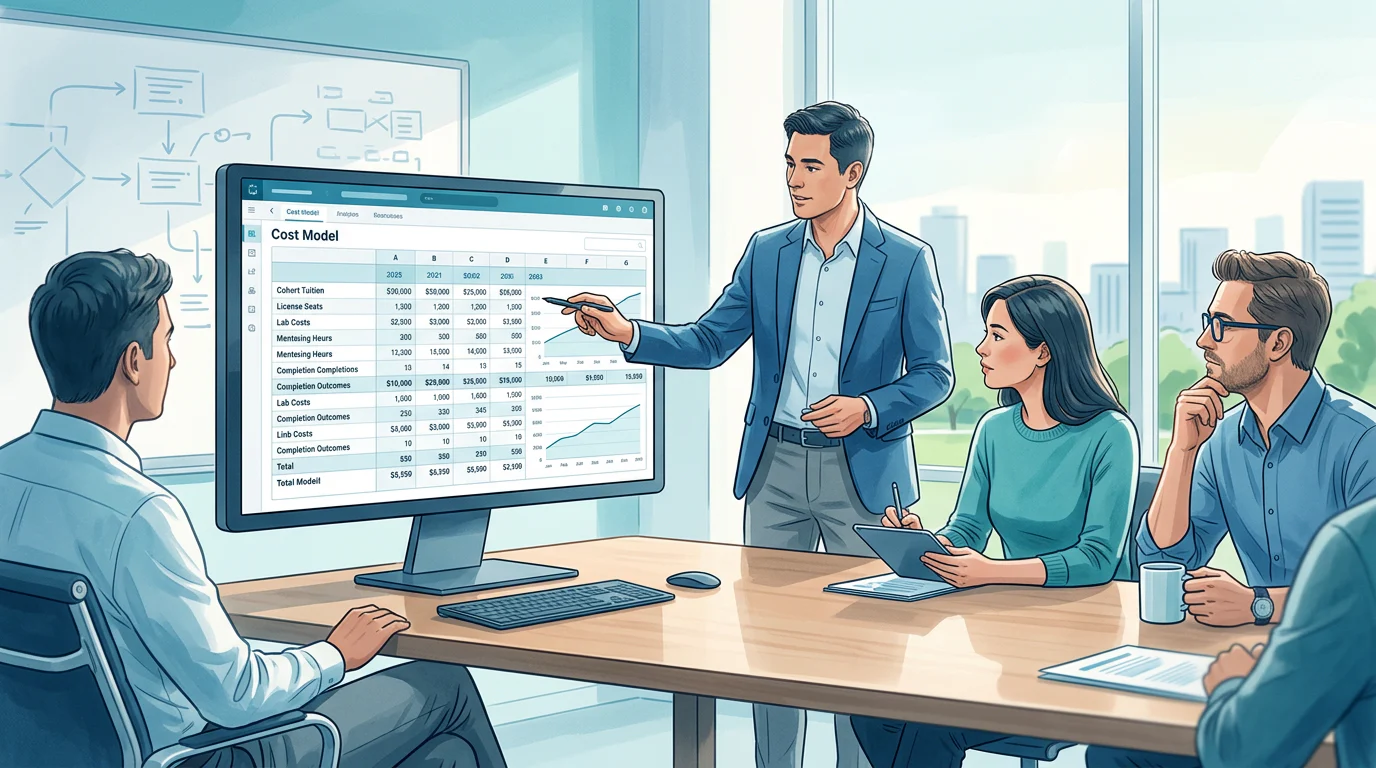
Use our 30-person cost guide to document assumptions before procurement starts.
How Deep Should Your Fabric Labs and Certification Path Go?
A credible Fabric program should test decisions across the platform, not only ask learners to reproduce a demo. Teams need practice connecting ingestion, transformation, storage, reporting, governance, and deployment into an end-to-end workflow.
Microsoft’s Fabric workload overview confirms that these experiences operate within one analytics environment. That is why isolated Power BI, SQL, or notebook exercises are useful but insufficient when a team is preparing for shared delivery.
Build a Reviewable End-To-End Lab
Require a project that begins with raw data and ends with an inspectable result. A strong lab should include a Lakehouse or Warehouse choice, Data Factory ingestion, Spark or SQL transformation, a semantic model or report, and a documented governance or deployment decision.
The review should assess the learner’s reasoning, not just whether a pipeline ran once. Our production-realistic labs outline the difference between guided demonstrations and work that resembles delivery.
Match DP-600 to Analytics Engineering
DP-600 fits people who design and manage analytics assets, including semantic models, data preparation, security, governance, and lifecycle work. The current DP-600 guide weights data preparation at 45 to 50 percent, with solution maintenance and semantic models each at 25 to 30 percent.
Choose this path when the team’s output is trusted analytics, reusable models, and well-managed reporting assets. Learners who want practical projects without certification can still use the objectives as a lab rubric.
Match DP-700 to Data Engineering
DP-700 fits data engineering responsibilities: data loading patterns, architecture, orchestration, security, monitoring, and optimization. The official DP-700 course is aimed at professionals who build and deploy data engineering solutions using Fabric.
Choose it when the team owns pipelines, notebook transformations, operational troubleshooting, and scalable data movement. Certification can be valuable, but a reviewed pipeline, monitoring plan, and deployment decision remain better proof that the team can apply the material.
How Do You Vet a Flexible Training Provider?
Flexible scheduling only works when it is specific. “Learn at your own pace” does not tell a buyer whether recordings expire, who handles missed sessions, or whether an instructor will review a half-finished capstone.
We recommend asking these questions before buying, then adding the answers to the scope of work. A program that cannot answer them clearly is difficult to compare fairly, regardless of its advertised course length.
- Instructor Credentials: Who teaches the sessions, and what Fabric implementation experience can they demonstrate?
- Project Review: Does every learner receive feedback on a reviewable project, not only a completion certificate?
- Hands-On Scope: Which of Lakehouse, Warehouse, Power BI, Data Factory, Spark, Real-Time Intelligence, governance, and deployment are truly hands-on?
- Lab Access: Who supplies the tenant, capacity, data, and access window needed to complete labs?
- Support Response: What response time applies when learners are blocked during a lab?
- Recordings And Make-Ups: Can learners revisit sessions, and what happens after a missed class?
- Trial Access: Can buyers inspect a sample lesson, lab, or project rubric before committing?
- Refunds And Transfers: What are the written rules for cancellation, transfer, pause, and reassignment?
- Outcome Evidence: Can the provider show how it distinguishes attendance from accepted applied work?
- Certification Fit: Is the course aligned to DP-600, DP-700, project delivery, or a clearly stated combination?
A team with strong internal mentors can accept more asynchronous risk. A team with uneven experience or a delivery deadline should value live feedback, scheduled practice, and capstone review more heavily. Our learning-path comparison helps clarify the difference between course coverage and implementation readiness.
Plan Microsoft Fabric Team Training with Vision Board
At Vision Board, we help analytics leaders turn a vague Fabric training request into a purchase decision their teams can execute. We start with the roles involved, the project that must work afterward, and the time people can genuinely protect. Then we help shape a short, practical learning plan around live sessions, recordings, lab access, office hours, capstone evidence, and manager checkpoints. That makes it easier to compare a cohort with subscriptions without confusing a license fee for a completed capability. If your team needs a pilot, we can define the same task, evidence standard, and cost inputs for every option before you scale. Bring your team size, schedule constraints, current Fabric environment, and target workload to us, and we will help you create a clear plan that budget owners and delivery leaders can act on. Start with Vision Board.
FAQs on Microsoft Fabric Team Training
Is Live Training Better Than Self-Paced Learning?
Live training is better when people need fixed practice, shared decisions, and feedback. Self-paced access works when learners have protected time, active mentors, and low-risk work.
How Much Does Microsoft Fabric Team Training Cost?
Thirty learners at a $2,295 public class list price equal $68,850 before discounts. A $14 monthly annual-billing license model equals $5,040 in seat fees for one year.
Which Certification Fits Analytics Work?
Choose DP-600 for analytics assets, semantic models, and governance. Choose DP-700 for ingestion, transformation, orchestration, monitoring, and optimization. A project-first learner should follow the workload.
What Should a Working Professional Demand?
Ask for recordings, make-up access, office hours, a defined lab window, support response expectations, and project review. Flexible access alone does not guarantee completed hands-on practice.