Enterprise Data Modernization Training: Live Training or Project Cohorts?
Compare live training and project cohorts for India and US Azure data teams modernizing Hadoop with governance, labs, and delivery evidence.
Enterprise Data Modernization Training: Live Training or Project Cohorts?
A Hadoop-to-cloud programme has to accommodate both learning and operational reality. In 2026, US daylight saving time spans 238 days, so an India and US schedule must account for two different overlap patterns during the year.
For an India and US team, we find private live cohorts usually fit better than fixed public classes when scheduling, role alignment, and facilitated change matter. Project cohorts fit better when the priority is applying new practices to a defined migration. Compare overlap hours, instructor access, labs, recordings, governance coverage, and workplace deliverables before choosing.
We compare both routes, show how to test a provider’s scheduling model, map curriculum to migration roles, and define the capstone evidence a modernisation team should expect.
Should Distributed Azure Data Teams Choose Live Training or Project Cohorts?
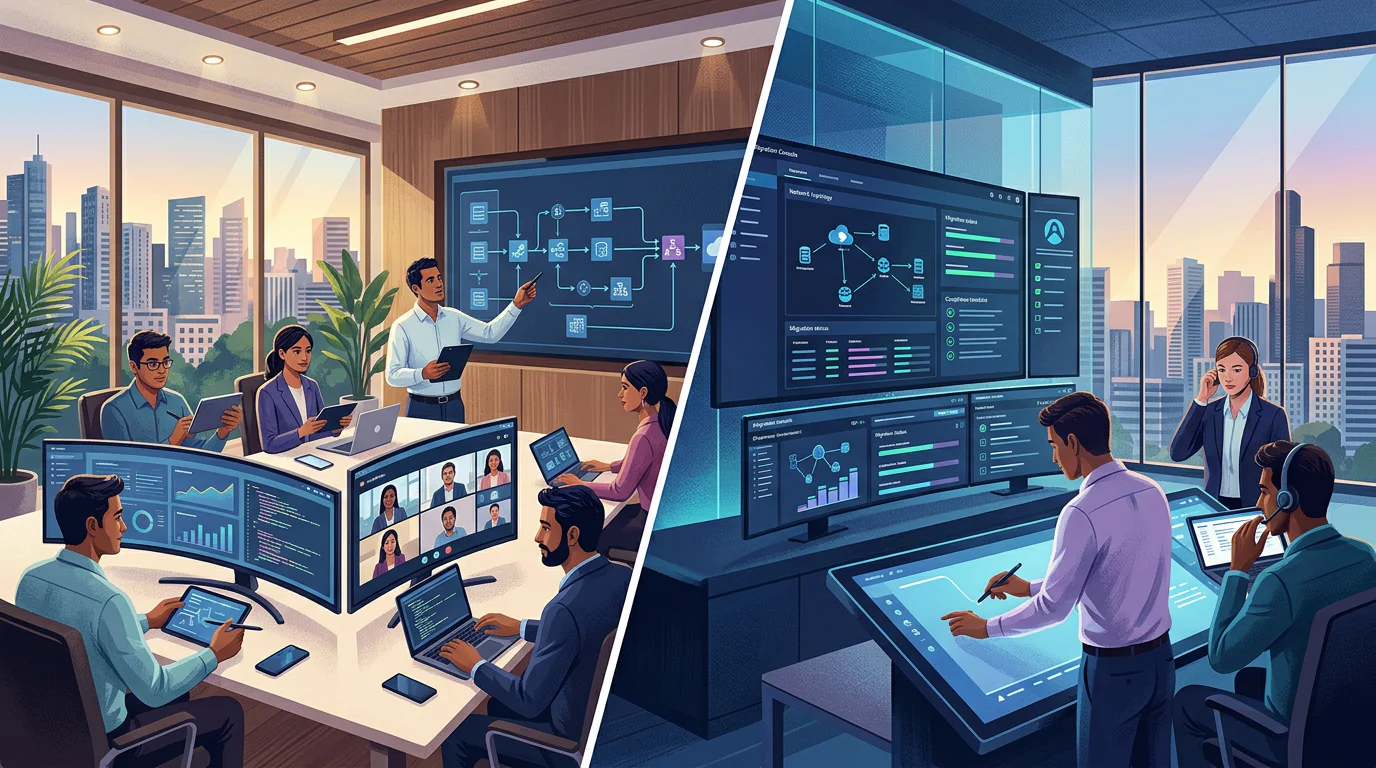
Choosing a format is not mainly a question of whether people prefer lessons or projects. It is a question of what the team must be able to do next. Enterprise data modernization training should give engineers, architects, governance leaders, managers, and data owners enough shared context to make sound decisions together.
A private live cohort is strongest when the team needs that shared context before delivery begins. A project cohort is strongest when the backlog already contains a bounded migration slice, the team can access a safe lab, and leaders will review the resulting operational choices. Our project cohort guide helps teams make the same distinction for lakehouse work.
Compare the Two Core Formats
| Criterion | Private Live Curriculum Cohort | Project Cohort |
|---|---|---|
| Best Audience | Cross-functional migration team | Delivery team with a defined workload |
| Primary Outcome | Shared language, governance, and role alignment | Demonstrated implementation capability |
| Scheduling | Private, repeated, or rotating live sessions | Cadence linked to sprint and migration milestones |
| Customization | Roles, policies, and operating model | Backlog, target architecture, and lab scenario |
| Practice | Guided labs and facilitated decisions | Work-like implementation and review |
| Deliverables | Role map, decisions, and learning evidence | Inventory, target controls, migrated slice, and handoff |
| Change-Management Depth | High when leaders and owners participate | High only when adoption work is explicit |
Recognize What Governance-Led Instruction Adds
Cloud migration changes who owns data, who approves access, how teams publish trusted assets, and how they respond when a pipeline fails. Fabric governance guidance separates tenant, domain, workspace, capacity, security, discovery, lineage, and monitoring responsibilities, which is why a migration curriculum should not treat governance as a final compliance module.
Use a Blended Route When the Foundation Is Missing
We recommend a blended route when the team has an urgent delivery goal but no agreement on ownership or target-state controls. Start with live instruction for the operating model, then move into an implementation cohort that produces a reviewable migration artefact. This prevents a technically successful pipeline from becoming an unowned production dependency.
What Enterprise Data Training Works Across India and US Time Zones?
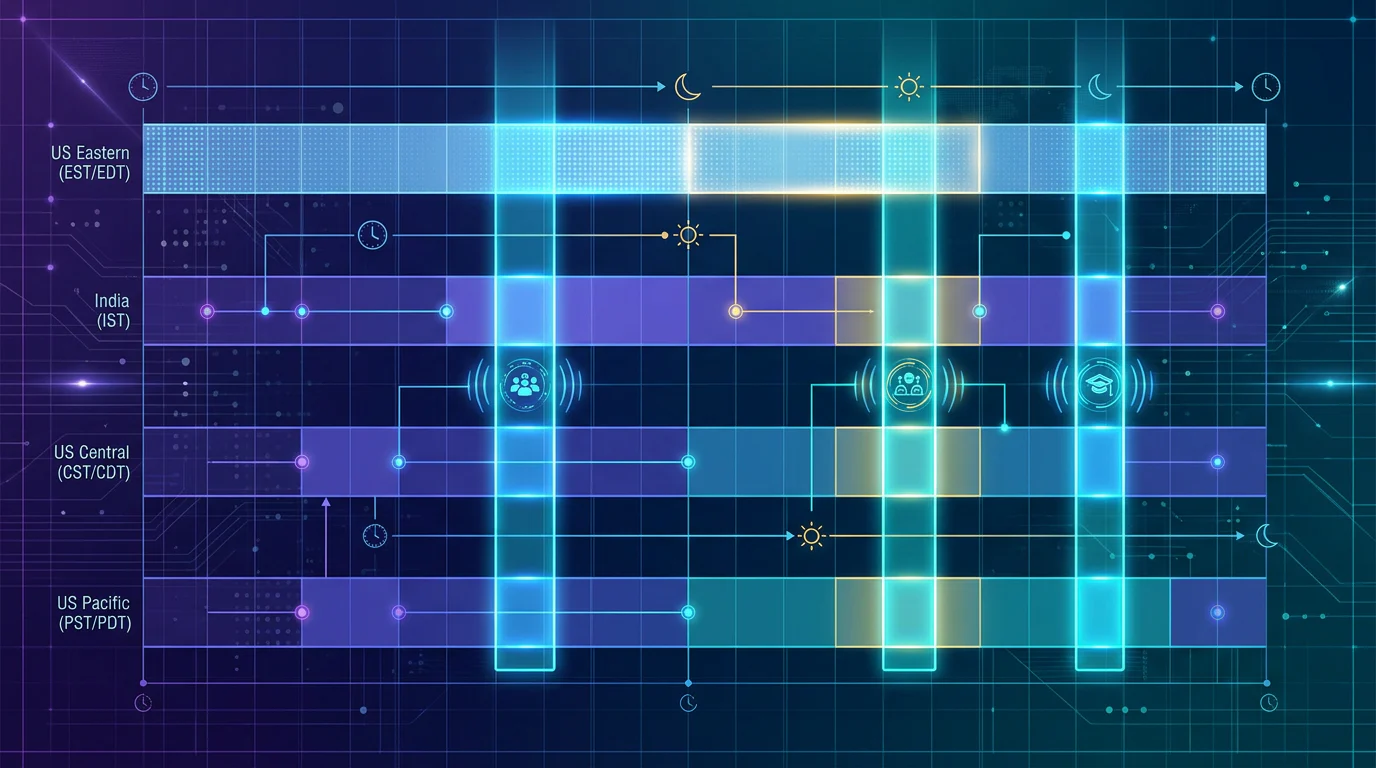
A provider is not time-zone capable merely because it hosts a video call. We look for a delivery design that distributes inconvenience fairly, gives participants a way to recover missed live work, and keeps an instructor available when engineering questions arise.
India Standard Time remains UTC+5:30 throughout the year, as shown by the official Indian time service. US teams, by contrast, can shift an hour during daylight saving time. A session that begins at 09:00 Eastern is 19:30 in India during US standard time and 18:30 during US daylight time.
Build a Scheduling Worksheet Before Buying
| Field | What We Ask A Provider To Show |
|---|---|
| Participant Locations | City, time zone, and expected attendee count |
| Seasonal Conversion | Standard-time and daylight-time meeting windows |
| Live Delivery | Rotating sessions or repeated live delivery |
| Overlap Window | Shared live hours and session duration |
| Recording Policy | Captions, access period, and release timing |
| Office Hours | Alternate time band and named instructor |
| Attendance Recovery | Make-up session, catch-up lab, and assessment rules |
| Instructor Access | Questions channel, response window, and escalation path |
Protect Live Learning Without Burdening One Region
We prefer rotating session times for extended programmes, or repeated live delivery for a team that cannot share reasonable overlap hours. Recordings matter, but they should support, not replace, live instruction. We also ask for office hours at a second time band, so an India-based engineer is not forced to bring every implementation question to a late-night call.
Our flexible training formats comparison can help teams turn these requirements into a format decision. The practical test is simple: if a supplier cannot document session rotation, attendance recovery, lab access, and instructor availability, the team is buying access to content rather than a live learning programme.
What Should a Hadoop-To-Cloud Curriculum Cover Beyond Technology?
A credible programme must teach the engineering mechanics of migration and the operating changes that let the new platform endure. That means inventorying legacy assets, choosing a target architecture, applying controls, and deciding how data owners, engineers, and governance leaders will work after go-live.
Start with a Real Migration Slice
A realistic lab begins with an HDFS source, a dependency map, a classification decision, and a target workload. Microsoft’s Hadoop migration guidance describes initial snapshot and delta migration, supports up to four VM nodes for one self-hosted integration runtime, and recommends starting with two nodes for high availability. We use such details to teach trade-offs, not to imply one configuration fits every environment.
The curriculum should then include secure connectivity, orchestration, validation, monitoring, recovery, and production handoff. Teams comparing replacement paths can also review our Hadoop replacement framework.
Teach Governance as Engineering Work
Data engineers need to understand ownership, access boundaries, quality checks, lineage, and release controls because they make those choices while building pipelines. Architects need to connect those controls to workspace design, domains, environments, and platform capacity. Business owners need enough visibility to validate data meaning and acceptance criteria before a new output becomes operational.
Treat Cultural Change as a Deliverable
Cloud migration often moves teams from central control toward clearer domain-level accountability. Microsoft’s adoption roadmap recommends incremental change, focused stakeholder involvement, recurring office hours, and explicit training and support plans for high-impact changes. We treat these as programme deliverables alongside code and documentation.

Which Roles Need Which Data-Management Outcomes During Migration?
A single syllabus can make a mixed team feel trained while leaving critical decisions unowned. We map learning and project work to the role each participant plays in the target operating model, then bring the roles together for shared migration reviews.
| Role | Technical Outcome | Operating Outcome |
|---|---|---|
| Data Engineers | Build and validate one migration slice | Apply ownership, quality, lineage, and release controls |
| Data Architects | Define target patterns and environment boundaries | Align technical design with decision rights |
| Governance Leaders | Define domains, controls, and measurable policies | Establish escalation and stewardship paths |
| Engineering Managers | Sequence capability and migration milestones | Fund time for adoption and cross-region participation |
| Business Data Owners | Validate meaning, criticality, and acceptance criteria | Own business definitions and trade-offs |
Purview role guidance notes that organisations should assign at least two governance-domain owners, which helps avoid an ownership gap when one person changes roles. Our unified platform architecture article gives teams a supporting view of how these roles converge on one shared analytics platform.
How Should You Compare Enterprise Data Modernization Training Providers?
The best provider choice comes from evidence, not a catalogue of topics. We ask what participants will build, who reviews the work, how time zones are handled, and what remains after the last session. Those questions reveal whether a programme is designed for implementation or simply for completion.
Compare All Four Delivery Formats
| Format | Best Fit | Main Limitation | Evidence To Request |
|---|---|---|---|
| Private Live Cohort | Distributed team needing role alignment | Relies on sound instructor and schedule design | Agenda, time-zone plan, role map |
| Public Live Class | Individuals who can attend fixed dates | Limited company context and schedule control | Published dates, class size, recovery policy |
| Blended Programme | Team needing live alignment and reinforcement | Can become passive content consumption | Live touchpoints, office hours, assessment |
| Project-Based Cohort | Team with a defined migration backlog | Weak fit when the target state is unclear | Capstone scope, lab access, review rubric |
Require a Capstone with Workplace Evidence
We look for a capstone that inventories legacy assets, defines target controls, implements and validates one migration slice, documents recovery choices, and presents operational trade-offs to technical and business owners. Teams with older orchestration work can also review our legacy ETL choices before matching a learning programme to the migration backlog.
A useful rubric assigns 20 points to the inventory and risk statement, 20 to target controls and named owners, 30 to the working migration slice, 20 to operational trade-offs and rollback, and 10 to the role-aware handoff. The project should use a safe environment, never uncontrolled production data.
Put These Questions in the Procurement Checklist
- Instructor Background: What migration and production Azure data-engineering work has each instructor personally led?
- Customization: Can we adapt labs, examples, role maps, and reviews to our target architecture?
- Lab Access: Is the environment isolated, accessible, documented, and available for catch-up work?
- Data Handling: How are learner artefacts, sample data, recordings, and access credentials protected and retained?
- Assessment: What evidence proves capability beyond attendance or course completion?
- Post-Course Support: Are office hours, architecture reviews, or adoption check-ins included after delivery?
Track attendance from the roster, lab completion from platform logs, demonstrated competency from the capstone rubric, and adoption through 30, 60, and 90-day delivery reviews. Our realistic lab guide provides further tests for whether practice resembles real delivery. Those measures let leaders see whether the programme changed migration practice, rather than simply whether people attended.
Build Your Modernization Team with Vision Board
At Vision Board, we build enterprise data modernization training around the work your Azure team must actually do, not a generic completion record. We can shape a private live cohort around your India and US schedule, define role-specific labs, and give teams a shared language for governance, ownership, and migration risk. When a delivery slice is ready, we can turn that foundation into a project cohort where participants inventory assets, define controls, implement a bounded pipeline, and defend operational trade-offs. Our approach keeps instructors available while the team converts learning into decisions and evidence. Bring us your existing platform constraints, role mix, and timetable, and we will help you choose a format that supports both capability and adoption. After the cohort, we can also structure office hours and review moments so managers can see where adoption is sticking and where teams need another decision. Explore Vision Board
FAQs on Enterprise Data Modernization Training
These answers address the format, scheduling, governance, and capstone questions that procurement and delivery leaders raise before choosing a programme. They work best when read alongside the team’s actual migration scope and operating constraints.
Should Our Data Modernization Team Choose Live Training or a Project Cohort?
Choose private live instruction when alignment, scheduling flexibility, and governance decisions matter. Choose project cohorts when a defined migration slice requires implementation, review, and workplace deliverables.
What Training Format Works Across India and US Time Zones?
India uses UTC+5:30 year-round, while US locations change with daylight saving time. Require rotating delivery, recordings, alternate office hours, and attendance recovery for missed sessions.
Do Data Engineers Need Governance Training During Cloud Migration?
Yes. Engineers make pipeline, access, quality, lineage, and release choices during migration. Governance training helps them apply agreed controls before new workloads become production dependencies.
What Should a Hadoop-To-Cloud Capstone Include?
A useful capstone inventories legacy assets, defines target controls, implements and validates one migration slice, documents recovery choices, then presents trade-offs to technical and business owners.