
How Do Analytics Teams Share One Platform? A Unified Analytics Platform Architecture for Azure Data Teams


TL;DR
We help Azure data teams share one platform by standardizing governed datasets, ownership, lineage, access policies, orchestration, and release controls while preserving each role’s preferred tools. This guide maps the shared architecture, role boundaries, dataset journey, governance mechanics, and a practical way to assess consolidation without creating new data copies.
How Do Analytics Teams Share One Platform? A Unified Analytics Platform Architecture for Azure Data Teams
Azure data teams rarely start with one clean estate. Microsoft documents more than 200 native connectors for its analytics environment, which explains why ingestion paths and downstream tools can multiply quickly across an organization. 200-plus connectors
A unified analytics platform works when engineers, analysts, and data scientists share governed datasets and production controls, while keeping role-specific tools. Engineers own ingestion and reliability, analysts own certified models and metrics, and data scientists own reusable features and models. A common catalog, policy layer, lineage record, orchestration path, and release process join the work without duplicating storage.
We will map the shared architecture, establish role ownership, follow one dataset into BI and ML, and show how to judge a consolidation effort without replacing useful tools merely for the sake of standardization.
What Does a Unified Analytics Platform Mean for Azure Data Teams?
A shared platform is not a mandate to make everyone write notebooks or every analyst use the same interface. It is an agreement that the assets crossing team boundaries, such as tables, metrics, policies, lineage, owners, and release records, have one trusted home. SQL, notebooks, pipelines, BI reports, and model-development tools can remain role-specific at the edge.
For Azure teams, the architectural center is a governed logical data store and a set of production controls around it. A lakehouse approach helps because raw, validated, and curated data can remain available to multiple workloads instead of being exported into separate team-owned copies. Microsoft describes a lifecycle in which workloads can store and access shared data through OneLake, rather than moving it between engines. Shared lifecycle
We use “unified” carefully. A platform is unified when a dashboard metric, a SQL table, and a model score can be traced through the same asset graph and governed through the same identity and release practices. It is not unified simply because several services appear under one billing account.
For the lakehouse foundations behind this model, our Azure lakehouse guide explains the storage and architecture choices that make shared access practical.
Which Layers Should Teams Share in a Unified Analytics Platform?
The architecture should share the layers where one team’s output becomes another team’s input. That is where duplication causes conflicting definitions, hard-to-audit access, and handoffs that depend on tribal knowledge. Compute can vary by workload, but data contracts and governance cannot.
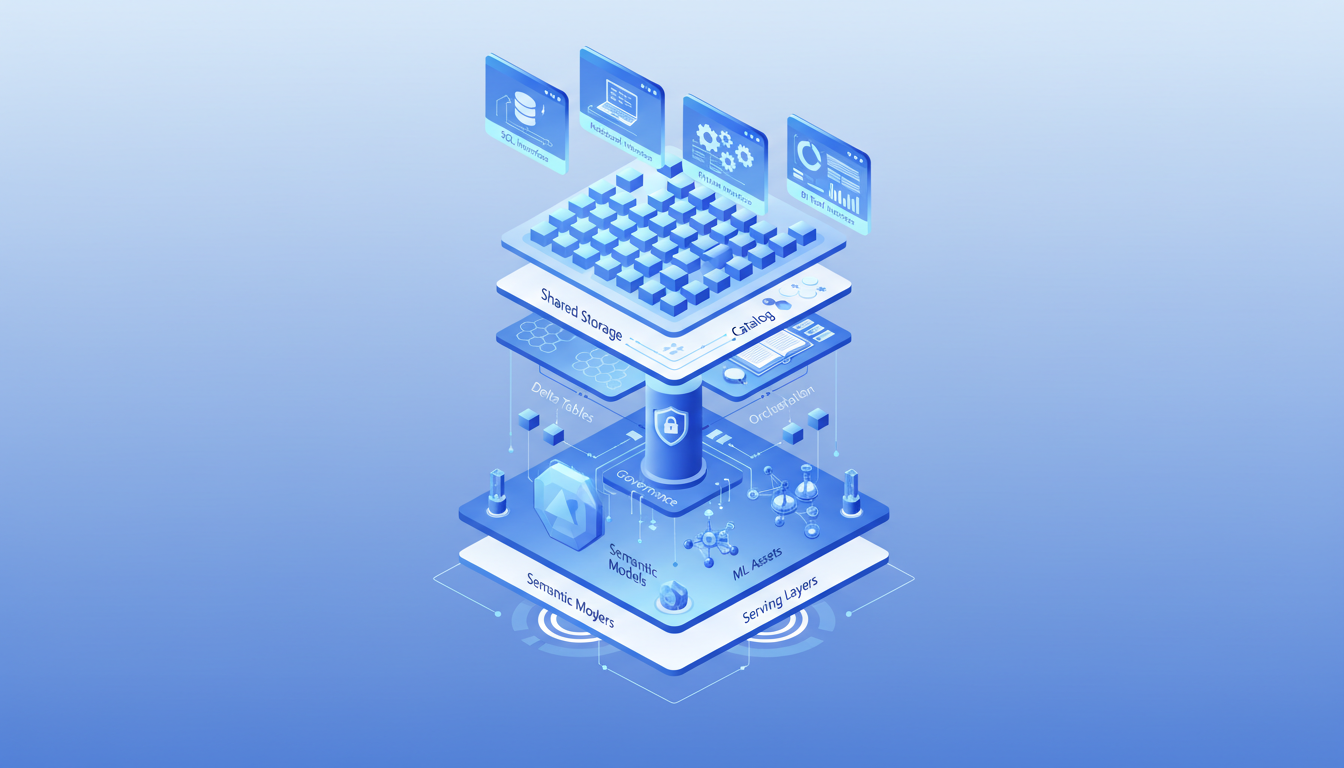
How Do Storage and Table Formats Prevent Copy-Driven Handoffs?
Engineers publish raw data, then improve its quality through validated and curated tables. The familiar bronze, silver, and gold pattern separates raw ingestion, validation, and business-ready aggregation by data quality and intended use, not by departmental ownership. Medallion layers
A table becomes reusable when its owner, schema expectation, freshness target, and permitted consumers are visible. Teams should use shortcuts or governed references where they can, rather than copying a source into a separate BI or ML store simply because a new tool enters the workflow. Our migration guide is useful when older pipeline estates are part of that transition.
How Do Catalog, Lineage, and Ownership Make Assets Reusable?
A catalog should answer practical questions before a person opens a table: Who owns it? Is it certified? What does it contain? Which reports, models, and pipelines depend on it? What security and sensitivity rules apply? Catalog details can include metadata, permissions, endorsement, and upstream or downstream lineage, giving consumers a way to evaluate trust before creating another version. Catalog details
Ownership needs two sides. A business owner is accountable for meaning and acceptable use. A technical owner is accountable for reliability, documentation, and change management. Platform teams define the operating pattern and enforce the guardrails, but they should not become the unscalable owner of every domain metric.
How Do Orchestration and Release Controls Connect Development to Production?
Orchestration links dependencies, schedules, quality checks, retries, alerts, and incident records. Release controls link development, test, and production through versioned definitions, review gates, and environment-specific configuration. Together, they turn a shared dataset into a production data product.
A deployment process should promote the definitions that describe the asset while keeping production data in its governed location. Microsoft’s deployment guidance distinguishes copied content metadata from underlying data, which supports safer environment promotion without manufacturing a new dataset for every stage. Deployment process
Where Do Semantic Models, ML Assets, and Serving Fit?
Semantic models hold the approved business definitions that reports and self-service analysis should reuse. ML assets hold experiment records, model versions, evaluation metrics, feature definitions, and approved prediction outputs. Serving is the controlled endpoint: a dashboard, SQL view, API, application, or scored-output table.
This separation matters because not every consumer needs raw data, and not every model artifact belongs in a report workspace. A reusable model record should connect its results back to code, configuration, metrics, and the datasets used in training. MLflow tracking
Who Owns Shared Assets Across the Analytics Team?
Clear ownership prevents the common failure mode where everyone can change an asset but nobody is accountable for its quality. We recommend assigning responsibilities by the asset and outcome, not by which tool a contributor prefers.
| Role | Primary Responsibility | Shared Assets They Publish or Govern | Main Consumer Relationship |
|---|---|---|---|
| Data Engineers | Reliable ingestion and operational quality | Raw tables, pipeline contracts, freshness alerts | Supply validated inputs to every downstream role |
| Analytics Engineers | Tested transformations and business-ready models | Curated SQL tables, metric definitions, documentation | Give analysts and scientists reusable trusted data |
| SQL Analysts | Governed analysis and report logic | Validated analyses, feedback on metric usability | Consume certified semantic models and curated tables |
| Data Scientists | Reusable feature logic and evaluated models | Experiment records, model versions, prediction outputs | Reuse trusted data and return governed model outputs |
| Platform Teams | Guardrails and platform reliability | Identity patterns, workspace standards, CI/CD templates | Enable all roles without owning every data product |
| Business Users | Business definition and consumption feedback | Metric approval input, issue reports, decision context | Consume certified outputs without broad raw-data access |
The boundary between analytics engineering and analysis is especially valuable. Analytics engineers create tested, reusable assets. Analysts answer business questions with those assets and help expose where definitions are incomplete. Data scientists should be able to use curated data without bypassing its meaning, ownership, or access rules.
A shared operating model also needs training aligned to these boundaries. Our team training options can help teams decide whether they need a common cohort, flexible learning, or a more targeted implementation path.
How Does One Dataset Move from Ingestion to Dashboard and Model Output?
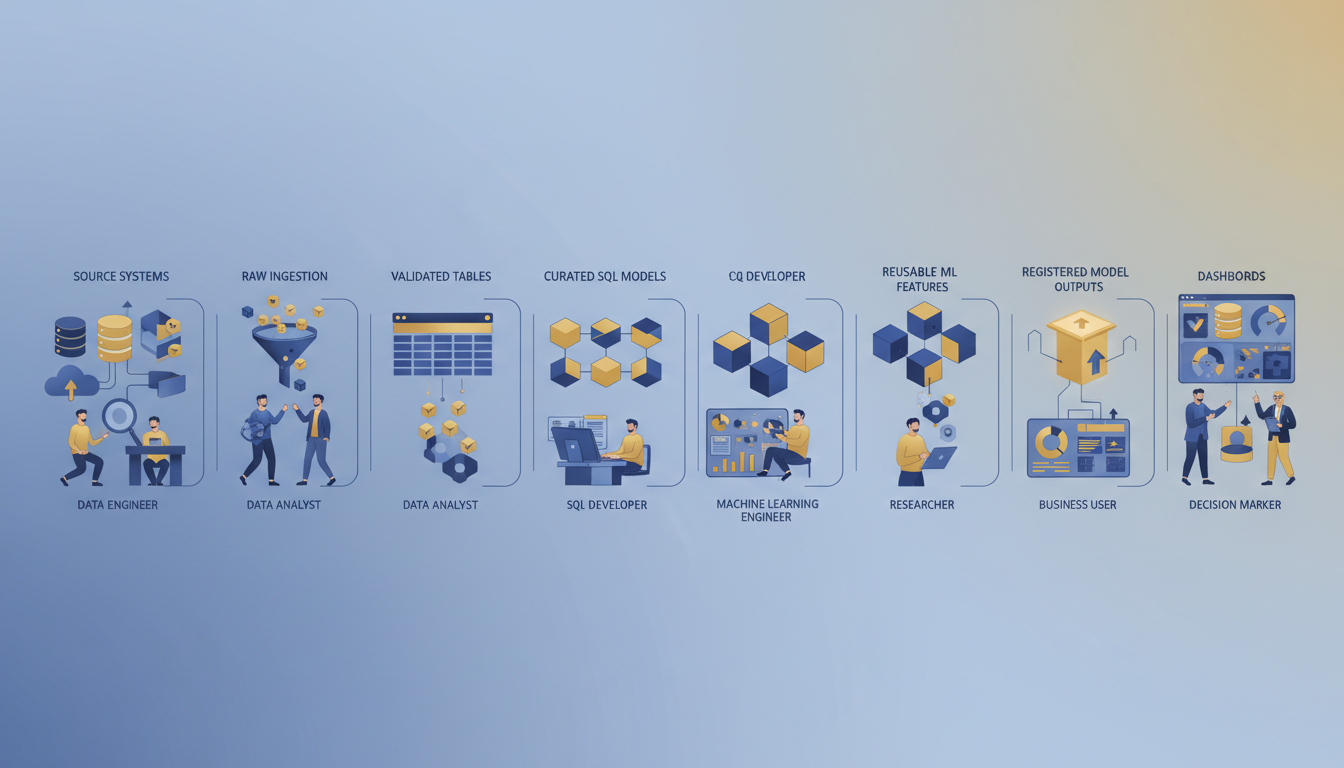
A dataset journey is the proof that teams share a platform. The path should be visible from source ingestion through transformation, model work, and business consumption, with each role contributing a durable asset instead of a private handoff.
How Does Engineering Publish the Raw Layer?
An engineer ingests source records on a defined schedule, event trigger, or replication path. The raw layer preserves source fidelity, records a technical owner, and defines the expected schema, freshness target, classification, and incident route before downstream users depend on it.
How Do Analytics Engineers Publish Trusted SQL Tables?
Analytics engineers transform raw records into validated and conformed tables, then publish curated models for agreed business use. Tests, documentation, and approval turn a SQL transformation into a team asset. Analysts should reference the approved metric or semantic definition instead of rebuilding it separately in each report.
How Do Data Scientists Reuse the Same Dataset?
Data scientists read validated or curated tables, develop feature logic, and record training data, parameters, metrics, and code version with each experiment. Once approved, batch scores or predictions return as governed output tables that analysts and applications can consume. Microsoft’s end-to-end example follows this same progression from ingestion through ML scoring to BI visualization. Data science flow
How Do Business Users Consume the Output?
Business users consume a certified semantic model, dashboard, or approved model output. They should be able to see who owns the metric and what data feeds it, without gaining unrestricted access to raw sensitive data. When a definition is wrong, the feedback travels to the accountable owner, not into a new spreadsheet definition.
Teams building these habits benefit from practicing the full delivery path. Our lakehouse learning path focuses on the engineering decisions that make shared datasets reliable in real work.
How Do Governance and Environment Boundaries Protect Collaboration?
Governance should make the right data easier to use than an unofficial copy. The control model needs to work consistently whether a person queries SQL, runs a notebook, builds a semantic model, or consumes a report. Otherwise, the platform merely relocates fragmentation.
Access starts with identity and workspace boundaries, then becomes more precise through table, row, column, and object controls. OneLake security can apply row-level and column-level restrictions across supported engines, so a policy is not limited to a single analysis interface. Row-level controls
Use these controls as a connected system:
- Catalog and ownership: Every published asset has a named technical and business owner.
- Environment boundaries: Development, test, and production have separate workspaces, configuration, and promotion rules.
- Access controls: Permissions start at the least-privilege level and become more specific for sensitive rows, columns, and objects.
- Lineage and labels: Users can trace material dependencies and recognize sensitivity before reuse.
- Release evidence: Tests, approvals, and deployment records travel with the transformation or model change.
Warning signs matter because they reveal when “unified” is only a collection of adjacent services. Watch for repeated data exports between BI and ML, duplicated transformation logic, metrics with no certification route, access rules recreated in each tool, lineage that stops at a workspace boundary, or notebooks that hold the only record of a production model. Our curriculum audit helps teams assess whether training covers these operating requirements rather than only individual tools.
When Should an Azure Data Team Consolidate Its Stack?
Consolidation should remove reconciliation work, not erase useful specialization. Start by identifying where teams pay to copy data, rebuild the same transformation, resolve inconsistent metrics, or manually coordinate pipeline failures. Then consolidate the shared control plane and data layer before deciding whether to retire role-specific interfaces.
| Decision Factor | Warehouse And Transformation Pattern | Lakehouse And External Scheduler Pattern | Shared-Asset Target |
|---|---|---|---|
| Storage | Analytics data may be separated from ML data | Tables may be shared while governance remains fragmented | One governed store or governed zero-copy access |
| Transformations | SQL models are often the main production path | Code and notebook jobs may dominate | SQL and code publish trusted shared assets |
| Orchestration | Scheduling may be embedded or separate | Scheduler often coordinates several services | One visible dependency, alerting, and release path |
| Governance | Catalog and policy can be split by tool | Control varies across workspaces and engines | Shared lineage, ownership, access, and certification |
| What Can Remain | Proven reports, SQL models, and connectors | Proven notebooks and ingestion jobs | Role-specific tools that honor shared controls |
A practical decision worksheet keeps the discussion grounded in verified team inputs rather than a generic savings claim.
| Monthly Reconciliation Input | Team Measurement | Calculation |
|---|---|---|
| Data Movement | Copied data volume and unit storage or transfer cost | Monthly copy cost |
| Duplicated Transformations | Duplicate job runs, hours, and compute rate | Monthly duplication cost |
| Incident Handling | Incidents, engineer hours, and loaded hourly rate | Monthly reliability cost |
| Metric Disputes | Rework meetings, participants, and loaded hourly rate | Monthly trust cost |
| Total Reconciliation Tax | Sum of the four subtotals | Monthly and annualized baseline |
Keep a specialized tool when it can access trusted shared assets, follow the same security and lineage rules, and participate in reviewed releases. Consolidate first where a dataset is copied merely to make another tool usable. Our implementation comparison can help frame whether the next step is capability building, a focused pilot, or a broader migration.
Build the Shared Platform with Vision Board
Vision Board helps Azure data teams turn platform diagrams into working habits. We teach teams how to define shared layers, assign owners, version transformations, protect sensitive fields, and promote trusted assets without forcing every practitioner into one workflow. Our learning is built for engineers who must connect ingestion, lakehouse design, SQL modeling, governance, and business consumption in the same delivery path. We also help teams spot unnecessary copies, unclear handoffs, and fragile operational work before a migration turns them into permanent debt. Use this article as an architecture discussion starter, then choose a learning path that lets your team practice it on realistic datasets, reviews, and releases. That practice makes responsibility visible, gives analysts confidence in certified metrics, and makes production changes reviewable for the people who operate them every day across critical reporting workloads safely. Start with Vision Board.
FAQs on Unified Analytics Platform
Does One Platform Mean Every Role Uses the Same Interface?
No. A single platform means teams share governed assets and release controls while selecting the SQL, notebook, pipeline, BI, or ML interface that fits daily responsibilities.
Can Analysts and Data Scientists Use the Same Dataset?
Yes. Analysts use curated tables and certified semantic definitions, while data scientists reuse validated data. Both paths retain the same policies, ownership records, and lineage.
What Is the Difference Between Shared Storage and Shared Governance?
Shared storage makes one dataset available across tools. Shared governance adds named ownership, access rules, lineage, certification, quality expectations, and release controls for safe reuse.
Who Should Own a Certified Metric and Reusable Feature?
A business owner approves meaning and intended use. A technical owner maintains reliability and change control, while the analytics or data science team maintains implementation.
What Should Remain During Platform Consolidation?
Keep tools that access trusted assets, follow shared policies, expose lineage, and support reviewed releases. Retire copied datasets, duplicate transformations, and disconnected control paths first.