
How to Consolidate Data Tools Without Replatforming: An Analytics Tool Consolidation Plan


TL;DR
At Vision Board, we show Azure data engineering teams how to consolidate analytics tools without replatforming: stabilise shared storage and metadata, classify tools, pilot one governed batch-plus-ML workflow, and retire duplicates only after validation. We also provide RACI ownership, rollback gates, semantic-layer rules, and operational measures that prove whether consolidation is reducing risk and data movement.
How to Consolidate Data Tools Without Replatforming: An Analytics Tool Consolidation Plan
For industrial data teams, fragmented analytics is not an abstract architecture problem: in a 2024 industry survey, only 41% of respondents said data was shared across functions.
Companies can achieve analytics tool consolidation without a rip-and-replace program by establishing shared governed storage and metadata, then moving one workflow at a time. Keep specialist tools with unique value, replace duplicate ingestion and transformations, and let batch, BI, and machine-learning workloads use governed tables. Each stage stays reversible.
We will show you how to diagnose the estate, decide each tool’s role, design shared data boundaries, prove the approach in a batch-plus-ML pilot, migrate safely, and measure results. Start with our unified analytics overview if your team needs a shared vocabulary first.
How Does Analytics Tool Consolidation Start with a Silo Inventory?
Most teams do not set out to create silos. They add a pipeline to meet a deadline, introduce a BI extract to improve report performance, and create a separate feature dataset because model training needs a clean interface. Over time, each local decision becomes another copy, scheduler, transformation path, ownership boundary, and definition of the same business metric.
The first move is not choosing a new platform. It is identifying where data moves, where logic diverges, and who can approve a change. A governance glossary is useful here because it connects technical assets, lineage, classifications, and semantic context instead of treating cataloguing as an isolated compliance task.
Create an inventory for critical datasets and workflows before discussing retirement. Include the operational source, every physical copy, the transformation that created it, its refresh expectation, its consumers, and the team that supports it.
| Layer | Silo Signal | What To Record |
|---|---|---|
| Storage copies | The same entity lives in raw storage, a warehouse, BI imports, and ML files | Location, format, size, owner, and purpose |
| Ingestion tools | More than one process extracts the same source | Schedule, latency, failure rate, and downstream dependency |
| Transformation engines | The same business rule exists in SQL, notebooks, and report logic | Rule owner, test coverage, and certified version |
| Catalogs | Teams cannot agree on names, classifications, or lineage | Authoritative owner and discoverability gap |
| Semantic layers | Revenue, units, downtime, or customer definitions differ | Metric definition, approver, and affected reports |
| BI extracts | Reports maintain hidden or unmanaged copies | Refresh mode, size, and freshness requirement |
| ML Feature Pipelines | Features recreate logic already present upstream | Feature source, training use, and scoring use |
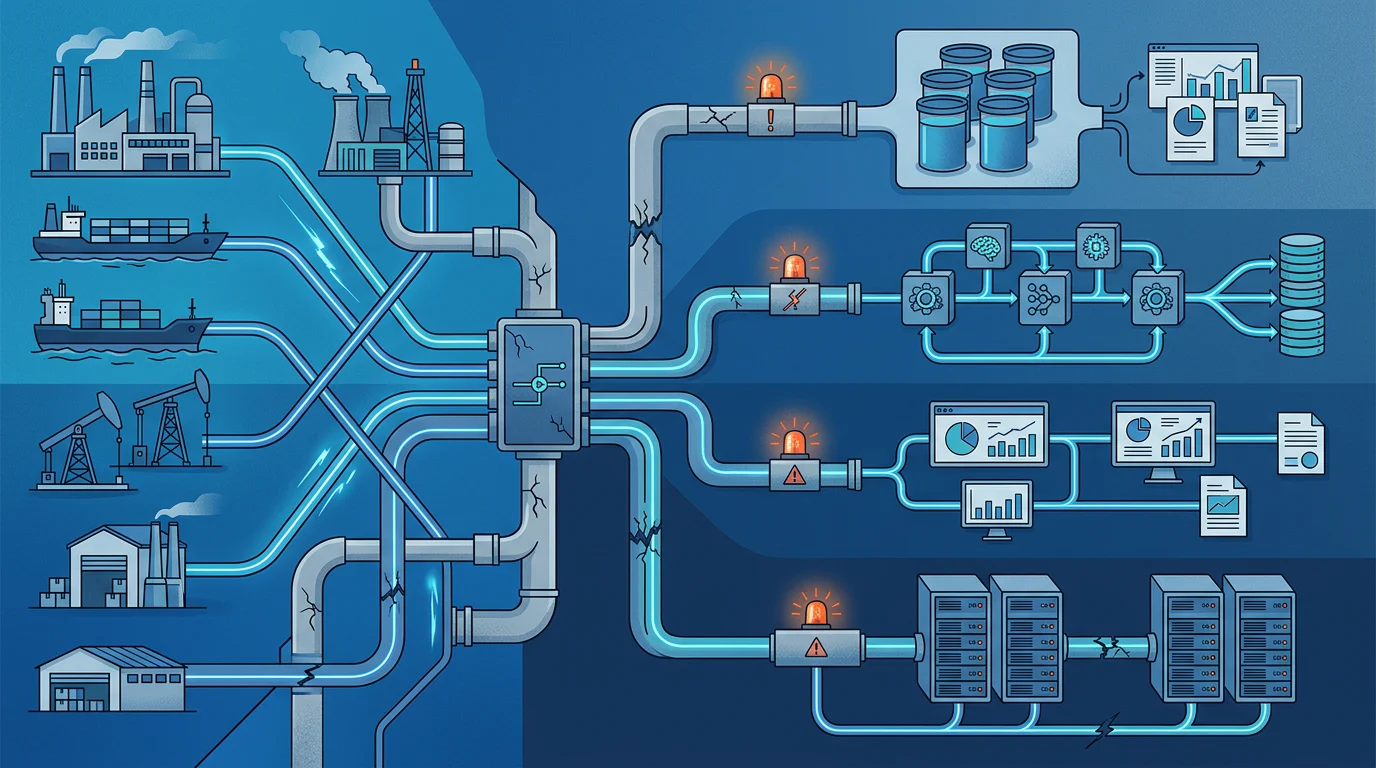
Record a 30-day median for freshness, failures, cloud spend, and engineering reconciliation time. That gives us a defensible baseline and exposes the costly handoffs that a tool count alone cannot reveal. Teams that need a broader starting pattern can compare their findings with this centralisation pattern.
Which Tools Should We Keep, Integrate, Replace, or Retire?
A consolidation program fails when it treats every incumbent tool as technical debt. Some tools are specialised for low-latency telemetry, complex model experimentation, regulated reporting, or a hard-to-replace operational dependency. The question is whether the tool provides a distinct capability while participating in shared governance, not whether it is fashionable.
We recommend scoring every tool against four factors: unique capability, duplication, switching cost, and operational risk. Use the result to make a visible decision rather than letting tools remain by default. Active glossary terms can attach policy and business context to data assets, which makes the decision less dependent on tribal knowledge.
| Decision | Use It When | Required Condition | Common Example |
|---|---|---|---|
| Keep | It delivers a distinct workload capability | It can expose lineage, ownership, and governed outputs | Specialised real-time or model experimentation compute |
| Integrate | It remains useful but duplicates storage or metadata | It reads or writes certified tables and follows contracts | Existing scheduler feeding a governed landing zone |
| Replace | It duplicates a standard path with material operating cost | A tested shared alternative meets its workload SLA | Parallel ingestion or transformation services |
| Retire | It has low switching cost and no unique capability | Parallel validation has passed and rollback window has closed | Redundant BI extract or abandoned pipeline |
The semantic layer deserves special treatment. BI users need governed measures, dimensions, relationships, and business-facing names. ML teams need reproducible feature definitions and training snapshots. These are different representations, but they should derive from documented governed tables instead of separately reinventing business logic.
That distinction makes tool decisions calmer and more precise. Our ETL modernisation guide can help teams evaluate older transformation paths without assuming every workload must move at once.
What Should We Share, and What Can Remain Specialised?
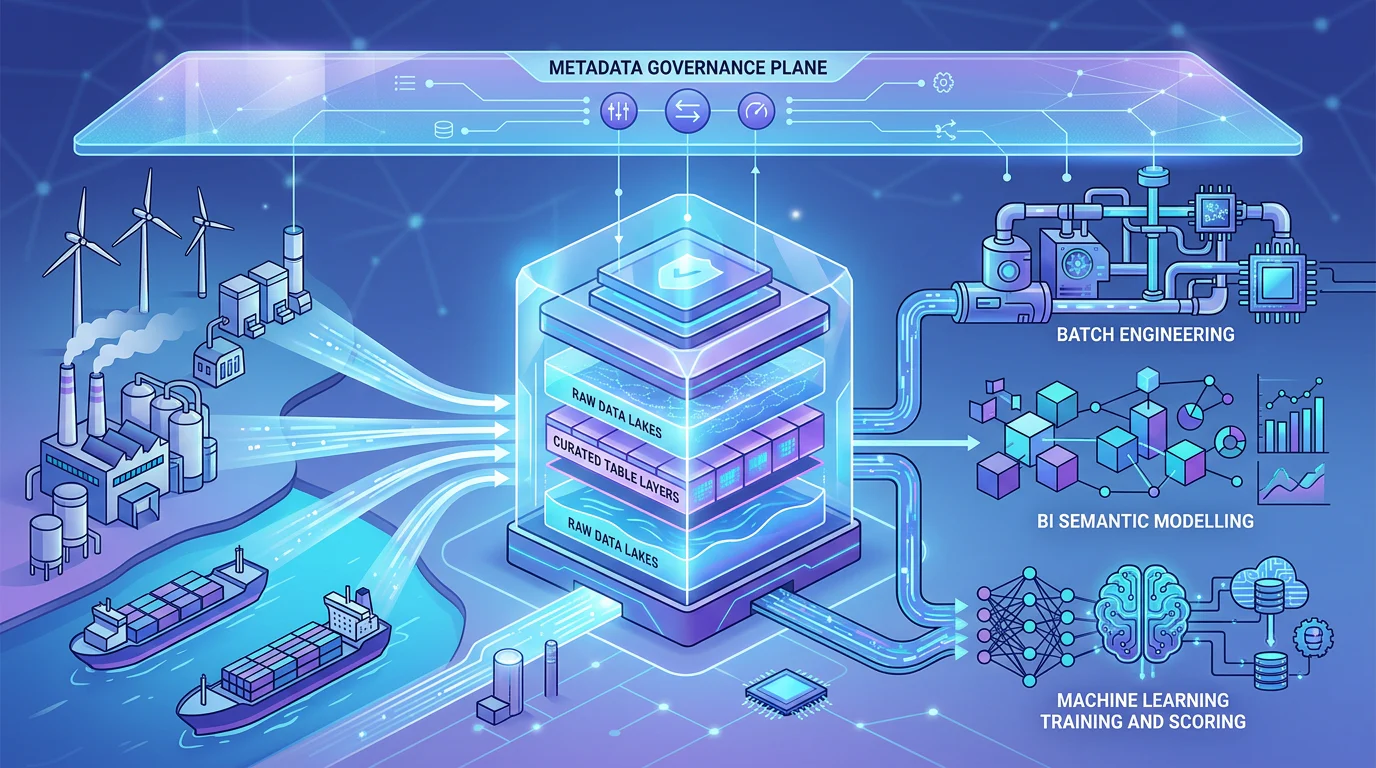
Shared storage does not mean forcing every workload through one compute engine. It means deciding what must be common so that batch processing, BI, and ML stop copying and reconciling the same business data. For Azure-focused teams, a shared lakehouse foundation works best when it is paired with shared metadata, certified transformations, and workload-specific compute where needed.
The boundary is practical: shared storage holds governed tables, shared metadata records ownership and lineage, shared transformations produce certified entities, and shared compute is optional. Current platform guidance supports this open-table approach, where one engine can produce a governed table and another can consume it for analytics or BI through the open table model.
A useful architecture separates the data product from the engine using it:
- Shared Storage: Curated Delta tables hold trusted business entities and model-ready datasets.
- Shared Metadata: Owners, contracts, classifications, lineage, quality rules, and retention policies apply consistently.
- Shared Transformations: Common customer, asset, order, batch, and KPI logic is built once and tested.
- Specialised Compute: Spark, SQL, real-time analytics, BI query engines, and ML notebooks use the governed data according to their workload needs.
| Dimension | Staged Consolidation | Full Replatforming |
|---|---|---|
| Disruption | Moves one validated workflow at a time | Changes many dependencies simultaneously |
| Reversibility | Keeps a parallel path and rollback gate per stage | Makes rollback broad, expensive, and difficult to isolate |
| Governance | Establishes metadata and contracts before migration | Governance is often delayed by cutover pressure |
| Latency | Tests each workload against its own SLA | Risks discovering latency issues after migration |
| Technical Debt | Reduces duplicate paths progressively | Can remove more debt, but with greater transition risk |
For real-time workloads, do not mistake shared storage for a universal low-latency answer. Keep the right serving pattern when it earns its place, then publish governed outputs for broader reuse. Our real-time stack comparison explains where that boundary matters.
How Do We Prove the Approach with a Batch-Plus-ML Pilot?
The most useful pilot is narrow enough to finish and important enough to expose real constraints. For an industrial organisation, choose an equipment reliability or production-quality workflow that joins daily work orders, asset master data, production batches, and historical sensor summaries. It has a clear batch process, visible business users, and an ML outcome that can be measured.
The pilot should use one governed daily dataset. Batch transformations create and quality-check it. The BI semantic model serves maintenance or quality dashboards. The ML workflow trains and scores from the same curated tables, then writes predictions back for operations to review. This reflects the documented pattern of loading governed lakehouse tables, tracking an ML experiment, and saving scoring output through a Fabric tutorial.
Choose the Dataset and Contract
Define the entity grain, source systems, primary keys, refresh expectation, sensitivity classification, data owner, data steward, and quality thresholds. Treat schema changes, delayed source delivery, and null-rate breaches as contract events, not informal tickets.
Build Shared Tables Before Rebuilding Everything
Land source data using the existing ingestion path initially. Publish raw and curated tables, then reconstruct only the transformation required for the pilot. This limits scope while testing whether shared storage and metadata eliminate an actual duplicate path.
Run BI and ML Against the Same Governed Foundation
Build the report from certified entities and governed measures. Train the reliability or quality model from documented feature-ready tables, retain the experiment record, and write predictions to a governed output table. BI sees prediction outcomes without a separate export.
Validate Before Retiring Any Path
Run incumbent and pilot outputs in parallel. Compare row counts, key aggregates, metric definitions, feature distributions, access controls, freshness, failure behaviour, and monthly cost. Block retirement when a quality threshold, SLA, or business metric fails.
Teams looking for a realistic way to rehearse this workflow can review whether production lab reality matches the skills and constraints they need to validate.
How Do We Migrate Incrementally Without Creating New Risk?
Incremental migration is a controlled sequence, not a series of disconnected technical tasks. We begin with visibility and ownership, then create contracts, publish shared tables, move consumers individually, validate in parallel, and retire a duplicate only when evidence supports it. Scheduled Purview scans can help keep metadata, lineage, and classifications current as the estate changes.
A practical migration has six stages:
- Inventory The Estate: Confirm copies, pipelines, consumers, owners, and operating cost for the selected workflow.
- Define Data Contracts: Set schema, freshness, quality, access, and change-notice expectations.
- Publish Shared Tables: Establish raw and curated governed tables with lineage and test coverage.
- Migrate One Workload: Move a single batch, BI, or ML consumer and retain the incumbent path.
- Validate In Parallel: Check parity, freshness, quality, performance, cost, and access controls.
- Retire Deliberately: Remove the duplicate pipeline, extract, or transformation only after its rollback period closes.
Governance needs named people, not a vague shared responsibility. The platform lead is accountable for the shared foundation. Engineers build and operate pipelines. BI and ML owners validate their consumption patterns. Domain stewards approve definitions and quality expectations. Security and FinOps review access and spend.
| Activity | Platform Lead | Data Engineer | BI Owner | ML Owner | Domain Steward | Security And FinOps |
|---|---|---|---|---|---|---|
| Inventory And Disposition | Accountable | Responsible | Consulted | Consulted | Consulted | Consulted |
| Data Contract | Consulted | Responsible | Consulted | Consulted | Accountable | Consulted |
| Shared Table Publishing | Accountable | Responsible | Consulted | Consulted | Consulted | Consulted |
| Metric Approval | Consulted | Consulted | Responsible | Consulted | Accountable | Consulted |
| Pilot Validation | Accountable | Responsible | Responsible | Responsible | Consulted | Consulted |
| Retirement Decision | Accountable | Responsible | Consulted | Consulted | Consulted | Consulted |
Every stage needs a rollback gate. Stop promotion for a contract violation, keep the incumbent route for an unacceptable reconciliation variance, and pause retirement if freshness, cost, or access controls fail. Use our gradual pipeline hub to connect these decisions to a broader Azure modernisation plan.
How Do We Measure Whether Consolidation Is Working?
Measure improvement from the first inventory, not from an assumed industry benchmark. A meaningful scorecard compares the same workload before and after migration, using a 30-day median where operating behaviour is variable. It should show whether the team has reduced copies and handoffs without harming trust, freshness, availability, or cost.
| Measure | Baseline Method | Success Test |
|---|---|---|
| Physical Data Copies | Count every storage location for a critical entity | Fewer unmanaged copies with documented exceptions |
| Active Pipelines Per Source | Inventory scheduled, triggered, and streaming paths | Fewer duplicate extraction and transformation paths |
| Cross-Team Handoffs | Review change tickets and approval steps | Fewer manual reconciliation and ownership transfers |
| Freshness | Record source-to-consumer median and tail latency | Meets the agreed workload SLA |
| Pipeline Failures | Divide failed production runs by total runs | Declines without hiding failures through retries |
| Cloud Cost | Track storage, compute, and data movement for the workload | Lowers cost per successful workload |
| Engineering Time | Record hours spent reconciling data and fixing handoffs | Frees capacity for tested data products |
Keep one important caveat visible: a shared semantic model still needs capacity planning. Current capacity guardrails list limits that vary by SKU, including 5,000 Parquet files per table and 25 GB of maximum model memory for an F64 Direct Lake semantic model. Validate these limits against the real table layout before retiring an import-based serving path.
The final test is behavioural. Analysts should find trusted definitions faster, engineers should operate fewer duplicate paths, data scientists should reproduce features from governed inputs, and business users should receive metrics that reconcile across reports and predictions. For a skills path that supports that outcome, see our Azure lakehouse engineering guide.
Build the Consolidation Capability with Vision Board
Vision Board helps Azure data engineering teams turn architecture diagrams into production-ready practice. We focus on the work that often gets skipped in platform conversations: inventorying the estate, defining contracts, building governed tables, validating real batch and machine-learning workloads, and documenting the retirement decision. Our project-led learning is useful when your team needs confidence moving from disconnected pipelines to a measured implementation plan, without pretending every legacy tool must disappear on day one. We can help your engineers rehearse the handoffs between ingestion, transformation, semantic modelling, observability, and deployment, then apply the same pattern to their own industrial data. The outcome is a team that can defend its tool decisions, run parallel validation, and improve the architecture safely. We also make governance roles and rollback gates tangible before a team changes production routing. Explore our practical Azure lakehouse learning and project implementation support at Vision Board.
FAQs on Analytics Tool Consolidation
Can We Consolidate Analytics Tools Without Replacing Every Tool?
Yes. Centralise metadata and one governed dataset, then migrate one validated workload at a time while existing systems remain available as a practical rollback path.
What Causes Data Silos Across BI, Engineering, and ML?
Silos arise when teams own separate storage, ingestion, transformations, definitions, and refresh cycles. Each local optimisation creates copies, handoffs, inconsistent metrics, and unclear ownership over time.
Can Batch and ML Workloads Use the Same Tables?
They can use governed, versioned tables in shared object storage with different compute. ML features and BI metrics need separate representations, not additional unmanaged physical copies.
When Should We Retire a Legacy Data Tool?
Retire a tool when parallel validation proves data parity, freshness, access controls, operating cost, and rollback readiness. Keep it if it provides a unique governed capability.