From SQL to Delta Lake on Azure: Azure Delta Lake Training for Database Professionals
Azure Delta Lake training for database professionals: learn Spark, Delta, medallion architecture, Fabric, Data Factory, Databricks, and Power BI.

From SQL to Delta Lake on Azure: Azure Delta Lake Training for Database Professionals
Moving from transactional SQL work to Azure lakehouse engineering is easier when the learning path respects what you already know. Microsoft's current Fabric data engineering course runs for four days, a useful signal that the modern stack extends beyond a quick product tour.
Azure Delta Lake training for database professionals works best when it starts with familiar SQL ideas, then introduces distributed processing only where the job needs it. Learn Delta tables, schema controls, incremental loads, medallion layers, orchestration, governance, and Power BI through one connected project that includes broken data and performance decisions.
In this hub, we map the transition from relational design to a practical Azure lakehouse implementation, then show how to judge whether a course teaches the technical work that matters.
How Does Azure Delta Lake Training for Database Professionals Translate SQL Skills?
The fastest transition begins by preserving useful instincts. You already understand tables, joins, transactions, constraints, dimensional models, and operational dependencies. What changes is where data lives, how compute executes, and how a team proves that a pipeline can be rerun safely.
Delta Lake adds ACID transactions, schema enforcement, table history, and batch and streaming support to files in cloud storage, according to the Delta Lake docs. That means the target outcome remains recognizable to a database professional, even when notebooks and distributed compute replace many stored procedure patterns.
| Relational Database Concept | Lakehouse Equivalent | Practical Change |
|---|---|---|
| Table | Delta table | Data is backed by cloud files and a transaction log. |
| Index | Data skipping, clustering, and file layout | Query patterns guide data layout choices. |
| Transaction | Delta ACID transaction | Reads and writes remain consistent across files. |
| Constraint | Schema enforcement and quality rules | Validation happens during writes and transformations. |
| Stored procedure | Notebook or pipeline | Transformation logic is separated from orchestration and monitoring. |
We teach the new vocabulary as an extension of SQL, not a replacement for it. A Gold-layer star schema still matters, but it should be built after raw data is preserved and conformed. For a broader route decision, compare our Azure learning paths.
What Spark Knowledge Do SQL Professionals Need First?
You do not need to become a distributed-systems specialist before creating useful Delta tables. You do need to understand why a familiar SQL statement can become expensive when it moves data between worker nodes.
Start with DataFrames, Spark SQL, lazy transformations, actions, partitions, joins, and shuffles. Learn to read an execution plan well enough to ask whether a slow job is scanning too much data, creating too many files, or moving a skewed key across the cluster. That foundation is more useful than memorizing every API.
Apache Spark's current tuning guidance centers on caching, partition changes, join strategies, statistics, and adaptive query execution, which has been enabled by default since Spark 3.2.0 in Spark documentation. Those are the practical concepts behind a technical Spark lab.
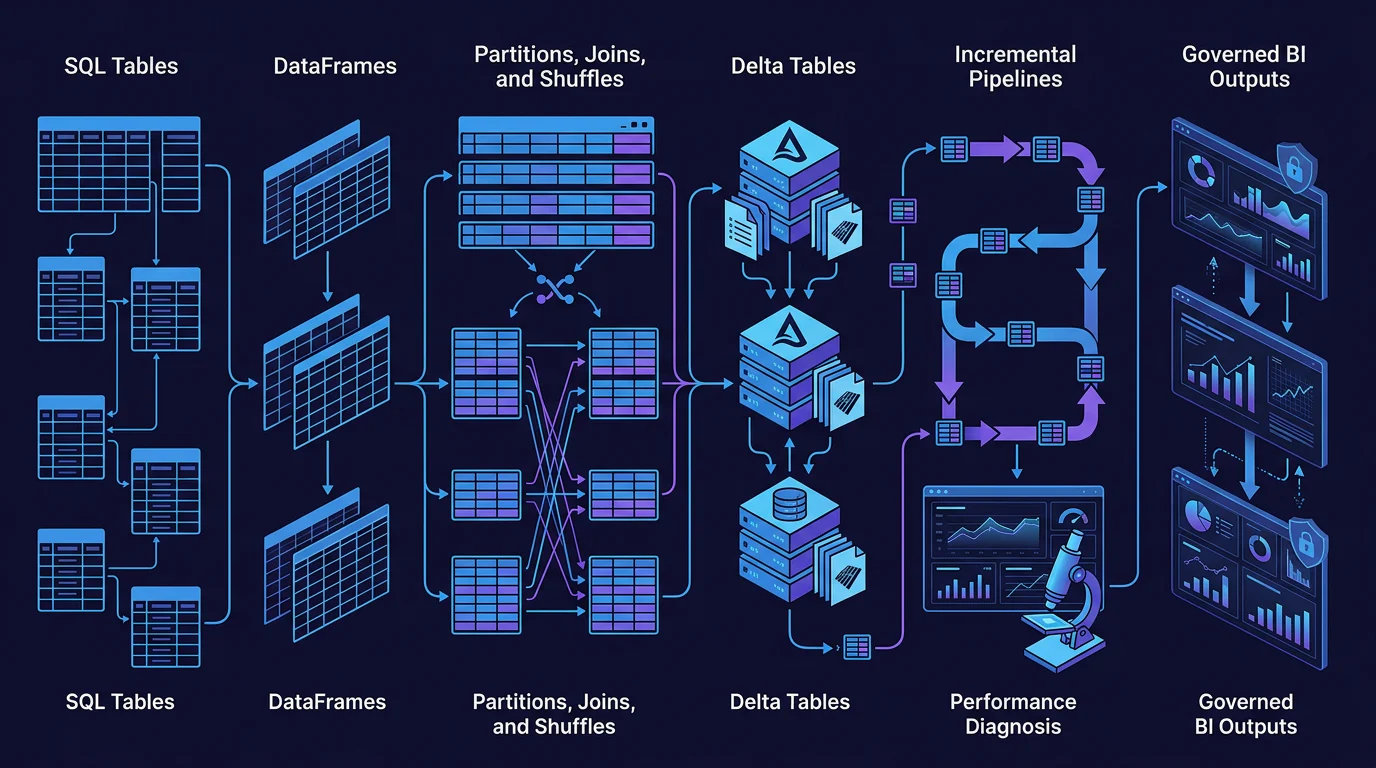
We build the sequence around decisions learners will make at work: when to repartition, when to inspect a join, when to persist a result, and when a small-file problem is really a pipeline-design problem. If Spark is deliberately out of scope for your role, review Azure ETL tools before choosing this route.
Which Delta Lake Skills Separate Technical Training from a Surface-Level Overview?
A credible course does more than create a table and run a query. It requires learners to make a schema decision, process a change safely, recover from an error, and explain a performance result.
Delta Tables and Quality Boundaries
Learners should create managed Delta tables, define expected columns and types, and decide what happens to records that fail validation. A meaningful lab includes an invalid-record path instead of silently accepting every change from the source.
Schema Evolution and Version Recovery
Schema evolution should be taught as a controlled write-level choice, not as a switch learners enable everywhere. Current guidance recommends using WITH SCHEMA EVOLUTION or mergeSchema for the individual write that needs it, as explained in schema evolution guidance.
Incremental Processing and Relational Changes
The curriculum should include MERGE, idempotent reruns, change data capture concepts, and slowly changing dimensions. These are the lakehouse equivalents of safely applying inserts, updates, and deletes without rebuilding every downstream table.
Performance Tuning with Evidence
A lab should require a before-and-after result. Learners need to identify a shuffle, inspect data skew, reduce harmful small files, and justify a clustering or layout choice. Current Azure Databricks guidance favors liquid clustering for new tables and advises against partitioning tables below 1 TB in many cases.
Our lakehouse architecture guide expands these practices into a broader implementation framework, but the essential test is simple: can the learner explain why a pipeline is correct, recoverable, and performant?
How Do Medallion Layers and Azure Services Form One Implementation?
Medallion architecture gives each part of the pipeline a defined responsibility. Bronze preserves raw source data and ingestion context. Silver validates, deduplicates, standardizes, and conforms records. Gold produces business-ready dimensional models, aggregates, and governed data products for reporting.
Microsoft's current medallion reference describes Bronze as raw ingestion, Silver as cleaning and validation, and Gold as dimensional modeling and aggregation for business consumers in its architecture guidance. That separation helps SQL professionals stop treating one large transformation procedure as the only unit of delivery.
| Layer | Main Responsibility | Typical Evidence Of Completion | Primary Consumer |
|---|---|---|---|
| Bronze | Preserve source records and ingestion metadata | Batch record count and source timestamp | Data engineering |
| Silver | Validate, deduplicate, and conform data | Quality checks and rejected-record output | Engineering and analytics |
| Gold | Model and aggregate trusted data | Reconciled fact tables and semantic definitions | BI developers and business users |
Azure Data Factory or Fabric pipelines should orchestrate data movement, parameters, schedules, retries, and monitoring. Databricks notebooks should perform Spark and Delta transformations. Power BI should consume governed Gold outputs through an appropriate semantic model or supported connection.
We use that full-stack handoff because it reveals integration mistakes that isolated demonstrations hide. For context on the platform model, see how a unified platform works.
How Should You Test a Full-Stack Azure Learning Project?
The strongest capstone starts with relational ingestion and ends with a governed analytical model. It should be one connected business scenario, not a collection of unrelated labs.
Stage One: Ingest and Validate a Relational Source
Copy a relational dataset into Bronze, capture source and batch metadata, parameterize the pipeline, and deliberately fail a validation check. The acceptance test is that a failed run is visible, explainable, and safe to rerun without duplicating accepted data.
Stage Two: Build Silver and Gold with Spark and Delta
Use notebooks to clean and conform the records, apply an incremental update, evolve one approved schema change, and write a business-facing fact and dimension model. The acceptance test is a documented MERGE, a rejected invalid record, and a table-history check.
Stage Three: Govern and Serve the Analytical Model
Apply access controls, document lineage, and connect the Gold layer to Power BI. Power BI can connect to Azure Databricks clusters and SQL warehouses through supported methods described in Power BI integration guidance. The acceptance test is a role-appropriate report that reconciles to a documented Gold-layer total.
A course should also make learners explain the orchestration path, including why Azure Data Factory or Fabric Data Factory triggers the transformation when it does. Use our curriculum audit to assess whether a syllabus requires that evidence. For course-format guidance, explore our project learning route.
What Should You Look for in a Modern Azure Data Engineering Course?
Evaluate the course by its evidence, not its product list. A current route should acknowledge that the older Azure data engineering course DP-203T00 was retired on December 31, 2025, with DP-700T00 listed as its replacement in the retired course record.
- Currency: Dated content that reflects current Fabric, Delta, governance, and performance terminology.
- SQL-To-Spark Bridge: Direct instruction on DataFrames, partitions, joins, shuffles, and execution plans.
- Delta Depth: Schema enforcement, evolution, history, incremental processing, and optimization.
- Real Labs: Imperfect data, failures, reruns, and reconciliation, not only happy-path clicks.
- Debugging: Logs, root-cause analysis, data-quality checks, and recovery decisions.
- Deployment: Parameters, environment differences, schedules, monitoring, and promotion practices.
- Governance: Permissions, lineage, auditability, and semantic-model access.
- Performance: Measured diagnosis of file layout, skew, joins, and cluster behavior.
Official modules suit learners who need a current baseline and can direct their own study. Instructor-led training suits learners who benefit from a paced environment and live clarification. Project-based coaching suits people who need feedback on their own technical decisions, code, data quality rules, and deployment evidence.
Why Learn with Vision Board?
Vision Board built this learning hub for data professionals who can already reason in SQL and now need to build dependable Azure lakehouse systems. We do not treat Spark, Delta, orchestration, governance, and BI as unrelated modules. We connect them through a single sequence that begins with a relational source and ends with a governed analytical model. In our sessions, you work through schema changes, invalid records, reruns, file-layout choices, and dashboard reconciliation, because those are the decisions that make a pipeline useful at work. We also help teams choose the right pace, whether they need a focused technical baseline, live feedback, or a project that mirrors their own data environment. If your goal is to move from database work to credible Azure data engineering, we can help you make that transition with practical evidence, not just completion badges. Explore Vision Board.
FAQs on Azure Delta Lake Training for Database Professionals
Do I Need Python Before Learning Delta Lake?
No. Start with DataFrames, Spark SQL, joins, partitions, and the difference between transformations and actions. Add Python gradually when a notebook task requires a small script.
What Is the Minimum Spark Knowledge I Need?
Learn partitions, lazy transformations, actions, joins, shuffles, DataFrames, and basic execution-plan reading. You do not need to study low-level RDD internals before building Delta pipelines.
Are Delta Tables Just Parquet Files?
No. Delta tables store data in files, but their transaction log adds ACID behavior, schema controls, version history, and reliable updates that ordinary file layouts lack.
Should I Use Azure Data Factory or Fabric Data Factory?
Choose Azure Data Factory when it already orchestrates your Azure estate. Choose Fabric Data Factory when the lakehouse, notebooks, semantic model, and deployment workflow live in Fabric.
Can Power BI Read Gold-Layer Data from Azure Databricks?
Yes. Power BI can query curated Azure Databricks data through supported connections, but your course should also teach permissions, semantic modeling, refresh behavior, and reconciliation checks.
What Makes a Lab Production-Realistic?
A production-realistic lab includes failed records, schema drift, incremental updates, retries, access controls, monitoring, lineage, and a dashboard that reconciles with documented Gold-layer totals during review.
Should I Learn Fabric and Databricks Together?
Learn both through one connected project when your goal is engineering work. Add structured modules when you need a stronger baseline, then seek feedback for difficult implementation decisions.