
AI Data Governance Regulations: Tips for Governing Synthetic Data After the August 17 Signal


TL;DR
We explain why AI Data Governance Regulations now make provenance, validation and disclosure essential for synthetic data, especially after the EU AI Act transparency rules began applying in August 2026. We show which rules apply today, what evidence data teams should retain, and how to build practical controls for analytics pipelines.
AI Data Governance Regulations: Tips for Governing Synthetic Data After the August 17 Signal
On August 2, 2026, the EU AI Act’s transparency rules began applying, putting synthetic-content provenance on the operational agenda for data teams. The August 17 reporting signal matters because it turns a broad governance concern into a current implementation question.
AI Data Governance Regulations now make provenance, validation and disclosure practical requirements, not optional documentation. Covered providers of synthetic text, image, audio and video need machine-readable marking under the EU AI Act, while every team using synthetic datasets should retain evidence of origin, privacy testing, fitness for purpose and accountable approval.
We explain what changed, which rules apply now, and how analytics teams can convert those requirements into durable controls.
What Changed on August 17
The August 17 report was a timely governance signal, not a new law or a regulator’s enforcement action. Its central point was sound: AI-generated and synthetic data can be useful for testing, simulation and privacy-conscious development, but it can also create inaccurate analysis, amplify bias, support deception or enable harmful use when teams treat it as ordinary data.
The live regulatory context is more specific. The EU’s transparency obligations now apply to covered synthetic content, while the European Data Protection Board has also opened consultation on generative-AI web-scraping guidance through October 30, 2026. That combination makes source records, use restrictions and evidence of review more important for every team building a unified analytics platform, even where a particular workflow is not directly regulated.
The practical shift is simple. We should no longer ask only whether data is real or synthetic. We should ask who generated it, from what inputs, for what approved purpose, what checks it passed and where it is allowed to travel.
Which AI Data Governance Regulations Apply Now
The most useful way to understand AI Data Governance Regulations is to separate content transparency, high-risk AI dataset quality and privacy duties. They overlap in a data platform, but they do not create the same obligation or follow the same date.
Article 50 Covers Certain Synthetic Content
Providers of AI systems that generate synthetic audio, image, video or text must ensure outputs are machine-readable and detectable as artificially generated or manipulated, where Article 50 applies. The obligation has exceptions, including certain assistive editing functions, so teams should classify the actual system and output rather than assuming every generated file follows one rule. The official Article 50 text also creates related disclosure duties for deployers using deepfakes and some public-interest text.
For teams running content generation alongside analytics, provenance needs to survive publication and handoff. A governed storage and transformation pattern gives us a reliable place to retain those records.
Article 10 Is a Different, Later Obligation
Article 10 concerns the quality and governance of training, validation and testing datasets used by high-risk AI systems. Its requirements include relevance, representativeness, error examination and bias controls appropriate to intended use. The current implementation schedule puts Annex III high-risk AI rules at December 2, 2027, so teams should prepare without incorrectly stating that every synthetic dataset faces that deadline today.
Teams deciding how to apply quality controls can use our modern Azure data course as a starting point for building platform skills alongside governance knowledge.
Synthetic Does Not Automatically Mean Anonymous
Synthetic data can reduce exposure to direct identifiers, yet making it often requires processing real data. If outputs can reveal information about people in the source data, or if the process itself handles personal data, privacy obligations remain relevant. The ICO guidance makes the tradeoff clear: greater similarity to original records can increase usefulness and disclosure risk at the same time.
Penalties Make Documentation Worth Doing
For Article 50 transparency obligations, the AI Act provides for maximum administrative fines of up to €15 million or 3% of worldwide annual turnover, whichever is higher. The penalty framework does not make every team a provider, but it does make casual claims of compliance risky. We need a clear record of scope decisions, responsibilities and technical controls.
Teams building that foundation can connect governance with enterprise data management training, rather than treating regulatory work as separate from everyday engineering.
Why Synthetic Data Needs Its Own Controls
Synthetic data is not bad data. It is a separate class of data product with a different failure pattern. A well-designed synthetic dataset can help us test pipelines without broadly exposing source records, simulate rare conditions and develop responsibly before production access is approved. But usefulness does not prove representativeness, privacy or reliability.
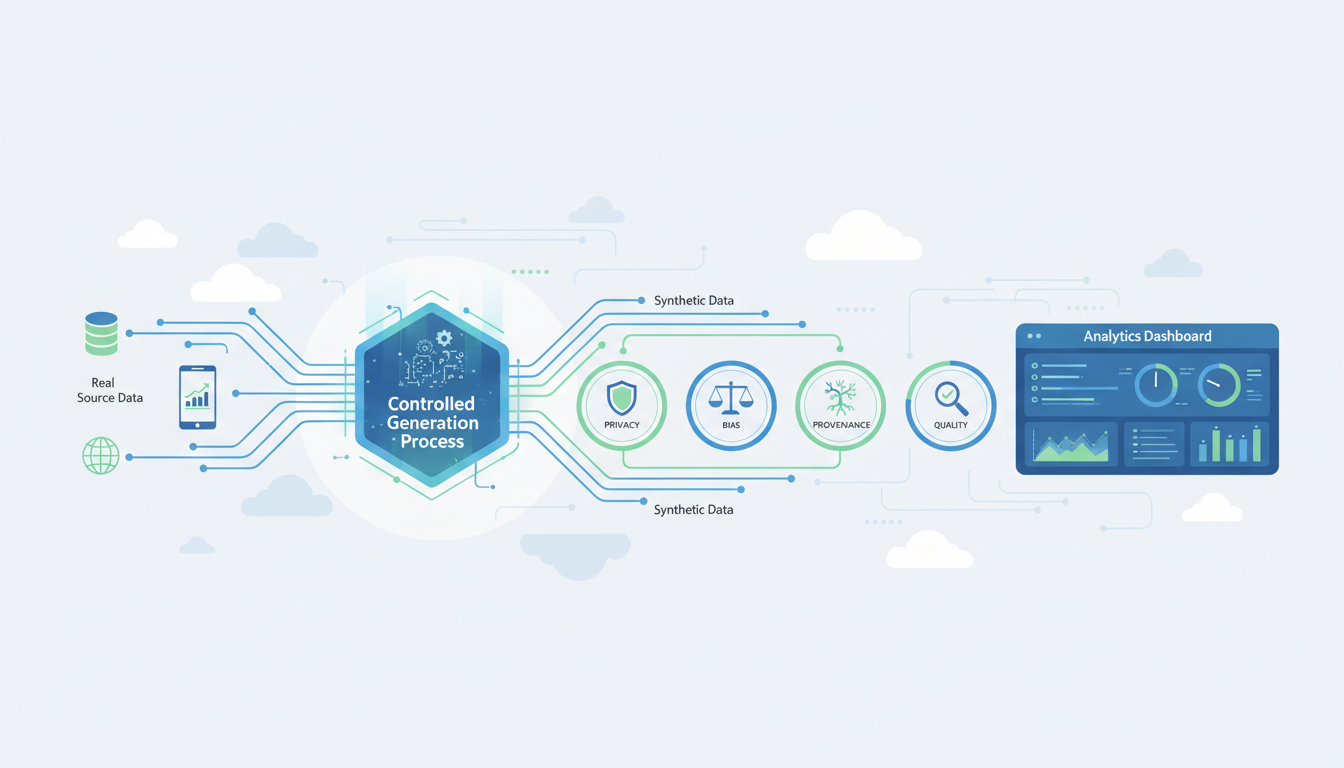
The first risk is inaccurate use. A synthetic record can look plausible while failing to preserve the relationships that matter for a business decision. The second is unrepresentative use, where bias in the source or generator becomes bias in downstream analysis. The third and fourth are deliberate misuse and harmful use, including deceptive content, fraud and polluted inputs entering otherwise trusted reporting.
| Risk | What Can Go Wrong | Evidence We Should Retain |
|---|---|---|
| Inaccurate use | Synthetic records are treated as observed facts | Fitness-for-purpose tests and intended-use approval |
| Unrepresentative use | Important groups, edge cases or relationships are lost | Bias and representativeness assessment |
| Privacy leakage | Outputs expose patterns from identifiable source data | Re-identification testing and source-data classification |
| Data contamination | Generated material silently enters training or reporting inputs | Origin labels, lineage and dataset version history |
| Deceptive use | Synthetic media or text is mistaken for authentic material | Disclosure record and machine-readable provenance check |
The NIST profile identifies model collapse as a risk when training over-relies on synthetic data, because parts of the original data distribution can disappear from later outputs. That is why we should measure the synthetic-to-non-synthetic mix and keep generated training material distinguishable from source observations.
A lakehouse can make this easier if metadata moves with each asset instead of being stored in disconnected spreadsheets. Our guidance on a lakehouse architecture helps teams think about governed ingestion, shared cataloguing and downstream consumption as one system.
Build an Evidence Trail for Every Synthetic Asset
A policy document cannot govern an asset that nobody can identify. The stronger approach is to make evidence part of the normal data lifecycle, from ingestion and generation through approval, monitoring and retirement.
Keep a Useful Inventory
Each entry should identify the data asset or generated output, owner, intended use, risk tier, source classification, approved users and downstream systems. For AI systems, we should also capture the generator or model, its version, known limitations and whether the asset contains machine-readable provenance information.
This inventory becomes the bridge between governance and engineering. It lets us answer whether a report contains generated material, whether a model was tested on it and who can suspend its use if a problem appears.
Record Lineage at Generation Time
Lineage should include the source dataset identifier, generation method, model and version, date, transformations, destination and retention decision. For public content, it should also include the labeling method and the result of a detection test. Capturing those fields at the moment of generation is far less expensive than reconstructing them after an audit, incident or customer challenge.
A provenance standard can support this work, but it does not prove factual accuracy. The Content Credentials standard records verifiable information about an asset’s origin and history, while making clear that provenance alone is not a truth judgment.
Test Privacy, Quality and Bias Before Release
We should test whether the asset is fit for its stated purpose, whether it preserves relevant statistical properties, whether it introduces uneven outcomes and whether it can reveal information about source individuals. Results belong with the asset record, not in a slide deck that disappears when the project changes hands.
For legacy pipelines, the same discipline applies during SSIS migration. Moving data to a newer platform is a chance to add asset IDs, classification fields, lineage capture and release gates before generated data becomes harder to trace.
Assign Approval and Recovery Ownership
Every release should have a named approver, a permissible-use statement and a response path. Monitor generated outputs for drift, missing labels, quality decline and unexpected sharing. If a risk appears, we need to know which downstream dashboards, models and recipients are affected and how to pause distribution safely.
Apply the Right Control to the Right Asset
Not every generated asset has the same risk profile. The table below helps us avoid two common errors: treating all synthetic data as if Article 50 applies, or assuming a workflow outside Article 50 needs no governance at all.
| Asset Or Use Case | Main Question | Minimum Evidence | Regulatory Relevance |
|---|---|---|---|
| Public synthetic text, image, audio or video | Is covered content correctly marked and disclosed? | Detectable, machine-readable marking and publication record | Article 50 applies where its scope is met |
| Synthetic dataset derived from customer or employee data | Could source data be inferred or bias carried forward? | Privacy, fidelity and bias testing | Data-protection duties can apply |
| Dataset for a high-risk AI system | Is it relevant, representative and bias-managed? | Dataset quality assessment and documentation | Article 10 readiness for applicable high-risk systems |
| AI-generated analytics output | Can users see its origin and review status? | Model version, source record and human review | Strong operational governance practice |
| Synthetic data in a shared platform | Can its permitted use travel with it? | Classification, lineage and access controls | Platform-level accountability |
For data teams, the key is not building a separate governance universe. It is extending existing quality, access and lineage patterns so generated assets stay identifiable as they move between storage, notebooks, semantic models and dashboards. Our comparison of a real time stack is relevant here because architecture choices affect how easily metadata and controls stay attached to data products.
We should also be disciplined about language. A provenance marker may help show origin, but it does not certify quality. A privacy test may reduce risk, but it does not guarantee that every use is lawful. Governance works when evidence supports a bounded decision by an accountable person.
Build Governance Skills with Vision Board
At Vision Board, we turn governance principles into skills data teams can use in production. Our training connects lakehouse architecture, ingestion, transformation, access control, lineage and AI-ready analytics, so people can trace a generated asset instead of merely describing a policy. We focus on the working habits that make evidence durable: classifying data at intake, recording transformations, testing data products, and keeping deployment decisions visible to the people accountable for them. That is especially useful when a synthetic dataset moves from prototype to a shared workspace or customer-facing workflow. We also help teams build a shared language across engineering, analytics and leadership, which makes regulatory updates easier to convert into platform controls. Explore our courses, learning paths and practical data-engineering resources for teams working under changing AI rules without losing the useful context behind operational data products at Vision Board
FAQs on AI Data Governance Regulations
Does Synthetic Data Count as Personal Data?
Not by itself. Creating synthetic records from identifiable source data can still trigger data-protection duties, so teams should assess whether outputs reveal information about real people.
What Does Article 50 Require for Synthetic Content?
Article 50 covers providers of AI systems that generate synthetic audio, image, video or text, with specified exceptions, while deployers have related disclosure duties for deepfakes.
What Should a Synthetic Data Record Include?
Keep an asset identifier, source classification, generator and version, creation date, approved purpose, validation results, release approver, provenance marker, recipient list and retention decision together.
Where Should a Data Team Start?
Begin with an inventory of systems and datasets, identify public synthetic outputs and sensitive source data, then use one repeatable approval and evidence workflow.