Which Azure Data Course Teaches the Modern Stack? A Modern Azure Data Engineering Course Audit
Find a modern Azure data engineering course with Delta Lake, Fabric, Databricks, ADF, governance, and Power BI project depth.
Which Azure Data Course Teaches the Modern Stack? A Modern Azure Data Engineering Course Audit
The Azure Data Engineer Associate certification retired on 31 March 2025, a useful warning against choosing training solely because its syllabus resembles an old exam outline. Modern Azure data work now spans engineering, governance, and consumption choices that must operate together.
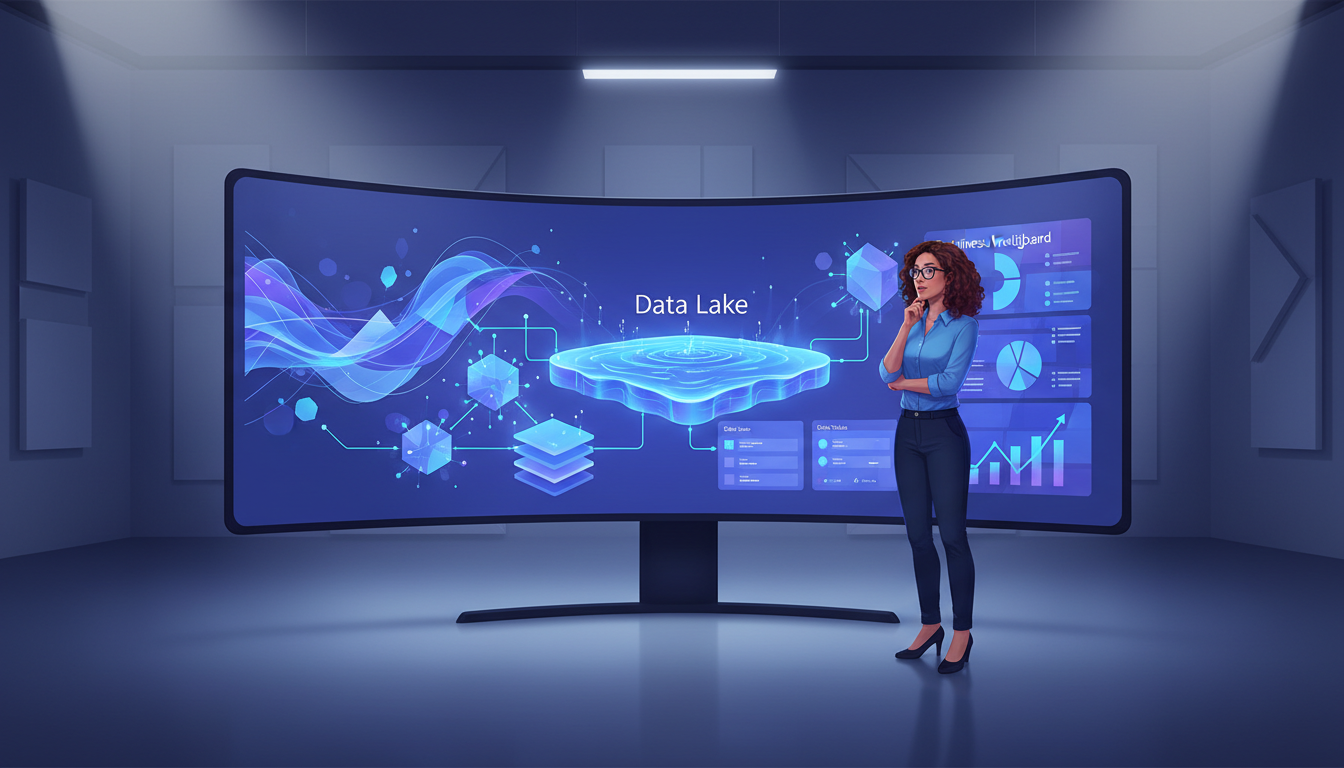
A modern Azure data engineering course teaches pipelines, Spark, Delta Lake, medallion architecture, governance, orchestration, and Power BI semantic models as one working system. It should make learners build, test, optimize, monitor, and explain an end-to-end lakehouse project, while treating Fabric as an architectural choice instead of a product demonstration.
We use this audit to help Azure data engineering learners inspect course evidence, bridge from relational databases into distributed processing, and choose a format that produces credible project work.
What Makes a Modern Azure Data Engineering Course Current?
A current curriculum is not a product inventory. It shows how data moves from source systems through ingestion, distributed transformation, reliable tables, governance, and business consumption. Microsoft’s Fabric architecture places OneLake beneath its analytics workloads, which is why learners need to understand shared data, access, and serving decisions alongside individual tools.
We look for dated syllabi, runnable labs, assessed work, and a clear explanation of why each platform is used. A course can still include familiar services, but it becomes stale when it treats them as disconnected demos, relies on retired certification language, or never asks learners to diagnose a failed run. Our Azure Lakehouse architecture guide gives useful context before comparing offerings.
| Current-Curriculum Signal | Legacy-Curriculum Signal |
|---|---|
| Learners build and explain an end-to-end workflow | Learners only watch tool demonstrations |
| Delta behavior is tested with changing data | Delta Lake appears as a definition or slide |
| Pipelines, notebooks, governance, and BI are connected | Each service is taught in isolation |
| Performance and failures are part of assessment | Successful runs are the only evidence |
| Syllabus dates and project requirements are visible | Broad claims replace lab and assessment detail |
The strongest training also teaches medallion architecture as a set of decisions. Bronze should preserve usable source evidence, silver should validate and standardize reusable data, and gold should support a defined analytical purpose. Repeating layer names without explaining tradeoffs does not prepare someone to design a lakehouse.
How Should Relational Database Learners Move into Spark and Delta?
SQL is an advantage, not a detour. Relational experience gives learners joins, aggregations, data modeling, keys, and incremental-load concepts. The new challenge is understanding files, partitioning, distributed execution, and the fact that a slow transformation often reflects shuffles, skew, storage layout, or an inefficient design choice.
The prerequisite bridge should start with SQL and files before it asks someone to reason about cluster behavior. Microsoft’s current Databricks course expects SQL, Python notebooks, cloud-storage knowledge, basic governance awareness, and Git familiarity, which is a useful reality check for any course marketed as beginner-friendly.
A sensible sequence moves from relational modeling into Parquet and object storage, then Spark DataFrames and SQL, then partitions and shuffles, then Delta tables. From there, learners can build incremental pipelines, evaluate data quality, and serve curated data. Our 90-day roadmap helps structure that progression around a real project.
Delta Lake should be taught through behavior learners can observe. They should make a write fail through schema enforcement, approve a controlled schema evolution, merge changed records, query an earlier table version, and explain which layout decision improves a workload. Those are engineering skills, not vocabulary tests.
Does the Course Teach the Full Azure Data Stack as One Architecture?
A course that covers several familiar names is not automatically full-stack. We want evidence that its labs connect ingestion to Spark, Delta reliability to governed storage, and curated tables to a semantic model or report. Power BI’s Direct Lake model reads Delta-table data from OneLake for analysis, which makes the engineering and consumption boundary a practical design topic.
The audit below compares what a syllabus must prove. A listing deserves a higher score only when its published lesson depth, lab evidence, assessment method, and recent verification date are all visible.
| Required Competency | Lesson Depth To Verify | Lab Evidence To Require | Assessment Method | Last Verified Date |
|---|---|---|---|---|
| ADF Or Fabric Pipelines | Ingestion, incremental loading, orchestration | Scheduled run and failure recovery | Observed build and explanation | 14 August 2026 |
| Spark | Joins, partitions, shuffles, execution behavior | Notebook plus Spark UI review | Troubleshooting task | 14 August 2026 |
| Delta Lake | Enforcement, evolution, merge, time travel | Failed write and controlled recovery | Practical lab | 14 August 2026 |
| OneLake | Storage, shortcuts, access implications | Architecture decision record | Design review | 14 August 2026 |
| Azure Databricks | Notebooks, compute, governed data access | Governed transformation job | Hands-on check | 14 August 2026 |
| Governance | Access, lineage, certified assets | Access and lineage evidence | Scenario assessment | 14 August 2026 |
| Power BI | Semantic model, relationships, serving choice | Curated report connection | Demo and explanation | 14 August 2026 |
How Should Pipelines and Spark Connect?
A learner should ingest from a relational source, API, or file system, then orchestrate a Spark notebook or transformation step with dependencies, parameters, scheduling, and retry logic. The work should include a deliberate failure, a run-history review, and a documented correction.
Which Delta Lake Skills Must Be Demonstrated?
Look for schema enforcement, schema evolution, partitioning or data-layout decisions, optimization, time travel, and sharing patterns. The key proof is not a list of commands. It is a learner explaining what happens when source data changes and why a particular table design protects downstream users.
Where Do OneLake, Governance, and Power BI Fit?
OneLake should be taught as a shared data foundation, while governance stays cross-cutting through identity, access, lineage, and certified serving assets. A full workflow finishes with a semantic model and a report, not a spreadsheet export. Our unified platform comparison helps learners frame that architecture choice around workload needs.
What Project Depth Proves Real Lakehouse Capability?
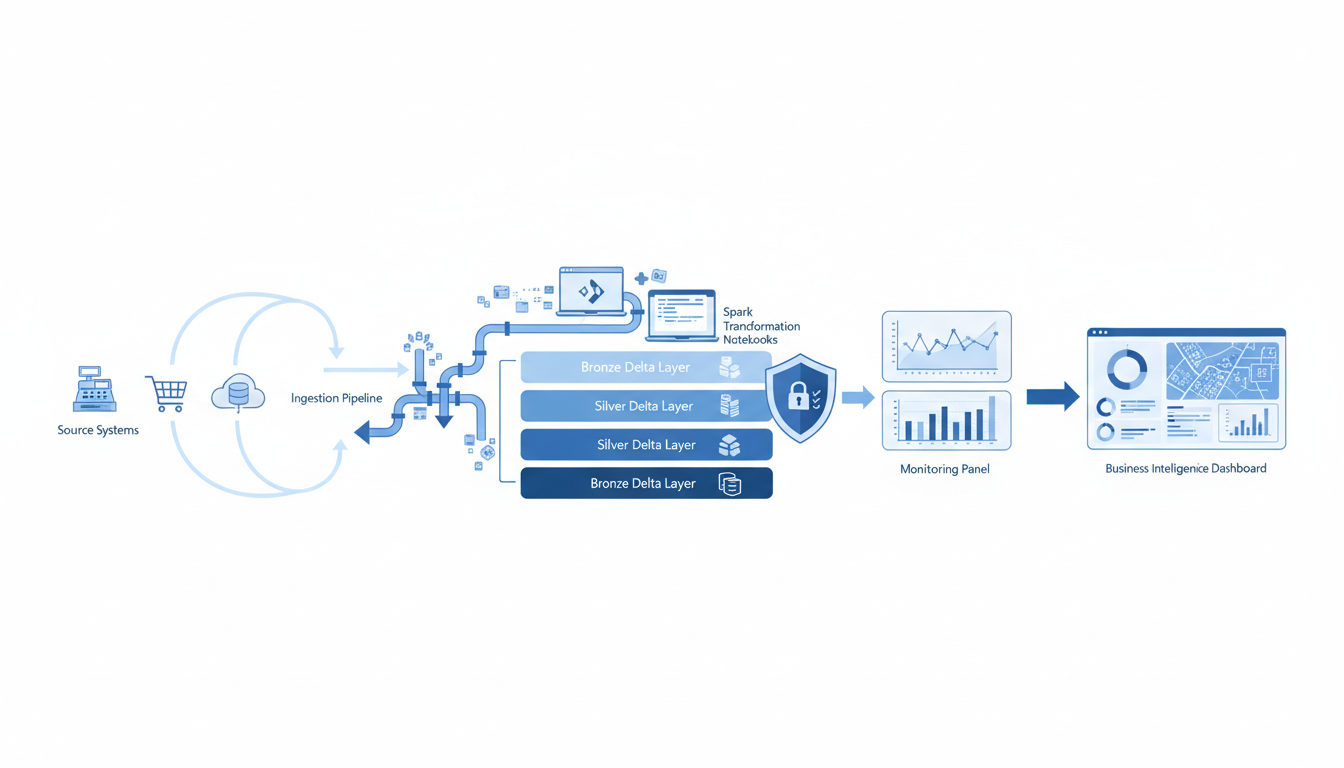
A credible capstone creates evidence across the complete data lifecycle. We expect ingestion, transformation, orchestration, testing, monitoring, governance, and BI consumption, with decisions explained at each stage. Microsoft’s lakehouse scenario likewise connects ingestion, Bronze, Silver, Gold transformation, and Power BI consumption in one workflow.
What Should the Capstone Brief Include?
Use a realistic retail operations case: ingest daily orders plus product and customer reference data, preserve raw records, validate and deduplicate reusable data, then publish a governed sales model for reporting. Introduce a late-arriving update and a source schema change so the learner must recover, explain the impact, and document the result.
How Should Medallion Architecture Be Assessed?
Ask learners why a table belongs in a specific layer, what quality gate it needs, who consumes it, and how it changes over time. That replaces memorized Bronze, Silver, and Gold labels with design reasoning. Our project implementation guide helps distinguish a real build from an attractive but shallow portfolio exercise.
What Troubleshooting Evidence Matters?
A capstone should contain a visible incident, such as schema drift, skew, small files, a delayed pipeline, or an access problem. Learners should inspect logs and execution details, describe the likely cause, make a correction, and compare the result. That evidence is more useful than a completed notebook with no operational story.
| Selection Criterion | Weight | Evidence Required |
|---|---|---|
| Full-Stack Coverage | 25% | Labs connect pipelines, Spark, Delta Lake, governance, and BI |
| Project Depth | 25% | Capstone artifacts and reviewed architectural decisions |
| Troubleshooting And Operations | 20% | Monitoring, failure recovery, and optimization evidence |
| Prerequisite Bridge | 15% | Clear SQL-to-Spark learning sequence |
| Freshness And Transparency | 15% | Dated syllabus, visible hours, price, and assessment scope |
Which Course Format Fits After the Syllabus Passes the Audit?
Once a syllabus meets the technical standard, the right format depends on how much feedback and accountability a learner needs. Guided cohorts can make debugging and architectural review more immediate. Self-paced certificates offer flexibility, but only earn confidence when their labs, assessments, and project requirements are public. Official modules are useful for focused skills, while project-led programs work best when learners must present decisions and recover from realistic failures.
For learners modernizing established integration work, our SSIS migration guide can turn inherited pipeline knowledge into a practical project. It is especially useful when a learner already understands scheduled data movement but needs to learn how distributed transformation, Delta reliability, governance, and serving change the architecture.
We recommend comparing formats by their evidence, not their promises. Look for a dated syllabus, visible lesson hours, a stated price, lab access, review expectations, and a capstone that joins the full workflow. Teams deciding between instructor-led support and independent learning can also use our Fabric team training comparison to assess scheduling, learner support, and implementation needs.
How We Build Modern Azure Data Engineering Capability at Vision Board
At Vision Board, we built our Azure data engineering learning experience for people who need proof of capability, not a crowded folder of videos. We move from SQL foundations into files, Spark, Delta tables, orchestration, governance, and BI consumption so each concept has a job in a real architecture. Our work is designed for working Azure data engineers who want a visible, reviewable path from relational thinking to production lakehouse decisions with confidence. Our coaching emphasizes project reviews, failed-run diagnosis, and choices that learners can defend in an interview or a delivery meeting. We give learners room to ask why a design is appropriate, revise it after feedback, and present an end-to-end explanation that connects technical choices to business use. Start your modern Azure data engineering course with Vision Board.
FAQs on Modern Azure Data Engineering Course
Which Azure Data Engineering Course Covers Delta Lake?
Choose a course with Delta labs covering schema enforcement, controlled evolution, MERGE, time travel, table layout, and documented recovery after a deliberate failure in production.
What Should a Modern Azure Data Engineering Curriculum Include?
A current syllabus connects ingestion, Spark transformations, Delta reliability, orchestration, governance, monitoring, and Power BI semantic models through assessed labs, projects, and dated course evidence.
Which Course Teaches Azure Data Factory, Databricks, Fabric, and Power BI?
Choose training where a pipeline triggers Spark work, governed Delta tables feed a semantic model, and learners clearly explain the architectural tradeoffs behind each decision.
Can I Learn Lakehouse Engineering with Only Relational Database Experience?
Begin with SQL and data modeling, then learn files, partitions, Spark transformations, and Delta writes before attempting sophisticated platform architecture. A project should gradually add orchestration, monitoring, governance, and BI.