Framework Training or Cloud Migration Projects? Enterprise Data Management Training for Azure Teams
Compare framework training, Azure migration projects, and live blended programs for India and US enterprise data teams.
Framework Training or Cloud Migration Projects? Enterprise Data Management Training for Azure Teams
For Azure data engineering teams moving from on-premises Hadoop, training needs to cover more than a certification syllabus. A current four-day official course teaches Fabric data-engineering practices, but a migration team also has to align ownership, controls, validation, and cutover decisions.
Enterprise data management training should match the readiness gap. Framework courses build shared ownership, controls, and governance language. Hands-on Azure migration projects build architecture, pipeline, security, testing, and cutover skill. For distributed teams moving from Hadoop, we recommend a live blended program with role-specific work, reviewed artifacts, recordings, and regional instructor handoffs.
Here, we compare the three paths, map each role to the work it needs to perform, and show how India and US cohorts can learn live without treating attendance or credentials as proof of delivery skill.
What Separates Framework Training from Cloud Migration Projects?
Framework-led training explains how an enterprise should govern data. It gives architects, stewards, leaders, and platform owners a shared language for ownership, controls, quality, risk, and operating-model decisions. Project-led migration training instead asks learners to make and defend technical decisions while building realistic Azure data workloads.
The strongest comparison is not framework versus projects as competing choices. It is a question of what the team must be able to do when training ends. If people cannot agree who owns a critical dataset, a working pipeline alone will not fix the problem. If people understand governance but cannot build, test, secure, and support a cloud-native workload, the framework remains theoretical.
| Decision Factor | Framework-Led Training | Project-Led Azure Migration Training | Blended Live Program |
|---|---|---|---|
| Best Audience | Governance leaders, stewards, executives, architects | Data engineers, architects, platform owners | Cross-functional migration squads |
| Primary Outcome | Shared language, ownership, and controls | Build and validate a target-state workload | Adopt controls while delivering migration work |
| Core Artifacts | RACI, glossary, control map, operating model | Architecture record, pipeline, test plan, cutover runbook | Both governance and delivery artifacts |
| Delivery | Live virtual, dedicated cohort, or self-paced | Instructor-led sprints, labs, and reviews | Repeated live cohorts with shared handoffs |
| Assessment | Knowledge and scenario assessment | Reviewed implementation and scenario assessment | Role-specific assessment plus artifact review |
| Workplace Transfer | Governance adoption plan | Migration-ready patterns and runbooks | Measurable ownership and delivery outputs |
Framework Training Builds the Operating Model
A framework course is the right starting point when the team lacks clarity on who approves data access, owns quality rules, maintains definitions, or resolves control exceptions. Microsoft describes the cloud operating model as the way an organization manages cloud resources, responsibilities, and collaboration.
We use that foundation to make roles practical: which team owns a domain, where policy is enforced, how a steward raises a quality issue, and how an engineer proves a workload meets the agreed control. For an early check of technical coverage, teams can use our curriculum audit.
Project Training Builds Delivery Confidence
A migration project should produce work a technical reviewer can inspect. That includes target architecture decisions, batch and streaming pipelines, source-to-target mappings, security assumptions, automated tests, validation evidence, and a cutover plan.
Project work matters because a migration changes daily engineering practice. Teams must make decisions about orchestration, data contracts, performance, monitoring, access, rollback, and source-platform retirement. A project-led program is strongest when it makes those decisions visible, reviewed, and revisable.
Blended Training Connects Both Gaps
A blended program is the better fit when an organization is changing platform and behavior at the same time. The governance cohort establishes the conditions for trusted work, while technical cohorts build the actual data products within those conditions.
That is especially important for teams moving from Hadoop into Azure lakehouse and real-time patterns. We connect the change to migration work rather than teaching it as separate theory, then point teams to our project route comparison when they need to decide how much hands-on delivery is required.
When Does Enterprise Data Management Training Need a Blended Program?
We recommend choosing the path based on the blocker, not the most familiar course format. A team with strong engineers but unclear decision rights needs framework work first. A team with mature governance but little Azure delivery experience needs project work. A team facing both conditions needs a coordinated blend.
The migration sequence itself supports that decision. Planning, preparation, execution, evaluation, and decommissioning each demand technical and organizational action. Microsoft’s five migration phases explicitly separate preparation from execution and validation from source-platform retirement.
-
Choose Framework Training: When ownership, control requirements, quality expectations, and governance decision rights are unclear.
-
Choose Project Training: When roles and controls are established, but engineers need to build, test, secure, and cut over Azure workloads.
-
Choose A Blended Program: When a Hadoop migration requires governance adoption while engineers build a unified analytics platform.
Use the first cohort to identify capability gaps, then assign the next modules to the work already on the migration backlog. This prevents abstract training from drifting away from implementation, while still giving leaders the evidence they need to make architecture and operating-model decisions.
How Should Azure Migration Roles Learn Governance and Implementation?
A single curriculum should not expect executives, engineers, and stewards to demonstrate the same capability. We assign everyone a common migration context, then give each role its own learning objective and workplace artifact.
That approach keeps governance connected to delivery. Current role definitions distinguish data owners, who manage data assets, from stewards, who maintain quality standards, nomenclature, and rules. Our role mapping turns that distinction into artifacts teams can review together.
| Role | Governance Capability | Azure Project Capability | Workplace Output |
|---|---|---|---|
| Architects | Operating model and decision rights | Target architecture and lakehouse patterns | Signed architecture decision record |
| Data Engineers | Quality and ownership expectations | Batch, streaming, orchestration, and tests | Reviewed pipeline and test evidence |
| Data Stewards | Glossary, quality rules, and stewardship | Metadata, lineage, and validation workflow | Domain glossary and rule set |
| Governance Leaders | Controls, accountability, and adoption metrics | Guardrails and exception workflow | Governance adoption backlog |
| Analysts | Literacy and trusted-data use | Consumption and acceptance criteria | Trusted-data acceptance criteria |
| Platform Owners | Shared responsibility and standards | Security, monitoring, and access controls | Platform control and runbook pack |
| Executives | Sponsorship and measurable outcomes | Investment, risk, and decision cadence | Success measures and escalation model |
For engineers, the practical path should cover both batch and real-time patterns, then require them to explain the tradeoffs in their own migration context. Our lakehouse guide helps teams establish the architecture vocabulary before they start a build sprint.
What Does a Six-Stage Blended Curriculum Deliver?
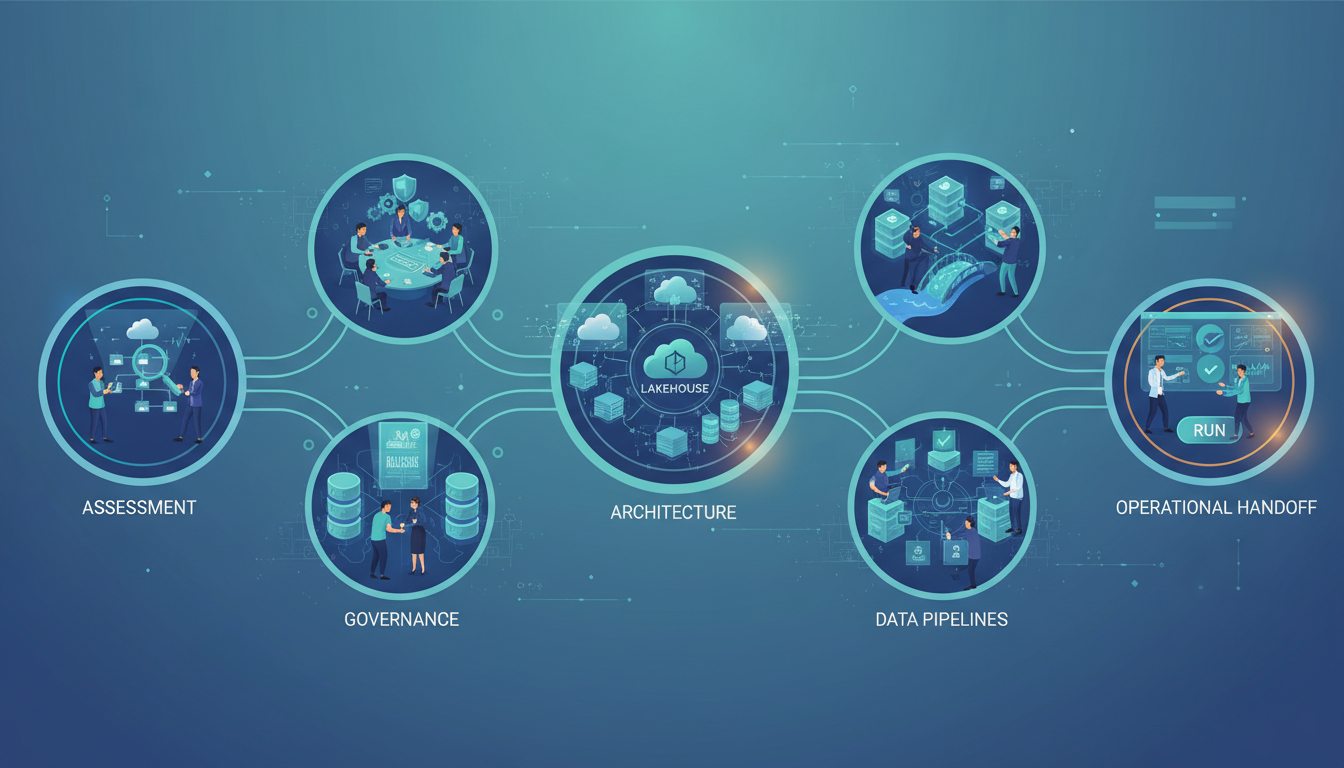
We structure blended learning around migration evidence, not a stack of disconnected modules. Every stage produces an output that someone can use in planning, engineering, governance, or leadership review. That gives the program a clear bridge from capability assessment to workplace transfer.
The six stages should follow the sequence of real migration work: assess the current state, agree ownership, design the target platform, build pipelines, validate the move, and retire what no longer belongs in production.
Assess Readiness and Establish Ownership
Stage one maps capabilities, workload dependencies, source-system risks, and role gaps. Stage two establishes the target operating model through a RACI, glossary, stewardship model, literacy expectations, and adoption measures.
The goal is not to make every learner a governance specialist. It is to give every migration decision an accountable owner and every critical data asset an agreed definition. This is where leaders set sponsorship expectations and teams identify which controls must be designed into the target platform.
Design the Platform and Build the Work
Stage three covers Azure architecture, landing-zone assumptions, identity, cloud controls, access, security, and architectural decision records. Stage four moves into batch ingestion, transformations, orchestration, lakehouse patterns, and real-time processing.
For streaming scenarios, current real-time guidance describes Eventstream as a way to ingest, transform, and route real-time data. We use comparable scenarios so engineers can make decisions with realistic constraints rather than simply follow a lab script. Teams moving legacy integration workloads can also review our SSIS migration guide.
Validate, Cut over, and Transfer Ownership
Stage five requires security checks, data validation, acceptance criteria, cutover communication, rollback conditions, and support coverage. Stage six documents operational ownership, source-platform decommissioning, post-migration metrics, and a 30, 60, and 90-day review cadence.
The final workplace evidence should include a reviewed pipeline, validation report, cutover runbook, control map, and operating handoff. We reinforce those outputs with delivery formats that let teams match instruction time to live project deadlines.
How Do India and US Teams Run Live Training?
Global delivery works when the schedule recognizes that live participation, repeated instruction, and asynchronous handoffs are separate needs. We design shared workshops for the overlap window, then repeat critical sessions when a single window would consistently disadvantage one region.
India uses one national time zone, IST at UTC+5:30, with no daylight-saving changes. During US daylight time, 18:00 IST equals 08:30 Eastern and 05:30 Pacific, while 20:00 IST equals 10:30 Eastern and 07:30 Pacific.
For teams balancing time zones with a demanding project schedule, our delivery formats help leaders choose a practical mix of live instruction, recordings, and project reviews.

| Cohort Event | India | US Eastern | US Pacific | Delivery Rule |
|---|---|---|---|---|
| Shared Live Workshop | 18:00 to 19:30 IST | 08:30 to 10:00 EDT | 05:30 to 07:00 PDT | Use when Eastern participation is primary |
| India-Led Repeat Session | 09:00 to 10:30 IST | Prior day, 23:30 to 01:00 EDT | Prior day, 20:30 to 22:00 PDT | Record and hand off to US office hours |
| Pacific-Friendly Workshop | 20:00 to 21:30 IST | 10:30 to 12:00 EDT | 07:30 to 09:00 PDT | Use for Pacific-heavy teams |
| Instructor Office Hours | Rotated weekly | Rotated weekly | Rotated weekly | Publish decisions and unanswered questions |
We recheck the timetable before each cohort because US clocks change in March and November under daylight-time rules. Recordings should support revision and handoffs, not quietly replace interaction. We track live attendance separately from recording completion, assign named instructor handoffs, rotate office hours, and provide captions, transcripts, accessible materials, and lab-access checks.
The same evidence standard should guide vendor selection. Framework and certification providers can teach common language. Private cohorts can adapt delivery to a team. Project-led providers can review builds. A strong blended option proves how those elements work together.
| Vetting Criterion | Evidence To Request |
|---|---|
| Practitioner Instructors | Recent Azure migration delivery experience |
| Realistic Migration Work | Source-to-target mapping, pipelines, testing, and cutover scenarios |
| Reviewed Work | Named reviewer, rubric, feedback, and revision opportunity |
| Governance Transfer | RACI, ownership, control, and stewardship artifacts |
| Global Live Delivery | Repeated sessions, recordings, handoffs, and rotated office hours |
| Assessment | Scenario assessment plus artifact assessment |
| Completion Reporting | Attendance, completion, accommodations, and output summary |
| Credential Clarity | Clear difference between completion, certification, and implementation evidence |
| Workplace Transfer | Manager review and measurable post-course outputs |
For proof that the learning transferred, leaders should look beyond a badge. They should ask whether the team can show the architecture decision, pipeline review, validation evidence, and ownership model produced during the program. Our learner stories show the kind of real-work outcomes we want training to support.
Why Choose Vision Board for Your Team?
At Vision Board, we build live, project-led learning for Azure data engineering teams that need more than a badge or a library of recordings. Our cohorts connect architecture choices to the migration work people must complete: pipelines, lakehouse patterns, real-time flows, security decisions, validation evidence, and cutover readiness. We also make the organizational work visible through role maps, ownership artifacts, instructor feedback, attendance reporting, and regional handoffs for India and US participants. That combination gives leaders evidence they can review, while learners get practical work that resembles the decisions waiting in their backlog. If your team is moving from Hadoop while establishing a governed cloud-native operating model, we can help shape the right blend of live instruction, reviewed project work, and workplace transfer. We will align the cohort plan to roles, schedules, and shared measurable delivery outcomes. Start with Vision Board.
FAQs on Enterprise Data Management Training
Can a Framework Credential Prove Migration Skill?
No. A credential shows assessment completion, but reviewed architecture, pipelines, test evidence, and cutover decisions show whether a learner can deliver reliable migration work.
Can Recordings Replace Live Instruction for Global Teams?
No. Recordings support handoffs and revision, but live instruction gives teams critique, shared decisions, office hours, and visible participation across regions and roles together.
When Should We Choose a Blended Program?
Choose a blended program when ownership and governance are unsettled while engineers build Azure workloads, because organizational behavior and implementation practices must change together.
What Evidence Should a Training Provider Supply?
Ask for migration experience, realistic artifacts, named review criteria, assessment results, attendance reporting, accessibility support, recordings, and a process for measuring workplace outputs afterward.
How Should We Schedule India and US Cohorts?
Schedule repeated live sessions, rotate office hours, record critical workshops, assign instructor handoffs, track attendance separately, and recheck local times whenever US daylight saving changes.