How Fast Can Oracle DBAs Learn Fabric? An Oracle DBA Transition to Fabric Plan


TL;DR
At Vision Board, we help Oracle DBAs move into Microsoft Fabric by measuring transferable SQL and operations skills, then closing gaps in OneLake, Delta, Spark, orchestration, security, semantic models, and deployment. We show why readiness depends on artifacts and role targets, not a fixed course duration, and how teams can choose a practical schedule and certification path.
How Fast Can Oracle DBAs Learn Fabric? An Oracle DBA Transition to Fabric Plan
Microsoft’s official Fabric data-engineering course is listed as a four-day course, but its intended learners already have data integration and orchestration experience. That makes duration a starting point for planning, not proof of job readiness.
An Oracle DBA transition to Fabric can move quickly when training begins with a skills map rather than a generic beginner syllabus. Strong SQL, schema, job, security, and tuning experience transfers, while OneLake, Delta tables, Spark, notebooks, capacity, semantic models, and modern deployment practices determine the additional time required.
We will map the transferable skills, identify the real gaps, compare workable schedules, and show the evidence a DBA team should produce before taking ownership of a Fabric lakehouse.
How Quickly Can Oracle DBAs Become Productive in Fabric?
A DBA who already designs schemas, writes complex SQL, supports batch jobs, controls access, and investigates production issues does not start from zero. The faster route is to preserve those strengths while changing the unit of work from a database instance to a shared analytics platform with storage, compute, orchestration, and consumption layers.
The right question is not whether the transition takes two weeks or six months. It is whether the learner can complete the responsibilities of the target role, at the available weekly pace, and troubleshoot the artifacts they create. Microsoft also publishes a beginner Fabric path of 7 hours 27 minutes, which is useful orientation but not a substitute for a production-style project.
| Schedule Model | Duration And Weekly Effort | Instructor Access | Lab Depth | Best Fit |
|---|---|---|---|---|
| Intensive | Four training days in one week, followed by capstone practice | Live questions during delivery | Guided labs, then independent troubleshooting | Experienced DBAs with established ETL and cloud fundamentals |
| Part-Time Cohort | Four weeks, with two guided sessions and four hours of labs each week | Scheduled reviews and feedback | Shared capstone with milestone reviews | Working professionals who need accountability |
| Self-Paced | Official orientation takes 7 hours 27 minutes, with project time set after assessment | Peer, mentor, or community support should be arranged | Official exercises plus self-reviewed artifacts | Self-directed learners with reliable technical support |
A fast schedule is sensible only when it leaves room for hands-on evidence. For teams deciding between guided delivery and licenses, our team training formats explain the scheduling and support tradeoffs.
Which Oracle DBA Skills Transfer to Fabric?
The best Oracle DBA transition to Fabric plan starts by translating existing judgment, not discarding it. Database discipline remains valuable because Fabric still requires intentional data design, security boundaries, reliable orchestration, performance investigation, and controlled change.
| Oracle DBA Capability | Fabric Equivalent | What Transfers | What Changes |
|---|---|---|---|
| Schemas, tables, and SQL | Lakehouse tables, warehouses, SQL analytics endpoint | Data modeling and query reasoning | Delta storage and analytical data patterns |
| PL/SQL procedures | Notebooks, Spark SQL, PySpark, and T-SQL | Transformation logic and error handling | Distributed execution and code notebooks |
| Scheduled jobs | Pipelines, triggers, and orchestration | Dependencies, recovery, and scheduling | Parameters, activities, and event patterns |
| Roles and grants | Workspace, item, and OneLake security | Least privilege and audit thinking | Control-plane and data-plane permissions |
| Performance tuning | Capacity, Spark, pipeline, and query monitoring | Baselines, diagnostics, and remediation | Shared capacity and distributed compute |
| Backup and recovery thinking | Delta history, deployment, governance, and lineage | Resilience and change discipline | Lakehouse operations are not database backup administration |
Fabric has four workspace roles, Viewer, Contributor, Member, and Admin, while OneLake security applies data-plane access at more granular levels. That makes an access-control mindset directly useful, even though the permission model is different. Fabric permissions explain the boundary.
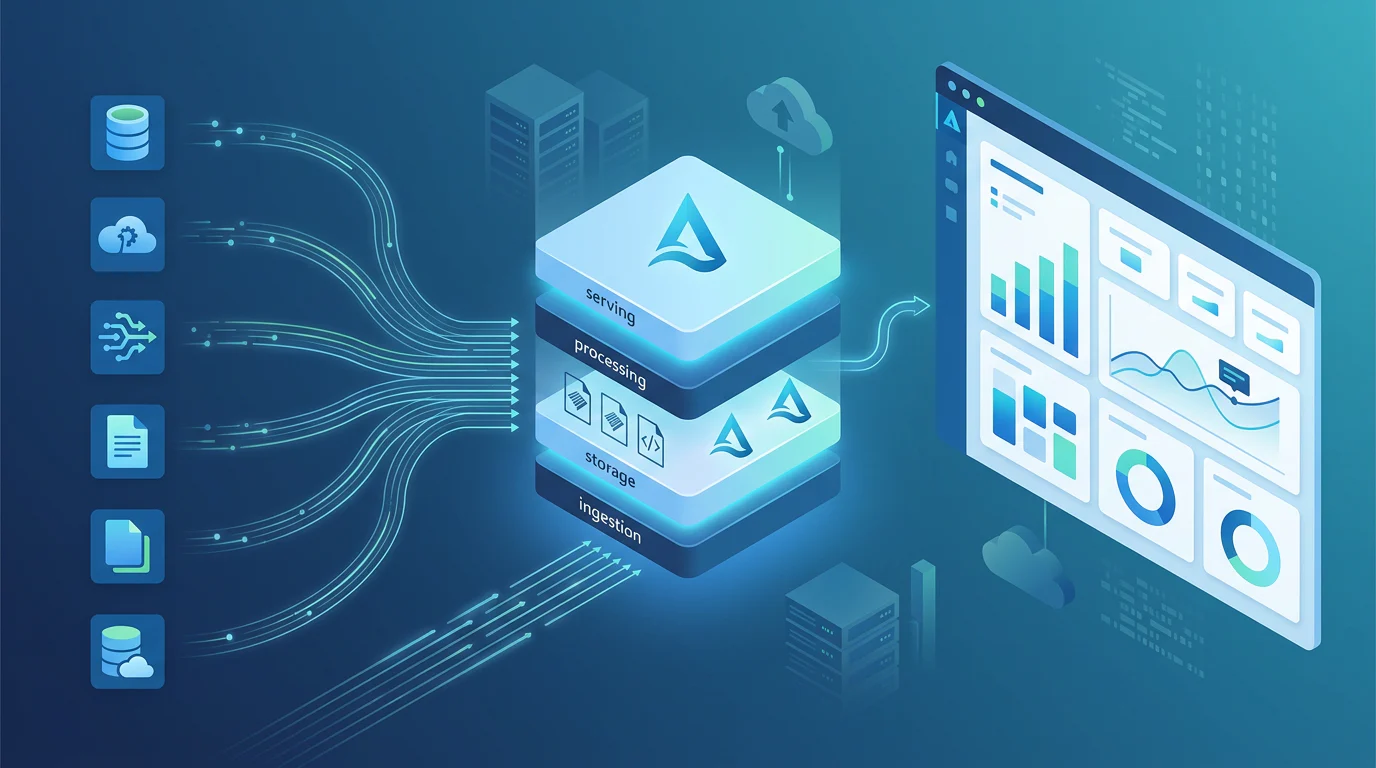
The biggest conceptual shift is accepting that a lakehouse is not simply an Oracle database in another interface. Fabric lakehouses store structured and unstructured data in OneLake, use Delta Lake by default, and can be accessed through both Spark and SQL. Our unified analytics architecture provides useful context for how those responsibilities fit across a data team.
What Must an Oracle DBA Learn for a Fabric Lakehouse Role?
The gaps are specific. Oracle DBAs generally need to learn object storage behavior, OneLake organization, Delta table operations, distributed Spark execution, notebook development, capacity behavior, dimensional modeling, semantic models, and Fabric delivery practices. A lakehouse combines storage flexibility with SQL and Spark access, but it does not make those design choices disappear. Lakehouse fundamentals show why both engines matter.
Assess the Starting Point First
We use a simple 0 to 3 score for each area below. The point is not to label a learner as good or bad. It is to decide where guided time has the highest value.
- SQL And Data Reasoning: Query design, joins, window functions, execution plans, and data-quality logic.
- Python Or Spark Exposure: Any experience with Python, Spark SQL, PySpark, partitions, and distributed transformations.
- Cloud Foundations: Identity, storage, networking, workspaces, and managed-service concepts.
- Dimensional Modeling: Facts, dimensions, grain, history, relationships, and consumer-friendly models.
- DevOps Practices: Git, pull requests, testing, release controls, and environment-specific configuration.
- Target Responsibilities: Engineering, warehousing, analytics engineering, BI development, or platform administration.
Scores of 0 to 6 call for foundations before acceleration. Scores of 7 to 12 suit a guided lakehouse path. Scores of 13 to 18 can move quickly into real artifacts and role-specific troubleshooting.
Learn the Concepts That Are Actually New
OneLake is Fabric’s unified logical data lake, and every Fabric tenant includes it automatically. It is built on Azure Data Lake Storage and supports open table formats such as Delta Parquet and Iceberg. OneLake overview is the right starting point for the storage mental model.
Delta tables add transaction logs, consistency, schema support, and time-travel capabilities to file-based data. Spark introduces distributed execution, while Fabric notebooks support PySpark, Spark SQL, Scala, and SparkR. The learning objective is not merely writing a notebook. It is understanding why a transformation runs where it does and how its compute use affects other workloads.
Separate the Roles Before Training Everyone
Data engineers focus on ingestion, transformation, orchestration, monitoring, and reliability. Warehouse-focused professionals stay closer to SQL-first modeling and structured analytics. Analytics engineers bridge curated data and semantic models. BI developers own reports and business-facing consumption. Platform administrators manage tenant settings, capacities, workspaces, policy, and governance.
That division prevents a DBA from spending weeks on peripheral workloads before mastering their intended responsibilities. For a structured next step, use our lakehouse learning path.
Is a Bootcamp Enough for an Oracle DBA Transition to Fabric?
A bootcamp can be enough to create shared vocabulary, demonstrate the platform, and complete guided exercises. It is not enough on its own to prove that a learner can design a secure lakehouse, recover from a broken load, judge a capacity issue, or deploy safely to a production environment.
Microsoft’s data-engineering certification scope includes implementing and managing analytics solutions, ingesting and transforming data, and monitoring and optimizing the result. Each domain carries a 30 to 35 percent weighting in the DP-700 study guide. That breadth is why completion time must not be confused with operational readiness.
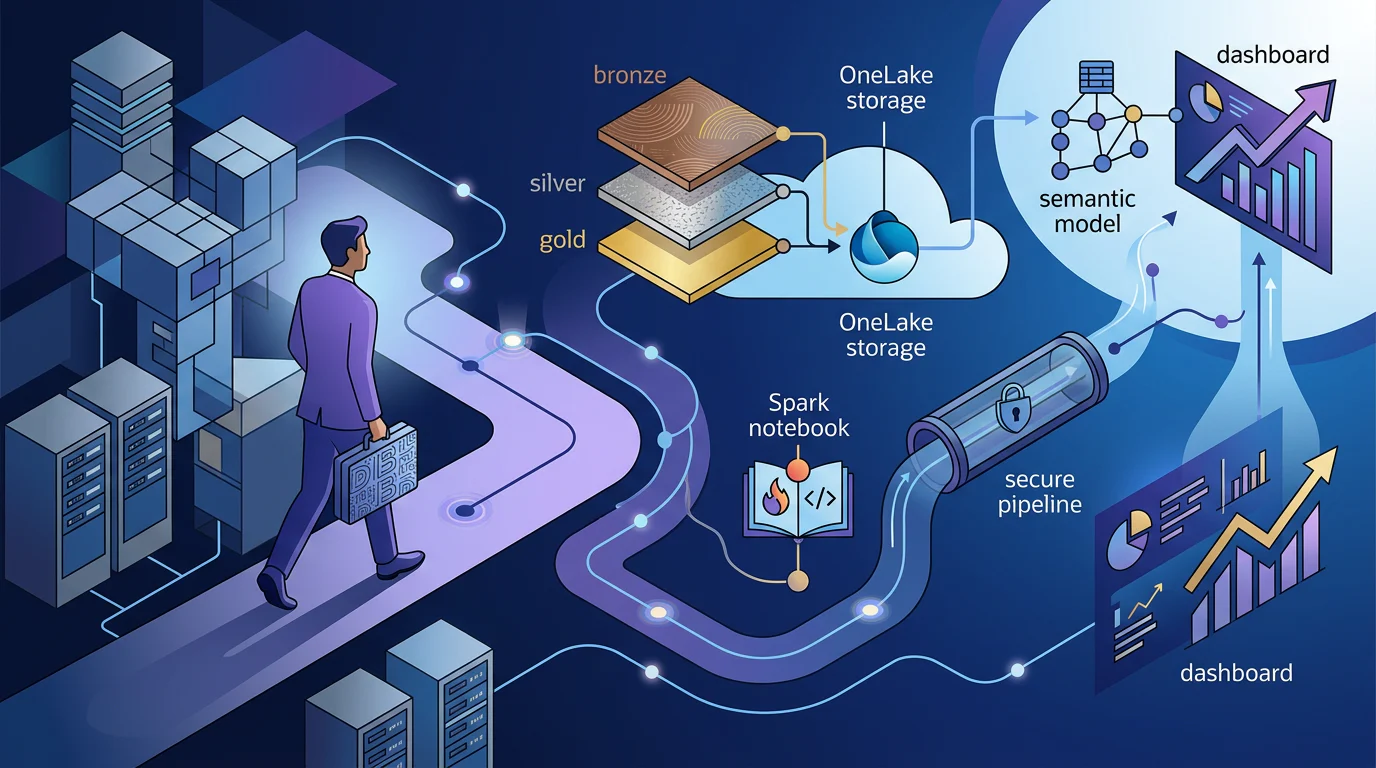
The better measure is a six-stage capstone that persists beyond class time:
- Ingest: Bring a source into Fabric through a pipeline or supported replication pattern.
- Land: Preserve raw data in a bronze layer with clear source, load, and lineage evidence.
- Transform: Build validated silver Delta tables and document quality checks.
- Model: Create gold-layer structures at a defined business grain.
- Secure And Operate: Configure appropriate access, test a failure, and document the diagnosis and fix.
- Deploy And Consume: Promote a controlled change and expose the finished data through a semantic model and report.
Oracle mirroring is a particularly useful capstone scenario because it requires real DBA knowledge. Supported Oracle environments include version 10 and later with LogMiner enabled, alongside archive logging, supplemental logging, gateway setup, and permissions. Oracle mirroring documents those prerequisites.
A capstone also demonstrates whether a learner understands medallion layers. Bronze keeps source data close to its original form, while silver and gold commonly use Delta tables for validated and curated consumption. Choose project-based implementation when the goal is demonstrated capability rather than video completion.
How Should Teams Retrain Oracle DBAs for Fabric?
For a team, the practical answer is not to make every DBA become every kind of Fabric specialist. Start with a shared foundation, assess each person, then assign a primary role path and a secondary literacy goal. A platform administrator should understand semantic-model dependencies, but does not need to become the team’s DAX author. An analytics engineer should understand ingestion reliability, but does not need to own tenant-wide capacity administration.
Teams should select a shared source system and a clear data-consumption case before beginning the project. Using an already familiar source lets DBAs spend their attention on new Fabric concepts instead of also learning unfamiliar business rules. A common capstone makes it easier to compare progress across the cohort, while individual role assignments prevent the training from becoming a shallow tour of every workload.
Teams planning those role paths can compare Azure learning paths before they choose the pace, project scope, and type of support required.
Use Artifacts as the Milestone Rubric
| Milestone | Required Artifact | Troubleshooting Evidence |
|---|---|---|
| Lakehouse Foundation | OneLake and lakehouse design | Explain Files versus Tables choices |
| Ingestion | Parameterized pipeline or replication design | Diagnose a failed or late load |
| Transformation | Notebook and data-quality checks | Resolve schema or Spark errors |
| Governance | Workspace and OneLake access design | Demonstrate least-privilege access |
| Deployment | Source-controlled workspace plan | Explain rollback and change control |
| Consumption | Semantic model and Power BI report | Validate grain, relationships, and refresh behavior |
This model gives leaders something more useful than attendance. It shows who can build, validate, recover, and explain a working data product.
Build Delivery Skills into the Project
Fabric supports Git integration, deployment pipelines, REST APIs, and variable libraries for lifecycle management. A learner should not wait until after the lakehouse is built to discover how changes reach test and production environments. Fabric CI/CD tools should be part of the capstone from the beginning.
Align Certification to the Intended Role
| Intended Role | Recommended Certification | Why It Fits |
|---|---|---|
| Fabric Data Engineer | DP-700 | Ingestion, transformation, orchestration, security, monitoring, and optimization |
| Fabric Analytics Engineer | DP-600 | Data preparation, analytical assets, semantic models, DAX, and Direct Lake |
| Platform Administrator | Role-specific operational learning first | Capacity, tenant, governance, and workspace responsibilities need hands-on administration evidence |
DP-600 places 45 to 50 percent of its current objectives on preparing data, with the remaining objectives split between maintaining the analytics solution and implementing semantic models. DP-600 objectives make it a stronger fit for a DBA moving toward analytics engineering than for a purely platform-administration role.
For a team that needs a paced transition rather than a single event, combine the milestone rubric with our 90-day roadmap.
Learn Fabric with Vision Board
Vision Board helps Oracle DBA teams turn familiar database discipline into working Fabric capability. We begin with a practical assessment of SQL, orchestration, cloud, modeling, and delivery skills, then select the shortest schedule that still leaves time to build and troubleshoot real artifacts. Our instructors can focus a cohort on the role the team actually needs, whether that means ingestion pipelines, lakehouse transformations, governed semantic models, or platform operations. We use a shared capstone so leaders can review evidence, not attendance: tested loads, documented failures, security decisions, deployment records, and a report that consumes the finished data product. That approach keeps fast learners moving without treating a short class as a universal finish line. For working professionals, we can structure guided sessions around existing responsibilities and maintain a clear milestone cadence. We also leave teams with a repeatable review framework. Explore our flexible Microsoft Fabric training.
FAQs on Oracle DBA Transition to Fabric
How Long Does It Take an Oracle DBA to Learn Fabric?
Timeline depends on assessed skills, weekly availability, and target role. Require working lakehouse artifacts and troubleshooting evidence before confirming that the learner has completed the transition.
What Fabric Skills Do Oracle DBAs Already Have?
Oracle DBAs bring SQL, schema design, jobs, access control, recovery thinking, monitoring, and performance diagnosis. They must apply those strengths to shared data, distributed compute, and analytical consumption.
Is a Bootcamp Enough for an Oracle DBA Moving to Fabric?
A bootcamp can establish vocabulary and guided practice for experienced data professionals. It cannot alone demonstrate secure deployment, failure recovery, or ownership of a production-style lakehouse.
Should an Oracle DBA Take DP-700 or DP-600?
Choose DP-700 for engineering, orchestration, security, monitoring, and optimization work. Choose DP-600 when analytical preparation, semantic models, Direct Lake, and DAX are central to the role.