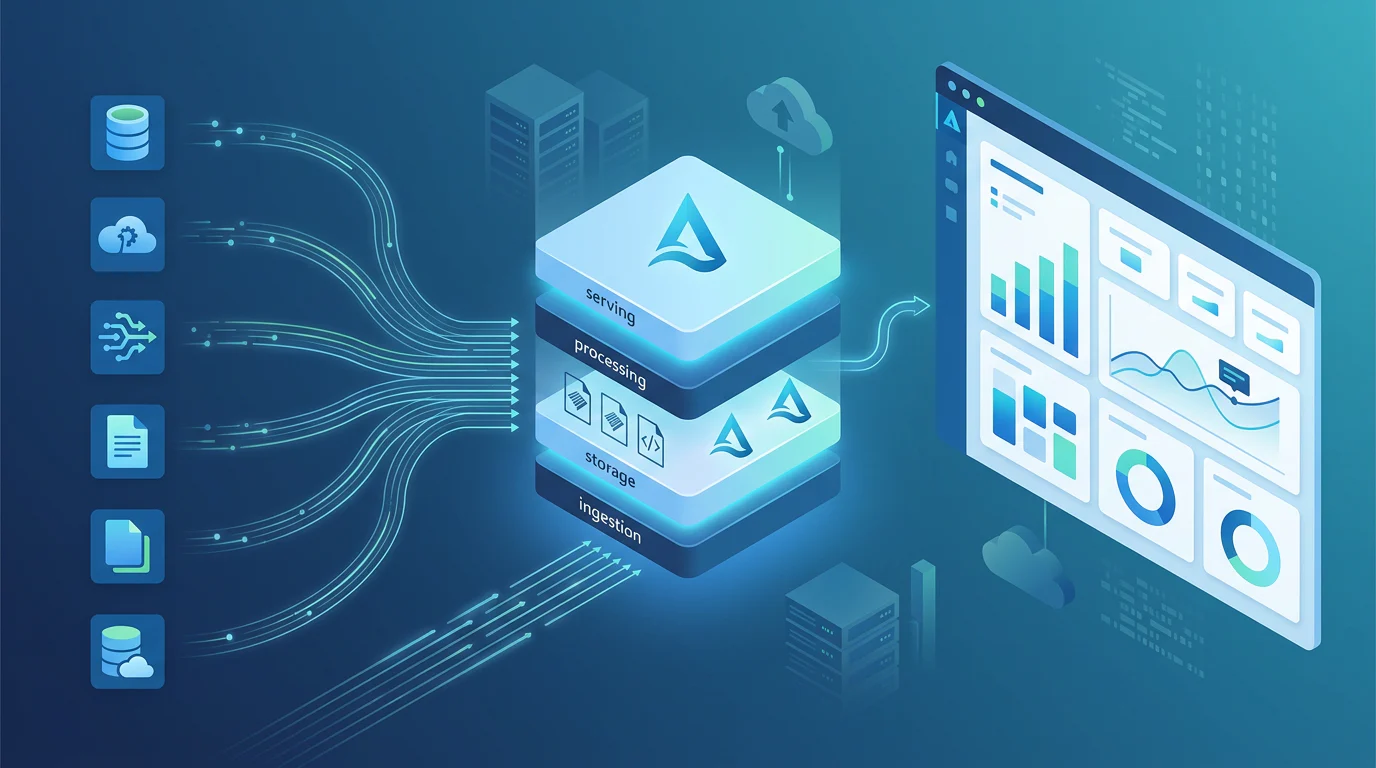
Lakehouse Architecture for Multi-Source BI: End Dashboard Joins

TL;DR
We show Azure data engineering teams how to centralize multi-source BI in a governed lakehouse, moving fragile report-level joins into reusable bronze, silver, gold, and semantic layers. The article explains architecture choices, ingestion patterns, BI performance design, governance controls, and a phased migration that preserves existing dashboards.
Lakehouse Architecture for Multi-Source BI: End Dashboard Joins
Azure teams rarely struggle because they lack a connector. The current data-integration guidance lists 50+ connectors for managed copy patterns, yet dashboards still become fragile when every report performs its own cross-source joins.
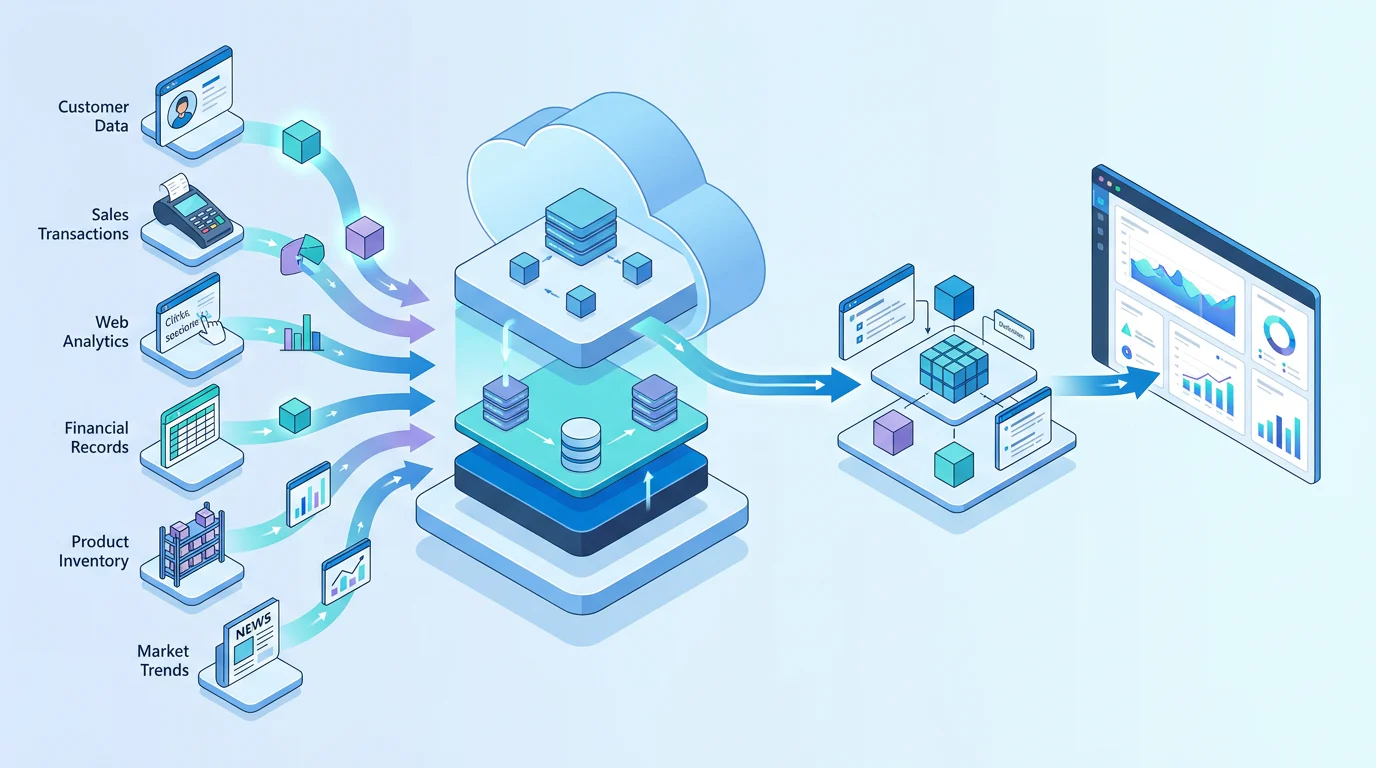
We centralize multi-source BI by landing every source in a governed lakehouse, standardizing shared entities in silver, and serving gold dimensional models through a semantic layer. That moves joins out of reports, preserves lineage and incremental refresh, applies access rules consistently, and lets BI, engineering, and ML use governed data without sharing every compute path.
This guide shows how to choose the right architecture, ingest mixed sources, define layer contracts, optimize BI serving, and migrate without breaking the dashboards people already trust.
Why Do Dashboard-Level Joins Fail with Six Sources?
When a dashboard joins finance, CRM, support, product, files, and event data directly, it becomes an integration pipeline disguised as a report. Every author must decide how to match customers, which timestamp wins, how deleted records behave, and what “revenue” means. Those decisions drift across reports, creating inconsistent metrics and refresh failures that are difficult to trace.
A better boundary is simple: operational systems own transactions, while the analytics platform owns repeatable integration and business definitions. A semantic model is designed for this job because it represents an analytical domain through facts, dimensions, measures, and friendly business terminology. Microsoft’s semantic model guidance describes this layer as typically following a star schema.
For Azure data engineering teams, the point is not to force every source into one immediate replacement project. It is to stop recreating the same join logic in every report and publish a governed path that improves over time. Our unified analytics primer explores the platform roles behind that shift.
Which Lakehouse Architecture for Multi-Source BI Should You Choose?
The right lakehouse architecture for multi-source BI depends on where transformation belongs and how dashboards need to behave. A lakehouse suits shared engineering, BI, and ML storage. A warehouse suits a SQL-first curated serving layer. Virtualization suits narrow live lookups, but it leaves dashboard speed dependent on source performance and network conditions.
For most teams managing six sources, the practical answer is combined architecture: ingest and standardize in lakehouse layers, publish gold marts in the serving engine that fits the team, and expose certified metrics through a semantic model. Current Microsoft guidance supports both all-lakehouse designs and a bronze-and-silver lakehouse with a warehouse gold layer, while keeping engines on shared storage.
| Criterion | Lakehouse | Warehouse | Virtualization | Combined Architecture |
|---|---|---|---|---|
| Dashboard Latency | Interactive when gold is optimized | Interactive for SQL-first marts | Depends on source and network | Curated dashboards plus live exceptions |
| Freshness | Batch, CDC, or stream dependent | Load and refresh dependent | Source-current | Match the serving path to the workload |
| Data Duplication | Intentional raw-to-curated copies | Curated analytical copy | No managed replica | Retain only justified analytical copies |
| Governance | Shared contracts and lineage | Strong curated access boundary | Inherits source boundaries | Central governance plus source controls |
| ML Support | Reuses detailed and curated data | Often needs an adjacent path | Weak for repeatable features | Shared storage, separate compute |
| Operating Effort | Moderate | Lower for SQL-only teams | Low initially, fragile at scale | Moderate, supports phased adoption |
Use virtualization for exceptions, such as a one-off operational status lookup. Do not make it the default answer for recurring executive dashboards that repeatedly combine domains. For a broader workload-selection framework, see our platform comparison.
How Should Batch, CDC, and Streams Feed the Same Model?
Ingestion should match the source’s change behavior, not the preferences of the reporting tool. Use scheduled batch loads for files and historical extracts, CDC for databases that expose inserted, updated, and deleted records, and streams for event data that needs low-latency operational visibility. All three paths can land in the same governed storage boundary when they retain source identity and ingestion metadata.
Every bronze record should carry its source name, extraction time, batch or change identifier, schema version, and processing status. This makes replay, auditing, and late-arriving-data handling possible without asking report authors to reconstruct pipeline history. CDC is especially useful because it processes only changed records, reducing source-system load while keeping the analytical copy current. Microsoft’s CDC guidance covers both source-based CDC and watermark-based incremental copy when CDC is unavailable.
A dependable migration pattern starts with a historical backfill, then switches to incremental changes, then proves totals and record counts before any dashboard is repointed. Streaming deserves its own serving path when seconds matter, but its durable events should still become part of the broader analytical record. Our Azure pipeline guide can help teams map those choices to maintainable orchestration.
What Does Each Data Layer Own?
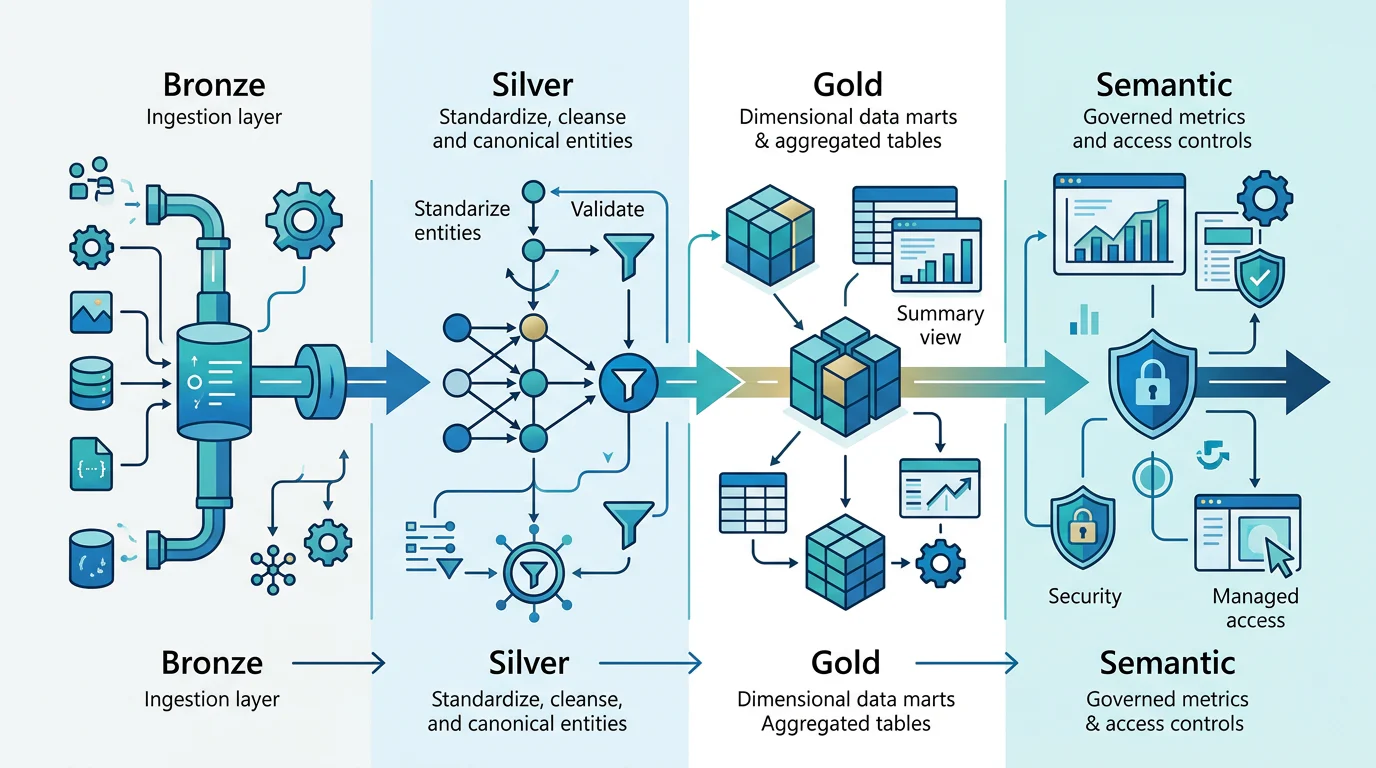
The medallion pattern works when layers are contracts, not folder names. Each layer should answer a distinct question: did we receive the source record, can we trust and reuse it, is it ready for a defined business decision, and how will people interpret it consistently?
Bronze: Preserve and Replay Source Data
Bronze stores data as it arrived, with minimal transformation and enough metadata to prove provenance. It is where teams retain raw files, extracts, CDC events, and stream records so they can reprocess a source after a rule changes or an upstream defect is found.
When teams need a practical way to sequence that work without replacing every system at once, our consolidation plan helps frame the transition around governed delivery.
Silver: Create Canonical Business Entities
Silver is where cross-source joins belong. Standardize dates and currencies, validate keys, remove duplicates, resolve customer and product identity, and manage slowly changing dimensions. The output should include at least one validated, non-aggregated representation of important business events.
Gold: Serve Business Questions
Gold turns reusable entities into domain marts: facts at declared grain, conformed dimensions, materialized results, and aggregates that match common dashboard questions. Gold data is curated for consumption, not a place to hide additional source-cleaning logic.
Semantic Layer: Govern Interpretation and Access
The semantic layer owns measures, relationships, labels, default filters, certification, and row-level security. It prevents the dashboard author from redefining margin, active customer, or fiscal period every time they build a visual. Cataloging lineage also matters, although teams should document gaps because some current lineage coverage remains item-level rather than fully granular.
| Layer | Contracted Output | Required Controls | Primary Owner | Typical Consumers |
|---|---|---|---|---|
| Bronze | Raw source records and ingest metadata | Source lineage, replayability, schema quarantine | Data engineering | Engineering and audit |
| Silver | Canonical entities and validated event detail | Deduplication, conformance, SCD rules, quality tests | Domain data product owner | Engineering, analytics, ML |
| Gold | Dimensional marts and aggregates | Reconciled metrics, performance tests, release versions | Analytics engineering | BI and approved ML |
| Semantic | Measures, relationships, and access rules | Metric approval, RLS testing, certification | BI lead and data steward | Dashboards and self-service BI |
This contract-based approach gives BI, data engineering, and ML teams shared governed storage without forcing them onto one compute path. Teams building the necessary skills can use our lakehouse engineering path.
How Do You Serve, Govern, and Migrate BI Without Slowing It Down?
Fast BI begins with a serving design, not a promise that raw data will query quickly. Model gold data as facts and conformed dimensions, then create aggregate tables for the few high-value slices users ask for repeatedly. Keep detailed facts available for drillthrough, but do not make every executive visual scan them.
Design for the Common Query
Build star schemas around business processes, such as orders, tickets, payments, or product usage. Create aggregate tables for common date, customer, geography, and product combinations. Power BI guidance notes that performance can become a consideration once a distinct-count column exceeds 2 to 5 million values, which makes modeled aggregates and carefully chosen grains especially valuable.
Separate Storage from Serving
Gold tables can be optimized through sensible file management, clustering or partition-aware access, materialized results, and cache-aware semantic models. Direct Lake is useful when a semantic model needs to consume lake files without an extra import copy, while Import and DirectQuery remain valid when their refresh and freshness tradeoffs fit the workload.
Put Governance in the Query Path
Metric definitions need named owners and testable approval rules. Data stewards should own glossary consistency, quality expectations, and issue triage. Security should apply least privilege at storage and workspace boundaries, then use semantic-model row-level security for report consumers. Avoid sharing raw lakehouse access simply because someone needs a dashboard.
Migrate in Phases, Not with a Big Switch
Keep existing dashboards running while new gold marts and semantic models are proven in parallel. Deployment pipelines can preserve incremental-refresh data and partitions during model changes, which supports controlled adoption rather than an abrupt cutover. Microsoft documents that behavior in its deployment process.
| Phase | Deliverable | Dashboard Continuity Control |
|---|---|---|
| Inventory And Baseline | Source-join map, metric inventory, refresh baseline | Existing dashboards remain unchanged |
| Land And Backfill | Bronze history plus incremental ingestion | Reconcile source totals before exposure |
| Conform And Validate | Silver entities, SCD rules, quality gates | Run old and new results in parallel |
| Serve And Certify | Gold marts, semantic model, aggregates, RLS | Migrate one domain at a time |
| Cut Over And Retire | Sign-off, lineage, runbooks, deprecation date | Keep a rollback window before retiring joins |
For more detail on keeping response times practical as the model grows, read our BI performance guide.
Build the Foundation with Vision Board
At Vision Board, we help Azure data engineering teams turn a confusing collection of pipelines, reports, and isolated tools into an architecture people can operate. Our learning paths focus on the design decisions that determine whether a lakehouse becomes a dependable BI foundation: source contracts, conformed entities, semantic models, performance testing, security, and phased delivery. We work from the dashboards and source systems your team already relies on, so training can strengthen existing delivery while guiding the next migration wave. If your team needs to align engineering, BI, and ML contributors around shared data products, start by assessing the architecture you have, the joins you can retire, and the controls you need before publishing new metrics. We make the technical choices concrete before your team commits to a wholesale replacement. Explore our practical Azure-focused courses, team learning options, architecture guides, and resources at Vision Board.
FAQs on Lakehouse Architecture for Multi-source BI
How Should BI Centralize Data from Multiple Sources?
Centralize source data in a governed lakehouse, then publish canonical entities and dimensional marts. Reports should query one certified semantic model instead of rebuilding joins independently.
When Is Virtualization Better Than a Lakehouse?
Use virtualization for occasional, freshness-critical operational lookups that cannot tolerate replication. Use a lakehouse when dashboards repeatedly combine domains, need historical consistency, or support ML.
How Does Medallion Architecture Improve BI Performance?
Model gold data as facts and conformed dimensions, create aggregates for repeated high-level questions, and use a semantic model to govern measures, relationships, access, and security.
How Can Teams Migrate Without Breaking Dashboards?
Run old and new models in parallel, reconcile agreed metrics, migrate reports by domain, retain a rollback window, and retire dashboard joins only after consumer acceptance.