Live Workshops vs Migration Simulations Across India-US Time Zones
Live workshops vs migration simulations for India-US Azure data teams moving from Hadoop to a cloud-native unified analytics platform.
Live Workshops vs Migration Simulations Across India-US Time Zones
When an India-US data team moves Hadoop workloads to a cloud-native platform, training is part of delivery risk, not a side benefit. A 2025 industry survey found average training spend of US$874 per learner, which makes the format decision worth treating as an operating investment.
For live workshops vs migration simulations, we recommend live workshops when a distributed team needs shared architecture language, instructor challenge, and immediate answers. We use simulations when the team must rehearse decisions, governance, incidents, and time-zone handoffs. For a Hadoop-to-cloud program, we sequence both: common instruction first, then role-based practice using real migration scenarios.
This comparison shows how to schedule, assign, measure, and choose the right mix for distributed Azure data engineering teams.
What Do Live Workshops vs Migration Simulations Teach?
These enterprise migration training formats solve different problems. A live workshop gives engineers, architects, operators, governance teams, and project leads a shared model of the target platform. It is where we resolve vocabulary gaps, inspect trade-offs, and make sure every role understands why a chosen pattern matters.
A simulation tests whether that shared understanding survives pressure. Azure’s architecture guidance frames decisions through reliability, security, cost optimization, operational excellence, and performance efficiency, which makes a useful workshop backbone. Azure principles
| Criterion | Live Workshop | Migration Simulation | Blended Sequence |
|---|---|---|---|
| Primary outcome | Shared concepts and architecture language | Practiced decisions, handoffs, and incident behavior | Knowledge applied to the actual operating model |
| Best timing | Discovery and target-state design | Pilot, cutover rehearsal, and stabilization | Workshop first, simulation second |
| Instructor role | Explain, challenge, and answer questions | Inject events, observe, and debrief | Teach, then facilitate practice |
| Evidence produced | Architecture review and knowledge assessment | Runbooks, decision logs, and retrospective actions | Both design and operational evidence |
| Risk When Used Alone | Knowledge may not transfer to incident conditions | Baseline skill gaps may slow the exercise | Requires stronger coordination |
For a Hadoop transition, workshops should cover inventory, cloud architecture, batch and streaming pipelines, identity, security, governance, monitoring, and cost controls. Our modern Azure data engineering curriculum should create enough common language that a later exercise can focus on decisions rather than definitions.
Simulations should be realistic, but not theatrical. Research on interdisciplinary simulations found a positive knowledge effect across 766 participants, yet that evidence comes from healthcare, not enterprise data engineering. We use it as support for disciplined scenario design and debriefing, not as a promise that one format automatically produces ROI. Simulation evidence
A blended program is especially useful when teams are moving from Hadoop clusters to a unified analytics platform. The workshop makes the target architecture legible. The simulation exposes where handoffs, ownership, controls, and recovery assumptions still break.
How Should India-US Sessions Be Scheduled?
Time-zone design is a learning-design decision. If India repeatedly attends late at night or the United States repeatedly joins before the workday, participation may remain visible while discussion, questions, and ownership quietly drop.
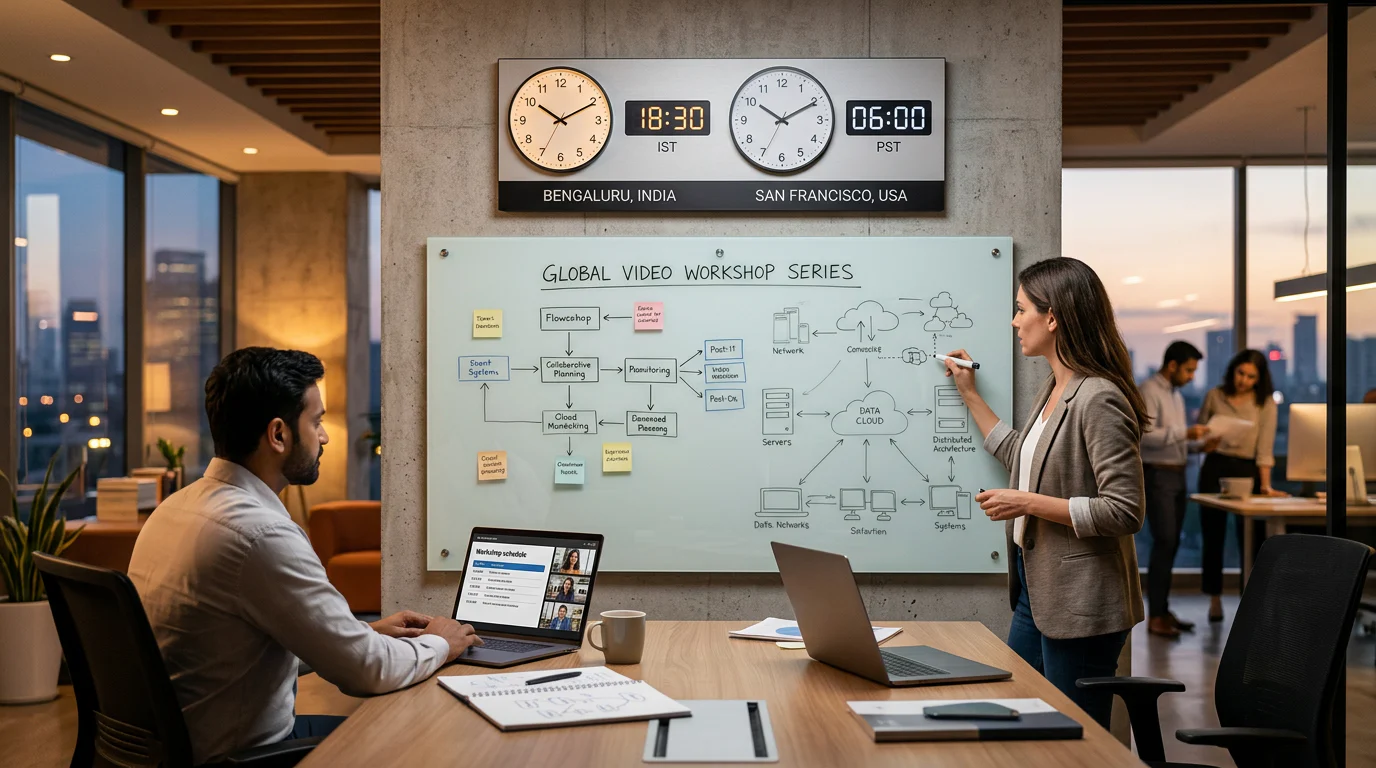
India uses IST, UTC+5:30. U.S. Eastern Daylight Time ends on November 1, 2026, so calendar invites should always show local time, UTC, date, and the applicable time-zone abbreviation. IST guidance
| Schedule Template | Verified Local Times During U.S. Daylight Time | Best Use |
|---|---|---|
| Shared Live Workshop | 20:00 to 21:30 IST, 10:30 to 12:00 EDT, 07:30 to 09:00 PDT | Whole-team architecture instruction |
| Duplicate Cohorts | Cohort A: 20:00 to 21:30 IST, 10:30 to 12:00 EDT. Cohort B: 07:30 to 09:00 IST, 22:00 to 23:30 EDT previous day, 19:00 to 20:30 PDT previous day | Preserves live access when one recurring slot is inequitable |
| Rotating Simulation Handoff | Week A: 20:30 to 21:15 IST, 11:00 to 11:45 EDT, 08:00 to 08:45 PDT. Week B: 07:30 to 08:15 IST, 22:00 to 22:45 EDT previous day, 19:00 to 19:45 PDT previous day | Shares early and late burden during handoff practice |
After daylight time ends, 20:00 IST becomes 09:30 EST and 06:30 PST. Teams should publish the standard-time conversion before it changes, rotate the inconvenient slot, and keep asynchronous office hours available for design questions that cannot wait for the next session.
Recordings are useful for review, but they are not a replacement for real collaboration. We pair them with captions, a written decision log, and duplicate cohorts when necessary. Our global data-team training guide can help teams design the cadence around actual migration milestones.
What Should Migration Simulations Contain, and Which Roles Need Which Track?
A strong simulation uses sanitized migration inputs, clear decision rights, and consequences that feel plausible to the team. We do not use production PII in an exercise, and we do not treat a simulation as an excuse to improvise governance after an incident appears.
Start with Sanitized Migration Inputs
Build the scenario from a Hadoop estate inventory: datasets, schema dependencies, jobs, service identities, classifications, batch SLAs, streaming latency expectations, and cost constraints. Microsoft’s migration guidance specifically identifies HDFS-to-Azure big-data migration as a relevant use case for Azure Data Factory. Migration guidance
Rehearse Six Migration Events
| Event | Inject | What The Team Must Demonstrate |
|---|---|---|
| Inventory And Schema Mapping | A critical dataset has incompatible types and undocumented ownership | Map the schema, assign ownership, and record a migration decision |
| Batch And Streaming Design | A workload needs daily batch plus near-real-time events | Select patterns and explain governance and cost consequences |
| Pipeline Failure And Handoff | A pipeline fails before the India-US handoff | Triage, update the runbook, and transfer clear ownership |
| PII Exposure | A classifier flags sensitive data in a target zone | Contain access, classify data, notify the right role, and preserve evidence |
| Reconciliation Gate | Source and target row counts diverge | Diagnose the difference and enforce an acceptance threshold |
| Cutover And Rollback | A critical cutover misses its service target | Apply go or no-go authority, rollback, communicate, and review |
Give Each Role a Track
| Role | Workshop Focus | Simulation Responsibility | Learning Evidence |
|---|---|---|---|
| Azure Data Engineers | Batch, streaming, schema evolution, and pipeline design | Resolve pipeline failures and reconciliation defects | Tested pipeline and updated runbook |
| Architects | Target architecture, identity, resiliency, and cost trade-offs | Approve cutover or rollback against criteria | Decision record and architecture diagram |
| Platform Operators | Monitoring, access controls, and incident procedures | Detect, escalate, recover, and hand off | Alert-to-handoff timeline |
| Governance Teams | Catalog, stewardship, classification, and policy | Handle PII exposure and approval paths | Owner, classification, and remediation record |
| Project Leads | Dependencies, RACI, cutover governance, and communication | Coordinate escalation and stakeholder decisions | Risk log and retrospective actions |
The technical track should connect to the work already underway, whether the team is following a legacy ETL modernization path or building new workloads. Our Azure pipeline design guide is a useful companion when the simulation exposes a pipeline-design gap.
Turn the Debrief into Evidence
The debrief should create assets that survive the workshop room: a decision log, revised RACI, glossary additions, incident timeline, migration runbook, and prioritized remediation backlog. A useful exercise ends with a named owner and due date for every unresolved control or operating-model issue.
How Should Learning and Cultural Change Be Measured?
Attendance alone measures access, not readiness. We measure participation, competence, and application separately, because a learner can watch every session without being ready to approve a cutover or accept a cross-region handoff.
Measure Participation and Competence
Track invited learners, live attendance, recording completion, office-hours participation, and no-shows by region. Then use role-specific before-and-after tasks, architecture reviews, and simulation decision scores to identify whether the team can apply the material.
Measure the Operating Model
A cloud migration changes more than technical tools. Teams need explicit ownership, decision rights, shared terminology, escalation paths, and a clear division between platform and workload responsibilities. Our governed lakehouse guide supports the shared-data practices that make those responsibilities concrete.
We also use an anonymous psychological-safety pulse before and after the program. The foundational study associated psychological safety with learning behavior across 51 work teams, but we treat the measure as a signal for discussion, not proof that training caused a culture change. Team learning study
Preserve Evidence Without Over-Retaining Data
Keep attendance exports, assessment results, decision logs, runbook versions, and simulation actions according to the organization’s approved retention schedule. Review recordings, scenario data, access permissions, and retention requirements with privacy and compliance stakeholders before delivery.
Accessibility belongs in the operating model too. WCAG 2.2 includes live-captioning requirements for synchronized audio, so captions, transcripts, and accessible artifacts should be planned rather than added after delivery. WCAG 2.2
Which Format Should Your Team Choose?
Choose the format that resolves the next meaningful migration risk. If the team lacks a shared understanding of its target architecture, start live. If it understands the architecture but has not rehearsed a failed pipeline, reconciliation discrepancy, governance escalation, or rollback, move into facilitated practice. Teams can also use our platform-training comparison to frame the delivery choice.
Score each criterion from 0 to 2, then use the total as a discussion tool rather than an automatic procurement rule.
| Decision Criterion | Workshop Signal | Simulation Signal |
|---|---|---|
| Team Distribution | A common baseline is missing | Cross-time-zone handoffs must work under pressure |
| Migration Stage | Discovery or target-state design | Pilot, cutover, or stabilization |
| Skill Variance | Concepts and terminology vary widely | Core knowledge exists but response behavior varies |
| Compliance Needs | Policies and control vocabulary need alignment | Teams must demonstrate controls and preserve evidence |
| Interaction Requirement | Instructor Q&A and design critique matter | Escalation and decision behavior must be observed |
| Technical Scope | Architecture choices remain open | Pipelines, reconciliation, and rollback need rehearsal |
| Access And Scheduling | Cohorts and recordings can close access gaps | Live handoff practice is essential, so inconvenience must rotate |
| Budget | Compare fully loaded cost per eligible learner | Fund facilitation where migration risk justifies it |
Use external spending benchmarks carefully. They show why generic learning budgets cannot substitute for a real quote that includes duplicate cohorts, captions, recordings, office hours, scenario design, and privacy review. For teams deciding between formats, our global migration labs comparison gives another useful decision point.
The default answer for an active Hadoop migration is blended: workshop first for common architecture language, then simulation for real operating behavior. That sequence makes cultural change visible through ownership, decision rights, handoffs, and recovery actions.
Build an India-US Migration Program with Vision Board
Vision Board helps distributed Azure data engineering teams turn a Hadoop migration into a shared operating model, not a collection of disconnected lessons. We start by mapping the existing estate, target architecture, batch and streaming responsibilities, governance controls, and time-zone constraints. Then we build live sessions around the decisions your engineers, architects, operators, governance specialists, and project leads actually need to make. Our facilitated practice can use sanitized scenarios for schema mapping, failed pipelines, exposure containment, reconciliation, cutover, rollback, and handoff. We also help define evidence that leaders can review: attendance, task assessments, decision logs, runbooks, and remediation actions. The result is a program that gives each role a common vocabulary while testing whether the team can operate the modern platform together. It keeps the work grounded across India and the United States under realistic business constraints. Plan your team’s next migration learning sequence with Vision Board
FAQs on Live Workshops vs Migration Simulations
Are Live Workshops or Migration Simulations Better for a Hadoop Migration?
Start with workshops when architecture language, migration scope, or baseline skills differ. Add simulations before pilots or cutovers to rehearse decisions, recovery, and handoffs safely.
How Can India-US Data Teams Schedule Live Training Fairly?
Use published local and UTC times, duplicate cohorts when needed, rotate inconvenient sessions, provide captioned recordings, and hold asynchronous office hours for questions that need instructor follow-up.
Which Roles Should Join a Migration Simulation?
Include data engineers, architects, platform operators, governance teams, and project leads. Each role should practice its own decision rights while observing dependencies with every other role.
How Do We Measure Cultural Change During Migration Training?
Measure ownership, decision rights, glossary adoption, handoff quality, escalation clarity, and psychological safety signals alongside attendance, assessments, runbook updates, and remediation completion after every migration exercise.