Live Cohorts vs Migration Labs for Global Teams
Compare live cohorts and migration labs for India-US Azure data teams, including time-zone equity, practical proof, cultural change, and cost.
Live Cohorts vs Migration Labs for Global Teams
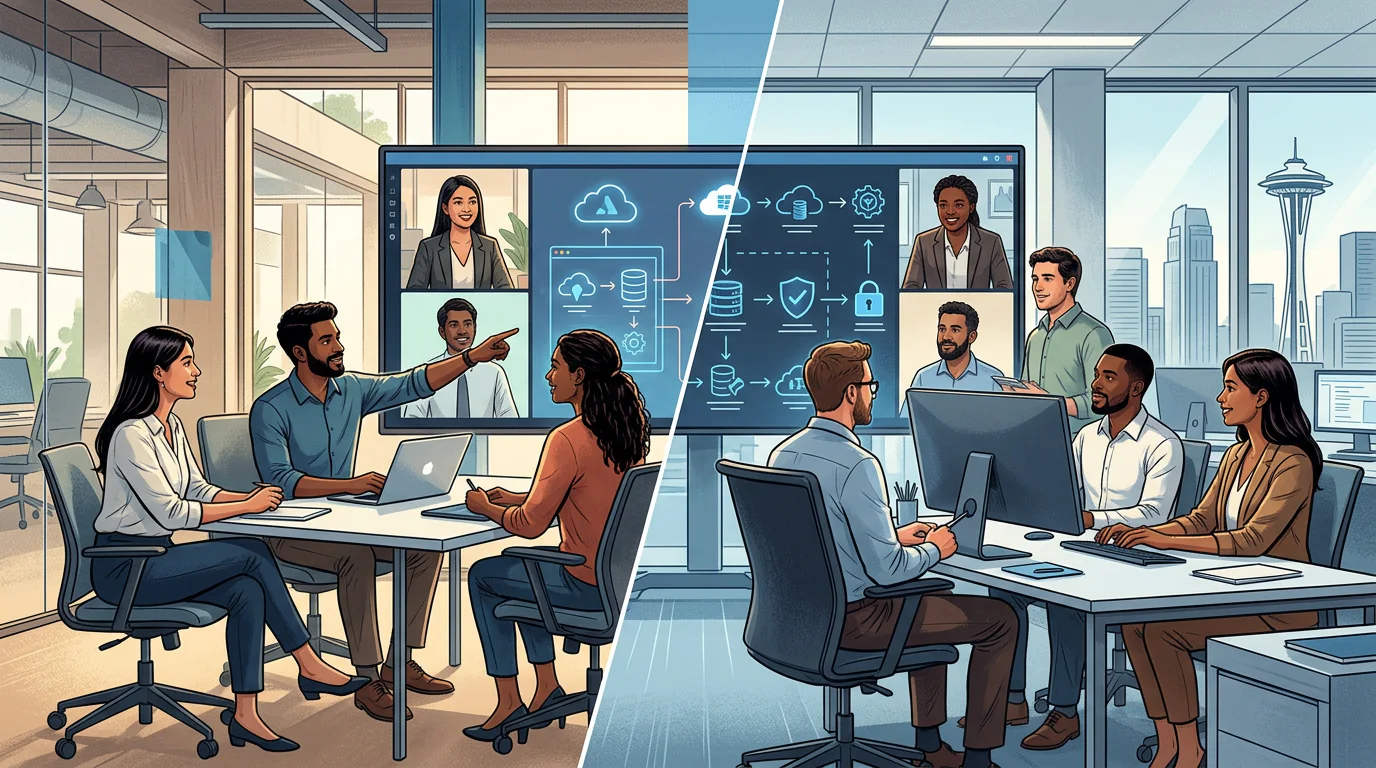
India operates on a UTC+5:30 official clock, while U.S. daylight saving changes the practical overlap window for global teams. We compare the delivery models, scheduling choices, curriculum, migration practice, and proof of readiness that matter when a data team must work across both regions.
Global teams should use live cohorts to establish shared language, governance decisions, and working norms, then use migration labs to test execution. The strongest live cohorts vs migration labs for global data teams program combines facilitated reviews, realistic Azure work, equitable India-US scheduling, documented handoffs, repeatable assessment, and auditable completion evidence.
How Should Global Teams Choose Live Cohorts or Migration Labs?
We treat this as a sequencing decision, not a choice between classroom theory and useful work. A live cohort gives architects, engineers, stewards, and managers a common way to discuss platform boundaries, quality rules, ownership, and migration tradeoffs. A migration lab then reveals whether that shared language survives real constraints, including incomplete source documentation, access design, failed runs, and late handoffs.
Microsoft’s cloud operating guidance makes the same underlying point: cloud adoption involves operating models, roles, skills, and culture, not only technology. We use that reality to help teams avoid a familiar failure mode, where every learner completes content but the group still cannot make a consistent architecture decision.
| Decision Factor | Live Azure Instruction | Real-Time Migration Lab | Recommended Combined Program |
|---|---|---|---|
| Primary Goal | Create shared vocabulary and decision standards | Test execution under realistic constraints | Align first, then validate together |
| Interaction | Instructor review, peer discussion, guided practice | Troubleshooting, handoffs, retrospectives | Live reviews inside sprint-based work |
| Technical Depth | Concepts, demos, and scoped exercises | End-to-end migration artifacts and tradeoffs | Architecture taught, then applied |
| Cultural Change | Strong for role alignment and ownership discussions | Strong for exposing unclear boundaries | Role map plus visible lab evidence |
| Time-Zone Equity | Depends on session rotation and recordings | Depends on handoffs and office hours | Rotated live access and written handoffs |
| Assessment | Scenario checks and architecture explanations | Artifact quality and decision review | Practical rubric plus completion record |
| Compliance Tracking | Attendance and completion data | Sign-offs and assessment artifacts | One auditable learner record |
| Cost Review | Instructor and coordination cost | Lab, coaching, and cloud-use cost | Compare verified all-in cost |
For teams starting with uneven experience, we begin with the cohort. For teams that already agree on the target architecture and operating model, we can shorten instruction and spend more time in the lab. Either route should connect with Azure learning paths so learners know what to reinforce between live sessions.
How Can India-US Teams Schedule Live Azure Instruction Fairly?
Fair scheduling is more than recording a session held at a difficult hour. We design live instruction so the inconvenience rotates, essential decisions are documented, and each region receives real access to an instructor. That protects collaboration while recognizing that a shared calendar cannot create a comfortable daily overlap for everyone.
Rotate the Inconvenient Slot
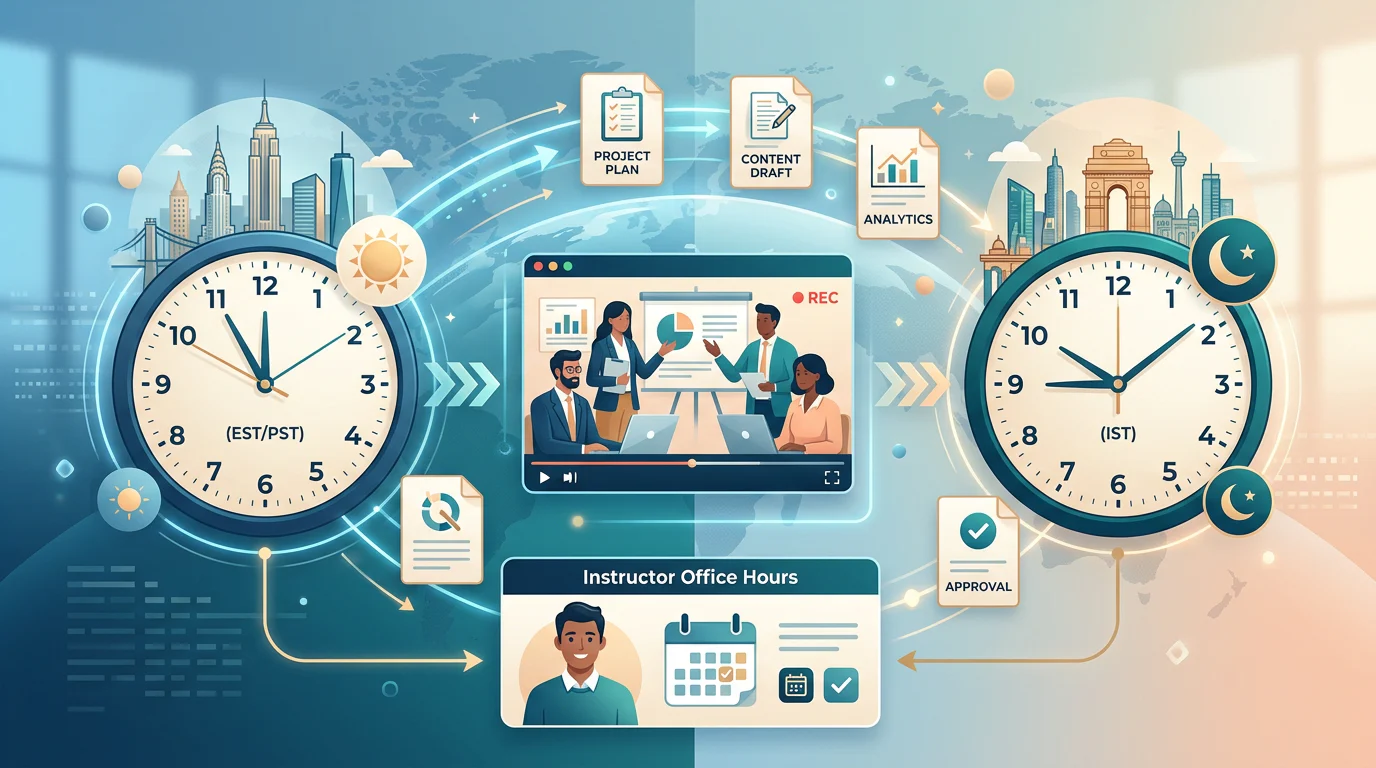
A single shared cohort can alternate its live meeting time every module or every two weeks. During U.S. daylight saving time, 08:00 Pacific daylight time is 20:30 India Standard Time. During U.S. standard time, 07:00 Pacific standard time is 20:30 India Standard Time. The 2026 DST calendar shows why the meeting owner must refresh invitations when daylight saving begins and ends.
Rotation only works when content and assessment are equivalent. We use the same facilitator, exercise, decision log, and feedback window for both sessions, then make the cross-region discussion available as a written artifact.
Use a Shared Decision Window
Regional cohorts work well when hands-on activities need deep local support. India and U.S. teams can learn in region-friendly sessions, then meet once per sprint for architecture reviews, demos, troubleshooting, and decisions that require both groups. A practical example is 19:30 IST, which is 09:00 Eastern daylight time or 08:00 Eastern standard time.
This model works best when the joint window is reserved for decisions, not lecture. Teams should arrive with an agreed agenda, a proposed design, unresolved risks, and a clear owner for the next handoff. Our global team training approach keeps the shared session focused on the work only both regions can resolve together.
Make Recordings Part of Access
Recordings are useful, but they should support live access rather than replace it. We pair them with captions, searchable notes, a decision log, and duplicated office hours so a learner can ask a question in a reasonable local-time window. WCAG 2.2 also requires captions for live synchronized audio and prerecorded audio, making accessibility a delivery requirement rather than an optional add-on.
Attendance, recording completion, and practical performance should remain separate measures. Someone who watches a session has not necessarily defended an architecture choice or completed a working lab artifact.
What Should the Cohort Teach Before the Lab?
The instruction phase should prepare the group to make migration decisions together. We do not treat a unified analytics platform as a list of services to memorize. We teach how architecture, governance, operations, and roles connect, then use the lab to make those connections visible in decisions and artifacts.
A strong foundation begins with cloud architecture and lakehouse concepts: storage and compute separation, ingestion patterns, data quality, orchestration, batch and real-time paths, and cutover criteria. Microsoft’s lakehouse guidance describes bronze, silver, and gold layers as a progression from raw to enriched to curated data. That model gives a migration cohort a shared frame for discussing where quality controls belong.
The curriculum should then move into governance and operations. We cover data-product thinking, stewardship, platform guardrails, identity design, quality ownership, monitoring, incident response, cost controls, and the difference between a one-time project deliverable and a maintained service. Teams that need the architecture context can start with one governed lakehouse, then return to the cohort to test those ideas against their own estate.
Finally, every learner group should practice migration decision-making. The useful question is not “Can this person configure a tool?” It is “Can this group explain why this workload should move, how it will be governed, who owns it after cutover, and what evidence proves it is ready?”
How Should a Hadoop-To-Azure Lab Simulate Real Work?
A credible migration lab should feel like a structured rehearsal, not a polished walkthrough. We use a fictionalized estate with the ambiguity of a real program: legacy dependencies, sensitive datasets, incomplete lineage, different priorities across regions, and a limited time to defend the target design.
Discover and Classify First
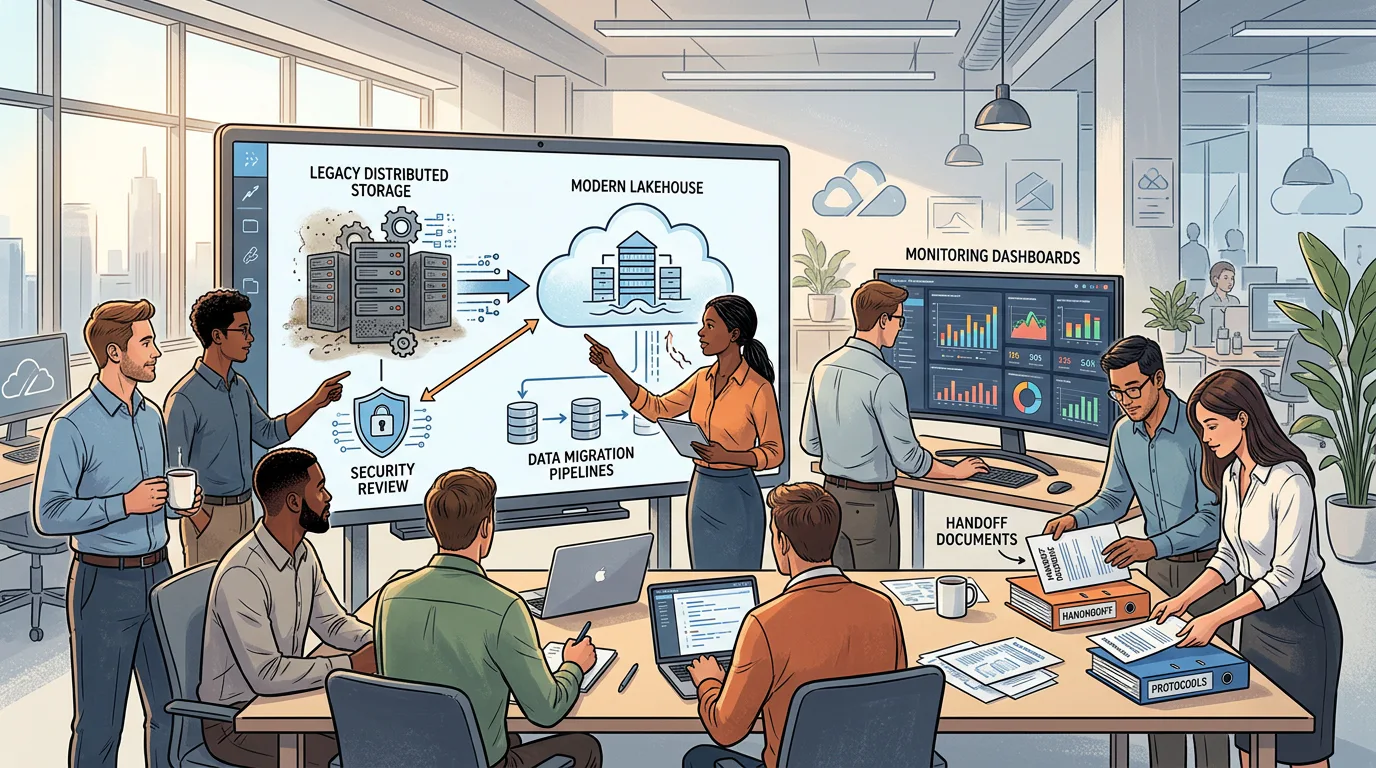
The lab begins with inventory. Teams identify HDFS storage, Hive metadata, Spark or MapReduce processing, scheduled jobs, data sensitivity, operating dependencies, and workload criticality. They must decide which workloads are ready to move, which need redesign, and which should remain temporarily connected to legacy systems.
For data movement, learners compare network transfer, staged migration, and operational limits. Microsoft’s migration transfer guide estimates that 1 TB can take 14 minutes at 10 Gbps, while 100 TB can take one day at that bandwidth. The point is not to promise a universal duration, but to force teams to size transfer choices against their own network and risk constraints.
Build and Defend the Target State
Next, teams map legacy components to Azure-oriented responsibilities. HDFS becomes a storage design using Azure Data Lake Storage capabilities or a unified lakehouse approach. Hive and batch transformation patterns become managed pipeline, SQL, or Spark decisions. Legacy permissions become identity, group, role, and file-level access design. Monitoring becomes telemetry, dashboards, alerts, and a named response owner.
| Migration Area | Hadoop-Era Concern | Azure Lab Output |
|---|---|---|
| Ingestion | HDFS feeds, DistCp, legacy batch movement | Copy plan, throughput assumptions, reconciliation checks |
| Storage | HDFS directories and Hive table locations | Lakehouse layout, retention approach, ownership model |
| Processing | MapReduce, Hive, Spark, scheduled jobs | Pipeline or notebook design and run criteria |
| Security | Kerberos, local permissions, policy rules | Identity groups, access matrix, RBAC and ACL decisions |
| Monitoring | Scripts, cluster consoles, manual escalation | Alert design, operational dashboard, runbook |
| Cutover | Incomplete handoffs and rollback uncertainty | Validation checklist, rollback path, retrospective |
Azure Data Lake Storage supports both role-based access control and POSIX-like ACLs through Microsoft Entra identities, which is why access design belongs in the lab rather than in an afterthought. The access-control documentation also helps us show teams where broad platform permissions should end and finer-grained data permissions should begin.
Rehearse Cutover and Handoffs
The final stage introduces a failed run, an access problem, or a late data-quality exception. One region documents the incident, proposes the next action, and hands the decision to the other region. The receiving team must continue from the written record, not from a private chat or an instructor’s memory.
This is where a lab proves cultural readiness. Architecture review notes, decisions, data-quality checks, access approvals, alert settings, cutover criteria, and retrospective actions become the assessment evidence. Teams can deepen that practice with legacy ETL modernization, especially when the migration must preserve useful logic while changing the operating model.
How Should Buyers Compare Providers and Prove Readiness?
A provider comparison should ask whether the program can serve the team that exists, not an idealized group in one office. We recommend scoring evidence rather than promises, especially for instructor coverage, practical lab design, accessibility, regional support, and reporting. A provider that cannot show the expected artifact, schedule, or export should not receive full credit.
Teams that want a broader framework for their syllabus can review our modern curriculum before comparing delivery formats. It helps sponsors separate a complete Azure data engineering learning plan from a lab that only demonstrates one narrow migration path.
| Evaluation Criterion | Weight | Evidence To Request |
|---|---|---|
| Customization To The Existing Estate | 15% | Discovery approach and sample lab brief |
| Trainer Credentials And Migration Experience | 10% | Named instructor background and delivery history |
| India-US Time-Zone Support | 20% | Rotation calendar, office-hour plan, response standard |
| Lab Realism | 20% | Five-stage scenario, sandbox, checkpoints, artifacts |
| Feedback And Facilitation | 10% | Architecture-review and retrospective cadence |
| Attendance, Completion, Accessibility, And Audit Evidence | 15% | Export sample, assessment rubric, captioning approach |
| Verified Total Cost | 10% | All-in written quote, including taxes, labs, assessments, recordings, and travel where relevant |
We do not score a headline course price as total cost. Buyers should request an all-in quote in the relevant billing currency and clarify whether it includes instructor time, customization, lab access, office hours, recordings, assessment, and certification fees. Microsoft notes that associate and expert exams typically cost US$165, but local currency, tax, and other variables can change the final amount, so that figure is a benchmark rather than a program price.
Readiness also needs more than a completion badge. We track attendance, recorded-session completion, practical artifact quality, feedback, and sponsor sign-off as separate signals. NIST training-record controls call for documenting, monitoring, and retaining individual training records for an organization-defined period. Teams can compare those expectations with production-realistic labs before committing to a delivery model.
A practical buying process tests one sample architecture review and one simulated handoff before contract signature. It should also establish whether a facilitator can challenge assumptions, return feedback fast enough for both regions, and produce the completion and assessment exports procurement expects. That small pilot exposes delivery gaps before a large cohort is scheduled.
Train with Vision Board
At Vision Board, we build team training for organizations that need a shared Azure delivery rhythm rather than another library of videos. We begin with the migration decisions that matter to your estate, then shape a live cohort around your India-US calendar, working roles, and governance expectations. Our instructors facilitate architecture reviews, troubleshoot pipelines, and turn handoffs into written operating habits. We track participation, completion, feedback, and practical artifacts so sponsors can see readiness without mistaking attendance for competence. When your team needs a lakehouse curriculum, a Hadoop-to-Azure simulation, and live support across regions, we can help you design the right mix of cohort instruction and migration practice. Before delivery, we agree on success criteria, assessment evidence, accessibility needs, and the cross-region office-hour schedule. That gives every learner a fair route to contribute, ask questions, and demonstrate applied judgment. Start the conversation with Vision Board.
FAQs on Live Cohorts vs Migration Labs for Global Data Teams
Should Global Teams Use Live Cohorts or Migration Labs?
We recommend both: use live cohorts to align vocabulary, ownership, and governance, then use migration labs to test technical execution, handoffs, troubleshooting, operational judgment, and cross-region collaboration.
What Live Schedule Works for India and US Teams?
Use rotating full-cohort sessions, regional workshops with shared decision windows, or both. Provide equivalent instruction, captions, recordings, duplicated office hours, documented handoffs, and matching assessment opportunities for each region.
What Should Hadoop-To-Azure Team Training Include?
It should cover architecture, lakehouse design, governance, platform operations, migration choices, identity and access, monitoring, data validation, cutover planning, role ownership, and a realistic team simulation.
How Should Enterprises Verify Training Readiness?
Verify attendance, completion, practical artifacts, assessment scores, feedback, manager sign-off, and auditable exports. Treat recording views as access evidence, then require each learner to demonstrate applied migration judgment.