Cloud Migration Training for Global Data Teams: How India-US Teams Should Train

TL;DR
We recommend cloud migration training for global data teams that pairs role-based Azure instruction with live Hadoop-to-cloud project labs. We show India-US scheduling patterns, a role map, a practical lab sequence, and an outcomes scorecard so leaders can verify technical readiness, ownership, governance, and compliance evidence instead of counting recorded-video views.
Cloud Migration Training for Global Data Teams: How India-US Teams Should Train
India sits 9.5 hours ahead of Washington during US daylight time, and 10.5 hours ahead during standard time. That gap makes a generic video library a poor substitute for a delivery model that gives both regions a fair chance to make technical decisions together.
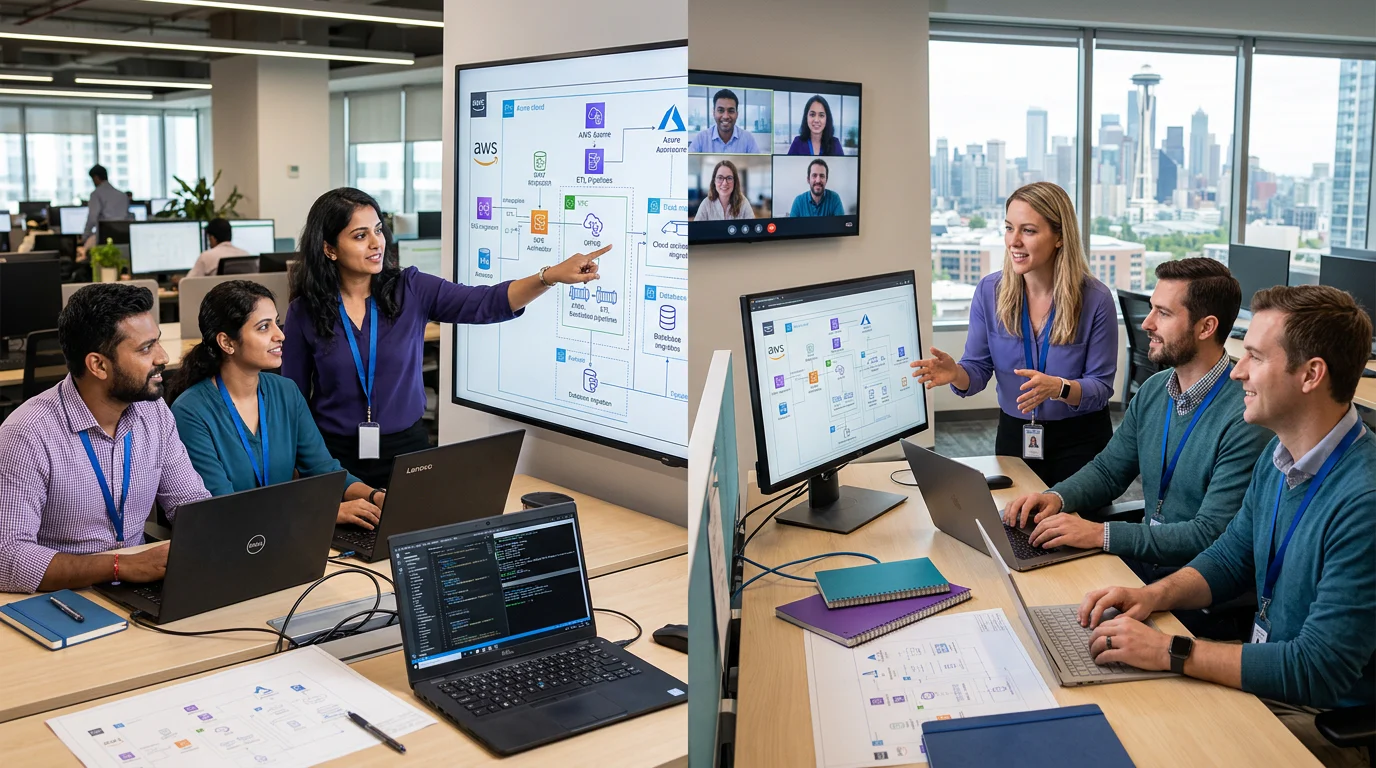
We recommend that global teams moving from Hadoop combine role-based Azure engineering instruction with live migration-project labs. Instruction gives roles a shared language for cloud storage, pipelines, governance, cost, and reliability. Labs expose workload mapping, validation, failure recovery, and ownership gaps. For India-US delivery, use shared overlap for decisions and coached labs, then mirror office hours and preserve artifacts.
This guide compares the formats, maps the roles, sets out four scheduling models, and shows how to measure whether the team is ready to move an actual workload.
When Does Cloud Migration Training for Global Data Teams Need Labs?
Role-based instruction and project labs solve different problems. We use instruction to align a team on the Azure data engineering concepts that recur across workloads. We use live labs to test whether that same team can make sound choices when the source estate contains incomplete lineage, access constraints, competing stakeholder priorities, and a real cutover risk.
The most reliable option is usually sequential: teach the shared foundation, then apply it to a bounded migration slice. NIST guidance supports role-based training designed for behavior change and measurable improvement, which is a better standard than course completion alone.
| Decision Factor | Role-Based Azure Engineering Instruction | Live Migration-Project Labs | Sequenced Hybrid |
|---|---|---|---|
| Primary Outcome | Shared technical and governance foundation | Demonstrated migration judgment | Foundation plus applied proof |
| Best Starting Point | Mixed skill levels or new platform adoption | Defined workload and target architecture | Active migration with uneven readiness |
| Main Risk If Used Alone | Completion without operational judgment | Gaps in common concepts and vocabulary | Requires a scoped workload and sponsor access |
| Evidence Of Mastery | Role assessment and architecture explanation | Validation report, rollback plan, review defense | Both forms of evidence |
| Best Live Use | Instructor questions and decision framing | Coached build, review, and incident rehearsal | Shared sessions followed by team labs |
When evaluating a training platform or partner, we recommend asking for proof of live instructor access, attendance exports, recordings with captions, isolated lab environments, curriculum customization, and regional support. A platform can host a session across time zones, but that does not prove it can support a migration handoff between regions.
For teams still selecting a foundation, our Azure learning paths help separate platform knowledge from a project-specific implementation plan.
Which Roles Need Which Migration Skills?
A migration cohort should not treat every participant as a generic learner. Platform engineers need guardrails, data engineers need dependable implementation patterns, and business data owners need a clear way to approve quality and ownership decisions. Microsoft describes a data engineer as responsible for integrating, transforming, consolidating, and keeping data systems reliable within business constraints, a useful baseline for defining the role. Microsoft's role definition
The role map below keeps the cohort focused on decisions that must survive after cutover. It also prevents governance from becoming a late-stage review performed after pipelines and permissions already exist.
| Role | Core Curriculum | Required Lab Evidence |
|---|---|---|
| Platform Engineers | Identity, networking, workspace guardrails, reliability | Access model and operating runbook |
| Data Engineers | Ingestion, orchestration, Spark, lakehouse tables | Working pipeline and validation checks |
| Architects | Target patterns, RTO and RPO trade-offs, FinOps | Defended target-state design |
| Analysts | Governed consumption, definitions, quality escalation | Acceptance test against curated data |
| Governance Leaders | Domains, stewardship, policy, lineage, accountability | Ownership and control matrix |
| Business Data Owners | Data-product purpose, quality thresholds, approvals | Named acceptance criteria and sign-off |
We ask teams to name a business owner for each data product, not merely an administrator for each workspace. That distinction matters because a governed lakehouse needs a decision-maker for appropriate use, quality thresholds, and change requests. Our guide to one governed lakehouse gives that ownership model a practical architecture context.
How Should India-US Cohorts Handle Time Zones?
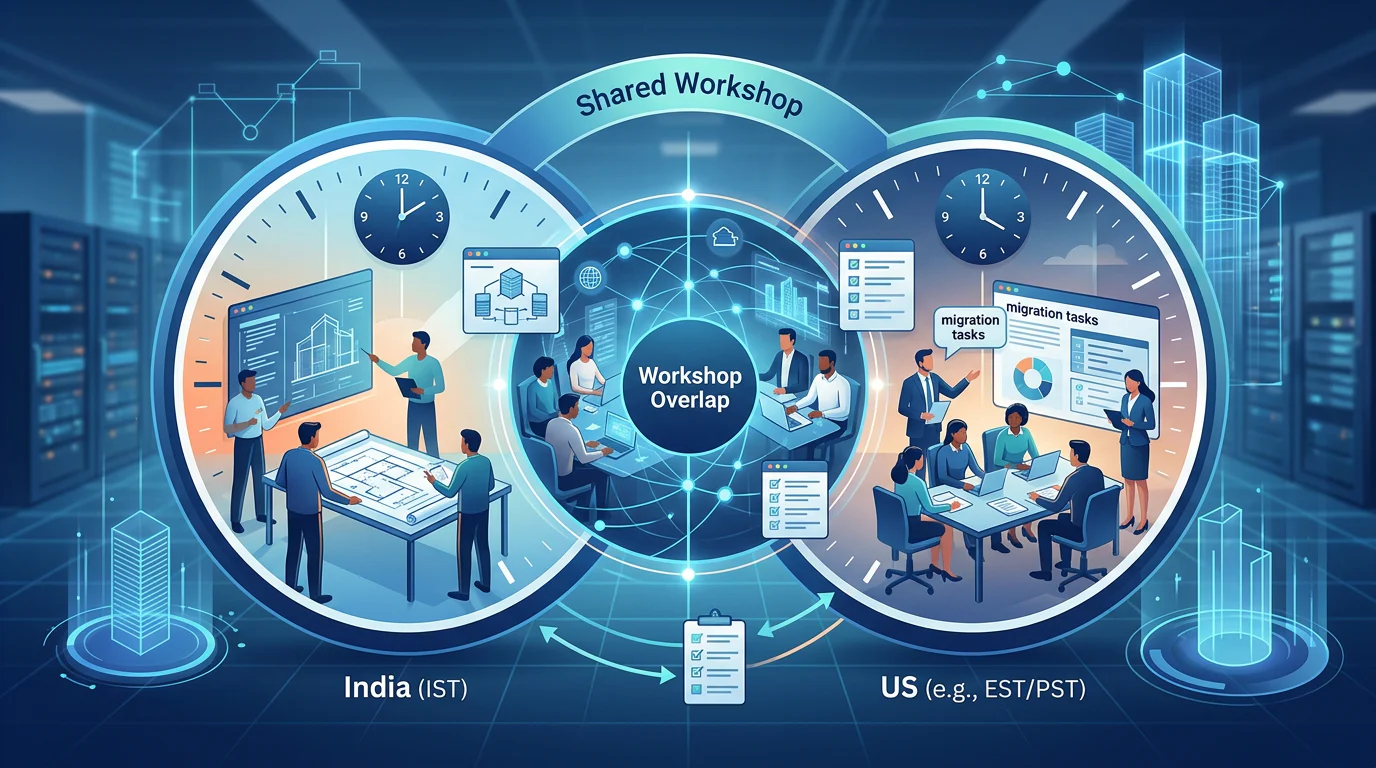
We reserve the shared India-US overlap for the moments that benefit from immediate discussion: architecture trade-offs, lab troubleshooting, incident drills, and review boards. We shift repeatable explanations, pre-reading, recorded demonstrations, and evidence review into asynchronous work so neither region is routinely asked to learn late at night.
The choice is not between live or recorded delivery. It is between a delivery pattern that uses live time for decisions and one that wastes scarce overlap on slide narration.
| Scheduling Model | Best When | Live Pattern | Continuity Safeguards |
|---|---|---|---|
| One Shared Cohort | Joint decisions are frequent | Early US morning and India evening | Recording, captions, decision log |
| Mirrored Regional Cohorts | Participation equity matters most | Same content delivered twice | Shared rubric and cross-region review |
| Rotating Sessions | Scheduling burden must be shared | Alternate India-friendly and US-friendly slots | Published rotation and equivalent assessments |
| Blended Asynchronous Preparation | Content is stable but decisions need live time | Prework before a shorter common lab | Office hours, handoffs, artifact repository |
We also treat attendance fairly. A recording view can confirm access, but it cannot substitute for a practical assessment or a chance to defend an architecture choice. For broader delivery patterns, see our approach to global team training.
What Should the Curriculum and Migration Labs Cover?
The curriculum bridge should begin with what the Hadoop estate actually does, then move toward the target operating model. We teach cloud storage, orchestration, lakehouse tables, streaming, governance, FinOps, and reliability as connected choices. That helps a team see why moving code without changing ownership or recovery practices only recreates the old operating problem in a new location.
Microsoft’s current Fabric migration map shows why inventory comes first: Spark pools, notebooks, job definitions, lake databases, Hive metadata, and linked services each have different migration considerations.
How Do We Start with the Source Estate?
We begin with an inventory of HDFS locations, Hive tables, Spark jobs, HBase tables, NiFi flows, dependencies, data sensitivity, owners, and workload criticality. The team selects one bounded slice that is meaningful enough to expose real trade-offs but constrained enough to rehearse safely.
That inventory becomes the shared backlog for the cohort. Teams that need a wider platform replacement decision can pair the exercise with our Hadoop replacement guide.
How Do We Map Hadoop Workloads to Target Services?
Hive metadata and tables can move toward a lakehouse catalog and Delta-table strategy. Spark workloads can move toward managed Spark and notebook patterns. HBase workloads need an explicit data-model review, because row keys, column families, and query patterns do not automatically become good partitioning choices in a target database.
NiFi flows require the same discipline. We ask whether the workload needs low-code orchestration, code-first orchestration, a notebook, or a streaming pattern before assigning it to a service. This keeps the lab from turning every existing flow into a like-for-like copy.
How Do We Rehearse Validation and Failure Recovery?
A credible lab requires row counts, schema checks, freshness expectations, access validation, lineage confirmation, and business-owner acceptance. Then we introduce a failed run, missing permission, late-data condition, or dependency outage and require the group to decide whether to retry, roll back, or continue a parallel run.
Azure reliability guidance recommends deriving recovery objectives from failure-mode analysis and tested recovery plans. We use that principle to make recovery a visible training outcome, not an appendix after implementation.
How Do We Turn the Lab into an Operating Handoff?
Each team finishes by presenting a migration decision log, ownership map, validation evidence, cost-allocation assumption, runbook, and rollback trigger. One region documents the incident or handoff, and the other region must continue from the written record without relying on a private conversation.
That exercise reveals whether the operating model can travel with the workload. Teams preserving useful pipeline logic while changing the platform can also use our guidance on legacy ETL modernization.
How Do We Measure Readiness and Cultural Change?
We measure whether people can make and explain decisions, not simply whether they attended. The scorecard should combine cohort participation with technical evidence, review quality, and early operating behavior after the lab. That approach gives leaders a better view of risk before they authorize a larger migration wave.
Cultural readiness belongs in the same scorecard. We assess whether platform ownership is clear, self-service boundaries are documented, data products have accountable owners, governance responsibilities are understood, and cross-region operating handoffs can work without informal escalation.
- Attendance And Recovery: Track live participation, recording access, and completed recovery work for missed sessions.
- Lab Completion: Require a submitted inventory, target design, validation pack, and handoff artifact.
- Architecture Review: Score trade-off reasoning, ownership clarity, and the quality of the rollback decision.
- Practical Assessment: Ask each participant to complete a role-relevant migration task, not only a multiple-choice test.
- Adoption Indicators: Review runbooks, owner assignments, recurring architecture reviews, and production support patterns after the cohort.
For regulated workloads, training evidence may itself be a compliance obligation. The HIPAA rule requires covered entities to train workforce members appropriately, document that training, and retain required documentation for six years. India-US teams processing personal data should also align their governance curriculum with applicable privacy obligations, including India’s phased privacy rules.
We use the scorecard to identify who needs targeted coaching before the next migration slice. Our live cohort comparison can help leaders choose the right format once the team’s readiness gap is visible.
Train with Vision Board
At Vision Board, we build live cloud migration training around the decisions your India-US team must make, not around a generic video library. We begin with your role mix, migration slice, governance obligations, and working-hours constraints. Then we shape instructor-led sessions, coached labs, written handoffs, and architecture reviews that let each region contribute on equal terms. Our approach gives sponsors a clear view of who attended, what the team built, where ownership is unresolved, and whether the next workload is ready for a controlled cutover. If you need foundational Azure engineering instruction, we can establish it before the lab. If you already have a prioritized migration slice, we can focus the cohort on its dependencies, validation tests, rollback plan, and operating handoff. We keep instructors available for questions and review when decisions become consequential. Start your planning with Vision Board.
FAQs on Cloud Migration Training for Global Data Teams
These answers address the format, scheduling, lab design, and evidence leaders should request before choosing a program for a distributed migration team.
Should Global Teams Choose Azure Instruction or Migration Labs?
Choose instruction when roles need a shared engineering foundation. Choose labs when a defined workload requires decisions, validation, recovery practice, and reviewed evidence before a controlled cutover.
What Live Schedule Works for India-US Data Teams?
Use shared live overlap for decisions and coached labs. Provide mirrored office hours, recordings, captions, and written decision logs so each region can continue independently.
What Must a Hadoop-to-Cloud Lab Include?
Start with workload inventory and target mapping, then require access checks, data validation, a failure drill, rollback criteria, handoff artifacts, and business-owner acceptance before cutover approval.
How Do We Prove Training Readiness?
Combine attendance with completed labs, architecture reviews, practical assessments, and adoption evidence. In regulated settings, retain the training documentation required by the applicable rule after completion.