
What Should Replace Hortonworks?
Choose a Hortonworks replacement for Azure by comparing batch, streaming, ML, BI, governance, migration effort, and operating burden.

What Should Replace Hortonworks?
Replacing a legacy Hadoop estate is an architectural decision, not merely an upgrade project. Apache Iceberg’s 2 migration approaches distinguish between full data migration and in-place metadata migration, which is a useful reminder that data movement is only one part of the risk.
A Hortonworks replacement should be chosen by workload and operating model, not feature count. A managed Spark service, a SaaS analytics suite, a hybrid data platform, and a self-managed Spark-plus-Kafka stack can all handle batch and streaming, but they differ in migration risk, infrastructure ownership, governance, ML workflow, and BI fit.
We will compare those paths, show how to inventory Hive assets, choose a table format, size for growth, and run a proof of concept that produces evidence rather than a hopeful platform recommendation.
What Is the Right Hortonworks Replacement on Azure?
The right replacement is the one that preserves critical workloads while removing the operating burden your team no longer wants. Start with deployment constraints, then assess batch processing, streaming, SQL, machine learning, BI, governance, and the people required to run each option.
This comparison is deliberately workload-first. It helps a team avoid choosing a platform because it looks comprehensive, only to discover during migration that its streaming behavior, governance controls, or delivery model does not match production needs.
| Decision Area | Managed Spark Service | SaaS Analytics Suite | Hybrid Data Platform | Self-Managed Spark Plus Kafka |
|---|---|---|---|---|
| Deployment | Azure-managed service | SaaS capacity model | Azure, hybrid, or on-premises | Team-operated infrastructure |
| Batch Processing | Strong Spark job support | Integrated Spark and pipelines | Strong Spark engineering support | Strong with team-owned Spark |
| Streaming | Structured streaming workflows | Event ingestion and real-time analytics | Validate exact runtime capability | Kafka plus Structured Streaming |
| SQL | Managed SQL serving | Warehouse and SQL endpoints | Enterprise SQL services | Spark SQL plus serving design |
| Machine Learning | Spark and Python workflows | Spark, Python, experiment tracking | AI workspaces and registry | Team-assembled ML tooling |
| BI Integration | Connectors and SQL access | Native semantic-model workflow | Requires integration design | Requires integration design |
| Table Format | Delta or Iceberg | Delta-native with portability checks | Iceberg-forward option | Delta or Iceberg |
| Governance | Unified catalog controls | Centralized SaaS governance | Enterprise governance layer | Catalog and policy tools assembled |
| Migration Effort | Medium | Medium to high | Often lower continuity, validate scope | Medium to high |
| Operating Burden | Low to moderate | Lowest | Moderate | Highest |
| Cost Inputs | Compute, storage, network | Capacity, storage, transactions | Compute units, infrastructure, network | Infrastructure, tooling, labor |
The managed Spark path usually fits teams that need extensive engineering control, while the SaaS path fits teams that value a shared analytics experience and minimal infrastructure work. A hybrid path deserves serious attention when locality, existing operational practices, or multicloud requirements are non-negotiable. The self-managed path is viable only when portability is worth the additional platform responsibility. For background on the shared-data model behind these choices, see our unified analytics guide.
Streaming should never be assumed from a product label. Apache Spark’s Kafka guide notes that Kafka writes are at least once, so retry behavior can create duplicates unless the destination design includes a durable unique key and deduplication strategy.
Which Deployment and Workload Constraints Change the Shortlist?
Azure-only does not automatically mean that every Azure-hosted option is equally suitable. A team with complex Spark jobs, custom Python dependencies, and frequent model training needs a different operating model from a team whose main objective is governed dashboards and standard data preparation.
For a retail workload around 2 TB of transactions a day, the annual raw-ingest planning figure is roughly 730 TB before retained copies, replay windows, and disaster recovery. That scenario should test late events, replay, checkpoint recovery, and dashboard freshness together. A startup beginning with 500 GB and growing 30% monthly should plan for about 11.6 TB after 12 months, not size the platform around today’s footprint.
Start with Deployment Boundaries
Choose the managed Spark route when the organization is Azure-only, has substantial Spark engineering work, and needs flexibility for batch, streaming, and model development. Choose the SaaS route when native BI, simpler capacity administration, and one shared experience outweigh deep infrastructure control.
A hybrid data platform moves to the front when data must remain on-premises, operate across clouds, or preserve established enterprise controls. A self-managed stack belongs on the shortlist only when the organization can staff security, upgrades, observability, incident response, and capacity planning as a product responsibility.
Match the Workload Shape
Use a shared lakehouse when the same governed data must serve batch transformations, streaming outputs, model features, and dashboard aggregates. Use a separate real-time layer when latency, event retention, or operational isolation makes one engine an unnecessary compromise. Our shared lakehouse guide explains the tradeoff in more depth.
For a 20-person data team, do not frame the decision as Spark versus BI. Frame it as whether one operating model can reliably support Spark jobs, distributed model training, governed tables, and the dashboards people use every day. That question exposes skills gaps earlier than a feature checklist.
Treat Operating Model as a Requirement
The most future-ready choice is not the platform with the longest roadmap. It is the platform whose day-two work your team can afford, staff, govern, and improve. That includes access reviews, schema changes, quality failures, streaming backlogs, cost monitoring, and recovery drills.
How Should You Migrate Hive Assets Safely?
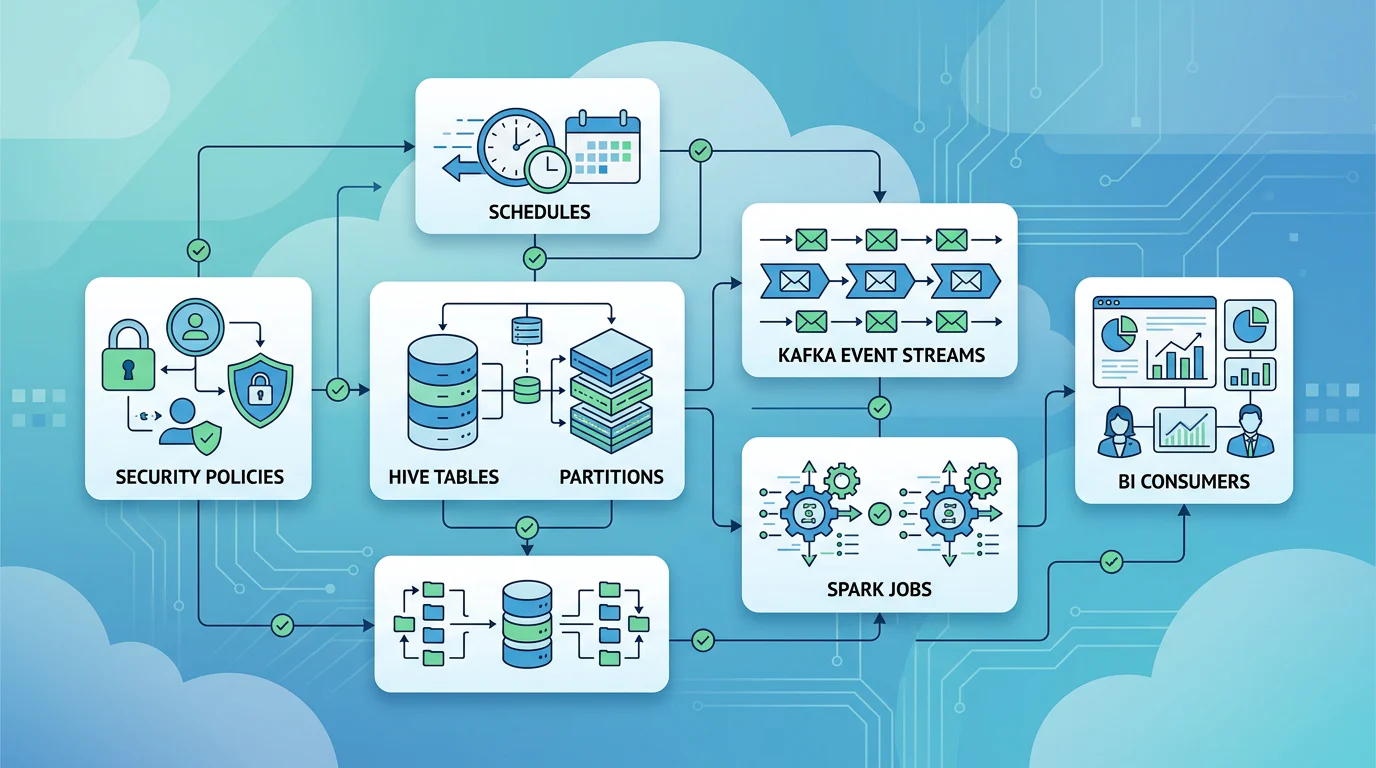
A safe migration begins with an inventory that is detailed enough to reveal hidden dependencies. Counting tables is not enough. We would inventory table ownership, storage paths, file formats, partitioning, SerDes, custom functions, Spark libraries, schedules, Kafka topics, security rules, metadata, SLAs, and every downstream consumer before choosing a migration wave.
The inventory also separates technical compatibility from business criticality. A simple external Parquet table can move early, while a transactional table feeding finance dashboards may require parallel operation and a tested rollback path. Teams can pair this work with our pipeline modernization plan to sequence change without forcing a big-bang cutover.
Inventory the Assets That Change Behavior
Create one record for every database, table, view, job, topic, and dashboard. Capture schema, row counts, partitions, file locations, ownership, data classification, upstream inputs, downstream outputs, and the recovery objective. Add runtime versions, libraries, checkpoints, retries, and scheduling dependencies for every Spark workload.
For Kafka, capture topic retention, schemas, consumer groups, offsets, producers, consumers, replay requirements, and idempotency behavior. For security, record identities, service accounts, policy inheritance, audit obligations, encryption controls, and access exceptions.
Select the Migration Path per Table
Parquet, ORC, and Avro tables are often the most straightforward candidates for metadata-first migration, but only after validating schema semantics and partition discovery. Apache Iceberg supports Hive migration actions for those formats, including snapshot, migrate, and add-files approaches.
Do not assume transactional semantics move automatically. Explicitly test inserts, updates, deletes, merge logic, concurrent writers, rollback expectations, and historical reads. Custom SerDes and deeply embedded HiveQL usually deserve a refactoring workstream instead of a hurried lift-and-shift.
Validate Before Changing Consumers
Run old and new paths in parallel long enough to compare row counts, aggregates, duplicate rates, schema drift, latency, access behavior, and dashboard output. Move readers before writers where possible, then keep a documented rollback point until the new pipeline has met its SLA through normal and failure conditions.
For teams preserving existing transformation logic while modernizing the destination, our ETL migration path offers a useful planning companion.
Should Your Lakehouse Use Delta Lake or Apache Iceberg?
Table format is not a cosmetic storage choice. It affects writer behavior, metadata management, partitioning, engine compatibility, governance patterns, and the cost of changing direction later. The correct answer depends on which engines must read and write the same tables, not on which format sounds more open.
Delta Lake is usually the pragmatic choice for a tightly integrated Azure lakehouse with batch, streaming, CDC, and BI workloads in one managed environment. Apache Iceberg is especially compelling when engine portability, hidden partitioning, and partition evolution matter across a broader estate. Delta Lake’s core capabilities include ACID transactions, schema enforcement, time travel, and unified batch and streaming processing.
| Decision Question | Delta Lake | Apache Iceberg |
|---|---|---|
| Best Fit | Integrated managed-lakehouse workloads | Multi-engine and portability-led estates |
| Write Patterns | Strong for streaming upserts and CDC | Validate writer behavior by engine |
| Governance | Test catalog integration and external access | Test catalog consistency across engines |
| Partitioning | Platform optimization choices | Hidden partitioning and partition evolution |
| Historical Reads | Versioned table history | Snapshot-based history |
| Migration Strategy | Good for Azure-centered workloads | Good for evolving cross-engine environments |
| Proof Requirement | Validate non-native consumers | Validate every intended reader and writer |
Do not select a format only because it appears to reduce future lock-in. Portability is real only when the engines, catalogs, access controls, and maintenance jobs your organization uses all behave as required. Our governed lakehouse guide can help teams turn that principle into concrete design decisions.
How Do You Size and Prove the Choice?
Sizing begins with workload evidence, not a generic volume threshold. Capture daily ingest, peak events per second, retained history, concurrent SQL users, dashboard refresh windows, transformation SLAs, model-training demand, and recovery objectives. Then model peak conditions, not just average days.
A realistic proof of concept should replay representative data and use the same policies, identities, and BI consumption patterns planned for production. It should score operating effort and cost inputs alongside elapsed time. We recommend four workloads because a replacement that wins one benchmark but fails a downstream dashboard or recovery drill is not a successful replacement.

Size the Inputs That Drive Cost and Reliability
Record daily volume, growth rate, concurrent jobs, query concurrency, event rate, latency target, retention, replay window, training-data size, model cadence, storage copies, and network movement. The aim is not a false precision estimate. It is a comparable cost model that exposes which option moves spending into compute, capacity, storage, operational labor, or specialist skills.
Score Four Production-Like Workloads
| Workload | Representative Test | Evidence To Capture | Pass Condition |
|---|---|---|---|
| Batch | Rebuild a critical transformation | Runtime, cost inputs, data reconciliation | SLA and totals met |
| Streaming | Replay late and duplicate events | Latency, recovery, duplicates, backlog | SLA met after failure test |
| Machine Learning | Train and register a distributed model | Reproducibility, lineage, scoring path | Repeatable run and governed output |
| BI | Refresh and query a business aggregate | Freshness, concurrency, access control | User-facing SLA met |
Reject Options Early
Reject an option when it fails an agreed workload SLA, requires unavailable skills, cannot meet identity or audit requirements, or exceeds the full operating-cost envelope. Also reject it when portability needs conflict with the platform model, or when a critical workflow depends on a capability that is not production-ready.
A strong proof of concept makes the decision easier to defend because it shows the tradeoffs in the work itself. For implementation patterns that combine scheduled and event-driven processing, see our single pipeline design.
Build Your Migration Capability with Vision Board
Vision Board helps Azure data engineering teams turn a platform decision into a working migration plan. We teach teams how to inventory legacy assets, design lakehouse pipelines, test governance, and run proof of concepts that produce evidence instead of slideware. Our approach connects platform learning to the real jobs that make a replacement succeed: Spark development, streaming design, data modeling, access control, cost review, and BI readiness. If your team needs to move from a broad shortlist to a repeatable delivery plan, we can help create the shared technical language and hands-on practice needed for a confident cutover. Start with our courses, compare learning paths, and use the results of your own pilot to choose the operating model your team can sustain with clearer responsibilities, measurable acceptance tests, and documentation that remains useful after the launch. Explore Vision Board
FAQs on Hortonworks Replacement
Which Option Handles Batch and Streaming Analytics Best?
Choose the option that meets latency, replay, governance, and operations requirements in testing. Managed services reduce infrastructure work, while self-managed stacks provide greater implementation control.
How Do We Move Hive Tables Safely?
Inventory schema, files, partitions, policies, writers, readers, and SLAs before migration. Move compatible tables in waves, validate outputs in parallel, then shift writers after acceptance.
Should We Choose Delta Lake or Apache Iceberg?
Choose Delta Lake for tightly integrated managed workflows. Choose Apache Iceberg when engine portability and evolving partition layouts matter, then test every intended reader and writer.
What Makes a Proof of Concept Fail?
A proof fails when it measures only speed. Test batch, streaming, ML, BI, recovery, governance, cost inputs, and staffing effort before approving any production architecture.