
Live Training or Project-Based Azure Upskilling for Global Teams
Compare live training and project cohorts for global Hadoop-to-Azure teams, including time zones, skills, culture, and provider evaluation.

Live Training or Project-Based Azure Upskilling for Global Teams
A project learning study examining 66 empirical papers found stronger learning effects in engineering and technology settings, which matters when an enterprise needs people to apply new data-platform skills together.
For Azure upskilling for global teams, choose live instruction when people need shared operating language, faster expert decisions, and reliable access across time zones. Choose project-based work when the goal is to prove migration capability. For a Hadoop-to-Azure transition, combine both through short live sessions, recorded support, role-based labs, and a governed capstone with acceptance criteria.
This comparison explains how to make that choice, run an India-US cohort fairly, map Hadoop skills to Azure responsibilities, and evaluate whether a provider can support a real migration.
Which Azure Upskilling for Global Teams Format Fits a Migration?
Live instruction and project work solve different problems. A live cohort creates a shared room for architects, engineers, platform owners, security teams, and analytics leaders to settle vocabulary and trade-offs. A project cohort tests whether that shared understanding survives ambiguous requirements, operational constraints, and team handoffs.
The most useful decision is rarely “live or project?” in isolation. It is “what must this team be able to do together when the cohort ends?” Teams still deciding how to organize a modern platform should begin with Azure learning paths. Teams already carrying a migration backlog should devote more time to applied delivery.
| Criterion | Live Instructor-Led Training | Real-Time Migration Project Cohort |
|---|---|---|
| Primary Objective | Shared understanding and decisions | Demonstrated application |
| Learner Effort | Scheduled participation and focused practice | Sustained team delivery between sessions |
| Facilitation | Instructor explanation and discussion | Coaching, reviews, and unblockers |
| Feedback | Immediate correction of concepts | Iterative feedback on designs and artefacts |
| Deliverable | Understanding, notes, and lab completion | Migration evidence and acceptance results |
| Assessment | Knowledge checks and observed exercises | Rubric-based evidence against requirements |
| Best Fit | New platform vocabulary and cross-role alignment | Readiness to execute a migration |
| Time-Zone Tolerance | Repeated or rotated sessions work well | Requires explicit asynchronous handoffs |
| Lab Pattern | Guided and bounded exercise | Ambiguous scenario with constraints |
| Team Dependency | Helpful, but not essential | Essential to the outcome |
| Procurement Evidence | Attendance and instructor credentials | Milestones, artefacts, and review results |
| Main Risk | Passive attendance without transfer | Unsupported project work without expert access |
Choose Live Instruction for Alignment
Choose live sessions when data engineers need to hear how architects, security leaders, and platform teams use the same terms differently. A skilled facilitator can surface disagreements about ownership, cost, reliability, and governance before those disagreements become competing designs.
A 2014 analysis of 225 STEM studies found active-learning sections produced roughly 6 percent higher examination performance than traditional lecture sections. The finding does not prove enterprise ROI, but the STEM evidence supports designing live time around interaction rather than passive presentation.
Choose Project Work for Transfer
Choose project work when learners must prove that they can translate a source-system problem into a governed Azure design. The project should require choices about ingestion, orchestration, access, monitoring, and recovery, not simply ask people to reproduce a known tutorial.
A realistic project also forces delivery conversations that slide-led training avoids: Who owns a failed pipeline? Who approves a sensitive-data classification? Who decides whether a workload has met its cost target? For a deeper implementation choice, compare project implementation with a course-only route.
Choose a Blended Cohort for Migration Readiness
A blended cohort is the strongest fit when an enterprise is moving off Hadoop while building a new operating model. Use live sessions to teach concepts and resolve architectural decisions, then use project reviews to test whether the team can apply them under documented constraints.
The program should not promise generic duration, live hours, or project hours before discovery. Buyers should require the provider to state those commitments, team size, delivery time zones, instructor access, and completion evidence in the statement of work.
How Should India-US Teams Run a Fair Live Cohort?
A global cohort needs more than a calendar invitation. India is on one national time standard, while the United States spans several time zones and many locations observe daylight saving time. A fair model makes attendance expectations visible, rotates inconvenience when workshops require full participation, and gives asynchronous work the same operational discipline as a live session.
For sessions hosted in Microsoft Teams, recordings, captions, transcript access, and retention should be agreed before the first class. Current Teams guidance confirms that recordings are stored in OneDrive or SharePoint and may expire according to the organization’s IT policy.

Repeat Core Instruction
Repeat foundational sessions when attendance across regions would otherwise force one group into a consistently unreasonable time. Keep the agenda, exercises, and instructor consistent, then consolidate questions into one shared knowledge base.
A repeat is not a substitute for a joint forum. Schedule at least some shared decision workshops where the whole team can debate architecture and operating responsibilities together.
Rotate High-Participation Workshops
Rotate the difficult time slot by sprint when the work requires every role in the room. This distributes inconvenience instead of assigning it permanently to one geography, while keeping decision-making transparent.
In 2026, the official U.S. time service records the spring daylight-saving change on March 8 at 2 a.m. local time. Use the official time service to validate invitations around seasonal changes rather than relying on a static conversion.
Treat Asynchronous Handoffs as Delivery Work
Every handoff should name an owner, a decision needed, the evidence attached, and the next review point. Recordings help people catch up, but a recording alone does not close a blocker or assign accountability.
Use recordings and transcripts for reinforcement, then run region-specific office hours for questions that require conversation. For related team-format decisions, see our team-training comparison.
What Must a Hadoop-to-Azure Skills Map Cover?
Hadoop migration training fails when it treats the move as a product substitution. Teams are not only changing storage and compute. They are moving toward managed services, different identity models, policy-driven governance, continuous cost visibility, and a clearer split between platform and workload responsibilities.
Microsoft defines a data engineer as someone who integrates, transforms, and consolidates data while designing reliable pipelines and data stores around business constraints. That data engineer role is a useful curriculum baseline because it connects technical implementation to reliable operation.
| Hadoop-Era Concept | Azure-Era Capability to Practice | Capstone Evidence |
|---|---|---|
| HDFS Storage and Zones | Data-lake design, lifecycle, and access boundaries | Storage and access design |
| Hive Tables and Metastore | Governed catalog, discovery, lineage, and classification | Catalog and lineage evidence |
| Oozie or Batch Schedulers | Pipeline dependencies, retries, and deployments | Runbook and failed-run recovery test |
| Spark and YARN Execution | Spark workload tuning and controlled compute | Performance and cost decision log |
| Kerberos and Perimeter Controls | Identity, least privilege, secrets, and network controls | Role matrix and access test |
| Batch Ingestion | Incremental loads, data quality, and replay | Idempotency and quality checks |
| Operations Monitoring | Pipeline, job, quality, and cost observability | Alert and incident scenario |
| Cluster Cost Allocation | Tags, budgets, usage attribution, and compute policies | Cost guardrail evidence |
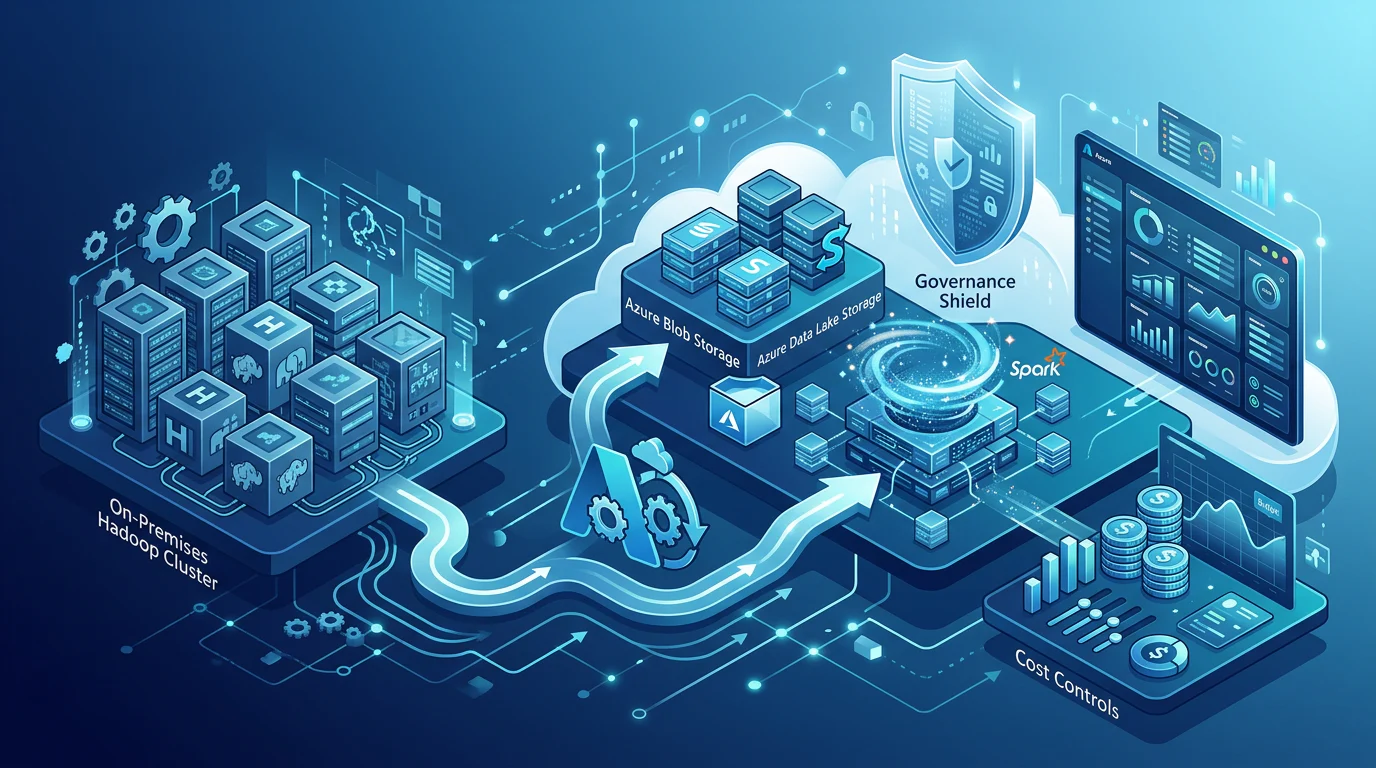
A skills map should preserve the useful concepts people already know while changing the operating assumptions. The team may still use Spark, but it must also learn the target platform’s governance, monitoring, and cost controls. Our Hortonworks replacement guide can help frame the technology decision before the cohort begins.
The project should require a recovery exercise, not just a successful first run. It should also require learners to explain who can access a sensitive dataset, how lineage is inspected, what happens when quality drops, and who receives the cost signal. A practical migration plan gives that technical work a sensible sequence.
Why Does Culture Matter as Much as Technology?
Cloud migration changes who makes decisions and who carries operational responsibility. A team that moves data successfully but keeps unclear ownership, siloed vocabulary, and central bottlenecks has not completed the hard part of modernization.
Microsoft’s cloud adoption guidance describes shared management as a model in which platform and workload teams divide responsibilities, while platform teams provide standardized services as products. That cloud operating model belongs in the curriculum because it makes culture a deliverable, not a motivational aside.
Define Data-Product Ownership
Each migrated domain needs a named owner for quality expectations, access decisions, and consumer communication. The project should require teams to publish a simple ownership map and a data-product contract. A measured pipeline modernization plan helps turn those ownership choices into sequenced delivery work.
Build Cross-Role Vocabulary
Security, engineering, finance, analytics, and platform teams often use words such as “owner,” “production-ready,” and “governance” differently. A live facilitator should make those meanings explicit, then test them during project reviews.
Practice Operating Responsibilities
The capstone should assign an incident scenario, a cost-review scenario, and an access-request scenario. Learners must show the escalation route and the evidence used to make a decision, not merely describe a preferred process.
How Can Buyers Test Project Realism and Provider Quality?
A scripted lab asks learners to follow a path that has already been designed for them. A realistic migration project introduces bounded ambiguity: incomplete requirements, security constraints, data-quality failures, role conflicts, and a need to explain trade-offs. The provider should review evidence at milestones, not only issue a completion certificate at the end.
Use a short procurement scorecard before selecting a program. Score each item as absent, partially evidenced, or fully evidenced, then treat missing data-handling controls or missing instructor access as disqualifying rather than minor weaknesses.
| Provider Check | Strong Evidence | Warning Sign |
|---|---|---|
| Instructor Access | Named instructors and escalation route | Generic mentor promise |
| Cohort Size | Published limit and role-aware grouping | No maximum disclosed |
| Lab Environment | Sandboxed access and teardown policy | Unclear credential handling |
| Accessibility | Captions, transcripts, and accessible materials | Recording-only accommodation |
| Scheduling | Repeats, rotation, office hours, and handoffs | One fixed global slot |
| Support | Response expectations and project reviews | Support described vaguely |
| Outcome Evidence | Rubrics, artefacts, and completion reporting | Attendance-only certificate |
| Data Handling | Approved data rules and retention policy | Real data encouraged without controls |
A capstone is realistic only when it can fail in useful ways. It should require an ingestion design, governed access model, orchestration plan, monitoring approach, cost guardrail, operating-owner map, and a live walkthrough. The review panel should ask why the team chose each approach, not just whether the pipeline produced an expected output. See our test for realistic labs before accepting “hands-on” as sufficient evidence.
Procurement should also ask how recordings integrate with the company’s Microsoft 365 environment, who controls transcript access, how instructor credentials are verified, what service-reliability commitment applies, and which learner-level reports are available. Completion reporting should distinguish attendance, lab progress, project contribution, and capstone acceptance.
Plan Your Cohort with VISION BOARD
VISION BOARD helps enterprise data teams turn an Azure learning decision into a delivery plan. We start with the migration context, who owns data products, which roles must make decisions together, and where India-US schedules create friction. Then we shape the cohort around live working sessions, recorded reinforcement, labs that respect data-handling rules, and a capstone reviewed against agreed evidence. Our goal is not to turn a migration into a generic course checklist. It is to leave the team with shared vocabulary, documented handoffs, reusable patterns, and a clearer basis for operating the platform after the cohort ends. Bring us your current Hadoop estate, target architecture, team locations, and procurement constraints. We will help you define the right blend of instruction, project work, governance practice, and completion reporting that stakeholders can audit and use with confidence before investment begins at scale. Explore Vision Board
FAQs on Azure Upskilling for Global Teams
When Should We Choose Live Instruction?
Choose live instruction when teams need to align roles, resolve architecture trade-offs together, unblock decisions quickly, and establish shared vocabulary before implementation begins across functions.
When Should We Choose Project Work?
Choose project work when success requires teams to integrate tools, make migration trade-offs, document handoffs, and demonstrate that their pipeline meets agreed operational acceptance criteria.
How Should India-US Teams Schedule a Cohort?
Repeat core sessions, rotate inconvenient workshops by sprint, publish recordings and transcripts promptly, and assign named owners to every asynchronous question, decision, and handoff item.
Which Skills Must Hadoop-to-Azure Training Include?
Include storage, orchestration, Spark, identity, governance, monitoring, cost management, and operating ownership, then assess each skill in a governed migration scenario instead of isolated exercises.
What Should We Ask a Training Provider?
Ask for instructor access, cohort limits, sandbox controls, accessibility support, time-zone practices, recording policies, credential evidence, project reviews, and completion reporting before signing a contract.