Azure Platform Training vs Migration Project Workshops?
Compare Azure platform training vs migration workshops for India-US enterprise data teams, including curriculum, live delivery, and vendor selection.
Azure Platform Training vs Migration Project Workshops?
A Hadoop migration can become a delivery problem long before teams move code. In one illustrative Microsoft model, transferring 200 TB takes 194 days over internet transfer, compared with 19 days through ExpressRoute.
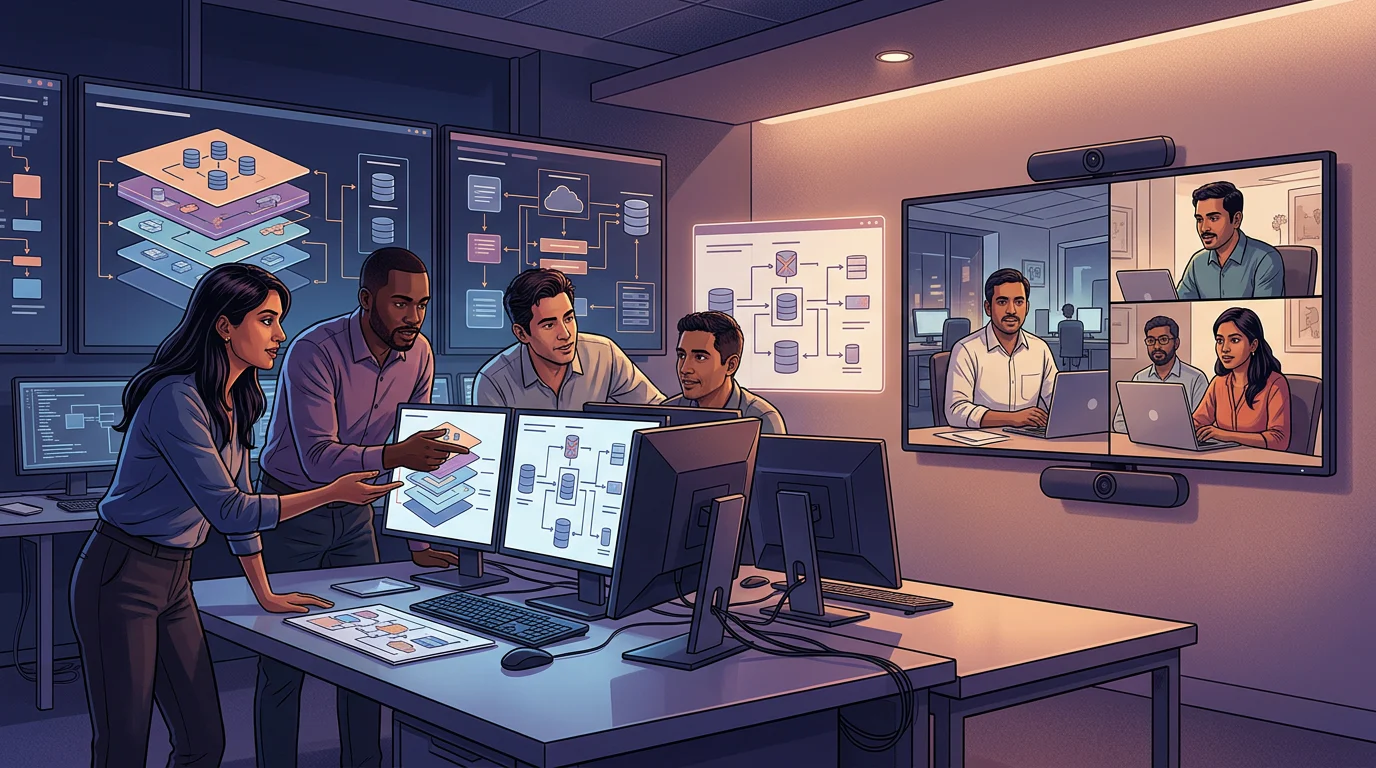
At Vision Board, we use Azure platform training vs migration workshops according to the gap holding a team back. We use platform instruction when India-US teams need shared Azure data-engineering fundamentals. We use live workshops when teams need to translate Hadoop practices into architecture, ownership, governed pipelines, and production delivery behavior.
This comparison shows how we choose the route, diagnose the real gap, design live cross-time-zone learning, build migration evidence, and assess a training partner.
Azure Platform Training vs Migration Workshops: Which Model Fits?
We start with the outcome, not the course format. A team that cannot explain storage, orchestration, streaming, monitoring, or deployment choices needs a shared technical foundation. A team that already knows the tools but keeps deferring architecture choices needs facilitated project work around its real migration.
The two routes can work together, but they should not be confused. Technical instruction proves that people can perform defined tasks. A migration workshop proves that the team can make and document decisions together under the constraints of its own data estate.
| Decision Factor | Azure Platform Training | Migration-Project Workshop |
|---|---|---|
| Best Fit | Uneven Azure data-engineering fundamentals | Real migration decisions are stalled |
| Starting Point | Role skills and lab readiness | Approved business scenario and current-state facts |
| Live Work | Instructor demonstrations and assessed labs | Architecture reviews, decision sessions, and delivery handoffs |
| Main Deliverable | Skills baseline and lab evidence | Target design, artifacts, runbooks, and acceptance criteria |
| Success Signal | Participants can complete core tasks | The team can build, review, and operate the migration path |
We use the blended route when both gaps exist. Microsoft’s migration guidance begins with current topology, project scope, timelines, team expertise, and target requirements. That is the same order we use: establish shared capability, then apply it to a migration decision with real consequences.
For teams comparing technical paths before selecting a cohort, our Azure learning paths help separate broad platform knowledge from the skills a particular migration requires.
How Do We Diagnose the Real Gap?
We do not treat a weak quiz result as proof that a migration workshop is unnecessary. Individual tool knowledge and team operating readiness are different measurements. A useful baseline identifies which one is actually slowing the program.
Our diagnostic asks participants to explain one approved pipeline, trace its dependencies, identify the data owner, describe a release path, and respond to a late-data or access incident. We score the results across technical fluency, architecture, governance, ownership, operations, and cost accountability.
- Tool Knowledge: Can participants build and troubleshoot ingestion, transformation, storage, orchestration, streaming, and monitoring patterns?
- Architecture: Can the team justify target storage, compute, integration, resilience, and cutover decisions?
- Governance: Can it name data owners, classifications, access controls, lineage expectations, and quality checks?
- Ways Of Working: Can it review changes, record decisions, assign owners, and hand work across regions?
- Operations And FinOps: Can it define alerts, recovery expectations, cost ownership, and escalation paths?
We anchor the governance portion in practical responsibilities. Purview role guidance distinguishes central governance responsibilities from data-owner and data-steward responsibilities, which makes it useful for exposing gaps that a technical course alone cannot resolve.
A team with low tool scores should start with structured instruction. A team with reasonable tool scores but unclear ownership, disconnected deployment practices, or unresolved architecture tradeoffs should start with a project workshop. When a legacy estate is the pressure point, our modernization plan gives teams a useful bridge from existing ETL logic to modern delivery choices.
What Does Each Curriculum Need to Cover?
We structure the curriculum around the work participants will perform after the session. Platform instruction builds a common vocabulary and repeatable technical habits. Project workshops apply that vocabulary to one scenario until the team has decisions and artifacts it can take through review.
Platform Instruction
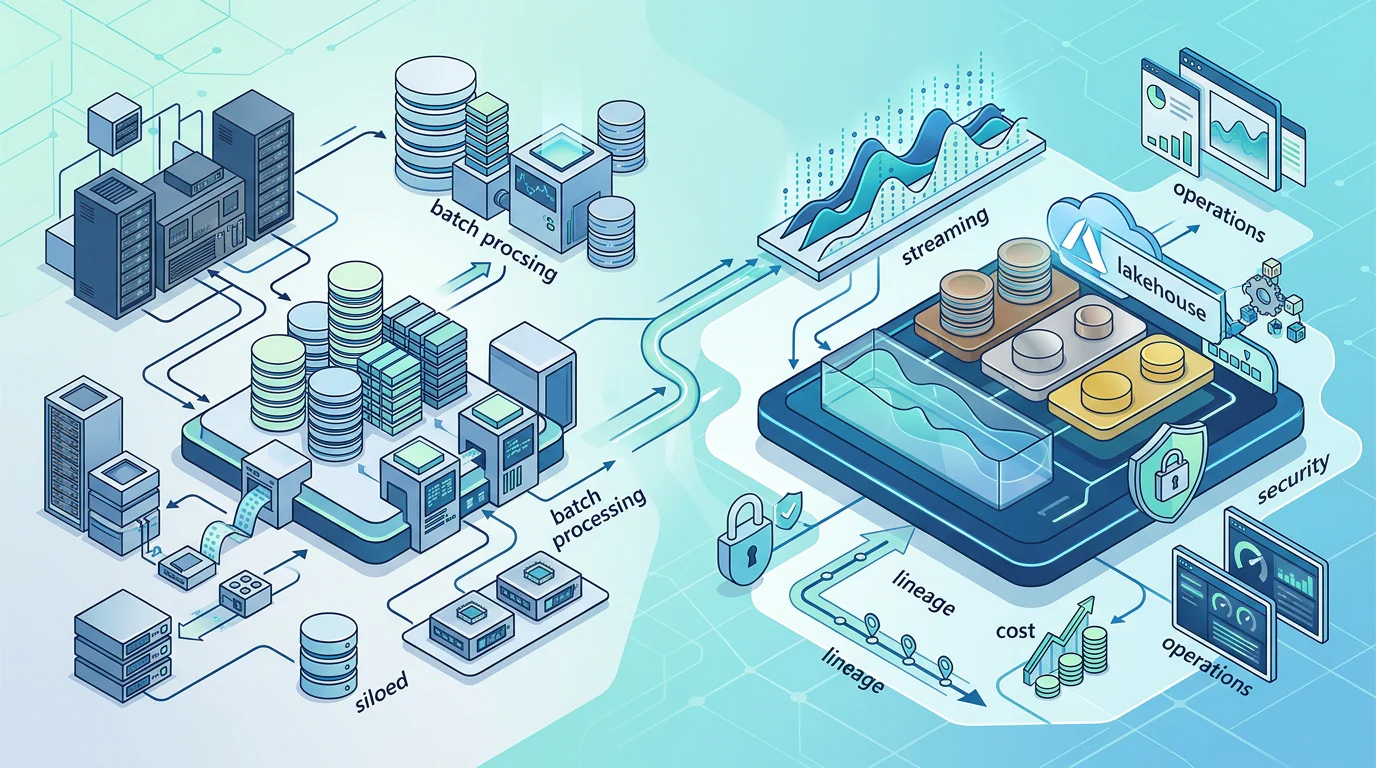
We cover the technical baseline expected of an Azure data-engineering team: data ingestion, lakehouse storage, transformation, orchestration, streaming, access controls, monitoring, testing, and CI/CD. We also include the enterprise-data-management layer that makes those skills usable, including quality, metadata, lineage, privacy, and accountability.
Individual labs should produce assessable evidence, not just attendance. We use our one governed lakehouse guide to connect technical architecture to the governance decisions that make shared data usable.
Migration Curriculum Map
We teach migration as a set of decisions, not as a one-to-one component replacement exercise. The project team maps existing Hadoop capabilities and practices to target responsibilities, then records the tradeoffs.
| Existing Estate Or Practice | Workshop Decision | Evidence Produced |
|---|---|---|
| HDFS Paths And Data Movement | Storage layout, transfer route, encryption, and cutover sequencing | Transfer and validation plan |
| Hive Metastore And SQL | Metadata, table compatibility, schema, and reconciliation approach | Schema and quality checklist |
| Scheduled Batch Jobs | Orchestration, retry, dependency, and release design | Pipeline and deployment design |
| Kafka Or Event Feeds | Streaming versus batch SLA and observability model | Event contract and monitoring plan |
| Access Policies | Classification, lineage, approval, and access model | Governance-control matrix |
| Shared Cluster Operations | Product, platform, incident, and cost ownership | RACI and operating runbook |
Microsoft’s Hadoop migration guide specifically addresses updating HDFS locations to cloud storage paths, Hive metastore compatibility, and policy-path transformation. We use those concrete migration details to keep workshops rooted in implementation rather than abstract cloud vocabulary.
Production Delivery Practices
We require a target architecture, a pipeline implementation or blueprint, test evidence, quality checks, deployment controls, a runbook, and acceptance criteria. Participants should be able to explain who approves a change, how it reaches production, and what happens when the pipeline fails.
For a focused comparison of learning versus implementation work, see our Hadoop migration options.
Unified Analytics Decisions
A cloud-native unified analytics platform changes the design conversation because ingestion, storage, transformation, and governance can be evaluated as a connected system. A current Fabric architecture guide describes more than 200 native connectors, Delta-based storage, and shared governance capabilities. We use that breadth as a reason to teach selection criteria, not as a reason to default every workload to the same design.
How Do India-US Teams Learn Live Across Time Zones?
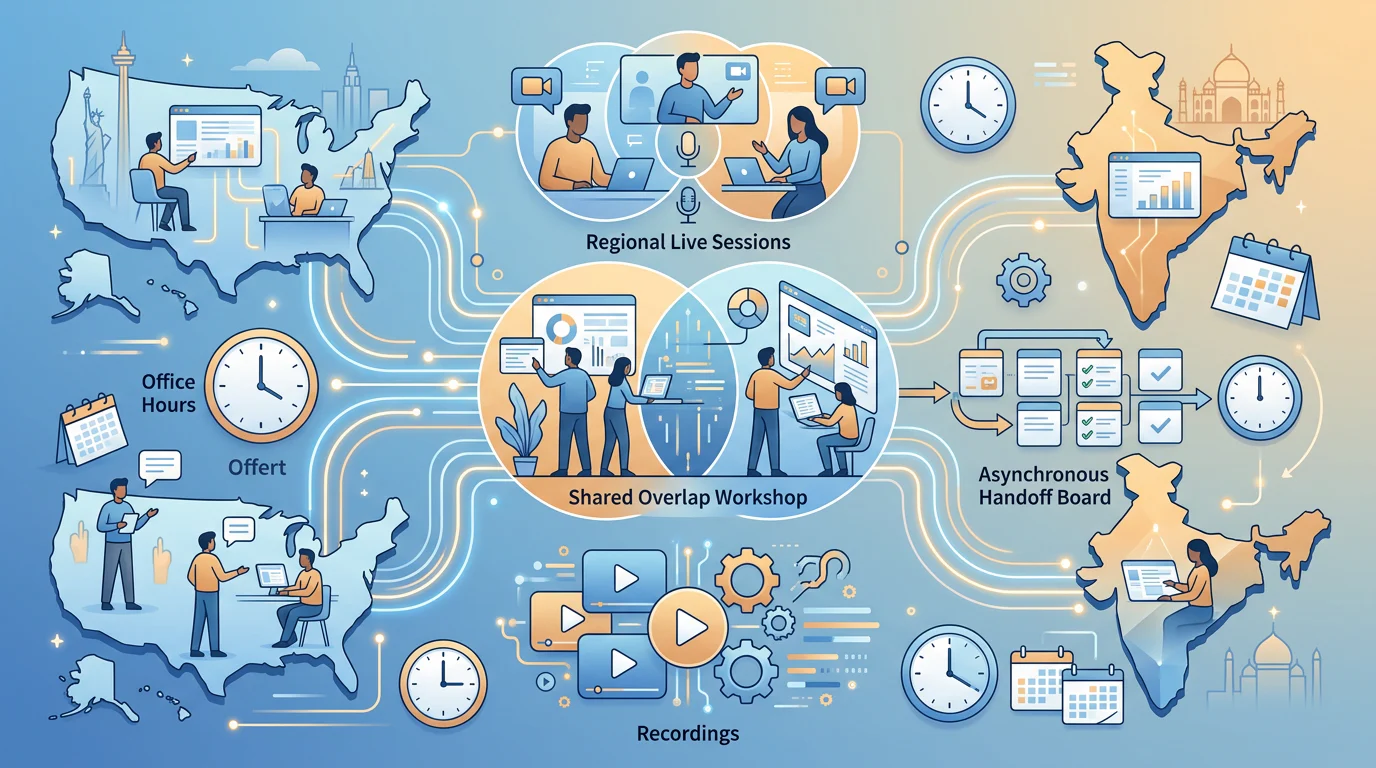
We design for regional energy, not just calendar overlap. India uses a single UTC+5:30 time zone without daylight-saving changes, so a schedule that looks balanced in one month can become unfair when U.S. clocks shift. Our live delivery plan makes the time-zone tradeoff visible before the cohort begins.
For an East Coast overlap, 13:00 UTC equals 18:30 IST, 09:00 EDT, or 08:00 EST. We use that window for decisions that need both regions, while regional cohorts handle deeper labs and role-specific practice. India’s fixed timing is documented in the IST record.
| Delivery Element | India Cohort | U.S. Cohort | Shared Team Work |
|---|---|---|---|
| Technical Modules | Live regional session | Live regional session | Recording available to both |
| Architecture Workshops | Attend selected overlap | Attend selected overlap | Rotating UTC decision session |
| Office Hours | India-friendly slot | U.S.-friendly slot | Escalation log shared asynchronously |
| Project Handoffs | End-of-day artifact update | Start-of-day review | Named owner and next decision |
We pair live instruction with recordings, captions, office hours, and written handoffs. A recording preserves access, but it does not replace facilitation when teams must negotiate ownership, architecture, or acceptance criteria. Our live cohort choices explain when a regional cohort is sufficient and when a cross-region workshop is essential.
Progress reporting should show attendance, baseline and post-assessment, lab completion, artifact status, decision-log participation, and manager sign-off. That creates evidence for internal capability tracking without pretending that seat time alone establishes production readiness.
How Do Migration Workshops Change Delivery Culture?
A migration workshop has to change more than technical vocabulary. We use the project itself to establish new ownership boundaries, review habits, operational expectations, and cost decisions. If a team leaves with only a new architecture diagram, it has not finished the most important part of the work.
Data-Product and Platform Ownership
We ask each domain to name the owner of a data product, its quality expectations, access path, consumer commitments, and change authority. We then define what the platform team owns, including guardrails, shared services, and reliability controls. This prevents a cloud migration from recreating the same ambiguity that made the old environment difficult to operate.
Review and Release Practices
We make participants use architecture decision records, pull-request review, test gates, environment promotion, and release approvals during the workshop. Azure Data Factory’s release guidance shows why validation and deployment artifacts belong in a repeatable pipeline, rather than in an individual’s manual publishing process.
Our pipeline architecture provides a practical reference for turning those decisions into a maintainable delivery path.
FinOps, Security, and Incident Response
We include cost accountability from the design stage. Teams identify workload owners, estimate the implications of architecture choices, and define how cost and usage will be reviewed after release. The FinOps Framework frames this as a collaborative practice across engineering, finance, and business teams, which is why it belongs in a migration workshop.
We also run an incident scenario. Participants define alert signals, response roles, escalation paths, recovery targets, and the contents of a usable runbook. The final acceptance review asks whether the team can build the pipeline, operate it, explain its costs, and recover it together.
How Should We Evaluate a Training Vendor?
We recommend evaluating evidence, not course titles. A provider may have capable instructors and polished materials yet still be unable to facilitate a cross-region migration decision or produce the reporting your program needs.
The procurement conversation should begin with an approved scenario, expected artifacts, data-handling constraints, and the internal stakeholders who will review outcomes. We use a weighted rubric so technical fluency does not overshadow the delivery, governance, and follow-through requirements of a real migration.
| Evaluation Criterion | Weight | Evidence To Request |
|---|---|---|
| Instructor Migration Experience | 20% | Anonymized architecture decisions and delivery examples |
| Scenario Customization | 15% | Discovery method and sample project brief |
| Architecture Facilitation | 15% | Workshop agenda and artifact templates |
| Time-Zone Delivery | 10% | Cohort plan, recordings, office hours, and handoffs |
| Secure Lab Environment | 10% | Isolation, access, reset, and data-handling controls |
| Assessment And Reporting | 10% | Attendance, rubrics, completion, and progress exports |
| Follow-Through | 10% | Review cadence and escalation route |
| Operational Integration | 10% | Runbook and acceptance-criteria assessment |
We ask vendors to demonstrate how they will assess a starting baseline, support regional cohorts, use the company’s approved scenario, and report results to leaders. Our project-based delivery framework helps procurement teams distinguish a learning event from a capability-building engagement.
Why Train with Vision Board?
At Vision Board, we build live learning around the migration decision your team must make. We begin with a short baseline, agree the approved business scenario, and separate regional skill sessions from the live workshops where architecture, governance, and ownership decisions need every voice in the room. Our goal is usable evidence: a target design, tested pipeline artifacts, a review trail, runbooks, acceptance criteria, and progress reporting your leaders can use.
If your India-US team needs shared Azure fundamentals, we can shape a role-based sequence with labs, recordings, office hours, and assessment. If the technical basics already exist, we can focus the cohort on the migration decisions that change delivery outcomes, from data contracts and deployment controls to incident response and cost accountability. We will help you choose the route, define what good looks like, and carry the work into a practical review cadence. Vision Board
FAQs on Azure Platform Training vs Migration Workshops
When Should a Team Choose Platform Training?
We recommend platform training when participants lack shared Azure fundamentals, cannot explain pipeline choices, or need assessed lab practice before contributing safely to the migration.
When Should a Team Use a Migration Workshop?
A migration workshop fits teams that know the tools but need target architecture, governance, ownership, deployment controls, and operational acceptance decisions for an approved business scenario.
How Do We Schedule India-US Live Learning?
We use regional live cohorts, a published UTC overlap for shared decisions, recordings, office hours, and written handoffs that assign the next owner and decision.
What Evidence Should Leaders Receive?
We track attendance, assessments, lab completion, artifact reviews, decision records, runbooks, and acceptance criteria, giving leaders evidence of capability progress beyond course completion for each participant.