Which Enterprise Data Management Training Works Across India and the US?
Compare enterprise data management training for India-US Azure teams: live schedules, labs, Hadoop modernization, governance, and outcomes.
Which Enterprise Data Management Training Works Across India and the US?
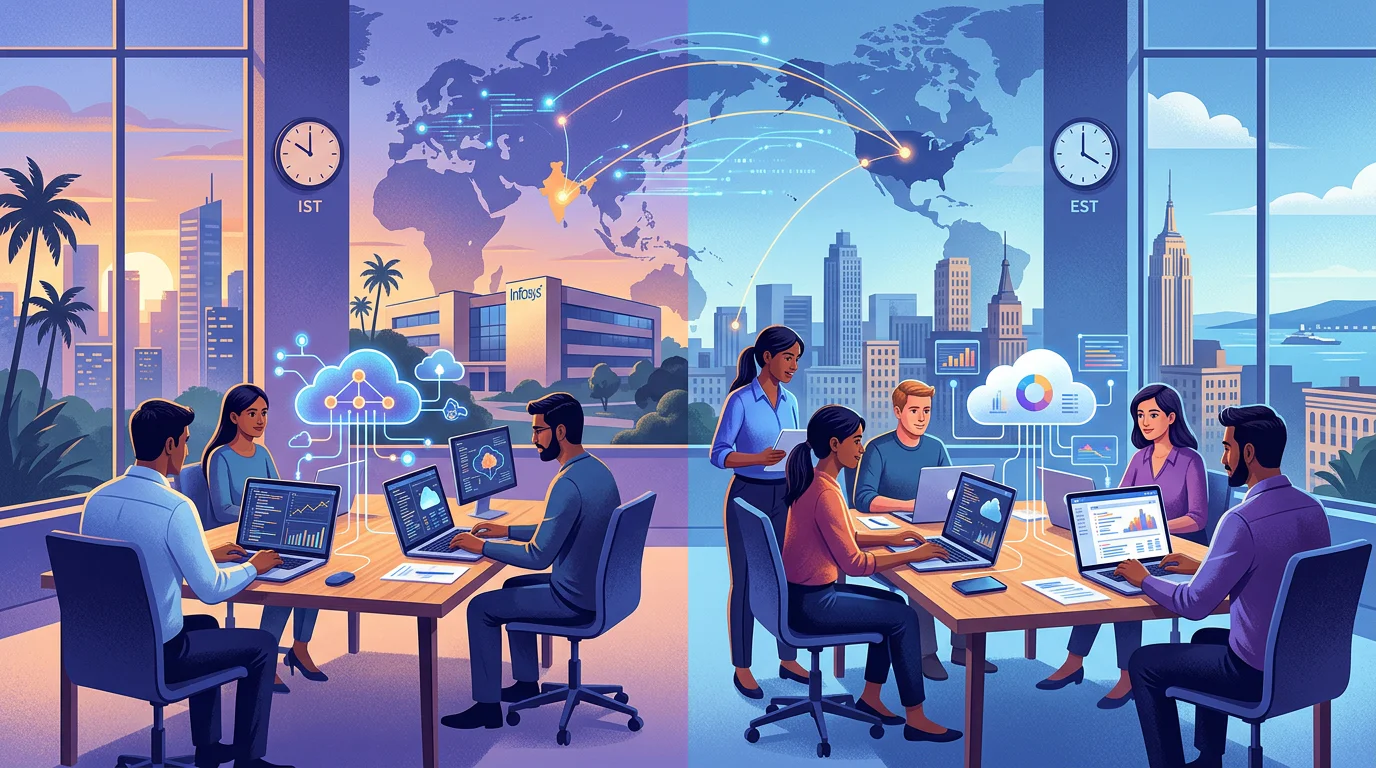
A fixed calendar can fail when the clocks change. In 2026, most US locations moved to daylight saving time on March 8 and return to standard time on November 1, while India stays on IST.
Enterprise data management training works across India and the United States when live sessions rotate between regions, asynchronous preparation carries part of the workload, and every cohort completes the same assessed migration project. Buyers should verify instructor availability, daylight-saving handling, lab access, attendance recovery, manager reporting, and operating-model change alongside cloud technology.
We compare the delivery choices, schedules, labs, Hadoop modernization content, procurement checks, and outcome measures that matter to Azure data engineering teams.
Which Enterprise Data Management Training Model Fits Global Azure Teams?
We recommend choosing a delivery model based on the work the team must perform together, not on a course library’s size. A framework-led program can establish common language for governance and stewardship. A live project cohort can test whether engineers can apply that language while moving a workload toward cloud-native analytics.
The strongest Enterprise Data Management Training arrangement combines both. Team members prepare independently, meet live for difficult decisions and reviews, then deliver a shared capstone that exposes gaps in architecture, ownership, and adoption. A self-paced learning catalog can support preparation, but it cannot by itself provide instructor feedback or resolve cross-region design tradeoffs.
| Training Option | Delivery Mode | India And US Coverage | Private Cohort | Labs | Framework Coverage | Modernization Content | Verified Price | Reporting |
|---|---|---|---|---|---|---|---|---|
| Framework certification catalog | Usually self-paced or scheduled sessions | Confirm per intake | Confirm in writing | Varies | Strong | Varies by course | Confirm published or quoted price | Confirm availability |
| Standards-aligned instructor program | Live, blended, or self-paced | Confirm instructor windows | Often available | Varies | Strong | Depends on curriculum | Require an all-in quote | Confirm manager access |
| Subscription learning library | Mostly asynchronous with selected live events | Global access may differ from live availability | Sometimes | Course-dependent | Broad | Often limited to individual modules | Compare subscription and cohort costs separately | Usually learner-level |
| Specialist live Azure cohort | Live, blended, recordings, office hours | Schedule must be designed | Usually available | Should be required | Varies | Should be central | Require an all-in quote | Require attendance and assessment reporting |
| LMS-supported cohort | Asynchronous preparation plus facilitated sessions | Strong for preparation | Depends on facilitator | Usually limited | Varies | Depends on selected path | Separate license and facilitation costs | Strong activity analytics |
| Vision Board Cohort | Live project cohort with asynchronous preparation | Designed around agreed working windows | Available for team delivery | Shared migration work | Applied governance and ownership | Cloud-native Azure analytics | Discussed for the team scope | Progress and project evidence |
For teams balancing live delivery with flexibility, our flexible team format helps separate recordings and self-study from the parts of learning that need a real instructor and a shared project.
How Should India-US Live Sessions Handle IST, Eastern, Pacific, and Daylight Saving?
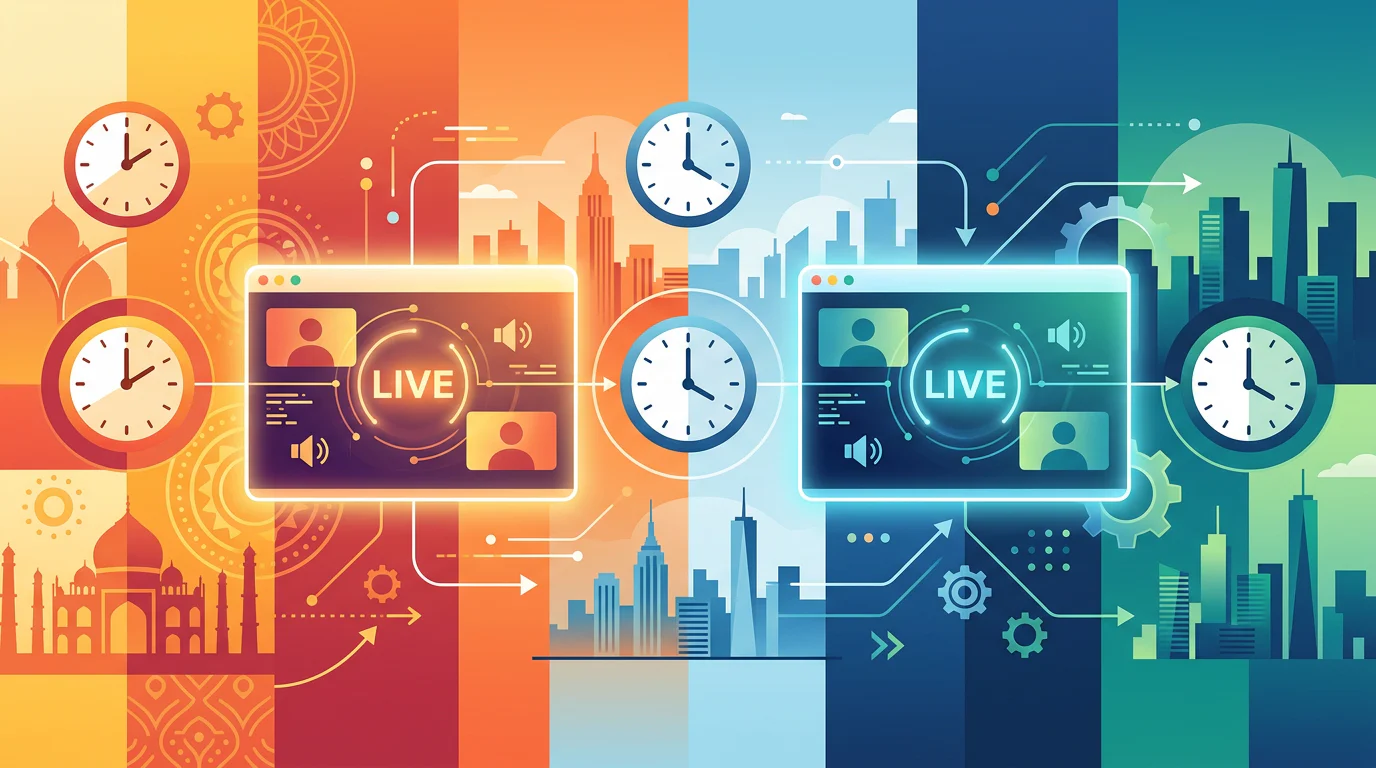
No single meeting time is equally convenient for India, Eastern Time, and Pacific Time. We treat that constraint as a design problem: rotate the burden, publish both standard-time and daylight-time equivalents, and move lectures or setup tasks into asynchronous preparation.
IST is UTC+5:30 throughout the year. US daylight-saving rules shift Eastern and Pacific time by one hour between the second Sunday in March and the first Sunday in November under the federal time law. Every calendar invite should show local time, UTC, the named time zone, and whether the session is standard or daylight time.
Which Time Windows Work Best?
An 08:00 IST session favors India mornings and US evenings. A 19:30 IST session shifts inconvenience toward India evenings and US Pacific mornings. Neither is universally ideal, which is why the cohort should rotate rather than permanently privilege one office.
| IST Session Start | Standard-Time Equivalent | Daylight-Time Equivalent |
|---|---|---|
| 08:00 IST | 21:30 EST, 18:30 PST, previous day | 22:30 EDT, 19:30 PDT, previous day |
| 19:30 IST | 09:00 EST, 06:00 PST | 10:00 EDT, 07:00 PDT |
What Does a Five-Day Cohort Rotation Look Like?
We use live sessions for work that benefits from real-time challenge and feedback. Setup, reading, short demonstrations, and environment checks happen before the session so participants do not spend the overlap window watching basic instruction.
| Day | Core Live Window | Shared Work | Recovery Path |
|---|---|---|---|
| Day 1 | 08:00 IST | Migration baseline and ownership map | Recording and instructor recap |
| Day 2 | 19:30 IST | Hadoop workload inventory lab | Pacific office hour |
| Day 3 | 08:00 IST | Lakehouse and pipeline design review | Shared project feedback |
| Day 4 | 19:30 IST | Governance and operating-model workshop | Eastern office hour |
| Day 5 | 08:00 IST | Capstone demo and post-assessment | Recording and manager summary |
What Should Happen When Someone Misses a Live Session?
Recordings should be a recovery mechanism, not the cohort’s main delivery model. We require a defined recording window, an attendance threshold, an instructor-led recovery option, and regional office hours for questions that cannot be solved by replaying a video.
For a more detailed schedule pattern, see our time-zone workshop guide.
What Must Hadoop-To-Cloud Training Teach Beyond Technology?
A Hadoop migration is not merely a syntax conversion. Teams must decide which workloads move first, how metadata and access controls transfer, where storage and compute separate, and who owns the resulting data product. Current Azure guidance notes that older HDInsight versions 4.0 and 5.0 retired on March 31, 2025, which makes a practical modernization plan more urgent than a generic certification path (migration guidance).
Which Technical Work Belongs in the Shared Lab?
The capstone should start with a representative workload, not a blank sandbox. Teams inventory jobs, dependencies, data classifications, metadata, and validation rules. They then build one migration slice that includes ingestion, transformation, quality checks, governed access, and a usable output for a defined consumer.
We connect this work to a migration-project framework so the team can distinguish a training exercise from evidence that its target architecture is viable.
Which Cultural Changes Need Explicit Coverage?
Cloud-native unified analytics changes decision rights as well as tools. Data owners, stewards, technical owners, platform administrators, and business sponsors need clear responsibilities. The Fabric governance roadmap emphasizes defined roles, accountability, policies, and a coordinated center of excellence.
Training should therefore include adoption resistance, role changes, governance exceptions, and a communication plan. A technically correct lakehouse will still struggle if engineers do not know who approves access, who maintains quality expectations, or who supports consumers after launch.
How Should Teams Assess the Capstone?
We assess technical execution and operating-model decisions separately. The technical score covers ingestion, transformation, validation, security, and reliability. The operating score covers ownership, documentation, escalation, and adoption evidence.
Our Hadoop migration lab explains why role-specific work can still converge on one shared data product.
How Do Live Cohorts Deliver Better Labs, Feedback, and Regional Support?
A realistic lab has individual access, appropriate permissions, sample data, a reset route, and support when a participant is blocked. Simulated interfaces can teach navigation, but they do not prove that a team can configure, validate, and govern its own workload. Official lab guidance makes this distinction clear by identifying a guided environment as a simulation.
We pair hands-on work with design review. Instructors should review assumptions, not merely mark tasks complete. Managers should receive a useful view of attendance, assessment results, capstone progress, and unresolved support needs without turning the program into surveillance.
A good global cohort also supports regional reality. India and US participants need office hours that do not simply recreate the same inconvenient meeting window, plus a clear escalation path for lab access or tenant issues. Our lab realism audit provides a practical way to evaluate whether exercises resemble the work the team will perform after training.
Which Procurement Checks Prove the Training Can Produce Team Outcomes?
Procurement should score evidence, not promises. We recommend a 20-point rubric: award one point only when the provider supplies a clear written answer or demonstrable evidence. A vendor can still be a fit with fewer points, but missing evidence should become a known buying risk rather than a surprise after enrollment.
- Named instructor and backup: Confirm who teaches and who covers absence.
- IST, Eastern, and Pacific calendar: Require both daylight and standard-time variants.
- Private cohort terms: Confirm minimum and maximum team size.
- Live instructional hours: Separate teaching time from self-study.
- Recording access: State duration and access controls.
- Attendance recovery: Define how missed live work is recovered.
- Regional office hours: Confirm windows and response expectations.
- Individual lab access: Specify permissions, accounts, and setup.
- Lab support: Define reset and troubleshooting paths.
- Shared capstone: Require one assessed team deliverable.
- Modernization scope: Include Hadoop or legacy workload decisions.
- Unified analytics scope: Cover ingestion, engineering, governance, and consumption.
- Ownership model: Assess owners, stewards, and technical responsibility.
- Adoption plan: Include champions, support, and feedback loops.
- Attendance analytics: Provide usable participation reporting.
- Assessment reporting: Show individual and cohort evidence.
- Manager reporting: Define what leaders receive and when.
- Retention measurement: Measure follow-up learning or application.
- All-in price: Include labs, tax, support, and certification costs.
- Outcome review: Agree on the 30-day and 90-day check-in.
The maturity model connects training, support, clear roles, governance, and measurement to stronger organizational adoption. That is why we treat procurement as the beginning of an outcome plan, not the end of a purchasing exercise.
| Measure | Before Cohort | 30 Days After | 90 Days After | Evidence Owner |
|---|---|---|---|---|
| Assessed migration-lab score | Baseline assessment | Reassessment | Production-style review | Instructor |
| Attendance recovery | Planned attendance | Recovery completed | N/A | Learning lead |
| Capstone completion | Scope agreed | Demo accepted | Reuse or extension status | Engineering lead |
| Ownership coverage | Named owner and steward coverage | Open-gap review | Exception resolution | Governance lead |
| Adoption | Active contributors and intended users | Usage and office-hour signals | KPI or OKR review | COE lead |
| Delivery impact | Baseline cycle time or error rate | Team-selected delta | Sustained delta | Delivery lead |
Teams can use our project cohort guide to turn this measurement table into a practical learning and delivery plan.
Build a Global Data Cohort with Vision Board
At Vision Board, we build private learning cohorts for Azure data engineers who need more than a completion certificate. We can shape a live schedule around India and US working hours, pair it with asynchronous preparation, and keep the whole cohort moving through one practical migration project. Our approach is designed for teams moving from legacy Hadoop patterns toward governed, cloud-native analytics, where technical fluency and ownership habits must change together. We use live reviews, project feedback, recordings, office hours, and progress conversations to help managers see where the team needs support. Bring your platform constraints, team locations, and target data product to us, and we will help map a cohort that respects working time while still creating shared evidence of learning. Start with a conversation about live delivery, lab access, migration scope, assessment, and the outcomes you need to prove. Visit Vision Board.
FAQs on Enterprise Data Management Training
Can Recordings Replace Live Instruction?
No. Recordings aid recovery and review, but live discussion, instructor feedback, regional office hours, and a shared assessed project create collaboration that recordings cannot provide.
How Should India-US Teams Plan for Daylight Saving?
Keep IST fixed at UTC+5:30, publish standard and daylight equivalents, rotate early and late windows, then offer recordings and regional office hours for missed sessions.
What Should a Hadoop-To-Cloud Capstone Include?
Include workload inventory, metadata decisions, security controls, lakehouse design, pipeline validation, governance roles, and a capstone demonstrating a production-relevant data product for real consumers together.
What Should an Enterprise Training Quote Include?
Ask for all-in cohort cost, cohort size, instructor hours, lab access, recordings, recovery support, assessments, attendance analytics, manager reporting, and a post-course outcome measurement plan.