Microsoft Fabric Lab Realism Audit: Microsoft Learn vs Other Providers
Our Microsoft Fabric lab realism audit compares guided labs, production controls, lakehouse depth, and evidence before you choose training.

Microsoft Fabric Lab Realism Audit: Microsoft Learn vs Other Providers
Learners preparing for Fabric data engineering face a role that expects experience with SQL, PySpark, or KQL, three separate languages named in the official course. The real question is whether a lab develops implementation judgment or only product familiarity.
Based on publicly inspectable materials, our Microsoft Fabric lab realism audit rates the Microsoft Learn collection as Level 2, guided workflow practice, rather than a complete production simulation. It demonstrates valuable workload and control features, while the other two providers cannot be scored without public lab artifacts, scenario details, and independently inspectable tasks.
We compare what learners build, how much they decide independently, which production controls they exercise, and where each path fits foundational, DP-600, DP-700, and enterprise implementation goals.
What Makes a Microsoft Fabric Lab Realistic?
A realistic lab gives the learner a business outcome and constraints, then asks them to make defensible choices. A walkthrough can still be valuable, especially when learning an unfamiliar workload, but it should not be presented as proof that someone can design, secure, recover, and promote an analytics solution.
| Provider | Inspectable Artifacts | Scenario And Workloads | Independence | Production Controls | Duration And Prerequisites | Current Price | Audit Result |
|---|---|---|---|---|---|---|---|
| Microsoft Learn | Published guided exercises and role-aligned learning paths | Lakehouse, warehouse, pipelines, Power BI, real-time, data science, security, and lifecycle topics | Click-by-click guided practice | Security, monitoring, and deployment tasks are separately demonstrated | Individual exercises commonly list short sessions; prerequisites vary by path | No consolidated course price listed in reviewed materials | Level 2, guided workflow practice |
| Other Provider A | Public lab artifacts unavailable for inspection | Public scenario detail unavailable | Not scorable | Not scorable | Not publicly verifiable | Not publicly verifiable | Not scorable |
| Other Provider B | Public lab artifacts unavailable for inspection | Public scenario detail unavailable | Not scorable | Not scorable | Not publicly verifiable | Not publicly verifiable | Not scorable |
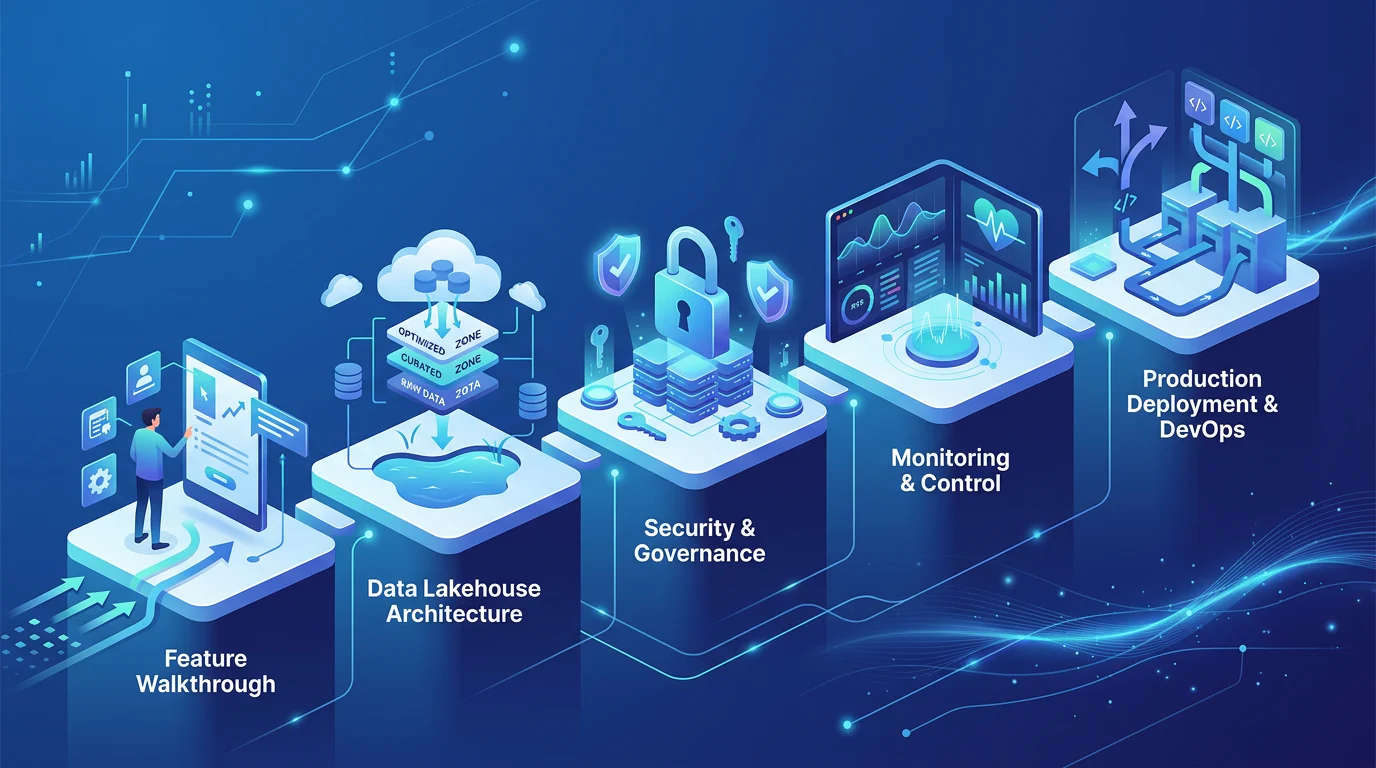
We use a five-level rubric because course labels alone tell readers very little. Our standard starts with feature walkthroughs, moves through guided workflows and guided end-to-end practice, then reserves the highest levels for semi-scaffolded and independent production simulations. A learner should be able to inspect the data, required artifacts, decisions, and controls before treating any course as realistic.
Microsoft’s architecture guidance makes the distinction practical: a production-oriented lakehouse separates raw, enriched, and curated data, while storage and workspace choices affect governance and consumption across teams. That is the standard behind our governed lakehouse guidance.
Level One: Feature Walkthrough
A learner follows prescribed steps in one workload using clean sample data. The result is useful familiarity, but there is little ambiguity, failure handling, or architecture choice.
Level Two: Guided Workflow
A learner connects multiple steps, such as ingesting data, transforming it, and creating an output. The route remains prescribed, so the lab demonstrates task completion more than design judgment.
Level Three: Guided End-To-End Practice
A learner touches several workloads and at least one production control, such as security, monitoring, or promotion. This is meaningful practice, but it still may not require independent decisions.
Levels Four and Five: Implementation Evidence
These levels require imperfect or incremental data, trade-offs, test evidence, recovery work, secure access, and promotion through environments. The final design should be reviewable by someone other than the learner.
What Does Each Provider Publicly Disclose About Its Fabric Labs?
Our audit treats disclosure as evidence, not as a marketing signal. Before scoring a lab, we look for its inputs, required deliverables, realistic constraints, guidance level, production tasks, prerequisites, current price, and an update date. If those items are absent, we mark the field unavailable instead of filling gaps with assumptions.
Microsoft Learn provides a broad, publicly inspectable inventory that includes guided work on OneLake, Delta tables, medallion layers, warehouse loading, eventstreams, semantic models, security, governance, monitoring, and deployment. In our September audit, we counted 46 distinct exercises appearing in 59 topic and course placements, including 15 exercises aligned to data-engineering preparation. Readers can use our Microsoft Fabric Hands-On Lab Index to organize that catalog by implementation goal.
The visible material also exposes the scenario type. Published examples include retail-style data preparation, streaming events, healthcare-oriented data work, and structured warehouse modeling. That matters because a scenario is more useful when it specifies a business question, data condition, and expected artifact instead of merely naming a feature.
For the two other providers in this comparison, we could not verify a public lab-artifact inventory detailed enough to score. A course outline, video list, or promise of practical learning is not sufficient evidence of dataset complexity, learner independence, production controls, or project outputs.
How Deep Is the Lakehouse Work in Each Fabric Lab?
Lakehouse depth is not about whether a course says “medallion.” We look for OneLake storage decisions, Delta table work, bronze, silver, and gold separation, Spark or SQL transformation, dimensional outputs, and a usable downstream serving layer.
Microsoft’s published material demonstrates these component skills. Learners can create and manage Delta tables, use PySpark and SQL, build bronze, silver, and gold layers, produce fact and dimension tables, and consume data through warehouse or semantic-model experiences. The official medallion architecture guidance recommends preserving raw data in bronze where possible and typically using Delta tables in the refined layers.
OneLake and Delta Table Evidence
A credible lakehouse lab should show what is stored in files versus managed tables, why data is copied or referenced, and how tables are maintained. It should also require learners to inspect the output, not simply run a supplied notebook.
Transformation and Dimensional Output
The strongest guided exercises include joins, aggregations, reusable logic, and fact-and-dimension modeling. These are closer to analytics delivery than isolated data-cleaning tasks, particularly when the learner must validate row counts, duplicate handling, or schema changes.
Cross-Workload Integration
A production design often spans pipelines, notebooks, warehouses, semantic models, and real-time components. Fabric supports shared data storage across workloads, but a realistic course should make learners explain why each workload belongs in the solution. Our multi-source BI architecture shows the kind of serving-layer decision a lab should surface.
| Lakehouse Test | Evidence To Request | What It Demonstrates |
|---|---|---|
| Raw To Curated Flow | Input files, transformation logic, and bronze, silver, gold outputs | Data quality and modeling progression |
| Delta Table Work | Table history, schema decisions, and validation queries | Reliable managed storage practice |
| Dimensional Serving Layer | Fact table, dimensions, relationships, and consumption query | Analytics-ready output |
| Cross-Workload Path | Pipeline, notebook or SQL transformation, and report or dashboard output | Integration beyond one feature |
| Design Choice | A documented reason for choosing a workload or pattern | Independent implementation judgment |
A learner who only follows the prescribed path should describe that work accurately as guided practice. The same components become more credible when learners can explain consumption, latency, and model-design trade-offs.
Which Production Practices Do the Labs Actually Exercise?
Production capability appears in the controls surrounding a transformation, not only in the transformation itself. We assess whether learners configure access, observe runs, diagnose a failure, validate an output, manage source changes, and move content between environments.
Microsoft Learn’s published collection includes separate exercises for security and governance, including workspace roles, item permissions, OneLake security, semantic-model security, endorsement, documentation, and lineage. That is stronger evidence than a generic claim that security is covered. Microsoft’s OneLake security model distinguishes workspace and item permissions from the data controls that reach tables, folders, rows, and columns.
Security and Governance
A lab should require an explicit access decision. Good evidence includes a role design, the protected asset, the intended audience, and proof that a restricted user cannot see protected data. A checklist that merely names row-level security is not enough.
Monitoring and Failure Handling
Published exercises can demonstrate monitoring hubs, run histories, warehouse activity, and query insights. That is valuable operational practice, but it does not automatically prove incident response skill. To reach a higher realism level, learners should deliberately encounter a failed run, identify its cause, correct it, and document the recovery.
Git and Deployment Pipelines
Fabric’s documented CI/CD capabilities include Git integration, deployment pipelines, conflict resolution, and automation guidance. A guided deployment exercise shows how promotion works, while a production simulation also requires change review, environment-specific configuration, validation, and rollback thinking. Our unified platform guide explains why these controls belong in the same operating model as storage and analytics.
| Production Practice | Guided Evidence Is Enough For | Higher-Realism Evidence Requires |
|---|---|---|
| Security | Configuring a role or access control | Testing permitted and denied access against a stated policy |
| Governance | Creating lineage, documentation, or endorsements | Defending ownership, classification, and downstream impact choices |
| Monitoring | Viewing run history or query activity | Diagnosing, correcting, and documenting a failed workflow |
| Testing | Running supplied validation queries | Defining quality rules and proving they catch a defect |
| Git And Deployment | Promoting supplied content across stages | Reviewing changes, resolving conflicts, validating environments, and planning rollback |
How Do the Labs Align with Roles and Exams?
Foundational learners need broad vocabulary and confidence across workloads. Microsoft Learn’s beginner path lists eight modules and seven hours 27 minutes of material, while the data-engineering course is aimed at people with prior integration and orchestration experience. That difference matters when someone asks whether a single lab sequence will make them ready for enterprise delivery.
For DP-600, the current study guide weights data preparation at 45 to 50 percent, with maintaining a solution and managing semantic models each at 25 to 30 percent. Its objectives include security, governance, version control, deployment pipelines, dimensional modeling, SQL, KQL, and DAX. The DP-600 guide therefore supports a learning plan that combines analytics assets with lifecycle work.
DP-700 divides implementation and management, ingestion and transformation, and monitoring and optimization into three areas weighted at 30 to 35 percent each. It expects learners to work across SQL, PySpark, and KQL, then apply security, orchestration, lifecycle, monitoring, and optimization. We recommend pairing study goals with team training options when a shared implementation standard matters.
The exam objective list is not a project brief. A learner can be exam-ready without having operated a production workload, and a practitioner can have strong project instincts while needing focused exam preparation. A useful training decision names which outcome matters now.
Which Fabric Lab Path Fits Each Learner?
Choose a short guided lab when you need to learn a product capability quickly. Choose a role-aligned sequence when you need structured certification preparation. Choose a project simulation when your goal is to demonstrate that you can make decisions under realistic delivery constraints.
For foundational learners, begin with a guided tour of storage, transformation, reporting, and real-time workloads. For analytics-engineering learners, prioritize semantic models, Direct Lake, dimensional design, security, governance, and lifecycle. For data-engineering learners, prioritize ingestion patterns, Delta tables, medallion design, Spark, orchestration, monitoring, and deployment.
For enterprise teams, the missing step is often a shared project brief. Give learners imperfect source data, an incremental-load requirement, a protected output, a monitoring requirement, a deployment path, and a reviewable final architecture. That approach is closer to what implementation teams actually need than a collection of isolated labs. Our training comparison can help you choose the right format.
Before paying for any lab-based program, ask to see the dataset, expected artifacts, level of scaffolding, required decisions, control-plane and data-plane security work, monitoring task, deployment task, assessment method, prerequisites, price, and last update date. If the provider cannot show those items, treat the program as unverified rather than unrealistic.
Build Production Judgment with Vision Board
At Vision Board, we help data professionals move from feature familiarity to implementation judgment. Our learning work focuses on the decisions that guided exercises often compress: choosing data boundaries, building resilient transformations, protecting sensitive outputs, and explaining tradeoffs to stakeholders. We can help teams turn a lab inventory into a focused practice plan that matches their role, current skills, and production responsibilities. For individuals, that can mean sequencing foundation work, lakehouse implementation, and deployment practice. For teams, it can mean designing a shared scenario with reviewable artifacts, realistic failure conditions, and clear evidence of competence. Start by comparing what learners must decide, build, test, observe, and improve, not only what they can click through. With support for busy schedules and collaborative project review, explore our practical Fabric learning options and choose the format that fits your implementation goals at Vision Board.
FAQs on Microsoft Fabric Lab Realism Audit
What Makes a Microsoft Fabric Lab Realistic?
A realistic lab connects multiple workloads, gives learners design choices, uses imperfect or incremental data, and requires security, monitoring, testing, and deployment evidence across environments.
Are Guided Fabric Labs Still Worthwhile?
Guided labs remain useful for learning features and prescribed workflows, but pair them with project practice that requires design choices, validation, recovery, and defensible production decisions.
Which Labs Best Support DP-700 Preparation?
Prioritize labs covering ingestion, Delta tables, medallion design, orchestration, security, monitoring, optimization, and deployment, then map activities to the current DP-700 objectives and role requirements.
Why Are Some Providers Not Scored?
We do not score training without publicly inspectable artifacts, scenarios, task details, and production-control evidence because marketing claims alone cannot demonstrate realism or learner independence.