What Replaces Hortonworks for Batch and Streaming? A Hortonworks Replacement for Batch and Streaming
Find the best Hortonworks replacement for batch and streaming, comparing Azure Databricks, Microsoft Fabric, and composable Azure stacks.
What Replaces Hortonworks for Batch and Streaming? A Hortonworks Replacement for Batch and Streaming
When an HDP-era estate moves to Azure, the decision is no longer simply Hadoop on new infrastructure: HDInsight 5.0 reached retirement in March 2025. We need to preserve data contracts, security, and recovery behavior while removing unnecessary operational work.
The best Hortonworks replacement for batch and streaming depends on the operating model. We would shortlist Azure Databricks when a team needs managed Spark, governed lakehouse tables, streaming, and ML; Microsoft Fabric when a Microsoft SaaS analytics experience fits; and Spark with Kafka or Flink when independent engines and operational control outweigh the higher DevOps burden.
In this comparison, we map the components an Azure data team must replace, score six realistic options, and lay out a controlled migration path. We also show how retail, fintech, and mixed analytics-and-ML teams can turn workload inputs into a defensible decision.
How Do We Choose a Hortonworks Replacement for Batch and Streaming?
We start with the architecture the team wants to operate after migration, not the cluster it operates today. A managed lakehouse reduces the number of services engineers must patch, scale, secure, and observe. A composable architecture leaves more design freedom, but it also leaves the team responsible for making separate engines behave like one trustworthy platform.
- Choose Azure Databricks: When Spark is central, ML training is a first-class workload, and the team wants managed streaming, SQL, governance, and lakehouse tables.
- Choose Microsoft Fabric: When SaaS administration, integrated Power BI serving, OneLake, and a Microsoft-native analytics workflow matter more than engine-level control.
- Choose A Composable Stack: When independent Kafka or Flink runtimes, specialized stateful streaming, or portability across engines are hard requirements.
- Treat HDInsight Carefully: It can reduce short-term migration friction, but it should be evaluated as a bridge against current lifecycle constraints, not assumed to be the strategic end state.
- Keep Azure Synapse Analytics In Scope: It remains relevant where Spark, SQL pools, pipelines, and Azure storage form an established operating model.
The right answer can be different for two teams with the same daily volume. One team may value low operational overhead and governed self-service SQL. Another may need strict event-time behavior, custom processor state, and control over every runtime upgrade. Our unified analytics comparison helps teams frame that operating-model choice before they narrow the shortlist.
How Do the Six Options Compare by Workload?
We score the options below as an architecture decision aid, not as a benchmark. A score of 5 means the option is a strong native fit for the workload. For DevOps burden, 5 means less platform work for the data team, while 1 means the team owns most runtime, broker, state, and observability work.
Microsoft Fabric deserves a separate cost-model conversation because its Azure F capacities are billed per second with a one-minute minimum, rather than as a per-job price we can responsibly generalize across regions. We use Fabric capacity billing as the starting point, then model the team’s actual workloads and regional pricing.
| Option | Batch | Streaming | ML | SQL | Governance | Portability | DevOps Burden | Cost Model |
|---|---|---|---|---|---|---|---|---|
| Azure Databricks | 5 | 4 | 5 | 5 | 5 | 4 | 4 | Usage-based platform compute plus Azure storage and networking |
| Microsoft Fabric | 4 | 4 | 4 | 5 | 4 | 3 | 5 | Capacity Units and storage consumption |
| Azure HDInsight 5.1 | 4 | 4 | 2 | 3 | 2 | 4 | 2 | Cluster and VM-based Azure consumption |
| Spark Plus Kafka | 4 | 4 | 4 | 3 | 2 | 5 | 1 | Infrastructure, broker, and SRE ownership |
| Spark Plus Flink | 4 | 5 | 3 | 3 | 2 | 5 | 1 | Infrastructure plus state and checkpoint operations |
| Azure Synapse Analytics Plus Event Hubs | 4 | 3 | 3 | 5 | 4 | 3 | 3 | Compute, Event Hubs, and storage consumption |
Which Option Fits Nightly Batch Processing?
For large scheduled transformations, the decisive questions are usually Spark compatibility, backfill behavior, data layout, and how easily teams can serve curated tables to SQL and BI users. Azure Databricks, Fabric, Synapse Spark, and a self-managed Spark stack can all process batch data, so we avoid treating batch capability alone as a tie-breaker.
We look instead at the jobs that come after the batch run. If the same tables feed ML feature preparation, governed SQL, and analytics consumers, a managed lakehouse often reduces handoffs. If the batch process must remain portable across several engines, an open table-format approach can matter more than the surrounding platform. Our shared lakehouse decision helps teams assess that tradeoff.
Which Option Fits Event-Time and Stateful Streaming?
Streaming should be split into simple ingestion and stateful event processing. Simple ingestion can land events for reporting quickly. Stateful work, such as late-arriving transaction reconciliation, customer-session windows, fraud rules, or stream joins, needs explicit decisions about watermarks, replay, checkpoint storage, and recovery time.
Spark Structured Streaming supports event-time windows and fault-tolerant micro-batch processing, while Flink is often a stronger fit when stateful, low-latency event-time logic dominates the architecture. We should test the needed behavior against actual late-event and recovery requirements, not select a runtime based on its label. The Spark streaming guide explains the fault-tolerance and latency tradeoffs teams should validate.
Which Option Fits ML, SQL, and BI from One Lake?
A team training models and feeding dashboards from the same governed tables should ask whether every consumer can read the same canonical data without unmanaged copies. Azure Databricks is a strong fit for Spark-led ML and SQL. Fabric is a strong fit when OneLake, SaaS workflows, and Power BI serving are central. Synapse can remain appropriate where its Spark and SQL capabilities already support the team’s operating model.
We also separate BI serving from ownership of the data plane. A dashboard tool can query curated tables without forcing every pipeline, notebook, and stream processor into the same runtime. Our unified platform guide helps teams distinguish shared governance from forced engine uniformity.
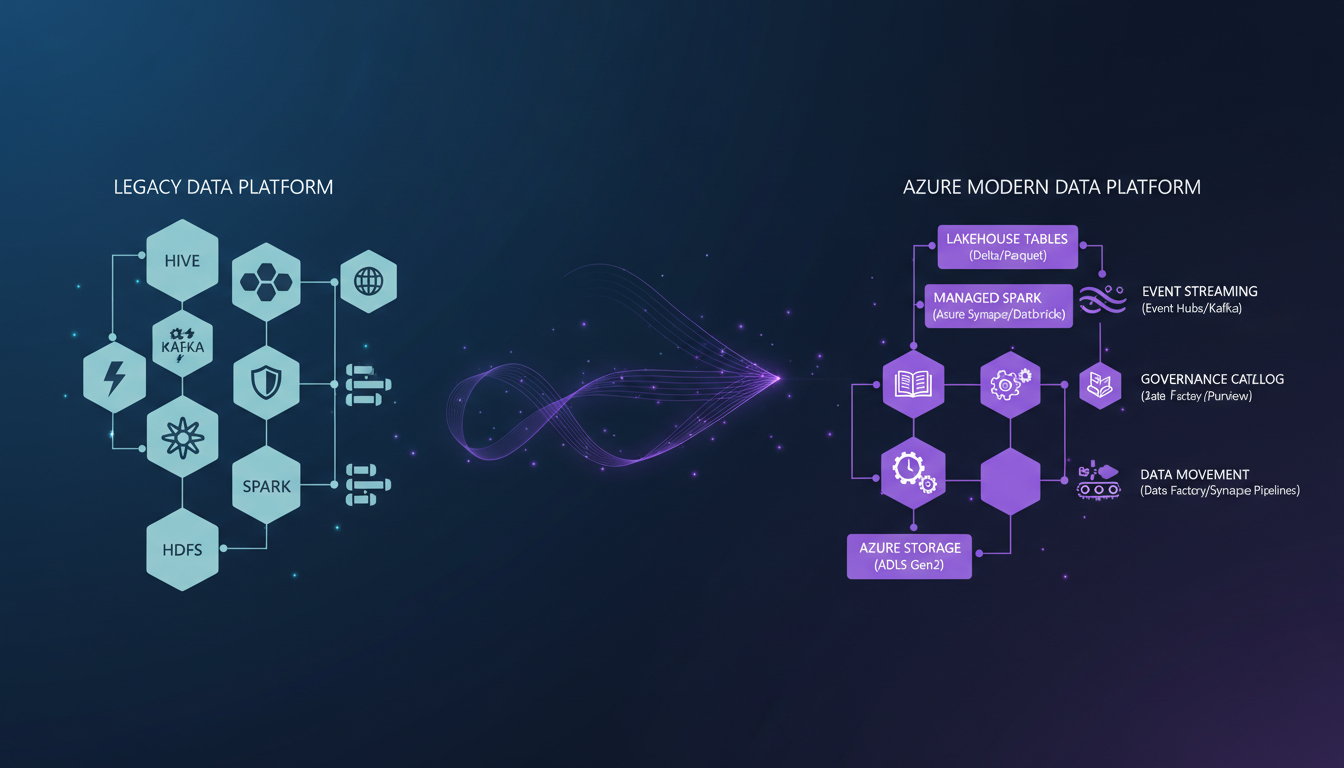
What Replaces HDFS, Hive, Ranger, Atlas, Oozie, and NiFi?
A migration fails when it treats Hortonworks as one product instead of a connected set of storage, compute, metadata, security, streaming, and orchestration contracts. We map each capability to a target design, then validate its dependencies before we move production workloads.
ADLS Gen2 is a practical HDFS replacement because it supports HDFS-compatible access through the ABFS driver. That compatibility helps with paths and Hadoop-oriented tools, but it does not eliminate the need to review ACLs, table locations, file formats, and application assumptions.
How Do We Replace Storage and Tables?
We use ADLS Gen2 as the durable storage layer, then choose a table format based on workload and interoperability. Delta Lake is a practical default for teams prioritizing managed Azure lakehouse workflows, ACID behavior, batch and streaming unification, and schema enforcement. Apache Iceberg deserves consideration where verified cross-engine portability and independent catalog choices are decisive.
The Delta Lake documentation describes how the format unifies batch and streaming data processing while adding transactions and schema enforcement. Our Azure lakehouse engineering guide explores the architectural choices behind that storage layer.
| Hortonworks Capability | Azure-Oriented Replacement | What We Validate Before Migration |
|---|---|---|
| HDFS | ADLS Gen2 and ABFS | Paths, ACLs, lifecycle rules, throughput, application assumptions |
| Hive | Governed tables, Delta Lake or Iceberg, SQL engines | SQL dialect, SerDes, partitions, views, metastore objects |
| Spark | Managed Spark or self-managed Spark | Runtime version, libraries, jobs, checkpoints, UDFs |
| Kafka | Existing Kafka or Event Hubs Kafka endpoint | Topics, offsets, retention, schemas, consumer behavior |
| Ranger | Unity Catalog or Fabric access controls | Roles, table privileges, row filters, column masking, audit needs |
| Atlas | Microsoft Purview and platform lineage | Glossary, classifications, lineage coverage, ownership |
| Oozie | Data Factory, Fabric pipelines, or platform jobs | Dependencies, retries, schedules, alerting, backfills |
| NiFi | Data Factory and specialized flow tooling | Routing, provenance, back-pressure, source connectors |
How Do We Replace Ranger and Atlas Governance?
Ranger policies should become a policy-by-policy validation exercise, not a claim of direct equivalence. We map identities, groups, table access, sensitive columns, and audit requirements to the target control plane. Unity Catalog can provide fine-grained filters and masks, while Fabric controls should be evaluated carefully where preview capabilities are involved.
For catalog and lineage, we use Purview to organize metadata, ownership, classification, and discovery across the estate. We also document known lineage gaps rather than assuming every path-based read, custom function, or legacy job will be captured automatically. Our cloud replacement framework shows how we connect governance decisions to architecture choices.
How Do We Replace Kafka, Oozie, and NiFi Workflows?
Kafka workloads can remain on Kafka or use a managed Kafka-compatible endpoint when application compatibility is more valuable than operating a broker cluster. Oozie schedules, dependencies, and retries should be rebuilt as observable pipelines or jobs, with backfill behavior tested separately from normal schedules.
NiFi deserves particular care because it may encode routing, provenance, back-pressure, and operational habits that do not map cleanly to a general pipeline service. We inventory those flows first, then decide which can become ordinary ingestion pipelines and which need specialized treatment.
Which Dependencies Change the Final Decision?
The hidden dependencies often decide the platform: custom Hive SerDes, Scala or Python libraries, Ranger policy sprawl, Kafka consumer groups, warehouse consumers, recovery objectives, and undocumented manual fixes. We put those dependencies into the migration inventory before a team narrows the shortlist.
How Do We Migrate Pipelines and Governance Without Breaking Production?
We migrate by domain, beginning with contracts that are understood and measurable. That lets us prove data quality, permissions, performance, and recovery behavior in smaller slices before we move the most business-critical streams and reports.
For Hive-oriented assets, Unity Catalog migration guidance explicitly warns that partition behavior differs from Hive and that some migration methods do not carry table history. A federation-first approach can preserve access during transition, but we still test permissions and storage paths under both old and new access patterns.
- Inventory The Estate: Record HDFS paths, Hive objects, Spark jobs, Kafka topics, NiFi flows, Oozie schedules, Ranger policies, Atlas metadata, downstream reports, and service-level expectations.
- Classify Each Workload: Capture daily volume, growth, latency, event-time lateness, concurrency, retention, state size, backfill window, recovery time, and recovery-point requirements.
- Build the Target Foundation: Provision storage, identities, network paths, catalog structure, external locations, and policy ownership before data movement begins.
- Convert Data and Metadata: Validate schemas, file formats, table locations, partitions, SQL compatibility, and historical-query requirements.
- Port Batch and Orchestration: Rebuild schedules, dependencies, retries, notifications, and backfills, then compare target output with the established production output.
- Dual-Run Critical Streams: Define offset, watermark, checkpoint, reconciliation, and rollback rules before either stream is considered production-ready.
- Cut Over by Domain: Move consumers only after data, security, BI, and recovery acceptance criteria pass, then retain evidence before decommissioning the old path.
For teams already moving related integration workloads, our SSIS migration guide helps connect pipeline redesign principles to a broader Azure modernization program.
Which Platform Fits Retail, Fintech, and Mixed Data Teams?
We use scenario scorecards to narrow the field, not to announce a universal winner. Volume alone is insufficient because the decision also depends on late events, security policies, BI concurrency, ML operating needs, and the amount of platform work the team can sustain.
For retail, 2 TB of daily transactions calls for a serious test of ingestion peaks, batch windows, event-time reconciliation, and dashboard concurrency. Azure Databricks is a strong candidate when Spark, streaming, and ML must share governed lakehouse data. Fabric is a strong candidate when SaaS analytics and Power BI serving lead the decision. Spark plus Flink becomes more compelling when demanding stateful event-time behavior is the primary risk.
| Scenario | Verified Workload Inputs | Conditional Shortlist | Decision Gates |
|---|---|---|---|
| Retail | About 2 TB of daily transaction data, batch and streaming analytics | Azure Databricks, Microsoft Fabric, Spark Plus Flink | Late-event tolerance, peak rate, state size, retention, BI concurrency, recovery |
| Fintech | About 500 GB of transaction data, growing 30% monthly | Azure Databricks, Microsoft Fabric, composable stack where control is required | Policy equivalence, audit evidence, lineage, recovery objectives, growth planning |
| Mixed Analytics and ML Team | 20-person data team, Spark jobs, XGBoost models, and Looker dashboards | Azure Databricks, Fabric with a compatible BI pattern, open table architecture | Model workflow, dashboard connectivity, SQL contracts, team operations capacity |
For fintech, governance proof should lead the pilot. We would test row and column protection, audit evidence, lineage visibility, schema change control, and recovery before treating convenience as a benefit. For the 20-person mixed team, we would prioritize a shared data contract across Spark, ML, SQL, and dashboard consumers, then verify that the selected platform removes work instead of moving it to another team.
Our platform architecture guide can help teams make those operating boundaries explicit before they commit to a migration sequence.
Build the Migration Capability with Vision Board
At Vision Board, we help Azure data teams turn platform choices into buildable migration plans. Our learning paths focus on the decisions that make a lakehouse durable: designing storage boundaries, writing reliable Spark transformations, choosing streaming patterns, applying governed access, and explaining tradeoffs to stakeholders. We do not teach a migration as a collection of screenshots. We teach teams to inspect source contracts, test incremental loads, prove data quality, and operate pipelines after cutover. That approach matters when a team is replacing several connected Hadoop services rather than selecting a single tool. If your engineers need a practical foundation before they redesign batch, streaming, governance, and BI workloads, we can help them develop the shared Azure vocabulary and implementation judgment the project needs. Start today with our courses, learning resources, and community, then bring that judgment into real production projects with Vision Board.
FAQs on Hortonworks Replacement for Batch and Streaming
What Is the Best Hortonworks Replacement for Batch and Streaming?
We would begin with Azure Databricks for managed Spark, Microsoft Fabric for SaaS-led analytics, and composable engines when operational control and portability are nonnegotiable requirements.
Should We Replace Hortonworks with Azure Databricks or Microsoft Fabric?
Neither wins automatically. We compare streaming latency, state recovery, ML workflows, SQL serving, governance maturity, BI expectations, operating capacity, and the data team's preferred control boundary.
Which Platforms Support Spark, Streaming Analytics, ML, and BI on One Data Lake?
Several platforms can combine these workloads, but we test whether every engine reads governed tables, whether streaming state recovers correctly, and whether BI users receive reliable SQL.
How Do We Migrate Hortonworks Governance and Pipelines to Azure?
We inventory data, metadata, policies, code, schedules, and consumers first, then migrate in domains, dual-run critical pipelines, reconcile results, and cut over against agreed recovery criteria.
What Replaces HDFS, Hive, Ranger, Atlas, and Oozie in Azure?
Use ADLS Gen2 for storage, then select Delta Lake when managed Azure lakehouse alignment matters or Iceberg when verified cross-engine portability is the decisive constraint.