
Turn IT Experience Into an Azure Data Engineering Career Path in India
A role-by-role route from existing IT work to Azure data engineering project evidence.
6 chapters · Updated Sep 20, 2026 · By Devikrishna R
In brief
The most practical data engineering career path starts with the IT work you already do, then adds the Azure capability your current role does not yet demonstrate. Choose one role route, build one end-to-end project that can be explained and debugged, and use that evidence for applications and interviews.
Choose the route that preserves your existing strengths
A data engineering switch does not require every IT professional to follow the same beginner sequence. A SQL developer already works close to data retrieval and query behaviour. An ETL developer already understands moving and transforming data. A DBA brings recovery, access and performance disciplines. An analyst knows how data is consumed, while a support engineer understands operational failure and escalation.
The target role combines those strengths with ownership of an analytics solution. Microsoft’s current Fabric Data Engineer description includes ingestion and transformation, security and management, and monitoring and optimisation, while noting collaboration with analysts, architects and administrators. Microsoft Learn’s Fabric Data Engineer certification outline provides a useful boundary for the role.
Start by naming the work you can already prove, then select the shortest missing capability. The Azure data engineer training guide for SQL and ETL professionals can help turn that gap into a focused study plan. This approach is not ideal for someone with no prior technical exposure, because it assumes you can already explain work in one of these IT contexts.
Build the common core around a working pipeline
A useful common core has five connected responsibilities: move data, transform it, store and secure it, monitor it, and promote changes safely. Azure Data Factory is Microsoft’s cloud ETL and data-integration service for orchestrating data movement and transformation. Its Copy activity can move data between on-premises and cloud data stores, which makes it a practical foundation for a migration-style project. Microsoft’s Data Factory introduction also documents CI/CD support through Azure DevOps and GitHub.
For storage, Azure Data Lake Storage adds hierarchical directory structure, file-level security and access controls on Blob Storage. For transformation and orchestration, Azure Databricks supports Spark batch and streaming workloads, while Fabric pipeline activities cover movement, transformation and control flow. The question is not whether to learn every option. It is whether the chosen stack lets you show the full responsibility chain.
Use the Azure Data Factory versus Microsoft Fabric learning path when choosing a first platform. A narrow stack is a better first portfolio choice than a multi-tool architecture you cannot operate or explain.
Turn adjacent experience into project evidence
A portfolio project should expose the work that a job title can hide. Start with a source and destination, then show the data movement, transformation, storage decision, run monitoring and a change-promotion approach. Azure Data Factory can monitor pipeline runs in Data Factory Studio and through programmatic interfaces. Microsoft also documents alerting for pipeline, activity and trigger runs, which gives a support-oriented learner an observable operating task rather than a static demo.
Starting point to portfolio proof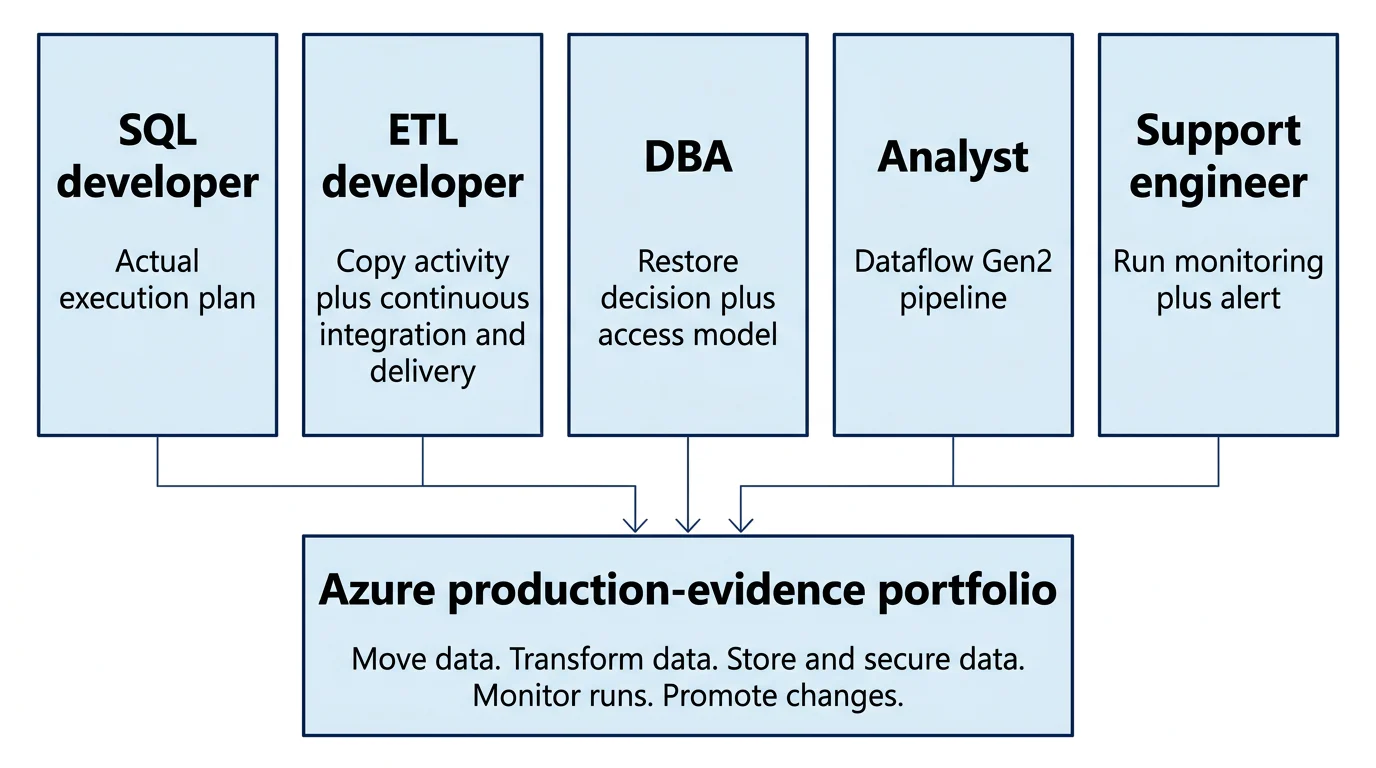
The evidence does not need to imitate a company’s production estate. It does need to be reproducible and specific. Record the source and sink, the transformation rules, a failure or data-quality scenario, the monitoring signal, and the deployment decision. A project that ends with a notebook or screenshot cannot demonstrate the same operational depth as one that can be run, monitored and explained.
Use the Azure data engineering project path to scope the work around project layers rather than adding unrelated services. The trade-off is time: operating evidence takes more effort than completing isolated exercises, but it gives you concrete material for a technical discussion.
Match each role to a proof that changes the hiring conversation
For a SQL developer, add an actual execution plan and explain the runtime metrics or warning that shaped a query decision. Microsoft documents that actual SQL Server execution plans include runtime resource-use metrics and warnings. For an ETL developer, use Copy activity and show how a change moves through continuous integration and delivery.
For a DBA, include a recovery and access decision. Azure SQL Database point-in-time restore defaults to seven days and is configurable within Microsoft’s stated ranges, while Azure Data Lake Storage supports Azure RBAC and POSIX ACLs. For an analyst, run a Dataflow Gen2 inside a Fabric pipeline. For a support engineer, document a pipeline run, an alert and the initial response path. These are role-specific project prompts, not universal employer requirements.
Each route has a limitation. Query analysis alone does not prove orchestration. A successful copy activity alone does not prove transformation design. Recovery knowledge alone does not prove data delivery. The project needs enough connected evidence to make the transition visible without pretending that one lab represents every production scenario.
Use interview milestones before you begin broad applications
Treat project completion as a communication test. You should be able to explain why data moves from a named source to a named destination, where transformation occurs, how access is controlled, what happens when a run fails and how a change reaches another environment. Microsoft’s Data Factory CI/CD guidance describes a development, test or UAT, and production lifecycle, with review through a pull request before deployment. That makes environment promotion a useful milestone to discuss.
For SQL-focused work, explain what an actual execution plan revealed. For operations-focused work, show where run status and alerts are inspected. For platform-focused work, explain the role of storage structure and permissions. For analyst-led work, explain why a Dataflow Gen2 or other transformation is placed in the pipeline.
These milestones do not guarantee an interview outcome, and they are not a substitute for role-specific job descriptions. They do prevent a common problem: listing tools without being able to describe a decision, trade-off or failure mode. Keep a short project README and a spoken walkthrough for every finished project.
Use current credentials as a study boundary, not as the destination
Microsoft’s current Fabric Data Engineer Associate outline names data loading patterns, data architectures and orchestration processes, and lists SQL, PySpark and KQL among relevant skills. That makes it a useful way to check whether a study plan includes ingestion, transformation, monitoring and optimisation rather than focusing on a single service.
Do not build a plan around DP-203 as a current certification. Microsoft states that the Azure Data Engineer Associate certification and its renewal assessment retired on 31 March 2025. Microsoft also lists the related DP-203T00 course as retired, with DP-700T00 named as a replacement course. The current-course guide after DP-203 can help you compare learning options against that change.
A credential can provide structure and a curriculum checkpoint. It is not proof that you can troubleshoot a failed pipeline, explain a storage-access decision or promote a change. Keep the credential optional and retain a project-first route if practical work is the immediate gap.
Go deeper
Frequently asked
A SQL developer should begin by turning query and schema knowledge into pipeline evidence. Build a project that moves data, transforms it with SQL or Spark, and explains how you inspected execution behaviour, then add orchestration and monitoring rather than restarting with basic SQL.
An ETL developer should start with the platform closest to the work they need to demonstrate. Azure Data Factory is useful for data movement, orchestration, monitoring and deployment workflows, while Fabric adds a broader analytics workspace with pipeline activities and Dataflow Gen2.
A DBA can build a credible route by carrying forward recovery, access control and performance habits. A portfolio project should show a data pipeline as well as a clear recovery decision, storage-access approach and explanation of how the solution will be monitored after deployment.
No. Microsoft states that the Azure Data Engineer Associate certification and its renewal assessment retired on 31 March 2025. Use current Microsoft Fabric Data Engineer materials such as DP-700 when certification is part of your plan, but treat hands-on project evidence as separate work.
A support engineer should show more than incident handling. Build and operate a small pipeline, capture how you inspect run status, describe a failure scenario, and configure an alert. That converts operational troubleshooting experience into evidence of data-platform ownership.
Start with a focused Azure data engineering introduction
Use the bootcamp to test the learning path before committing to a larger project plan.
Explore the 3-Day Bootcamp