Which Azure Data Engineering Project Path Gets You Job-Ready?
Compare Azure data engineering project paths and build a 12-week portfolio with batch, streaming, and governed analytics projects.

Which Azure Data Engineering Project Path Gets You Job-Ready?
A contract deadline turns a broad learning choice into a shipping problem. The official self-paced catalog includes a 56-minute path, which can be useful for orientation, but it cannot by itself create a portfolio that stands up in an interview.
We believe the fastest Azure Data Engineering Project Path for a professional facing a contract deadline is a 12-week build sequence: one recoverable batch medallion pipeline, one real-time streaming pipeline, and one governed analytics product. Certificates can show coverage, but deployable artifacts, fast feedback, and clear explanations prove job readiness.
We compare the practical routes, map a weekly build plan, define three portfolio projects, and show how to score the evidence before applying.
What Makes an Azure Data Engineering Project Path Job-Ready?
A job-ready path must help you make and defend engineering decisions. We look for a coherent system that ingests data, preserves raw inputs, transforms data with Spark and SQL, serves trusted outputs, and shows what happens when a pipeline fails. The relevant standard is not whether a learner watched every lesson. It is whether they can explain a design, deploy it safely, diagnose it, and recover it.
A strong starting architecture uses Data Factory for ingestion, Databricks for scalable processing, and a serving layer for analytics, as shown in the official architecture. The medallion pattern then gives the portfolio a clear story: bronze preserves raw data, silver validates and standardizes it, and gold provides business-ready outputs.
Use these four checks when evaluating any path:
- Architecture: Can you explain why data moves through bronze, silver, and gold rather than directly into a dashboard?
- Implementation: Can you build parameterized ingestion, Spark transformations, SQL models, tests, and repeatable deployments?
- Operations: Can you show monitoring, cost controls, alerts, recovery steps, and a safe replay process?
- Explanation: Can you narrate the system, trade-offs, and failure modes without reading from a notebook?
For a broader selection framework, use our learning path comparison before committing to a schedule.
Which Learning Route Fits Your Deadline and Budget?
Comparison only works when we separate published evidence from marketing promises. A four-month live programme may be valuable for someone who has runway, while a three-week project library may be too compressed for someone who still needs feedback, testing, and deployment practice.
| Path | Price | Published Duration | Live Support | Azure Environment | Portfolio Output |
|---|---|---|---|---|---|
| Vision Board Live Azure Programme | ₹25,422.88 currently displayed | Four months | Live sessions plus recordings | Confirm cohort access before enrolling | Project and career support, with scope varying by batch |
| Official Self-Paced Labs | Free | At least 7 hours 34 minutes across listed modules | No live support stated | Learning content, with separate cloud access needed | Guided exercises, not a defined three-project portfolio |
| Build-To-Spec Azure Route | Free instruction, cloud use varies | 12 weeks | Arrange peer or mentor review | Personal Azure subscription | Three deployable portfolio projects |
| Anonymous Commercial Project Library | Price not publicly displayed | About 19 hours, roughly three weeks | Mentorship advertised | Azure tools listed | Five guided project exercises |
| Anonymous Long-Schedule Curriculum | Not scored without published terms | Not scored without published terms | Not scored without published terms | Not scored without published terms | Not scored without published terms |
Cloud access deserves its own question. New Azure customers can receive $200 credit usable within 30 days, but that does not remove the need to set a budget, tag resources, and shut down compute after each build session. We advise deadline-driven learners to choose the option that leaves time for project reviews, debugging, and interview rehearsal, not merely content completion.
If you are deciding whether a course or the portfolio should come first, start with our project-first decision and work backward from the proof an interviewer can inspect.
How Can You Build the Portfolio in Twelve Weeks?
We designed this sequence around 144 hours of learner effort: 30 hours of guided study and labs, plus 114 hours of building, testing, documenting, and rehearsing. Those are our recommended commitment hours, not advertised contact hours from a provider. The point is to produce visible evidence every week.
| Week | Planned Commitment | Deliverable |
|---|---|---|
| 1 | 4 guided, 8 build | Repository, budget alert, source contract, and architecture decision record |
| 2 | 3 guided, 9 build | SQL transformations, quality assertions, and test fixtures |
| 3 | 3 guided, 9 build | ADLS structure, roles, secrets approach, and infrastructure skeleton |
| 4 | 2 guided, 10 build | Parameterized ingestion pipeline with retries and raw landing zone |
| 5 | 3 guided, 9 build | Bronze-to-silver Spark transformations and idempotent reruns |
| 6 | 2 guided, 10 build | Gold tables, KPI model, and batch project walkthrough |
| 7 | 2 guided, 10 build | Event producer, schema, consumer group, and event contract |
| 8 | 2 guided, 10 build | Structured Streaming with checkpoints, watermarks, and deduplication |
| 9 | 3 guided, 9 build | Late-event tests, failure recovery, and streaming walkthrough |
| 10 | 2 guided, 10 build | Governed serving product, role model, and metric glossary |
| 11 | 2 guided, 10 build | CI/CD, alerts, runbooks, and cost controls |
| 12 | 2 guided, 10 build | Readiness score, recorded demos, résumé bullets, and mock interviews |
The operational window matters because Data Factory retains pipeline run data for only 45 days. Build diagnostics and exported evidence as you go instead of trying to recreate proof at the end. Our 90-day roadmap adds supporting exercises if you need more foundation before Week 1.
Which Three Projects Should Your Portfolio Include?
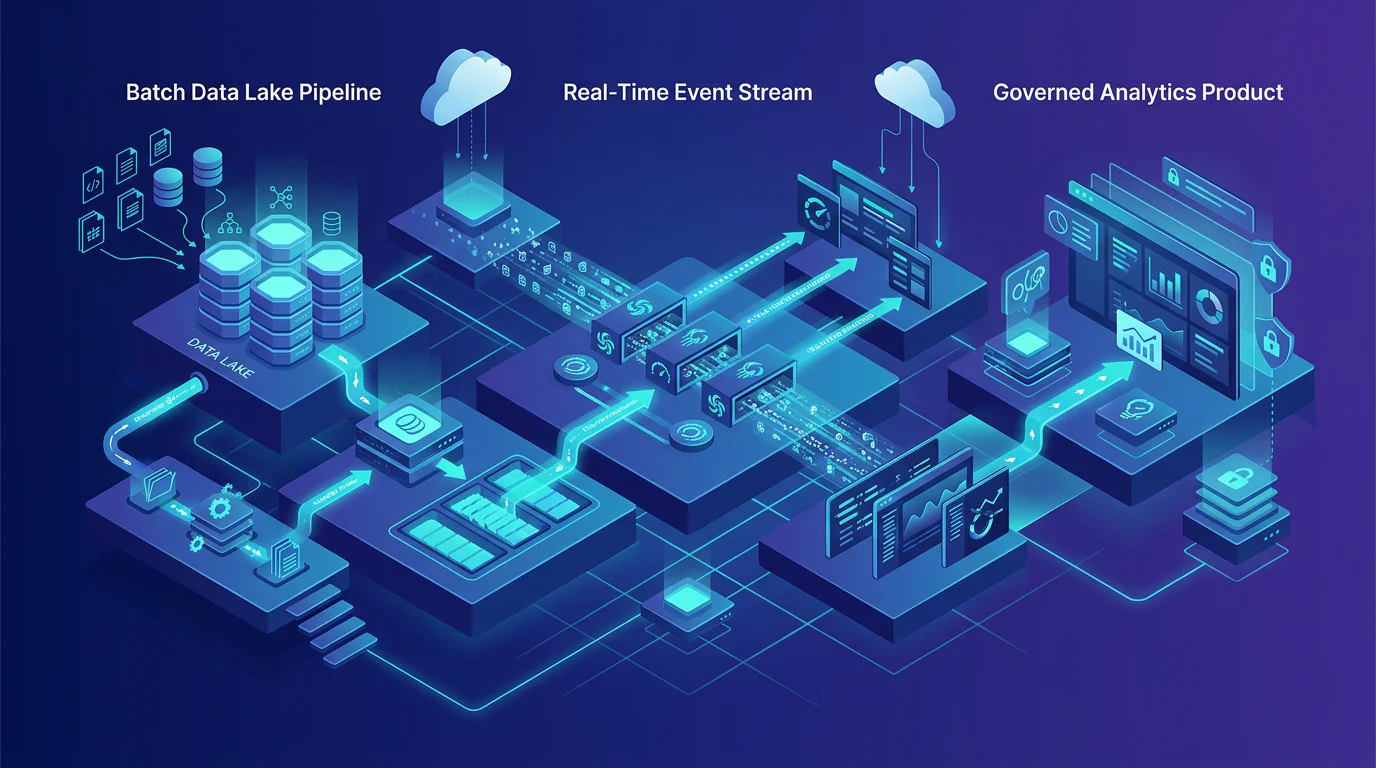
The three projects should relate to one another. That makes the final repository feel like a credible data product instead of a stack of unrelated tutorials. Event Hubs can ingest millions of events per second, so it gives the streaming project a realistic operational context without requiring an artificial enterprise-scale claim.
Batch Medallion Pipeline
Build a daily operations or retail pipeline that ingests source files with ADF, lands immutable raw data in ADLS, transforms it with Spark, and publishes gold tables for a KPI model.
- Acceptance Test: Rerun a failed load without duplicates or damaged historical records.
- Quality Control: Validate nulls, schema changes, row counts, and duplicate business keys.
- Deployment Proof: Store pipeline definitions, infrastructure, and environment configuration in source control.
- Recovery Proof: Document how to replay a source date and verify that gold metrics reconcile.
A shared lakehouse design makes this project easier to explain, especially when batch data later feeds streaming and governed outputs. Our governed lakehouse guide shows how to keep ownership, access, and trusted outputs clear across the system.
Real-Time Streaming Pipeline
Create an event producer and consume the events through Event Hubs into Structured Streaming. The portfolio must show checkpointing, a late-event policy, deduplication, and a small operational KPI.
- Acceptance Test: Stop the consumer, restart it, and show that the checkpoint avoids unwanted duplication.
- Security Control: Retrieve connection details from a secret store or secret scope, never from committed code.
- Observability Proof: Trigger an alert for failure or stale output and show the investigation path.
- Cost Control: Explain the capacity assumption, retention choice, and shutdown process.
Governed Analytics Product
Publish curated gold data through Fabric or a Databricks-connected analytics layer. Treat it as a product with a named owner, governed access, a glossary, and a defined consumer outcome.
- Acceptance Test: Promote the same configuration through development, test, and production environments.
- Governance Proof: Show role-based access, lineage, and an approved semantic output.
- Documentation Proof: Include metric definitions, upstream dependencies, and data-quality expectations.
- Interview Proof: Explain the trade-off between a fast dashboard delivery and a reusable governed model.
The final project should connect every tool choice to a business outcome and an operational responsibility. Use our modern curriculum checklist to ensure the portfolio demonstrates current platform practices rather than a disconnected collection of exercises.
How Should You Package and Score the Evidence?
A good repository lets another engineer understand the system without a long handover call. We expect infrastructure, pipelines, notebooks, tests, diagrams, and runbooks to be separate, readable, and runnable. That structure also gives you an efficient interview navigation path.

azure-data-engineering-portfolio/
├── infra/
├── adf/
├── notebooks/
├── src/
├── tests/
├── data-contracts/
├── docs/
│   ├── architecture/
│   ├── adr/
│   ├── metric-glossary/
│   └── interview-demo/
├── observability/
├── runbooks/
└── ci/
Use our pipeline building guide to turn separate files into a coherent system, with clear ownership, deployment evidence, and operational documentation.
We use the following 100-point scorecard before calling a portfolio ready. An 80 or higher is useful only when no category is neglected and all three project demonstrations work.
| Readiness Area | Weight | Evidence To Review |
|---|---|---|
| Architecture | 30 | Diagram, data contracts, layer rationale, identity design, and trade-offs |
| Implementation | 35 | ADF, ADLS, Spark, SQL, tests, incremental logic, and working deployments |
| Operations | 20 | Monitoring, alerts, budget controls, runbooks, CI/CD, and recovery drill |
| Explanation | 15 | Recorded walkthroughs, concise résumé bullets, and interview answers |
Modern CI/CD guidance recommends version-controlling notebooks, infrastructure, and job configurations, then automating tests and rollbacks through a reliable workflow. For career transition support after your portfolio is complete, follow our working-professional path and map every project to a role requirement you can explain.
Build Your Evidence with Vision Board
At Vision Board, we help working professionals turn a short runway into evidence they can defend. Our career-focused Data and AI community is built around the gap between completing lessons and winning a better role. If you are approaching a contract deadline, begin by comparing your available weekly hours with the artifacts you must ship, then choose a cohort, self-directed route, or blended plan that leaves room for reviews and recovery drills. We can help you organize the work around ADF, ADLS, Spark, SQL, streaming, monitoring, governance, and interview explanation, while keeping the portfolio tied to one coherent data product. Bring your current experience, job descriptions, and time constraint to the decision. We will help you identify the proof worth building first, rather than collecting disconnected certificates. Review schedules, prices, and course access before enrolment, then choose the path you can actually complete. Explore our course options
FAQs on Azure Data Engineering Project Path
Can I Become Job-Ready in Twelve Weeks?
Yes, if you have SQL and Python foundations and commit twelve weekly build hours. The goal is evidence of capability, not mastery of every service.
Which Azure Tools Should I Prioritize First?
Start with ADF, ADLS, Spark, SQL, and Event Hubs. Add Fabric or Databricks for governed serving, then explain why your selected tool fits the workload.
How Much Should I Budget for Cloud Practice?
Use introductory Azure credit if eligible, but set budgets before deployment. Shut down compute, tag resources, and document every cost assumption in the project runbook.
What Does Fast Feedback Actually Mean?
Fast feedback means a reviewer inspects your repository, tests, architecture choices, and recovery plan within days, then asks you to defend decisions in a mock interview.
Is a Certificate Enough to Apply?
A certificate can support credibility, but it cannot replace a public project walkthrough. Score build quality, operational controls, and your explanation under pressure before applying.