Azure Data Engineering Course vs Portfolio Projects: Which Comes First?
Azure data engineering course vs portfolio projects: choose the right 12-week hybrid plan and build job-ready evidence.
Azure Data Engineering Course vs Portfolio Projects: Which Comes First?
The current Microsoft Fabric Data Engineer Associate exam lists a price of $165 USD, although the actual price varies by proctoring country, which is one reason a certificate alone should not decide a short deadline plan. Microsoft lists
For an Azure data engineering course vs portfolio projects decision, we recommend a hybrid sequence for a three-month deadline. Learn foundations only when the next build requires them, then publish a batch pipeline, governed lakehouse, and streaming workflow with source control, automation, security, monitoring, recovery, and a concise architecture explanation.
We will show when each path fits, what job-ready proof looks like, and how to leave twelve weeks with three coherent projects instead of a long list of half-finished labs.
How Should We Evaluate an Azure Data Engineering Course vs Portfolio Projects?
A course path is useful when we need a stable sequence for unfamiliar concepts. Portfolio work becomes urgent when we can already write SQL or Python and need proof that we can turn requirements into a dependable system. For most contract engineers, the real choice is not study versus projects. It is whether every study session creates evidence that survives outside the classroom.
The older Azure Data Engineer Associate exam, DP-203, was retired on March 31, 2025. That makes a generic promise to “study for the Azure data engineer certificate” especially weak as a standalone plan. We use credentials as a learning framework when useful, but we treat a public repository and a defensible design decision as the hiring evidence. Retirement notice
| Path | Time To First Evidence | Skill Coverage | Feedback | Cost | Credential Value | Portfolio Depth |
|---|---|---|---|---|---|---|
| Curriculum First | After foundational modules | Broad, but often detached from delivery decisions | Quizzes, instructors, peers | Depends on provider and region | Shows completion | Usually needs a later build phase |
| Project First | As soon as the first pipeline runs | Deep in chosen tools, with possible knowledge gaps | Debugging, reviews, mock interviews | Depends on Azure consumption | No credential by itself | Strong if the build is reproducible |
| Hybrid | During the first build | Focused concepts plus applied delivery | Structured learning and working-system feedback | Depends on both learning and cloud use | Supplementary evidence | Strongest route for a fixed deadline |
We choose curriculum-first when foundational gaps would make every project feel like copy-paste work. We choose project-first when an experienced engineer can already explain ingestion, transformations, and data models. We choose hybrid when the deadline matters because it forces us to learn only what the next deliverable requires, then test whether we can use it independently.
For a broader tool and format comparison, pair this decision with our learning path comparison. The important distinction is simple: lessons create understanding, while an inspectable system demonstrates judgment.
What Does Job-Ready Portfolio Evidence Look Like?
Job-ready evidence is not a screenshot of a successful notebook. It is a small system that another engineer can inspect, reproduce, break, and understand. We want the repository to answer the questions a technical interviewer will ask before they ask them: where did the data come from, what happens when it changes, who can access it, and how do we know it is healthy?
A README is often the first artifact a repository visitor sees, so we use it as the entry point to the architecture, setup, trade-offs, and operating instructions. GitHub documentation
Score the Build Before You Call It Job-Ready
We use this 100-point readiness rubric across all three projects. A score is not a hiring guarantee, but it stops us from mistaking a working demo for an engineered deliverable.
| Evidence Category | Points |
|---|---|
| Meaningful Git history and pull requests | 8 |
| Infrastructure definition | 12 |
| CI/CD deployment | 12 |
| Secrets handling | 8 |
| Automated tests and data-quality tests | 10 |
| Lineage and ownership | 8 |
| Observability and alerts | 10 |
| Security and least-privilege decisions | 10 |
| Cost assumptions and cleanup notes | 5 |
| Documentation, diagrams, trade-offs, and incident walkthrough | 17 |
| Total | 100 |
We do not need perfect enterprise infrastructure in a portfolio. We do need a deliberate decision for every category, including what we left out and why. A concise note on a lower-cost test environment is more credible than an unexplained production-style diagram.
Build a Repository a Reviewer Can Navigate
Each repository should contain a problem statement, source-data assumptions, an architecture diagram, infrastructure code, runnable source files, tests, and a short operational runbook. We also include sample data or a data generator so the reviewer does not need access to a private system.
Use Azure data pipelines to support the implementation discussion. These connections let readers move from a portfolio decision into the technical choices behind it.
Explain the Design Like an Engineer
For every project, we prepare a 90-second explanation with four parts:
- Context: Describe the source, latency requirement, and business consumer.
- Architecture: Walk through the data flow and the ownership boundary.
- Trade-Off: Explain one choice, such as lower batch cost versus lower streaming latency.
- Incident: Show a realistic failure, the alert it creates, the rerun or replay path, and the lesson learned.
This approach is more persuasive than claiming a project is production-ready. We show the reviewer how we reason about a production-style problem.
How Can We Use Twelve Weeks to Become Job-Ready?
A twelve-week plan should not spend eight weeks collecting concepts and four weeks rushing through projects. We sequence the work so that the batch build establishes reliable delivery habits, the lakehouse adds governance and performance judgment, and the streaming build proves we can operate data under time pressure.
Microsoft documents watermark-based loading, change tracking, and modified-date patterns for incremental ingestion. That gives us a practical basis for making the first project more than a full-load tutorial. ADF guidance
| Week | Learn What The Build Needs | Build Milestone | Exit Criterion |
|---|---|---|---|
| 1 | Azure identity, storage, Git workflow | Repository template and architecture decision record | Commit a runnable sample-data setup |
| 2 | SQL, Python, and orchestration basics | Batch source-to-landing pipeline | Complete a successful first load |
| 3 | Watermarks and control tables | Incremental load path | Prove changed records load correctly |
| 4 | Tests and deployment basics | Data-quality gates and rerun logic | Fail a test, fix it, rerun safely |
| 5 | Delta tables and medallion design | Bronze, Silver, and Gold skeleton | Query one table in every layer |
| 6 | Governance and table design | Catalog, schemas, permissions, lineage | Explain access and ownership choices |
| 7 | Performance decisions | Optimization experiment | Record a reproducible query comparison |
| 8 | CI/CD and runbooks | Infrastructure-based deployment | Deploy a clean environment successfully |
| 9 | Event ingestion and streaming | Producer and event-ingestion path | Events reach the raw layer |
| 10 | Windows, state, and late data | Stateful streaming transformation | Demonstrate the late-event policy |
| 11 | Monitoring and recovery | Alerts, checkpoints, replay path | Simulate failure and recover |
| 12 | Portfolio packaging and interviews | Final documentation and walkthrough | Score all three projects against the rubric |
Our 90-day roadmap can support the calendar, but we would not add another curriculum simply to fill time. At the end of every week, we need a visible artifact, a test result, or a decision record.
Which Batch and Lakehouse Projects Impress Recruiters?
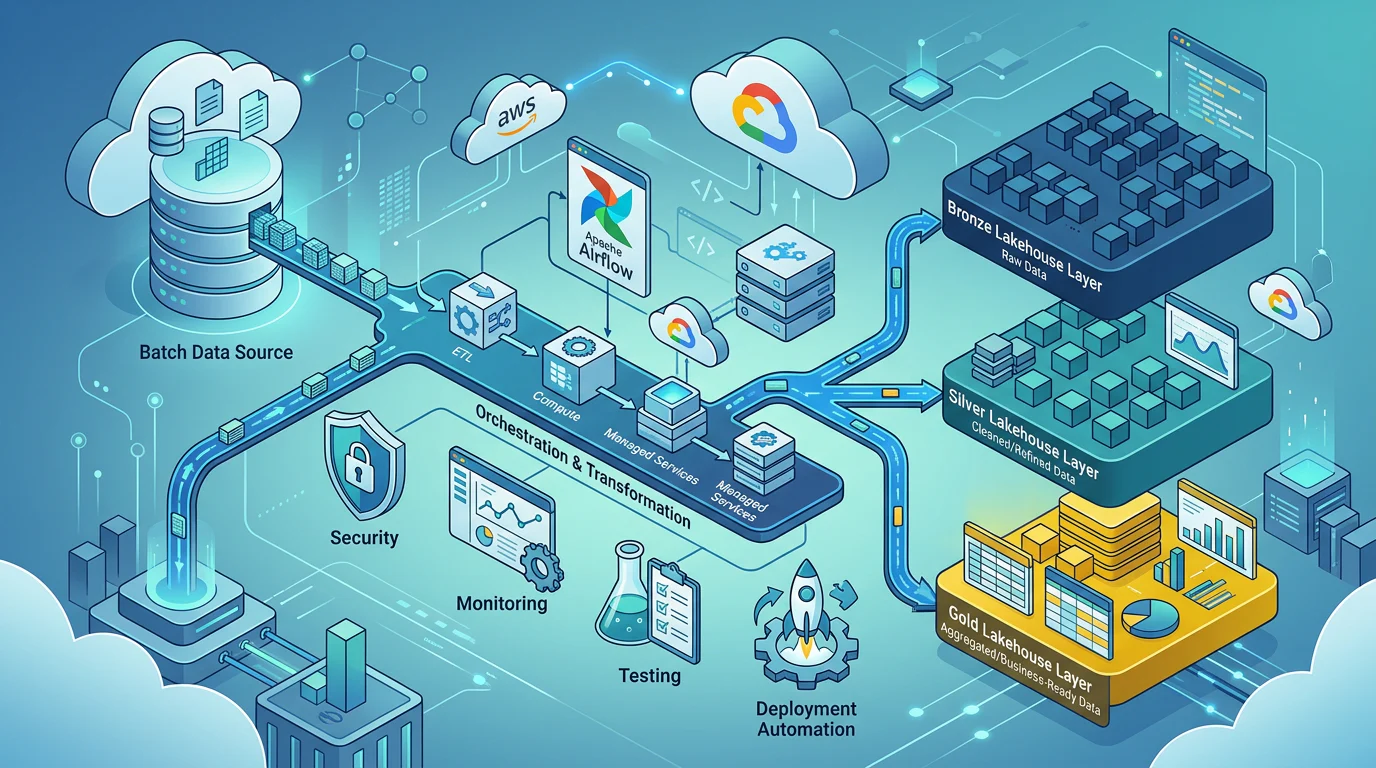
We standardize the first two projects around systems that look connected, not around a collection of unrelated service demonstrations. The batch project proves orchestration and recovery. The lakehouse project proves that we can turn raw data into governed data products. Together, they show how we move from an incoming file or table to something a business user can trust.
| Project Blueprint | Core Proof | Failure And Recovery Proof | Interview Lesson |
|---|---|---|---|
| Incremental Batch Pipeline | Orchestration, watermarks, quality gates | Safe rerun after a malformed delivery | We understand idempotency |
| Governed Medallion Lakehouse | Table design, lineage, access control | Rebuild a derived layer from raw data | We design for trust and reuse |
| Real-Time Operations Stream | Windows, late data, checkpoints | Recover a stopped consumer and replay safely | We can operate under latency constraints |
Build an Incremental Batch Pipeline
We build a retail orders or operations dataset with Azure Data Factory, a landing zone, and curated outputs. The first load establishes a baseline. Later runs use a timestamp or increasing-key watermark stored in a control table, then write the next batch without duplicating the prior result.
The project must include orchestration, incremental loading, duplicate and null checks, schema validation, reconciliation counts, and an idempotent rerun. We deliberately inject a malformed file or failed transformation, document the alert, and demonstrate the recovery procedure. For deployment, we use feature branches and an automated promotion path because Microsoft recommends CI/CD for moving Data Factory changes across environments. Deployment lifecycle
Build a Governed Medallion Lakehouse
For the lakehouse, we use ADLS Gen2, Azure Databricks, Delta tables, and Unity Catalog. Bronze preserves raw data, Silver cleans and standardizes it, and Gold serves a defined analytics use case such as revenue by region or delivery performance by day.
We choose managed tables for new curated data, document table ownership, and record why a performance decision fits the access pattern. Microsoft’s architecture guidance defines the Bronze, Silver, and Gold responsibilities and recommends quality checks, lineage, and governed table management across those layers. Delta architecture
Our governed lakehouse guide adds implementation context for ownership, access, and table design. We keep the project focused, but our decision record can compare Azure Databricks pipelines, Azure Stream Analytics, Synapse Spark, and Apache Iceberg where relevant. That shows awareness without turning one portfolio piece into several unfinished experiments.
Package Both Projects as One Story
The batch pipeline should feed the lakehouse wherever possible. That lets us explain a coherent progression: ingest safely, preserve raw facts, apply quality rules, govern access, and publish a consumer-ready table. It also gives us a stronger answer to “what would you improve next?” because the next improvement follows naturally from the system already in the repository.
How Should We Build and Defend a Real-Time Streaming Project?
The streaming project is where we prove we understand behavior that batch systems can hide. We must decide how long late data remains valid, how state is managed, how to monitor lag, and what happens when a consumer stops. Those choices matter more than whether the dashboard looks polished.
Define the Event and Serving Path
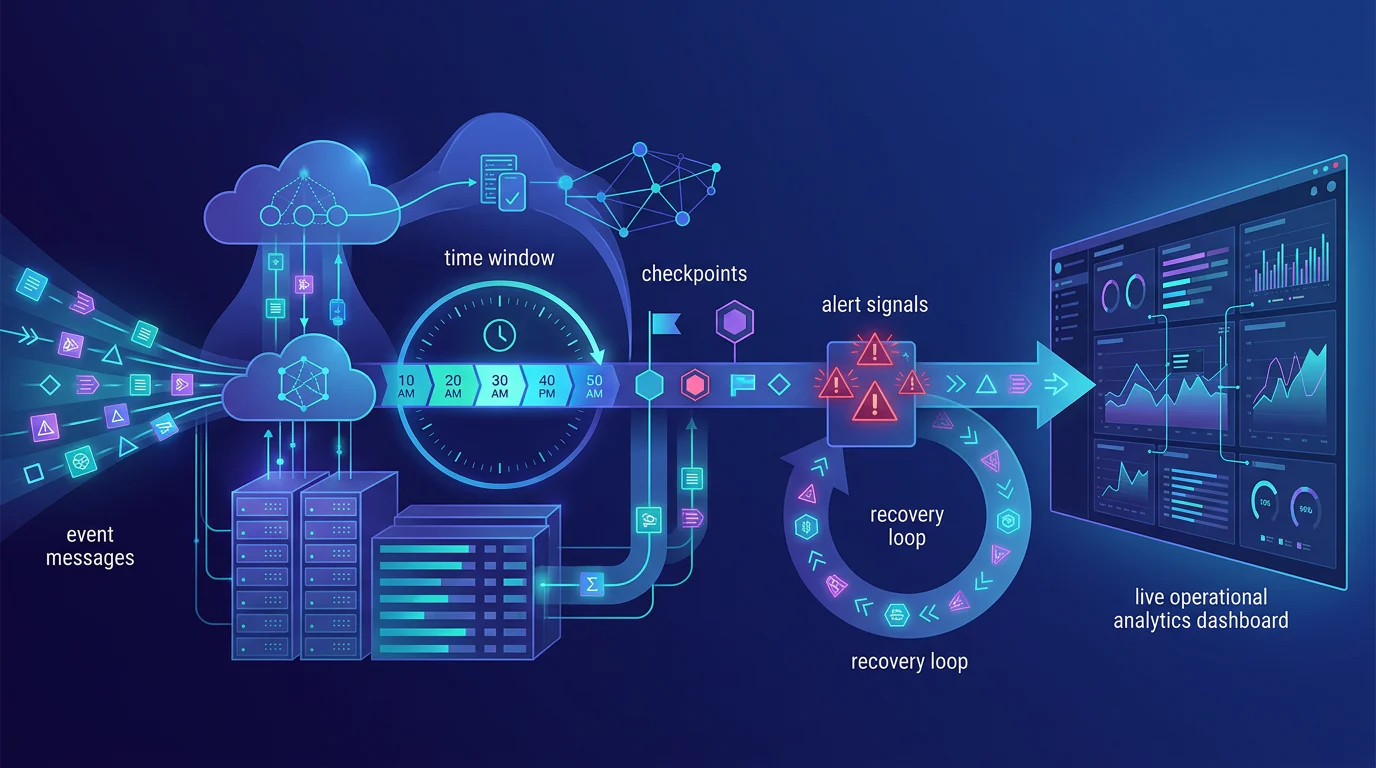
We use an event producer, Azure Event Hubs, Structured Streaming, Delta tables, and a queryable serving layer. The event schema should identify the business key, event time, ingestion time, and an idempotency key. We explain the partition-key decision and identify the consumer that needs the Gold output.
Use our single pipeline guide as related reading when readers need to decide where batch and streaming should share a model rather than share a runtime.
Make Late Data a Deliberate Policy
A windowed metric is only credible when we define what happens to a late event. We use a watermark threshold, document the acceptable delay, and show what is updated, dropped, or redirected after that point. Watermarks help control streaming state and late-data tolerance, especially in stateful joins. Streaming guidance
We also store checkpoints and add a replay procedure. The aim is not to claim zero data loss. It is to demonstrate that we understand the operating boundary and can explain the consequences.
Monitor the System and Rehearse a Failure
Our monitoring view tracks consumer lag, throughput, latency, processing failures, checkpoint health, and cost notes. We configure an alert for lag, stop a consumer deliberately, then show how the system returns to health. Azure Event Hubs supports monitoring through Azure Monitor, including application metrics such as consumer lag and active connections. Event Hubs monitoring
We also document poison-event handling because Event Hubs does not provide a built-in dead-letter queue. A clear custom handling pattern, plus a short incident runbook, is stronger interview evidence than a stream that has only been tested under perfect conditions.
For a broader checklist of what modern training should cover, use our modern curriculum guide. It helps us keep the portfolio focused on evidence while ensuring the build includes the operational skills teams expect.
Build the Evidence with Vision Board
At Vision Board, we help contract engineers turn limited study time into demonstrable systems. Our Azure data engineering work focuses on items a reviewer can inspect: decision records, pipelines that rerun safely, repository history, tested infrastructure, and clear explanations of failure handling. We do not ask you to collect disconnected badges before you build. Instead, we guide the hybrid sequence, use feedback to tighten each deliverable, and help you package the final work for technical conversations.
Start with the gap in your current evidence, not a generic syllabus. If batch orchestration is thin, build it first. If your foundations are solid, move faster into governance, deployment, and streaming recovery. We can help you choose the smallest next build that makes your portfolio more credible before your contract deadline and rehearse the trade-offs you will explain in interviews with confidence. Explore Vision Board
FAQs on Azure Data Engineering Course vs Portfolio Projects
Should I Take an Azure Data Engineering Course or Build Projects First?
Choose a hybrid path for a fixed deadline. Study each concept immediately before using it, then keep the working artifact, tests, and explanation as portfolio evidence.
How Can I Become Job-Ready for Azure Data Engineering in Three Months?
Start with a small batch pipeline in week one, then add a governed lakehouse and streaming scenario. Three complete projects demonstrate more readiness than unfinished coursework.
Which Azure Data Engineering Projects Impress Recruiters?
Build a project that ingests incrementally, validates data, reruns safely, deploys from source control, exposes monitoring, and explains a realistic failure with a recovery procedure.
What Should an Azure Data Engineering Portfolio Include?
Include source assumptions, diagrams, meaningful commits, infrastructure code, continuous deployment, tests, secret handling, lineage, monitoring, cost notes, a runbook, and concise business results for reviewers.
How Do I Learn Medallion Architecture Through Projects?
Build Bronze, Silver, and Gold tables from one source, document each quality gate, then explain the governance, performance, and consumer-access choices in writing for an interviewer.