
Scope Your Azure Data Engineering Portfolio Project in Three Layers
Set your current readiness, weekly availability, preferred Azure scope and target role. The calculator returns a bounded project estimate and the evidence to prioritise.
Estimated project weeks
7.1
Portfolio-sized scopeBuild one source-to-Gold project with raw ingestion, Silver validation and deduplication, Gold reporting, an architecture diagram, a failed-and-recovered run, a deployment path, and access or lineage evidence where the selected tools support it.
- Baseline focus hours
- 48
- Estimated project hours
- 56
- Core milestones
- 3
Assumptions
- This is a planning heuristic, not a market benchmark, hiring prediction, cloud-cost estimate or delivery commitment.
- The baseline assigns 16 focus hours to each of the three medallion layers, giving 48 baseline focus hours.
- Tool and role multipliers increase the planning workload for additional scope. Readiness reduces estimated hours only because familiar work generally requires less practice time.
- Weekly hours include building, testing, documentation and rehearsal. The estimate uses whole project weeks rather than calendar-date precision.
- The three milestones are Bronze, Silver and Gold. Optional streaming, governance and CI/CD evidence are added only when they match the selected scope.

By Devikrishna R, Founder · Reviewed 20 Sept 2026
In brief
One bounded Azure project is easier to finish and defend than a long list of disconnected tools. Use this estimator to turn your current skills, weekly availability, tool choice and target role into a practical scope, three milestones and a checklist of evidence.
Worked example at the defaults
With current project readiness at 0.85, weekly project time at 8 hours/week, preferred azure tool scope at 1, target role scope at 1:
- Baseline focus hours
- 48
- Estimated project hours
- 56
- Estimated project weeks
- 7.1
- Core milestones
- 3
How the calculator scopes work
Microsoft’s 2026 medallion guidance describes Bronze as raw ingestion, Silver as cleaning and validation, and Gold as modelling and aggregation. The calculator uses those three layers as the project backbone.
From Raw Data to Portfolio Evidence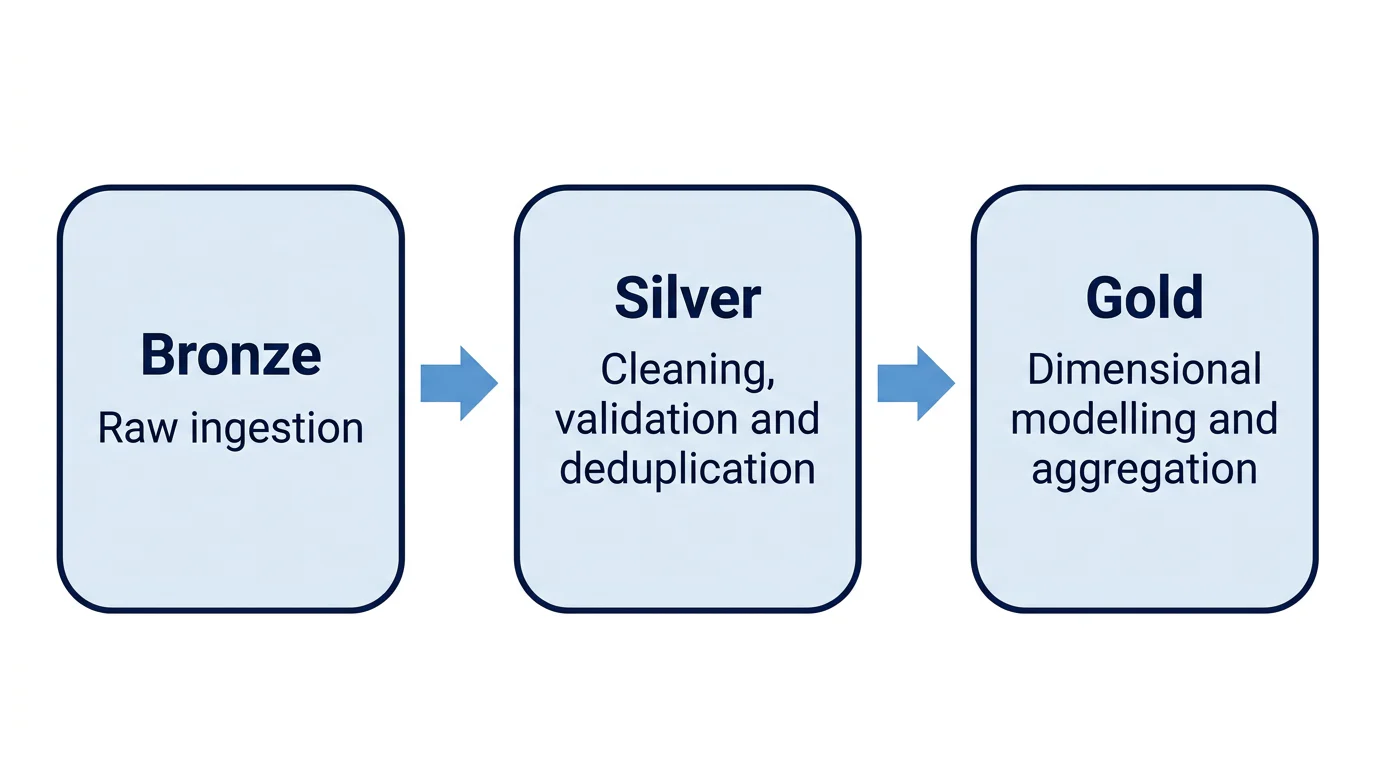
Baseline focus hours use the internal planning rule 3 × 16 = 48. Sixteen hours per layer is a disclosed calculator simplification, not an industry study. Estimated project hours equal baseline focus hours × tool multiplier × role multiplier ÷ readiness multiplier. Estimated project weeks equal estimated project hours ÷ weekly hours. Core milestones remain three because the plan follows Bronze, Silver and Gold.
For evidence, save a diagram, a validation or deduplication decision, and a failure or recovery record. Azure Data Factory stores pipeline-run data for only 45 days by default, so use Azure Monitor diagnostic logs when longer retention is needed.
When a project includes deployment evidence, Microsoft’s 2026 Data Factory CI/CD lifecycle provides a useful sequence: development, test or UAT, then production. When Databricks governance is in scope, Unity Catalog can provide access-control, lineage and auditing evidence.
This tool is not suited to production staffing, architecture approval, cloud-budget planning or a promise that a project will lead to an interview or role.
Related resources
Frequently asked
A bounded project can show raw ingestion in Bronze, cleaning and validation in Silver, then a business-ready reporting or analytics output in Gold. Add an architecture diagram, a recorded run or recovery, and notes that explain the technical decisions so the project can be discussed in an interview.
No. Start with a batch project when that is the smallest complete system you can build and explain. Add streaming only when it supports the target role or a clear requirement, because streaming also introduces checkpoints, processing guarantees and duplicate-handling decisions that need evidence.
The estimator starts with a three-layer project baseline, adjusts it for selected tools, target-role scope and current readiness, then divides the resulting focus hours by weekly hours. The result is a planning estimate for a portfolio brief, not a prediction of job readiness, salary or hiring outcomes.
No. Microsoft states that the Microsoft Certified: Azure Data Engineer Associate certification and its renewal assessment retired on 31 March 2025. A portfolio plan should therefore focus on demonstrable Azure engineering work rather than presenting DP-203 as a current certification target.
Azure Data Factory stores pipeline-run data for 45 days by default. If you need a longer evidence trail for a project, Microsoft recommends routing diagnostic logs through Azure Monitor so the run, failure and recovery material can be retained beyond that default period.
Take Your Project Brief Into a Live Azure Programme
Vision Board’s Azure Data Engineering programme lists live masterclasses, project work and interview preparation.
View the Azure programme