Generative AI Courses for Azure Data Engineers: Which Gets You Building Fastest?
Compare generative AI courses for Azure data engineers by time to a working app, six-week prototype fit, evaluation, safety, and deployment.
Generative AI Courses for Azure Data Engineers: Which Gets You Building Fastest?
Azure data engineers facing a six-week client deadline need a build sequence, not a sprawling credential path. The relevant Foundry learning path lists 6 hours 52 minutes across six modules covering evaluation, chat applications, tools, retrieval optimization, and responsible AI.
For Azure data engineers, generative AI courses for Azure data engineers should be ranked by time to a testable application, not certificate prestige. Choose the Foundry path for the fastest Azure-aligned build, then add a code-first curriculum for retrieval and agents. A credible six-week result is a deployed, evaluated RAG prototype with a documented cost and security plan.
We compare the practical options, identify what each misses, and lay out the smallest learning and build plan that can survive a client demo.
Which Generative AI Courses for Azure Data Engineers Get You Building Fastest?
Our fastest pick is the Foundry learning path because it reaches a coded chat application after its initial preparation and model-evaluation modules. It is not a complete production curriculum, but it gives an Azure data engineer a useful first artifact quickly.
| Course | Access Cost | Advertised Duration | Time To First Working Application | Coding Environment | Project Depth | Best Fit |
|---|---|---|---|---|---|---|
| Foundry Learning Path | Free training, Azure usage may cost extra | 6 hr 52 min | About 2 hr 56 min through the chat-app module | Foundry, SDKs, Azure services | Chat, tools, RAG, evaluation, safety | Fast Azure-aligned prototype |
| Open-Source Build Curriculum | Free repository access, model usage may cost extra | 21 lessons, no total hours published | Lesson 6, text-generation application | Python or TypeScript, local or cloud | Apps, vector search, function calling, agents | Flexible code-first path |
| Agents Course | Free | 3 to 4 hours per chapter weekly | Unit 1 first agent | Python and hosted exercises | Tools, agents, agentic RAG, evaluation | Add agents after RAG works |
| LLM Course | Free | 6 to 8 hours per chapter weekly | Demo work appears in chapter 9 | Python, notebooks, model libraries | Transformers, fine-tuning, demos | Deeper model literacy |
The open-source curriculum is the best companion when a team needs a repository, not just a portal exercise. Its July 2026 current course refresh modernized APIs and samples, but its self-directed format means we must supply our own project scope, test data, and acceptance criteria.
For Azure-focused engineers, this is also where existing Azure learning paths matter. We should not treat generative AI as a separate career track when the real work is extending governed data products with retrieval, permissions, observability, and operational ownership.
How Do the Shortlisted Courses Compare Beyond the First Demo?
A course can produce a chat window quickly and still leave an engineer unprepared for a client-facing build. We compare what happens after the first response appears: whether the path teaches retrieval, whether it has real code, and whether it helps us measure failures.
| Capability | Foundry Learning Path | Open-Source Build Curriculum | Agents Course | LLM Course |
|---|---|---|---|---|
| Model APIs And Prompt Design | Strong | Strong | Assumed, then applied | Strong |
| Embeddings And RAG | Strong | Strong | Agentic RAG later | Limited |
| Evaluation | Strong | Partial | Strong for agents | Limited |
| Agents And Tools | Strong | Strong | Core focus | Limited |
| Safety And Security | Strong | Partial | Partial | Limited |
| Observability | Partial | Partial | Included as bonus material | Limited |
| Deployment Practice | Partial | Repository-based samples | Hosted sharing | Demo sharing |
| Vendor Dependence | High | Flexible | Moderate | Moderate |
The agents option is valuable when the client problem truly needs tool selection or multi-step reasoning. It teaches a first Python agent in Unit 1 and recommends an agent course pace of roughly three to four hours per chapter each week. We should not start there if a retrieval application can answer the client need more simply.
Hands-on credibility matters more than an attractive syllabus. Before adopting any lab, compare it against Fabric lab realism: can we change the data, inspect failures, rerun the code, and explain its architecture without a guided interface? If not, it is practice, not a prototype.
What Will You Build, and What Is Missing?
The right choice depends on the gap between a course artifact and a client-ready artifact. We use each curriculum for its strongest job, then deliberately add the missing engineering work.
Foundry Learning Path
What We Build: A deployed model endpoint, a chat application, tool-enabled interactions, retrieval optimization, and basic safety controls.
Why It Works: It makes model evaluation part of the learning sequence, rather than an afterthought following a polished demo.
What Is Missing: We still need a client-specific corpus, evaluation dataset, authentication model, release process, and operating runbook.
Who Should Skip It: Engineers whose client must avoid Azure-specific hosting or who cannot access an Azure subscription for exercises.
Open-Source Build Curriculum
What We Build: Text and chat applications, embeddings-based search, function calls, agents, and samples in Python or TypeScript.
Why It Works: The 21-lesson format lets us start at the nearest build milestone and modify a real repository.
What Is Missing: It does not publish a total completion time or provide a client acceptance standard, so managers must protect build time.
Who Should Skip It: Learners who need fixed pacing, instructor feedback, or a formal credential before they can make progress.
Agents Course
What We Build: A simple agent, tools, framework implementations, agentic RAG, and a benchmark-oriented final assignment.
Why It Works: It combines assignments with evaluation and a free certificate path, while requiring only basic Python and LLM knowledge.
What Is Missing: Agent complexity can consume a six-week deadline before we validate retrieval quality and client value.
Who Should Skip It: Teams that have not yet shipped a bounded retrieval application with observable, testable behavior.
LLM Course
What We Build: Model workflows, fine-tuning experiments, and shareable demonstrations.
Why It Works: It is useful for engineers who need to understand model libraries and the tradeoffs below the API layer.
What Is Missing: It recommends strong Python and introductory deep-learning knowledge, and its chapter pace makes it a weaker deadline choice. Its course prerequisites are honest, which is exactly why we should not pretend it is the fastest route.
For curriculum depth beyond a demo, use a modern curriculum as the standard. We need a build that joins data engineering discipline with model behavior, not a disconnected set of notebooks.
What Must a Six-Week Client Prototype Include?
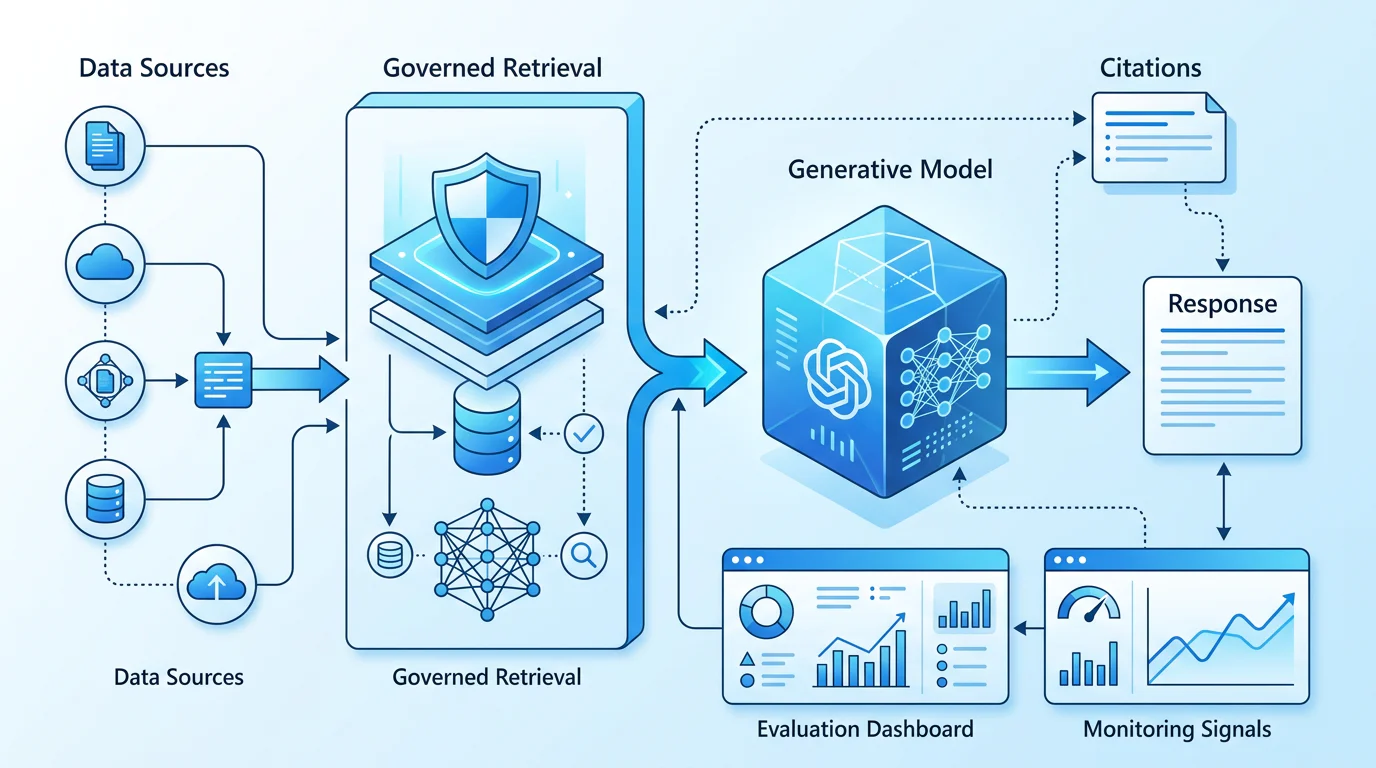
A client prototype does not need a custom foundation model. It needs a narrow question set, an approved source corpus, citations or traceable source references, and evidence that the system behaves acceptably on known questions.
Retrieval and Groundedness
We should evaluate retrieved context separately from generated answers. Foundry guidance recommends combining groundedness, relevance, completeness, and correctness because a response can be grounded in provided context while still reaching the wrong conclusion. Use retrieval evaluators with a labeled test set before we judge the demo by intuition.
Security and Data Access
Keep the corpus small and approved. Use managed identity where possible, least-privilege access, output validation, and explicit handling for unsupported questions. The 2025 OWASP risk list places prompt injection and sensitive-information disclosure among the core risks for LLM applications, so neither belongs on a later roadmap.
Cost and Operational Evidence
Track calls, tokens, latency, failed retrievals, and evaluation regressions from the first working build. The prototype does not need a polished operations center, but it needs enough telemetry for us to explain its cost and failure behavior. Our governed lakehouse guidance helps keep the data side accountable.
How Can We Turn Six Weeks into a Client Demo?
We recommend treating the course as a source of components, not as the calendar. Every week should produce an artifact that a technical stakeholder can inspect, reject, or extend.
Weeks One and Two: Build the Narrow Baseline
Use a daily learning budget that fits the team, then choose one client workflow and one approved document set. By the end of week two, we should have a model call, a simple interface, retrieval, and 20 to 30 representative test questions.
Cut fine-tuning, broad data connectors, multi-agent orchestration, and polished visual design. Those features are tempting because they look advanced, but they delay the evidence a client actually needs. Use our project estimator to keep the work in a deliverable layer.
Weeks Three and Four: Measure the Prototype
Add source references, prompt versions, failure responses, and an evaluation run for relevance and groundedness. Week four is also the deadline for identity, access checks, cost telemetry, and a decision about whether agents are necessary.
If the baseline does not evaluate well by the end of week four, reduce the scope rather than adding more features. A client will value an honest, bounded prototype more than a broad interface with unknown failure modes.
Weeks Five and Six: Rehearse the Operating Reality
Run regression tests, test adversarial inputs, repair the highest-impact retrieval failures, and deploy a controlled demonstration. Finish with a short runbook covering ownership, data refresh, fallback behavior, estimated usage, and the next engineering milestone.
We score the capstone with the rubric below, not with completion certificates. Foundry supports tracing, evaluation, logs, and automated quality gates through its observability guidance, which makes this evidence practical to collect. Our pipeline cost guide also helps teams frame model usage as an operating decision.
| Capstone Criterion | Required Evidence | Weight |
|---|---|---|
| Functionality | One repeatable client workflow works end to end | 20% |
| Groundedness | Citation-bearing test set and documented results | 20% |
| Evaluation Evidence | Baseline, current run, failures, and threshold | 20% |
| Security | Prompt injection, access, and sensitive-data checks | 15% |
| Cost Controls | Model choice, usage budget, and monitoring approach | 10% |
| Deployment | Reproducible demo and clear operating owner | 15% |
We use this ranking methodology because course catalogs change quickly: first working application, project depth, Azure fit, evaluation, security, deployment, support, credential, cost, and vendor dependence all matter. Update Log, September 13, 2026: We rechecked curriculum access, stated duration, and documented content, and we will revisit this comparison when major course or platform changes affect the build path.
How Can Vision Board Help You Build Faster?
At Vision Board, we help Azure data engineers turn a learning plan into working delivery habits. Our training focuses on the parts that make a client prototype credible: reading the existing data estate, shaping a narrow use case, writing code, testing retrieval, and explaining operational tradeoffs. We keep the work grounded in the Azure stack your team already supports, so learners practice decisions they can defend in architecture reviews. If a cohort needs more than a completed lesson, we can structure project milestones around its real source data, security requirements, and release window. That gives managers evidence of progress before the final demo, and gives engineers a build they can extend after training. Start by mapping your available hours, current skills, and client constraints, then choose the smallest project that proves useful behavior for real stakeholders in practice. Vision Board
FAQs on Generative AI Courses for Azure Data Engineers
Which Course Gets an Azure Data Engineer Building Fastest?
The Foundry learning path is our fastest Azure-aligned pick because it reaches deployment, chat development, tools, retrieval, evaluation, and safety in a listed 6-hour-52-minute course.
Can I Learn Enough in Six Weeks to Ship a Demo?
Yes, if we cut pretraining, fine-tuning, broad agent features, and unrestricted connectors. We instead protect time for retrieval, test cases, security, deployment, and clear ownership.
Do I Need Machine Learning Before Starting?
No. We start application work with model APIs, prompts, retrieval, and evaluations. Basic Python, SQL, and Azure familiarity are enough before deeper model concepts become necessary.
Should I Build an Agent for a Client Prototype?
Build an agent only when tool selection or multi-step decisions are essential. First ship a bounded retrieval application, then add agents only after evaluation proves the need.