Live Cohorts or Project Sprints for Hadoop Migration Training?
Compare live cohorts and project sprints for India-US Hadoop migration teams moving to Azure or Fabric, with schedule, RFP criteria, and readiness proof.

Live Cohorts or Project Sprints for Hadoop Migration Training?
Moving a distributed team from on-premises Hadoop to Azure or Fabric is an operating-model change as much as a tooling change. Microsoft’s current Fabric data-engineering blueprint assigns each of implementation, ingestion, and optimization a 30-35% weighting.
For an India-US team selecting Hadoop migration training, live cohorts work best for shared architecture, governance, and operating language. Project sprints work best for proving those standards on real Hive, Spark, streaming, and security work. We recommend a blended plan with duplicated live sessions, recorded reinforcement, regional office hours, and assessed migration artifacts.
We compare the two delivery models, show a workable time-zone design, map roles and workloads to evidence, and explain what we would require from a training platform before trusting it with an enterprise migration.
Which Hadoop Migration Training Model Fits India-US Teams?
A live cohort creates alignment before delivery pressure fragments the team. It gives engineers, architects, governance leads, and delivery managers a shared vocabulary for ownership, security, cost, and target architecture. A sprint starts with a real workload and turns that shared vocabulary into decisions, code, tests, and runbooks.
The right choice depends on the team’s current constraint. If people disagree on target patterns or decision rights, start with a cohort. If they already agree on the target state and have a prioritized workload, a sprint can create faster evidence. In most migrations, we use both.
| Decision Factor | Live Cohort | Project Sprint |
|---|---|---|
| Audience | Cross-functional engineers, architects, analysts, governance leads, and delivery managers | Defined migration pod with workload owners |
| Feedback | Instructor feedback on shared patterns and architecture decisions | Review of tests, pipelines, runbooks, and migration trade-offs |
| Time-Zone Resilience | Strong with duplicated delivery, recordings, and office hours | Depends on explicit handoffs and protected build time |
| Customization | Role tracks and company scenarios | Backlog based on actual workloads and constraints |
| Assessment | Knowledge checks, scenarios, and architecture reviews | Acceptance criteria, production artifacts, and operational review |
| Migration Output | Shared operating language and decision templates | Migrated workload slice, evidence pack, and runbook |
| Verified Cost | Custom delivery normally requires a scoped quote | Custom statement of work normally requires a scoped quote |
Certification can support a governance baseline, but it cannot prove deployment readiness. The official CDMP pricing lists US$311 per exam, with one exam for Associate level and three for Practitioner or Master level.
We use the comparison to decide whether a team needs foundations first, delivery proof first, or a staged blend. For related role and modality choices, see our Azure learning paths.
How Should India-US Teams Schedule Live Instruction?
A single recurring meeting time is not a time-zone strategy. It gradually shifts the inconvenience onto one region, then turns live learning into passive attendance. We design duplicate sessions around local working hours and use the overlap for discussions that genuinely require both regions.
In 2026, US daylight saving begins on 8 March and ends on 1 November, according to the 2026 DST dates. That change moves an Eastern Time session one hour later for India, so calendar owners should review the schedule before every cohort cycle.
| Activity | US Eastern, 8 Mar To 1 Nov 2026 | India | Purpose |
|---|---|---|---|
| Shared Architecture Cohort | Tuesday, 9:00 To 11:00 AM EDT | Tuesday, 6:30 To 8:30 PM IST | Live overlap for architecture and decision reviews |
| Duplicate India-Led Cohort | Tuesday, 11:00 PM To 1:00 AM EDT | Wednesday, 8:30 To 10:30 AM IST | Regional delivery of the same module |
| Americas Office Hour | Thursday, 9:00 To 10:00 AM EDT | Thursday, 6:30 To 7:30 PM IST | Resolve questions from Americas participants |
| India Office Hour | Thursday, 10:30 PM To 11:30 PM EDT | Friday, 9:00 To 10:00 AM IST | Resolve questions without requiring India evening attendance |
| Follow-The-Sun Handoff | End Of Regional Day | End Of Regional Day | Log blockers, decisions, owners, and next tests |
We pair every session with a searchable recording, written decisions, and regional office hours. That protects live instruction while giving teams a practical way to recover from holidays, incidents, and conflicting delivery commitments. Our global team formats show how to choose the right live and project mix.
What Should the Curriculum Teach Before a Sprint?
A technical migration fails when the team can move code but cannot agree who owns the data, who approves access, how costs are assigned, or who responds when a pipeline fails. We therefore teach operating decisions alongside platform mechanics.
Build One Operating Language
Before a project begins, we align the group on target architecture, data ownership, lineage, security controls, migration sequencing, and cutover criteria. This prevents an engineer in one region from implementing a valid local solution that conflicts with an architect or governance lead elsewhere.
Assign Competencies by Role
| Role | Core Competency | Evidence Produced |
|---|---|---|
| Data Engineers | Ingestion, transformation, batch, streaming, and testing | Tested pipeline or notebook with quality checks |
| Architects | Target architecture and non-functional trade-offs | Reviewed architecture decision record |
| Platform Operators | Identity, monitoring, deployment, and recovery | Support runbook and alert ownership |
| Analysts | Consumption requirements and data-product expectations | Validated reporting or semantic scenario |
| Governance Leads | Ownership, glossary, lineage, and classification | Control map and stewardship decision |
| Delivery Managers | Risks, sequencing, handoffs, and readiness | Migration scoreboard and decision log |
Include Governance, Cost, and Change
FinOps belongs in the curriculum because migrated workloads create ongoing ownership decisions, not only one-time implementation tasks. Microsoft’s FinOps framework connects cloud cost management with engineering, operations, and business value.
We also use DAMA concepts as a common governance language, then measure whether the team can apply those concepts to its own migration. For deeper curriculum context, our modern data curriculum explains the skills that should sit behind an Azure engineering track.
Which Hadoop Workloads Should Become Assessed Projects?
Workload-led sprints should not be generic labs with renamed tables. We start with a workload inventory, identify the business owner and risk profile, then turn a real migration question into an assessed project with acceptance criteria.
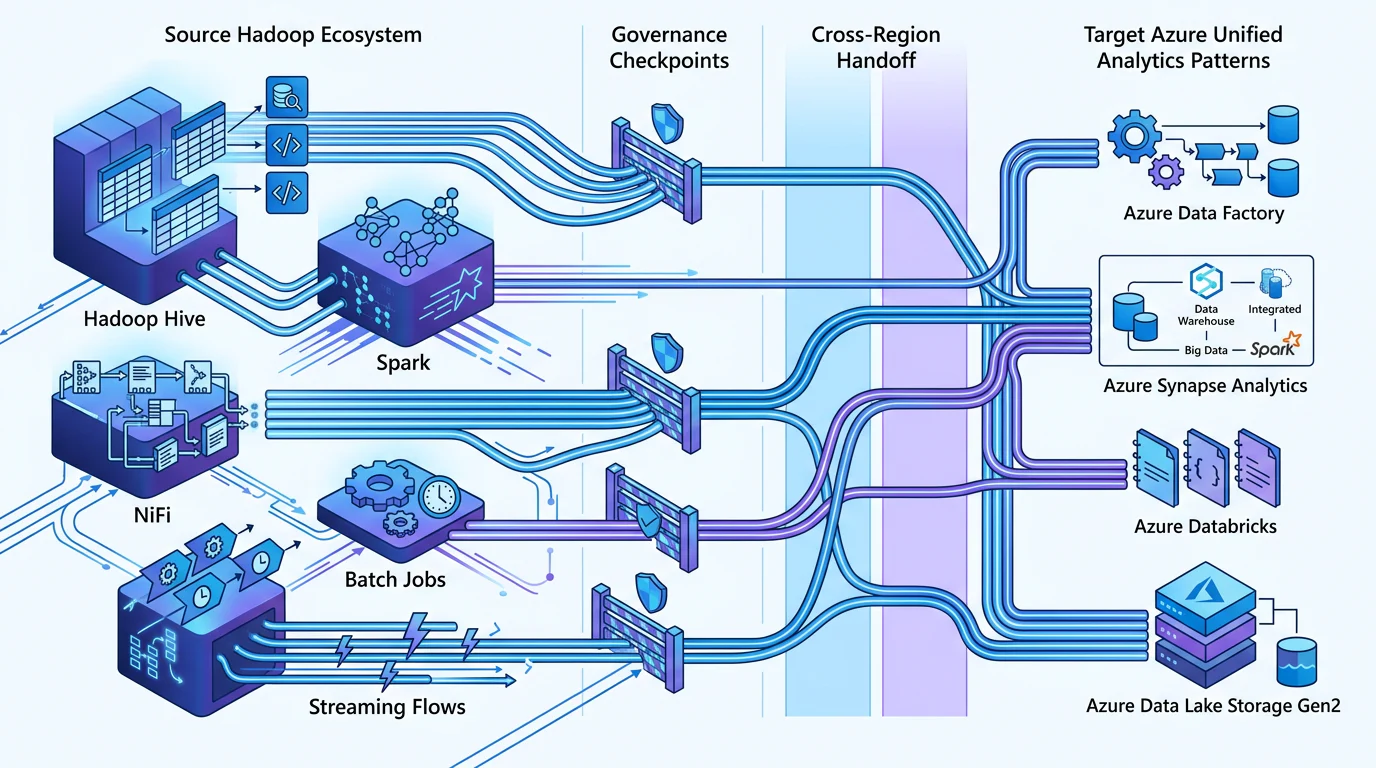
Microsoft’s migration guidance specifically calls out data transfer and Hive metastore work, which is why the first sprint should include metadata, validation, and rollback decisions, not only code conversion.
Map Workloads to Migration Evidence
| Source Workload | Sprint Question | Evidence To Assess |
|---|---|---|
| Hive Tables And Metastore | How will schemas, locations, and metadata be moved and reconciled? | Inventory, migration plan, and validation results |
| Spark Jobs | Which jobs move, refactor, or retire? | Test results, performance baseline, and rollback plan |
| NiFi Flows | Which dependencies require pipeline redesign? | Dependency map, failure handling, and ownership |
| Batch Workflows | What are the schedules, SLAs, and recovery steps? | Runbook, monitoring plan, and recovery drill |
| Streaming Workloads | What latency, replay, and retention controls apply? | Throughput test and incident procedure |
| Security Policies | How do legacy controls translate to the target environment? | Access matrix, classification, and audit evidence |
Review the Decision, Not Just the Output
A notebook that runs once is not migration proof. We assess whether the team can explain the design, validate output quality, recover from failure, hand the service to another region, and show who owns the next decision.
Our Hortonworks replacement framework can help teams structure that workload inventory before they choose a first project.
How Should a Training Platform Capture Enterprise Evidence?
Enterprise teams need more than a virtual classroom. They need a controlled place to prove attendance, preserve decisions, assess artifacts, and support accessibility without scattering critical evidence across personal drives and chat threads.
Microsoft’s Teams reporting can show attendance, join and leave times, and engagement activity. We treat that as supporting evidence, not the final measure of learning.
- Attendance Tracking: Exportable participation records for live sessions and office hours.
- Assessment Records: Role-based scores, artifact rubrics, reviewer comments, and remediation paths.
- Accessibility Controls: Captions, transcripts, recordings, and accessible written materials.
- M365 Integration: Calendar, Teams, OneDrive, SharePoint, and identity controls that match enterprise policy.
- Compliance Evidence: Defined retention, access permissions, change history, and named artifact owners.
- Migration Controls: A safe process for using representative data when production data cannot enter training.
We also ask whether labs resemble the operational conditions that the team will inherit. Our guide to production-realistic labs explains why realistic constraints matter more than polished demonstrations.
Why Choose Vision Board for Hadoop Migration Training?
Vision Board helps distributed Azure data teams turn training time into migration evidence. We begin with your actual workload inventory, role mix, regional availability, and governance obligations, then build a delivery plan that combines live architecture instruction with project reviews. Our facilitators can run duplicated sessions for India and the US, preserve recordings and assessment records, and guide teams through decisions on ownership, security, cost, and operational handoffs. We do not treat attendance as the finish line. We ask teams to show reviewed designs, tested transformations, documented controls, and runbooks that another region can operate. If your migration needs a shared operating language before delivery accelerates, we will help you choose the right cohort, sprint, or blended sequence with scoped objectives, transparent requirements, and a practical evidence review. We make format choices before calendars, labs, and project commitments. Plan your next team session with Vision Board
FAQs on Hadoop Migration Training
We answer the migration questions below. Each answer stays practical.
Should a Distributed Hadoop Migration Team Start with a Cohort or Sprint?
Start with a cohort when shared architecture, governance, and ownership remain unresolved. Start a sprint when a prioritized workload, secure environment, and accountable owners already exist.
How Many Live Sessions Should India-US Training Duplicate?
Use one overlap session, duplicate each module for regional convenience, and add recordings, office hours, and written handoffs. This keeps live learning accessible without expecting overnight attendance.
Does CDMP Certification Prove Azure or Fabric Migration Readiness?
No. CDMP tests data-management knowledge through exams, but readiness requires reviewed architecture decisions, validated outputs, runbooks, security controls, and cross-region ownership under real delivery conditions.
What Artifacts Should a Provider Assess During Migration Training?
Ask for reviewed designs, workload acceptance criteria, test evidence, quality controls, ownership maps, runbooks, and a readiness review. See our production-realistic labs for the evidence standard.