
Microsoft Fabric Courses Under 40 Hours
Compare Microsoft Fabric courses under 40 hours by price, labs, certification alignment, and schedule flexibility for working professionals.

Microsoft Fabric Courses Under 40 Hours
Working professionals can use an eligible 60-day trial to test Fabric workloads before they commit to training, but a short calendar promise does not automatically mean a short or useful learning commitment.
For working professionals, Microsoft Fabric courses under 40 hours should be chosen by role and proof of practice. DP-600 preparation centers on analytics assets and semantic models, while DP-700 preparation centers on ingestion, transformation, orchestration, security, and optimization. Compare verified hours, hands-on access, instructor support, schedule control, and assessment quality before buying.
We built this comparison to separate genuinely short options from courses that merely use short marketing labels, then help you choose a route that fits the work you actually intend to do.
Which Certification Suits Your Fabric Role?
The first choice is not course format. It is the role you want the course to support. An analytics engineer needs evidence of data preparation, semantic-model design, governance, and reporting performance. A data engineer needs evidence of reliable movement, transformation, monitoring, and optimization of data.
DP-600 is the better fit when your work centers on analytics assets, especially semantic models, warehouses, lakehouses, DAX, Direct Lake, and report-facing performance. Its current study guide assigns 45 to 50 percent of the assessment to preparing data, with the remaining objectives focused on maintaining analytics solutions and managing semantic models.
DP-700 is for people building and operating data-engineering solutions. Its current objectives divide the assessment across implementing and managing a solution, ingesting and transforming data, and monitoring and optimizing it. That makes a course incomplete for this goal if it skips pipelines, notebooks, Dataflows Gen2, troubleshooting, security, or performance work.
| Intended Work | Stronger Certification Fit | Practice Evidence To Look For | Common Mismatch |
|---|---|---|---|
| Semantic models and reporting | DP-600 | DAX, Direct Lake, model security, performance tuning | A course focused only on ingestion |
| Analytics data preparation | DP-600 | Dataflows, SQL, modeling decisions, deployment practices | Slide-only exam review |
| Data ingestion and orchestration | DP-700 | Pipelines, triggers, notebooks, transformation logic | Report-building exercises only |
| Reliability and optimization | DP-700 | Monitoring, alerts, error resolution, performance work | A basic product tour |
Before selecting either path, use our Fabric role guide to clarify whether your day-to-day work is closer to analytics engineering or data engineering. The distinction matters more than a course title that loosely promises “Fabric certification.”
Which Microsoft Fabric Courses Under 40 Hours Qualify?
We apply a strict rule: a course qualifies only when its live course page states total study or instructional time below 40 hours. A page that says “four days” without published teaching hours is useful context, but it does not meet that verification standard.
The official orientation path is suitable for a first look at Fabric, while the official certification paths are more targeted. The analytics-engineer path totals 23 hours 20 minutes from its listed modules, and the data-engineer path totals 27 hours 49 minutes. Both are self-paced, so they avoid a long enrollment commitment and let a working professional control the weekly pace.
| Route | Listed Price | Verified Time | Delivery Mode | DP Alignment | Lab Type | Instructor Access | Trial Or Preview | Schedule Control | Qualification |
|---|---|---|---|---|---|---|---|---|---|
| Official Fabric orientation path | Free | 7h 27m | Self-paced | Foundation | Guided exercises | None | Eligible 60-day Fabric trial | Full | Yes |
| Official analytics-engineer path | Free | 23h 20m | Self-paced | DP-600 | Guided exercises | None | Trial subject to eligibility | Full | Yes |
| Official data-engineer path | Free | 27h 49m | Self-paced | DP-700 | Guided exercises | None | Trial subject to eligibility | Full | Yes |
| Official instructor-led analytics course | Not listed in official catalog | Four days only | Instructor-led | DP-600 | Verify with provider | Live | Verify | Fixed dates | Conditional |
| Official instructor-led data-engineer course | Not listed in official catalog | Four days only | Instructor-led | DP-700 | Verify with provider | Live | Verify | Fixed dates | Conditional |
| Publisher-hosted analytics video | $119.99 USD | Not published | On-demand | DP-600 | Labs claimed, access must be checked | No live access stated | No trial stated | Full | Conditional |
Microsoft lists its official DP-600 instructor-led course as four days, but the catalog does not state its total instructional hours. We would ask for the daily timetable, time zone, breaks, recording policy, lab entitlement, and refund terms before calling it a short option. The same caution applies to the four-day DP-700 course.
Marketplace courses and subscription libraries can still be useful. We treat them as candidates until they publish a course-level duration, current price, prerequisites, lab terms, and a syllabus that maps to the current objectives. A cheap video can explain concepts well, but it does not prove access to a usable environment or a review of your work.
For a broader comparison of short and longer commitments, see our Fabric training under six months. It helps distinguish a focused credential path from a broader program that serves a different goal.
How Deep Are Hands-On Labs?
“Hands-on” is one of the least precise promises in technical training. It can mean watching an instructor create an item, completing a guided exercise, building independently in a trial tenant, or receiving feedback on a project. Those are very different learning experiences.
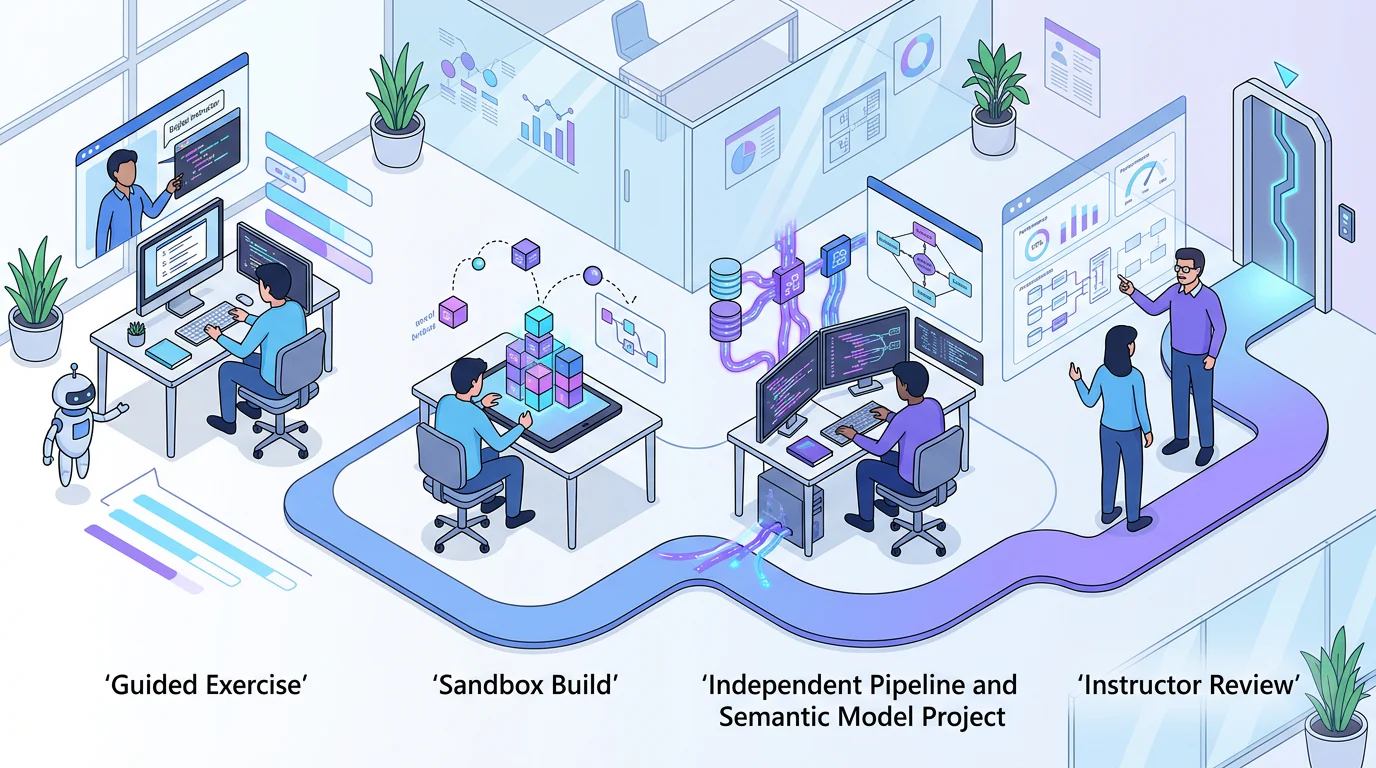
A useful short course makes the environment clear. Learners should know whether they receive Fabric access, how long it lasts, whether they can create pipelines and notebooks, and who helps when an exercise fails. Trial capacity is intended for evaluation and testing, so it is valuable for practice but should not be mistaken for production access.
Demonstration Versus Guided Exercises
A demonstration may explain the right steps without requiring you to make choices. Guided exercises are stronger because you carry out a defined task and check a result. Microsoft’s learning materials include exercises such as pipeline ingestion, which the official module allocates one hour to complete.
Sandbox Builds Versus Projects
A sandbox build asks you to create and troubleshoot items yourself. A project goes further: you define a small outcome, make design choices, test it, document it, and explain why it works. For a working professional, that distinction matters more than total video time.
Lab Evidence for DP-600
DP-600 practice should include data preparation, semantic-model design, security, performance, and lifecycle work. A course that covers only lakehouse creation or a report demo may be useful orientation, but it is not complete analytics-engineer preparation.
Lab Evidence for DP-700
DP-700 practice should include loading patterns, pipelines, transformation choices, orchestration, monitoring, and error handling. Candidates should be able to explain why a pipeline, notebook, or dataflow fits a task, not simply repeat an interface walkthrough.
| Lab Level | Learner Action | Fabric Access Needed | Feedback Needed | Best Use |
|---|---|---|---|---|
| Demonstration | Watches a workflow | No | No | Initial orientation |
| Guided Exercise | Follows defined steps | Usually | Automated or self-check | Foundation practice |
| Sandbox Build | Creates and troubleshoots items | Yes | Helpful | Skill development |
| Independent Project | Plans and builds an outcome | Yes | Strongly recommended | Job-facing evidence |
| Solution Review | Defends decisions and fixes gaps | Yes | Human review | Certification or project readiness |
Use our lab realism check before paying for a course that relies heavily on the phrase “practical training.” We recommend choosing the deepest lab model your schedule and role require, not the one with the most polished sales language.
Which Schedule Fits a Working Week?
A four-day class can be short in elapsed time while still being impossible for someone who cannot leave delivery work for full weekdays. A self-paced course can be more flexible, but only if you reserve recurring time and have reliable lab access.
An evening plan works well for the official analytics-engineer path: three two-hour sessions and one two-hour lab block each week finishes the listed 23 hours 20 minutes in about three weeks. The 27 hours 49 minutes data-engineer path fits a similar pattern in roughly four weeks, before extra revision and exam practice.
| Study Pattern | Weekly Commitment | Best For | Main Risk |
|---|---|---|---|
| Intensive weekdays | Four protected workdays | Learners with approved training leave | Attendance conflicts |
| Evening blocks | 8 hours | Working professionals with predictable evenings | Skipping independent labs |
| Weekend blocks | 10 hours | Learners with quieter weekends | Fatigue and weak retention |
| Fully self-paced | 5 hours | People needing maximum control | Slow progress without deadlines |
Schedule control also has a support dimension. Recordings can help you catch up, but recordings are not the same as live answers to questions about your own tenant, data source, pipeline error, or semantic-model design. Our flexible training formats guide can help you compare those tradeoffs before you commit.
What Does a Short Course Actually Cost?
The honest total cost includes more than tuition. It may include learning content, the certification exam, trial or capacity access, paid study time, and the cost of filling gaps after an incomplete course. We separate those components because a low content price can still lead to a poor-value path if it lacks usable practice.
Official learning paths reduce the content cost to zero, while eligible learners can use trial capacity for hands-on exploration. The U.S. listed price for either associate-level Fabric certification exam is $165 USD, although the actual price varies by the country or region where the exam is proctored.
A publisher-hosted DP-600 video currently lists $119.99 USD. Combined with a $165 USD exam, that is $284.99 USD before tax and any lab cost. We would still not treat that route as an under-40-hour course until the publisher states its total duration.
For team procurement, do not multiply an individual seat price and call the result a training budget. Instructor time, protected learning hours, shared lab capacity, feedback, and completion management change the outcome. We cover those separate variables in our 30-person cost comparison.
How Should You Choose a Short Fabric Course?
Choose by the outcome you need to prove. Certification-focused learners should start with the correct role path, then add current practice assessments and hands-on work. Project-focused learners should prioritize independent builds and solution review, even when that adds time beyond the listed module total.
Zero-budget learners can begin with official training and an eligible trial. Low-cost learners should compare the displayed content fee, the exam fee, the availability of labs, and whether they will need more support later. A course that omits lab access or current objective coverage often costs more in rework than it saves at checkout.
Before you enrol, check these conditions:
- Verified duration: The page states fewer than 40 total hours, not only a calendar duration.
- Current objectives: The syllabus matches the current DP-600 or DP-700 role.
- Usable labs: You can create, run, and troubleshoot the relevant Fabric items.
- Support terms: You know whether help is live, delayed, peer-based, or unavailable.
- Commercial clarity: Price, tax treatment, access length, and refund terms are visible.
- Schedule fit: You can protect enough time for modules, labs, and revision.
If you are moving from broader Azure work into Fabric, our Azure learning paths resource can help identify prerequisite gaps before you buy an exam-prep package.
Train with Vision Board
Vision Board is the right next stop when you want a decision rather than another course catalog. We help working professionals separate short, role-specific Fabric study from longer programs that solve a different problem. Before you enrol, use our matrix to confirm the hours, current objectives, access to a usable environment, and feedback you will receive on actual work. If you need a broader learning route, we can help you compare live sessions, recordings, practice, and project expectations without treating every format as interchangeable. We also encourage you to take a short pilot, protect recurring study time, and test access before paying for optional content or an exam. Start by reviewing current options, check them against the schedule you can actually keep, then choose the format that fits the role you intend to perform through our course store.
FAQs on Microsoft Fabric Courses Under 40 Hours
Can I Learn Microsoft Fabric in Under 40 Hours?
Yes. Official analytics-engineer study takes 23 hours 20 minutes, and data-engineer study takes 27 hours 49 minutes. Certification readiness still requires role-matched practice and revision.
Should I Choose DP-600 or DP-700?
Choose DP-600 for analytics assets, semantic models, and reporting. Choose DP-700 for pipelines, transformations, orchestration, monitoring, and optimization. Your planned work matters more than course marketing.
Does a Fabric Trial Provide Real Hands-On Practice?
Usually, but access depends on tenant settings, licensing, available trial capacity, and regional availability. Confirm that you can create the required Fabric items before scheduling deadline-driven labs.
Is a Four-Day Class Automatically Under 40 Hours?
No. Calendar days do not confirm teaching time. We count a live class only when the course page states total instructional hours clearly below 40.