
DP-203 Ended in 2025, How To Become an Azure Data Engineer
A versioned Azure portfolio pipeline that incrementally loads data, transforms it and shows a monitored run.
- Time
- Self-paced
- Difficulty
- Moderate
- Cost
- Azure usage-based billing
- Steps
- 6
Before you start, have
- Working knowledge of SQL or an existing ETL workflow
- Azure account or subscription access
- A small sample dataset or source table
- Python environment for notebook practice
- GitHub account and repository
Heads up: Do not treat a retired certification as a current Azure Data Engineering target.
Heads up: Azure services can incur pay-as-you-go charges after applicable free-account limits or introductory credit end.
Heads up: A portfolio project demonstrates practice, not production experience or a guaranteed job outcome.

By Devikrishna R, Founder · Reviewed 20 Sept 2026
In brief
Start by turning one SQL or ETL workflow you already understand into a small Azure pipeline: store data, incrementally move it with ADF, transform it with Databricks, then publish the evidence. Prioritise a working, monitored repository over collecting certificates, and use the project to prepare concrete interview answers.
- 1
Map your existing SQL and ETL work
Choose one workflow you can already describe, such as loading changed orders into a reporting table. Write down the source, target, transformation rules, failure risks and the person who uses the output. This converts past work into a project brief instead of starting with unfamiliar services.
Your brief should include one measurable change rule, such as a
last_modifiedfield. That is relevant because data engineers integrate and transform data while supporting reliable pipelines and stores, according to Microsoft’s data-engineer role description. - 2
Practise SQL and Python transformations
Use your sample data to write the joins, filters, aggregations and data-quality checks that the pipeline will need. Then recreate one transformation in Python so you can read data, inspect types and handle missing values before moving into Spark.
This is a prerequisite-focused step, not a reason to delay the project. Microsoft’s Azure Databricks data-engineering learning path lists familiarity with SQL and Python among its prerequisites. Read the learning-path requirements.
- 3
Create storage for the raw and processed data
Create Azure Data Lake Storage and organise separate locations for source data and transformed output. Enable the hierarchical namespace when configuring the storage account, then upload a small source file or load a sample extract.
Azure Data Lake Storage is built on Blob Storage, and its hierarchical namespace enables the data-lake capabilities used for big-data analytics. Microsoft’s ADLS overview explains the storage model.
- 4
Build an ADF incremental-load pipeline
In Azure Data Factory, create the linked services, source and destination datasets, then build a pipeline that copies only new or updated records. Store the last processed watermark and run the pipeline once with an initial load, then add or update source rows and run it again.
Microsoft’s tutorial uses a watermark column to slice new or changed records and includes creating, running and monitoring the pipeline. Follow the incremental-copy pattern.
- 5
Transform the data in Databricks and inspect the run
Use an Azure Databricks notebook to load the copied data, apply the SQL and Python transformations you prepared, and write a clean output. Check row counts, null handling and at least one aggregation against your expected result.
Apache Spark powers compute clusters and SQL warehouses in Azure Databricks. Microsoft’s Spark overview provides the platform context. In ADF, inspect the pipeline run and capture the status, activity details and any failure message you resolved.
- 6
Publish the evidence and rehearse the story
Commit your pipeline definitions, notebook, sample-safe configuration and README to GitHub. In the README, include the architecture, watermark rule, validation result, run evidence and next production improvement. Azure Data Factory can integrate with GitHub for source control, collaboration and versioning. Microsoft’s ADF source-control guidance explains that integration.
Prepare interview answers around your own choices: why the source and target were selected, how the watermark prevents unnecessary copying, how you validated the transformation and what you would monitor in production. If you need a smaller scope first, use the project estimator.
You'll know it worked when
Your GitHub repository contains the pipeline and notebook, the README explains the watermark and validation checks, the second ADF run processes only changed data, and the run monitor shows a completed status.
Start with proof, not a course list
An ETL or SQL background already gives you a useful starting point: Microsoft defines data engineering as integrating, transforming and consolidating structured and unstructured data into analytics-ready structures, while supporting reliable pipelines and stores. Microsoft’s data-engineer career path describes that role in those terms.
As of September 2026, do not make DP-203 the destination. Microsoft retired the Azure Data Engineer Associate certification on 31 March 2025. Microsoft’s retirement notice identifies the change, while the current Fabric Data Engineer Associate study guide emphasises SQL, PySpark, ingestion, transformation, monitoring and optimisation. Microsoft’s DP-700 study guide is useful for checking current skills, but a certification does not replace a project you can explain.
The portfolio proof chain
Use the six actions below as one connected project. The aim is not to claim production experience, but to show a reviewer exactly how you made a design choice, ran the pipeline and checked the result.
From Familiar ETL Work to an Observable Pipeline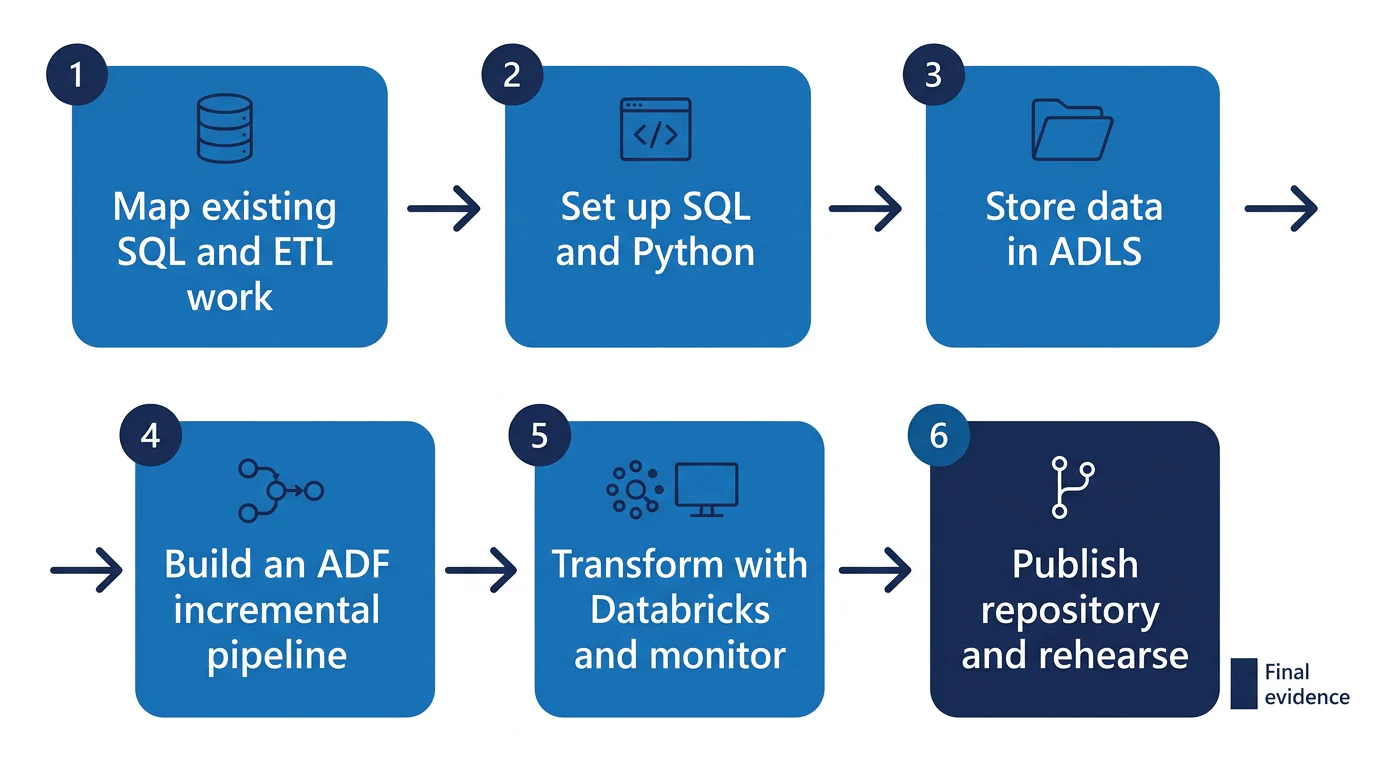
A short project can be enough to surface gaps before you spend more money on training. Use the Azure Data Engineering learning-path quiz to choose a starting point, then compare your intended scope with the portfolio project path.
Keep reading



Frequently asked
Yes, if you convert familiar work into evidence. Start with a source table or file you understand, define the change rule, move the changed data into storage, transform it and document the result. That sequence lets you show how your existing SQL and ETL judgement applies to an Azure pipeline.
For this path, learn enough Python to read, reshape and test data in a notebook. SQL remains useful for joins, filters and aggregations, while Python helps you work with PySpark-based transformations in Azure Databricks. You do not need to begin by learning general software engineering.
No. DP-203 is retired, so it should not be your current certification target. If you want a Microsoft credential after building hands-on evidence, review the current DP-700 requirements and decide whether its Fabric focus matches the roles you plan to pursue.
Include a clear source, an incremental-load rule such as a watermark, storage, an ADF pipeline, a Databricks transformation, a successful monitored run and a repository README. The README should explain the data flow, assumptions, validation checks and one improvement you would make for a production environment.
Use an eligible Azure free account carefully, check consumption in the portal and delete resources you no longer need. Microsoft provides limited free services and introductory credit for eligible new users, but usage beyond applicable limits can move to pay-as-you-go billing after an account is upgraded.
Practise the Azure data-engineering workflow with a live bootcamp
Use a structured starting point when you want guided practice before building your own portfolio project.
Explore the 3-Day Bootcamp