
Audit an Azure Data Engineer Course Syllabus Beyond Tool Names
Use this checklist to assess whether an Azure data engineering syllabus teaches the work behind the tool names, from foundations through production delivery and career evidence.
6 chapters · Updated Sep 29, 2026 · By Devikrishna R
In brief
A credible Azure data engineer course should show how it teaches production delivery, testing, governance and project evidence, not only list Azure Data Factory and Databricks. Microsoft retired DP-203 in 2025, so current course decisions should focus on practical role skills and the support a provider can define clearly.
Begin with the role, not a retired exam code
An Azure data engineer course should begin with the work the role requires. That means integrating, transforming and consolidating data, then keeping pipelines reliable, secure and efficient. The foundation should make SQL, Python, data architecture patterns and parallel processing visible before advanced platform lessons begin.
Certification language needs a date check. Microsoft retired the Azure Data Engineer Associate certification and renewal assessment on 31 March 2025. The current DP-700 study guide divides its responsibilities across implementing and managing an analytics solution, ingesting and transforming data, and monitoring and optimising it, with each area weighted 30–35%. A syllabus that teaches only ingestion leaves out a major part of the role.
Ask the provider to map every module to a responsibility: storage design, ingestion, transformation, security, monitoring, optimisation or troubleshooting. A list of service names is not a skills map.
Require Azure Data Factory work that reaches production
Azure Data Factory deserves more than a short copy-activity demonstration. A pipeline is a logical grouping of activities, while datasets reference the data used by those activities and linked services define connections to external resources. Microsoft's ADF documentation explains those distinct building blocks, so a syllabus should name which ones learners will create and how they fit together.
Then ask how the provider teaches releases. Microsoft's ADF CI/CD lifecycle moves work from a Git-connected development factory through a feature branch, debugging, peer review, development publication, user-acceptance testing and production deployment. A course need not copy every enterprise workflow, but a project should include version control, a review point, a test environment and a production-style hand-off.
From First Commit to Production Pipeline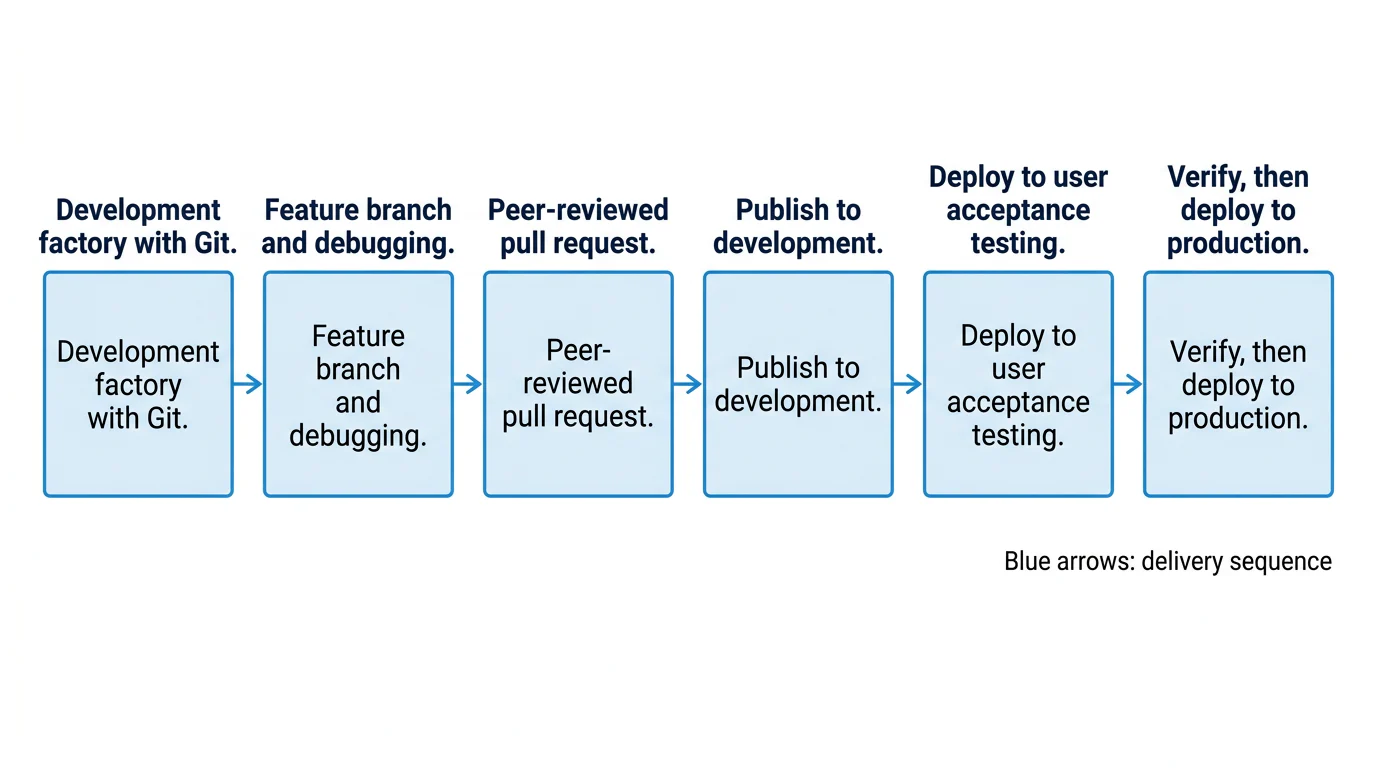
The strongest evidence is an artefact you can inspect: pipeline definitions, parameters, run history, a deployment plan and an explanation of what changes between environments.
Treat Databricks reliability and testing as syllabus requirements
Databricks lessons should explain why a transformation can be trusted, not only how to run a notebook. Azure Databricks uses Delta Lake by default for reads and writes, and Microsoft documents Delta Lake's ACID transaction guarantees. Ask whether the syllabus teaches table design, schema enforcement, handling duplicates, incremental loads and the consequences of failed or concurrent writes.
Testing must be explicit in the course plan. Microsoft's 2024 Azure data-engineering study guide included creating data-pipeline tests, validating batch loads, handling failures, monitoring pipeline performance and scheduling pipeline tests. Those are inspectable capabilities, not optional polish. A provider should state what learners validate, where expected results live and how a failed pipeline is investigated.
We run a live Azure Data Engineering + GenAI Masterclass on Sunday, 4 October 2026, at 11:00 AM. It costs ₹49, runs for two hours online, and covers Azure, Databricks, PySpark, SQL, real-time projects, interview preparation, resume and LinkedIn optimisation, and salary-negotiation support.
Check governance and lab costs before committing
Governance should appear in the same syllabus as ingestion and transformation. Microsoft Purview's governance workflow starts by assigning a governance administrator, scanning data assets, building governance domains and data products, connecting data to business concepts, then improving data quality. A course does not need to teach every enterprise configuration, but it should show whether learners will work with metadata, lineage, access, classification or quality controls.
Databricks governance deserves the same scrutiny. Unity Catalog can provide centralised access control, auditing, lineage and discovery across workspaces. Ask which of those controls are demonstrated and whether they are applied to a project rather than mentioned in a slide.
Also ask for a lab-cost plan. Azure Data Factory uses consumption billing, including activity runs and Data Integration Unit hours for Azure Integration Runtime copy activities. The course provider should state the expected Azure resources, who pays for usage and how learners can avoid unintended spend during practice.
Make projects and career support measurable
A project count is less useful than a project rubric. Before enrolling, ask whether each project includes a source system, storage design, transformation logic, orchestration, validation, failure handling, governance choices and deployment evidence. Ask what you will retain after the course: a repository, architecture explanation, run evidence, project feedback or a case-study narrative.
Career support needs the same level of detail. Request the exact activities included, the delivery format, the person responsible and the access period. Resume feedback, LinkedIn optimisation, mock interviews and project review are different services, so they should not be compressed into one vague placement label.
This approach has a trade-off. A detailed audit takes longer than choosing by a course title, price or tool list. It also exposes cases where a provider is suitable for introductory exposure but not for portfolio-grade project review. That distinction is useful when your goal is a role transition rather than passive course completion.
Use six questions before you submit an enquiry
Use these six questions in your next course conversation:
- Which foundation skills are assumed, and where are SQL, Python and architecture patterns taught?
- Which ADF pipeline, dataset and linked-service artefacts will I build?
- How will I test data quality, validate batch loads and investigate a failed run?
- Which Databricks and Delta Lake reliability concepts will I apply in a project?
- How will governance, metadata, access and lineage appear in practical work?
- What project feedback, interview practice and profile support are included, and for how long?
A provider that answers these questions clearly gives you a syllabus you can evaluate against the actual job. A provider that cannot answer them may still offer useful introductory learning, but it has not yet shown the evidence needed for a career-transition decision.