
Comparison
When RAG Beats Fine-Tuning, and When Neither Should Come First
Choose RAG for changing, source-backed enterprise knowledge, choose fine-tuning for measured behaviour or format gaps, and test prompt plus full context first for a knowledge base under 200,000 tokens.

By Devikrishna R, Founder · Updated 2 Oct 2026
RAG
Retrieve current supporting data at request time.
Best for: Enterprise answers that need current, proprietary, controlled or citable information.
Fine-Tuning
Train a model to perform a defined task more consistently.
Best for: Classification, fixed output formats and instruction-following gaps.
On this page
The short answer
RAG wins when enterprise answers need current, proprietary or citable data. Fine-tuning wins when the measured gap is consistent task behaviour, classification or output format. For a knowledge base below 200,000 tokens, about 500 pages, test prompt plus full context before building either system.
Which should you choose?
Choose Fine-Tuning if
- Choose fine-tuning when the measured need is reliable classification, nuanced translation or a fixed response format.
- Choose fine-tuning when repeated prompt examples and context are increasing token use at scale.
- Choose fine-tuning when a smaller model can be trained to perform one defined task effectively.
Choose RAG if
- Choose RAG when the answer must use proprietary material that was not part of the base model’s training.
- Choose RAG when the knowledge source changes and the application needs to cite the supporting source.
- Choose RAG when retrieval must respect user credentials and access controls.
RAG vs Fine-Tuning, point by point
A check marks the stronger side on that point. Points without a check are even, or depend on what you need.
| What matters | RAG | Fine-Tuning |
|---|---|---|
| Data | ||
| Knowledge source | Stronger hereRetrieves supporting data from an external knowledge base at request time. | Learns from application-relevant input and output examples for a defined task. |
| Freshness and source trail | Stronger hereCan use an updated knowledge base and cite specific sources. | Improves task performance without adding a retrieval step for current source material. |
| Output | ||
| Behaviour and output format | Adds supporting context to generation. | Stronger hereSupports classification, nuanced translation, specific formats and instruction-following correction. |
| Cost and latency | ||
| Prompt context and latency | Adds a retrieval step and supporting context to the request. | Stronger hereCan use shorter prompts with fewer repeated examples and context, which may lower token cost and latency. |
| Evaluation | ||
| Evaluation work | Requires quality, cost and latency evaluation, monitoring, governance and data-lineage work. | Requires representative test inputs and evaluation of the prompt and training data. |
Data
Knowledge source
- RAGStronger here
- Retrieves supporting data from an external knowledge base at request time.
- Fine-Tuning
- Learns from application-relevant input and output examples for a defined task.
Freshness and source trail
- RAGStronger here
- Can use an updated knowledge base and cite specific sources.
- Fine-Tuning
- Improves task performance without adding a retrieval step for current source material.
Output
Behaviour and output format
- RAG
- Adds supporting context to generation.
- Fine-TuningStronger here
- Supports classification, nuanced translation, specific formats and instruction-following correction.
Cost and latency
Prompt context and latency
- RAG
- Adds a retrieval step and supporting context to the request.
- Fine-TuningStronger here
- Can use shorter prompts with fewer repeated examples and context, which may lower token cost and latency.
Evaluation
Evaluation work
- RAG
- Requires quality, cost and latency evaluation, monitoring, governance and data-lineage work.
- Fine-Tuning
- Requires representative test inputs and evaluation of the prompt and training data.
Where each is stronger
RAG has a retrieval quality dependency
RAG needs a data pipeline and retrieval design that can locate relevant support before generation. Retrieval failures and weak context can limit the answer quality.
Fine-tuning is not a freshness mechanism
Fine-tuning can improve a defined task, but it does not by itself retrieve current documents, tables or APIs for each request.
The smallest solution can be the right one
For a knowledge base below 200,000 tokens, about 500 pages, test a prompt-plus-context workflow before committing to retrieval or training.
Measure the gap before choosing an architecture
As of October 2026, the decision should begin with task-specific criteria and representative test inputs. Test whether the failure is missing evidence, weak retrieval, inconsistent behaviour, unacceptable latency or cost.
A small corpus can make neither route the first move
Anthropic’s 2024 engineering guidance puts the full-context threshold at under 200,000 tokens, about 500 pages. This is a viable route to evaluate before adding a retrieval pipeline or a fine-tuning job.
RAG creates a data and governance workload
Databricks describes RAG as retrieval, augmentation and generation, surrounded by data preparation, evaluation, monitoring, governance, lineage and access controls. That operational scope belongs in the decision matrix.
Fine-tuning should solve a behaviour problem
Use fine-tuning when an evaluation identifies a repeatable task gap such as classification, output formatting, nuanced translation or instruction following. Evaluate it against the same representative workload as the alternative routes.
Test the smallest viable route before adding infrastructure
The decision starts with a representative evaluation set and explicit output criteria. OpenAI’s evaluation guidance describes the loop as defining the task, testing inputs, analysing results and iterating.
Anthropic reports that a knowledge base below 200,000 tokens, about 500 pages, can be passed directly as context rather than routed through retrieval. Its prompt-caching guidance reports latency reductions of more than 2× and cost reductions of up to 90% for frequently reused prompts, so treat those figures as Claude-specific evidence to test in your own stack.
Choose the Route Your Evaluation Supports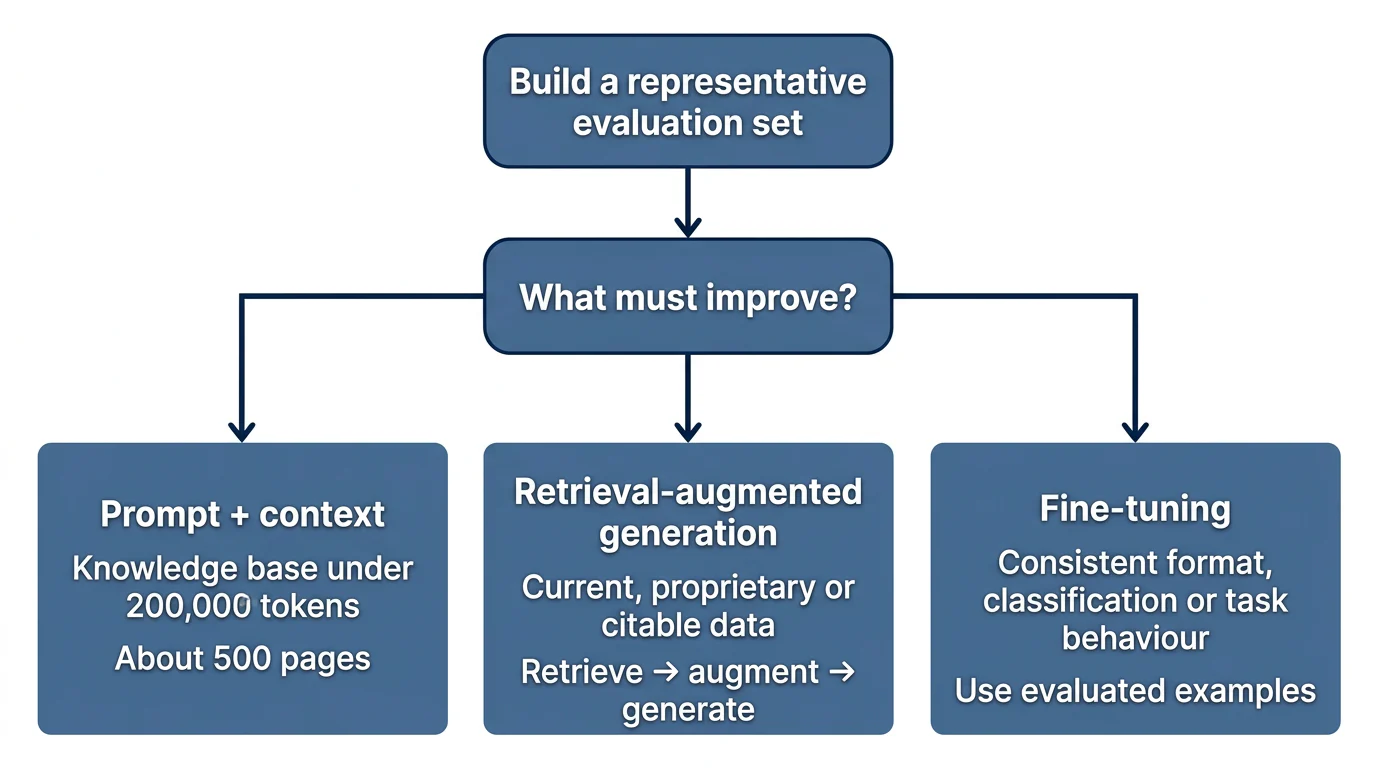
RAG is a data-system decision, not only a model decision
A RAG application retrieves supporting material, adds it to the prompt, then generates an answer. Databricks’ RAG documentation also identifies the surrounding work: data pipelines, evaluation and monitoring for quality, cost and latency, plus governance for lineage and access controls. That makes RAG the winning route when the answer must draw from current documents, tables, APIs or controlled proprietary sources.
For a practical next build, see how RAG fits an Azure Databricks project.
Fine-tuning earns its cost only after the task gap is clear
Fine-tuning trains a model on the inputs and outputs expected in an application. OpenAI’s model-optimisation guide identifies classification, nuanced translation, fixed output formats and instruction-following correction as suitable supervised fine-tuning cases. It can also reduce repeated prompt examples and context, which may lower token cost and latency at scale.
Fine-tuning is not the first answer when the real problem is changing source material that must be retrieved and cited. Start by separating knowledge quality from behaviour quality, then choose the route your evaluation supports. For a learning path that includes RAG, vector systems and deployment work, read what an LLM training course should help you build.
Our verdict
RAG wins for enterprise data teams that need current or citable source material. Fine-tuning wins when evaluation shows the gap is task behaviour or output format. Prompt plus full context should win first when the knowledge base is below 200,000 tokens, about 500 pages.
How we compared
The comparison uses the original 2020 RAG paper and current official technical guidance from Databricks, OpenAI and Anthropic. Vendor-specific performance figures are labelled as such and should be tested against the team’s own workload.
This page is published by www.visionboardedtech.com. If anything here is out of date, tell us and we will correct it.
Sources
- 1.Retrieval-Augmented Generation for Knowledge-Intensive NLP Tasks, Lewis et al., NeurIPS, 2020
- 2.RAG (Retrieval Augmented Generation) on Databricks, Databricks, 2026
- 3.Model Optimisation, OpenAI, 2026
- 4.Working With Evals, OpenAI, 2026
- 5.Introducing Contextual Retrieval, Anthropic, 2024